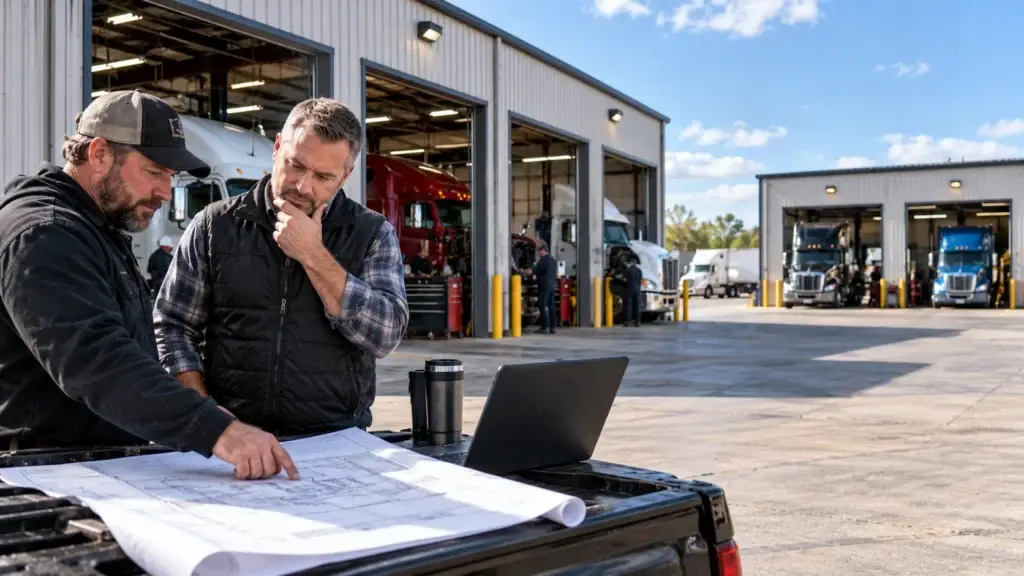
truck shop expansion

Multi-Location Truck Shop Expansion: Complete Guide [2025]

Table of Contents
    Add a header to begin generating the table of contents

    By Michael Nielsen, Editor & Publisher | 15+ Years in Diesel Repair

    Last Updated: December 2025

    📖 Estimated reading time: 22 minutes

    Expanding a diesel repair operation to multiple locations represents one of the most significant growth opportunities in the heavy-duty vehicle service market—and one of the most common paths to failure when executed without proper planning. Multi-location truck shop operators can leverage networked resources, coordinate inventory across sites, and serve broader geographic markets, but only if they build the right foundation first.

    Successful truck shop expansion demands far more than duplicating your current operation at a new address. You need sophisticated business systems, standardized processes across locations, and strategic capital allocation that accounts for the 18-36 month runway most new facilities require before reaching profitability. The difference between thriving multi-location operations and failed scaling attempts comes down to preparation, systematic implementation, and realistic financial expectations.

    This comprehensive guide walks you through the critical framework for commercial truck service expansion. You’ll discover proven strategies for assessing readiness, selecting optimal locations, securing appropriate financing, building scalable systems, and avoiding the mistakes that derail even experienced operators. Whether you’re considering your second location or planning a regional network, this roadmap provides the actionable insights fleet service shop owners need to make informed decisions.

    Key Takeaways

    • Financial thresholds matter: Your first location should generate $2-3 million in annual revenue with 15%+ profit margins and 24 months of positive cash flow before expansion makes financial sense.
    • New locations take time: Expect 18-36 months for a second location to reach break-even, requiring substantial working capital reserves beyond facility and equipment costs.
    • Systems before expansion: Document every process at your current operation so thoroughly that it runs without your daily presence—this is the foundation for multi-location management.
    • Location selection drives success: Site evaluation must account for commercial truck density, competitor landscape, highway access, zoning requirements, and environmental permits.
    • Technician shortage is your biggest challenge: The commercial truck service industry faces critical skilled labor shortages that require proactive recruitment, competitive compensation, and retention strategies.
    • Technology enables coordination: Cloud-based shop management systems transform disconnected facilities into an integrated enterprise with real-time visibility and standardized operations.

    Assessing Readiness and Strategic Planning for Growth

    Expanding to multiple locations represents a critical inflection point that separates sustainable diesel repair shop growth from businesses that overextend and fail. The difference between profitable expansion and financial disaster often comes down to objective readiness assessment rather than emotional decision-making. Shop owners who rush into second locations without proper evaluation frequently discover they’ve created two struggling operations instead of one thriving business.

    Your current operation must demonstrate consistent strength across multiple dimensions before adding complexity through expansion. Opening a second location demands as much planning and effort as launching the original business, with the added challenge of managing operations you cannot personally oversee every day. The foundation for successful multi-location growth gets built during months of documented performance at your primary facility, not during the excitement of lease negotiations.

    Fleet manager reviewing financial documents and expansion planning materials for diesel repair shop growth

    Several clear indicators signal genuine expansion readiness. Your business cannot meet customer demand despite optimized scheduling, you’ve run out of physical space for additional bays or equipment, and most importantly, you’ve documented every process so thoroughly that operations could continue without your constant presence. A strong brand reputation with loyal customers provides the foundation, while a well-developed team capable of maintaining quality standards at the primary site frees you to focus on expansion.

    Financial Performance Benchmarks for Expansion

    Truck shop profitability must reach specific thresholds before expansion makes financial sense. Industry benchmarks indicate that your first location should generate minimum annual revenue of $2 to $3 million before considering a second facility. This revenue level demonstrates sufficient market demand and operational capability to support the infrastructure required for multi-location management.

    Profit margins tell a more complete story than revenue alone. Your operation should maintain consistent profit margins above 15% after accounting for true owner compensation at market rates. Many shop owners mistakenly calculate profitability without properly accounting for their own labor, creating an inflated picture of financial health that collapses under expansion pressure.

    Cash flow consistency matters more than occasional profit spikes. Your business must show positive cash flow for at least 24 consecutive months to prove stability through seasonal fluctuations and economic cycles. This track record demonstrates your ability to manage working capital requirements during the inevitable slow periods that accompany opening new locations.

    Debt-to-equity ratios require careful evaluation before taking on additional leverage. Calculate your current ratio and model how expansion financing will impact this metric. Overleveraged businesses lack the financial flexibility to handle unexpected challenges like equipment failures, slower-than-projected customer acquisition, or economic downturns that affect commercial fleet services.

    Financial MetricMinimum BenchmarkPreferred TargetCritical Risk Level
    Annual Revenue$2,000,000$3,500,000+Below $1,500,000
    Net Profit Margin15%20%+Below 10%
    Cash Flow Consistency24 months positive36+ months positiveIrregular or negative
    Debt-to-Equity RatioBelow 2.0Below 1.5Above 3.0
    Cash Reserves6 months operating expenses9+ months operating expensesBelow 3 months

    Hidden costs frequently surprise expanding operators who focus only on obvious expenses. Beyond rent and equipment, factor in duplicate administrative overhead, increased insurance premiums, additional licensing fees, expanded technology infrastructure, and the productivity loss that occurs while you divide attention between locations. Conservative financial modeling assumes the second location will operate at a loss for six to twelve months while building customer base and refining operations.

    Operational Efficiency Indicators

    Measurable operational performance provides objective expansion readiness criteria. Bay utilization rates above 75% during normal business hours indicate you’re maximizing existing capacity and genuinely need additional space rather than better scheduling. Track this metric over several months to distinguish genuine capacity constraints from temporary busy periods.

    Average repair order values reflect your pricing strategy and service mix effectiveness. Higher average tickets indicate you’ve moved beyond basic maintenance into more profitable diagnostic and repair services that support the overhead of multiple locations. Target average repair orders of $800 to $1,200 for Class 8 commercial vehicles before expansion.

    Technician productivity metrics reveal operational efficiency that can be replicated. Calculate billable hours as a percentage of available hours for each technician, targeting 70% to 80% billable time. Lower productivity indicates process inefficiencies or management gaps that will multiply across locations rather than improve through expansion.

    Customer retention rates above 70% demonstrate service quality and relationship strength that supports diesel repair shop growth. New locations require time to build customer bases, so strong retention at your primary facility ensures stable revenue while expansion locations develop. Track both customer count retention and revenue retention to identify any concerning trends.

    Documentation completeness determines replication capability. Every service category should have written standard operating procedures that a new technician could follow to deliver consistent quality. If your operation depends on tribal knowledge or your personal oversight for quality control, you’re not ready to manage commercial fleet services across multiple sites.

    Development Timeline and Milestones

    Realistic expansion requires a comprehensive 12 to 24-month roadmap with specific checkpoints. Rushing through critical phases increases risk exponentially, while excessive delays waste market opportunities and momentum.

    During months one through three, focus on assessment and planning. Complete financial analysis, document operational procedures, assess team capability, and conduct preliminary market research. This phase concludes with a go/no-go decision based on objective criteria rather than enthusiasm.

    Months four through six involve detailed market research and location selection. Visit multiple potential locations, analyze traffic patterns and truck routes, meet with commercial real estate brokers, and narrow options to finalist sites. Secure option agreements on preferred properties without full commitment.

    The financing and site acquisition phase spans months seven through nine. Submit loan applications, prepare detailed financial projections, negotiate lease or purchase terms, and complete due diligence on the selected property. This phase ends with financing approval and executed site agreements.

    Construction and equipment procurement during months ten through fifteen represents the most capital-intensive phase. Manage facility renovation or construction, order and install equipment, establish utility services, and handle permitting requirements. Overlap recruitment activities during this period to ensure staff readiness for opening.

    Staff hiring and training from months sixteen through eighteen focuses on building your second location team. Recruit certified diesel technicians, select and train location management, establish communication protocols between sites, and conduct comprehensive training on standardized procedures.

    The phased opening and optimization period during months nineteen through twenty-four minimizes risk through gradual launch. Begin with limited services to known customers, systematically add service capabilities, refine processes based on real-world experience, and scale up marketing as operations stabilize.

    Market Research and Location Selection Strategy

    The difference between profitable fleet service expansion and costly mistakes lies in rigorous market research and site evaluation. Opening a second or third location without proper analysis can drain resources, split management attention, and ultimately compromise your entire operation. Strategic truck service center scaling requires a data-driven approach that identifies high-potential markets while avoiding common pitfalls.

    Your expansion should target markets far enough from your existing location to prevent cannibalization of your current customer base. The primary goal is attracting new local markets, not splitting the same revenue stream across multiple facilities. This geographical separation ensures each location builds its own client foundation while contributing to overall company growth.

    Analyzing Regional Commercial Trucking Markets

    Understanding truck traffic density forms the foundation of successful location selection. Department of Transportation data reveals freight corridor activity, commercial vehicle registration concentrations, and seasonal demand fluctuations that directly impact your revenue potential.

    Start by examining fleet concentrations across different industry sectors. Construction companies, agricultural operations, logistics providers, and municipal fleets each have distinct service needs and seasonal patterns. A market dominated by harvest-season agriculture creates different opportunities than one serving year-round distribution centers.

    Commercial real estate map showing truck traffic corridors and potential service center locations

    Commercial vehicle registration statistics provide concrete evidence of market size. States publish this data through their motor vehicle departments, showing how many Class 4-8 trucks operate in specific counties or regions. Cross-reference these numbers with existing service facility capacity to identify underserved areas.

    Economic indicators offer predictive value for sustained demand. Look beyond current truck counts to evaluate market trajectory: regional GDP growth rates and employment trends, new warehouse and distribution center construction permits, manufacturing facility expansions or relocations, port activity and intermodal facility development, and highway infrastructure improvement projects. These factors signal whether a market will support long-term heavy-duty shop locations or represents temporary opportunity.

    Competitive Landscape Evaluation

    Thorough competitor analysis determines whether sufficient market space exists for your entry. Map every heavy-duty repair facility within a 30-mile radius of potential sites, documenting their service capabilities, specializations, and market positioning.

    Evaluate competitor strengths and weaknesses through multiple research methods. Visit facilities as a customer, review online feedback, and talk with local fleet managers about their current service providers. This intelligence reveals service gaps that your expansion can fill.

    Pricing structure analysis helps you position your new location competitively. While you shouldn’t compete solely on price, understanding local rate expectations prevents overpricing yourself out of the market or underpricing to unsustainable levels.

    Market FactorStrong OpportunityModerate OpportunityWeak Opportunity
    Trucks per Facility Ratio500+ trucks per shop250-500 trucks per shopBelow 250 trucks per shop
    Competitor Service RangeLimited specializationsStandard services onlyFull-service competitors
    Market Growth Trend5%+ annual increase1-5% annual increaseFlat or declining
    Average Wait Times3+ days for service1-2 days for serviceSame-day availability

    Service gaps represent your strongest entry point. Perhaps competitors focus exclusively on mechanical work but lack body repair capabilities. Maybe no facility offers mobile service or extended hours for fleet customers. Identifying these unmet needs allows you to differentiate immediately rather than competing head-to-head with established players.

    Critical Site Selection Factors

    Once you’ve identified promising markets, physical site evaluation becomes paramount. The wrong property can undermine even the most promising market opportunity. Multiple criteria must align for optimal heavy-duty shop locations to function efficiently and profitably.

    Commercial truck facilities demand substantially more space than passenger vehicle shops. Minimum lot sizes typically range from two to three acres, accommodating building footprint, vehicle circulation, customer parking, and future expansion capacity. Building square footage requirements start at 8,000 square feet for basic operations, with 12,000-15,000 square feet providing comfortable capacity for growth.

    Bay configuration directly impacts throughput capacity. Door heights must reach at least 14 feet to accommodate modern trucks and their varied load heights. Plan for a minimum of four bays initially, with structural capability to add more as business grows. Vehicle circulation patterns require careful planning—tractor-trailers need wide turning radiuses and clear sightlines for safe maneuvering.

    Proximity to major truck routes determines how easily potential customers can reach your facility. Interstate access within five miles positions you along natural traffic flows where truckers already travel. Visibility from high-traffic corridors provides continuous advertising value. Ingress and egress capability for tractor-trailers eliminates a common site limitation—many properties lack adequate access points or force trucks into difficult backing maneuvers.

    Heavy commercial or industrial zoning classification is non-negotiable for truck service operations. Verify current zoning status and confirm your intended use falls within permitted activities. Environmental permits for waste oil, antifreeze, and other fluids require significant attention. The EPA regulations for used oil management apply to all facilities generating and handling these materials, with specific storage, labeling, and disposal requirements that vary by state.

    Financing Options for Truck Shop Expansion

    The financial foundation of successful truck repair business growth begins with understanding your complete funding needs and available capital sources. Most second-location launches require total capital ranging from $500,000 to $1.5 million, depending on whether you purchase or lease property, facility size, equipment specifications, and local market conditions. This substantial investment covers real estate acquisition or build-out, diagnostic equipment and lift systems, initial inventory, staffing costs, and the critical operating reserves that sustain operations during the establishment phase.

    Business owner reviewing financing documents with loan officer for truck shop expansion

    Financial preparation must occur well before signing any lease agreements or purchase contracts. Your existing location should demonstrate consistent profitability with positive cash flow for at least 18-24 consecutive months before pursuing expansion. Lenders and investors scrutinize current financial performance as the primary indicator of your ability to manage multiple operations successfully.

    SBA 504 and 7(a) Loan Programs

    Small Business Administration guaranteed loan programs offer compelling advantages for qualified truck shop operators pursuing expansion. These government-backed programs provide lower down payments, extended repayment terms, and below-market interest rates compared to conventional commercial loans.

    The SBA 504 program specifically targets real estate and major equipment purchases with favorable terms. This loan structure typically requires only 10% down payment from the borrower, with a Certified Development Company providing 40% through an SBA-guaranteed debenture and a traditional lender covering the remaining 50%. Fixed interest rates on the CDC portion often run 1-2 percentage points below conventional commercial rates, reducing long-term financing costs significantly.

    The SBA 7(a) program offers greater flexibility, funding real estate, equipment, working capital, and business acquisition. These loans provide up to $5 million with terms extending to 25 years for real estate and 10 years for equipment. The SBA guarantee (typically 75-85% of the loan amount) reduces lender risk, making approval more accessible for businesses that might not qualify for conventional financing.

    Processing timelines for SBA loans typically extend 60-90 days from application to closing, considerably longer than conventional loans. This extended timeline requires advance planning, but the significantly improved terms often justify the additional waiting period for truck repair business growth initiatives.

    Stay Ahead of Industry Financing Trends

    Capital availability, interest rates, and lending requirements for commercial vehicle service facilities change frequently. Get expert insights delivered to your inbox.

    Subscribe to the Newsletter →

    Working Capital Requirements

    Working capital represents the most frequently underestimated component of expansion financing, yet inadequate cash reserves cause more location failures than any other factor. New truck repair locations typically require 6-12 months to reach break-even operations, creating substantial cash demands that must be funded independently of facility and equipment costs.

    Essential working capital requirements include payroll for technicians, service advisors, and managers during the revenue ramp-up period, parts and inventory stocking ($75,000-$150,000 for adequate selection), insurance premiums and utility deposits, marketing and promotional investments for market penetration, and general operating expenses including supplies, maintenance, and administrative costs. These combined expenses typically total $150,000-$300,000 beyond the facility and equipment investments.

    The critical cash reserve buffer should equal minimum six months of projected operating expenses for the new location. This reserve prevents the devastating scenario of closing a potentially viable location simply because it exhausted cash during the normal market establishment period. Many successful operators maintain 9-12 months reserves to weather unforeseen challenges like delayed fleet contract awards or slower-than-projected market acceptance.

    Financing OptionTypical UseDown PaymentRepayment Term
    Commercial Real Estate LoanProperty purchase15-20%20-25 years
    SBA 504 ProgramReal estate & major equipment10%20-25 years
    SBA 7(a) ProgramReal estate, equipment, working capital10-20%Up to 25 years
    Equipment FinancingLifts, diagnostic systems, tools0-10%3-7 years

    Developing Scalable Operating Systems

    Scalable operating systems separate thriving multi-location truck shops from those struggling to maintain consistency. When your expansion reaches multiple sites, every process must function effectively whether you’re on-site or managing remotely. The difference between profitable growth and operational chaos comes down to how well you document, standardize, and implement repeatable systems across all locations.

    Creating comprehensive training manuals for every operational aspect represents your first critical investment. These documents should cover everything from diagnostic software usage to customer follow-up procedures. Have team members who didn’t write the manuals review them for clarity—if someone can’t understand a procedure without your personal explanation, the documentation needs improvement.

    Service bay showing standardized equipment layout and documented procedures for multi-location consistency

    Standardizing Service Protocols Across Locations

    Service protocol standardization establishes baseline expectations while preserving necessary flexibility for market-specific adaptations. Your diagnostic workflows should follow identical patterns whether a customer visits your original location or your newest facility. This consistency builds customer confidence and simplifies technician training when staff members transfer between sites.

    Develop detailed repair methodologies for common heavy-duty systems that your technicians encounter daily. Air brake system diagnostics, diesel fuel injection repairs, transmission services, and electrical troubleshooting should follow documented procedures. The TMC Recommended Practices Manual provides industry-standard procedures developed by maintenance professionals that can serve as a foundation for your shop’s protocols.

    Standard labor time estimates create pricing consistency across your network. When customers know they’ll receive uniform pricing for comparable services, they develop loyalty to your brand rather than individual locations. This predictability becomes a competitive advantage when bidding for fleet maintenance contracts.

    Customer communication protocols deserve equal attention. Define exactly when and how technicians should update customers during the service process. Establish standards for initial assessments, mid-service updates for additional repairs needed, and completion notifications. These touchpoints shape customer perception of your professionalism.

    “The systems you create should be so clear that anyone following them can deliver your expected level of service without direct supervision.”

    — Fleet Maintenance Best Practice

    Quality Control and Safety Standards

    Uniform inspection checklists ensure that every vehicle receives thorough evaluation regardless of location. These checklists should be digitally accessible through your shop management system, allowing real-time completion tracking and automated quality assurance. Digital checklists also create valuable service history documentation that builds customer trust.

    Technician certification requirements establish minimum competency standards across your organization. The ASE Medium/Heavy Truck certification tests (T-series) cover diesel engines, drive train, brakes, suspension, steering, and electrical systems—require these credentials for key positions and support ongoing professional development.

    Facility safety protocols including OSHA compliance requirements must be identical at every location. Standardized safety training, equipment inspection schedules, and incident reporting procedures minimize your liability exposure. Regular safety audits conducted by headquarters staff ensure consistent implementation of these critical standards.

    Inventory Management and Parts Distribution

    Multi-location parts management represents one of the most complex operational challenges in heavy equipment service growth. The decision between centralized and distributed inventory models significantly impacts your working capital requirements and service efficiency. Centralized inventory reduces total parts investment but may increase emergency shipping costs. Distributed inventory improves service speed but requires higher capital investment.

    Inter-location parts transfer protocols require careful attention to accountability and tracking. Establish clear processes that identify who’s responsible for initiating transfers, who approves them, and how transit inventory gets tracked. Cloud-based inventory systems provide real-time visibility across all locations, minimizing unnecessary transfers while ensuring parts availability.

    Transfer ChallengeRequired System ElementExpected Outcome
    AccountabilityDigital transfer requests with approval workflowZero unauthorized parts movements
    Context visibilityCloud-based parts management systemMinimized unnecessary transfers
    Transit trackingBarcode scanning or RFID technologyReal-time location awareness

    Emergency parts sourcing procedures minimize vehicle downtime when required components aren’t locally available. Establish relationships with parts delivery services that can provide same-day delivery. Create protocols for determining when overnight shipping costs justify faster customer service versus scheduling repairs for the next business day.

    Building Your Multi-Location Management Team

    The commercial truck service industry faces a critical shortage of qualified diesel technicians, making staffing your greatest expansion challenge. Without a solid team in place at each location, even the most strategic diesel repair shop growth plans will fail. Your success depends on recruiting employees and leaders who understand your business mission and service standards.

    Multi-location staffing requires a fundamentally different approach than single-shop operations. You cannot be physically present at every facility to catch mistakes or coach employees through challenges. This reality demands robust systems for hiring, training, and managing personnel across geographically dispersed locations.

    Organization chart showing multi-location management hierarchy for commercial truck service operations

    Creating a Scalable Organizational Framework

    Your organizational structure must evolve as you grow from one location to multiple facilities. The owner-operator model that worked for your first shop becomes unsustainable when managing three or more locations. Effective truck service center scaling requires clear reporting relationships and defined responsibilities at every level.

    For two to three locations, a centralized management approach typically works best. The owner maintains direct oversight of location managers who handle daily operations at each facility. As you expand to four or five locations, consider adding a regional operations manager between yourself and location managers. This intermediate leadership layer prevents your span of control from becoming unmanageable.

    Certain specialized roles should serve multiple locations rather than being duplicated at each facility: a fleet account manager who develops relationships with large commercial clients across all locations, a quality control supervisor who conducts regular audits ensuring consistent service standards, a purchasing coordinator who negotiates vendor contracts and manages inventory systems company-wide, and a training director who develops standardized training programs and oversees technician certification.

    Finding and Attracting Qualified Diesel Technicians

    The technician shortage represents the single largest obstacle to commercial truck service expansion. ASE-certified diesel technicians command premium compensation, typically ranging from $25 to $40 per hour depending on regional labor markets and specialization areas. Your recruitment strategy must acknowledge this competitive reality.

    Successful talent acquisition requires multiple approaches working simultaneously. Technical schools and community colleges with diesel technology programs provide entry-level candidates. Establish relationships with instructors and offer internships that create a pipeline of trained graduates familiar with your operations.

    Military veteran transition programs offer another valuable source of skilled technicians. Many veterans received extensive diesel and heavy equipment training during service. Their discipline and attention to safety protocols make them excellent candidates for commercial truck service environments.

    For experienced technicians, signing bonuses and relocation assistance have become standard recruitment tools. Offering $3,000 to $5,000 signing bonuses for certified technicians with five-plus years experience helps attract talent from competitors. Structure these bonuses to pay out over 12 to 18 months to encourage retention.

    The HDJ Perspective

    The most successful multi-location operators we’ve observed don’t just duplicate their original shop—they build systems that scale. The owners who struggle typically excel at hands-on technical work but underestimate the management infrastructure required to maintain quality across locations they can’t personally oversee. Investing in documented procedures, middle management, and technology infrastructure before you need them costs less than recovering from quality failures after expansion. The best time to build these systems is while your single location is thriving, not when you’re desperately trying to stabilize a struggling second facility.

    Selecting and Developing Location Leadership

    Location managers determine whether expansion sites succeed or struggle. These positions require a unique combination of technical knowledge, business acumen, and people management skills. Effective location managers typically possess ten or more years of industry experience with prior supervisory responsibility.

    Customer service orientation separates good managers from great ones. Location managers interact directly with commercial fleet customers, often during stressful breakdown situations. Their ability to communicate clearly, manage expectations, and preserve relationships during service challenges directly impacts customer retention.

    Consider bringing promising manager candidates to your flagship location for 60 to 90 days before their facility opens. This immersive training allows them to learn your systems thoroughly while building relationships with corporate support staff.

    Technology Infrastructure for Multi-Site Operations

    Modern truck shop expansion requires more than additional bays and equipment—it demands sophisticated technology infrastructure that enables seamless multi-site coordination. While a single-location operation might manage with basic systems, growing to multiple facilities creates complexity that only proper digital infrastructure can handle effectively.

    Computer screen displaying shop management software dashboard with multi-location performance metrics

    The right technology stack transforms disconnected locations into an integrated enterprise. It provides real-time visibility into operations, standardizes processes across facilities, and delivers the data needed for informed decision-making. Without this foundation, multi-location truck shop management becomes an overwhelming challenge of spreadsheets, phone calls, and guesswork.

    Unified Shop Management Platforms

    Cloud-based shop management systems have revolutionized how diesel repair operations coordinate across multiple locations. These platforms consolidate scheduling, work orders, technician tracking, parts ordering, invoicing, and payment processing into a single accessible interface.

    Leading platforms designed specifically for heavy-duty truck service include Mitchell 1, Shop-Ware, and Fullbay. Each offers distinct advantages depending on your operation’s size and complexity. The critical factor is selecting a system built for commercial truck applications rather than adapting automotive-focused software.

    Essential functionality requirements include mobile accessibility for managers and service advisors who need information while moving between bays or locations, integration capabilities with parts suppliers and accounting systems, and customizable labor guides for truck-specific repairs ensuring accurate estimates and consistent pricing across all facilities.

    Performance Visibility Through Analytics

    Real-time reporting and analytics provide the management visibility essential for multi-site oversight. Comprehensive dashboards track key performance indicators across all locations, revealing trends that individual facility reports might miss.

    Daily, weekly, and monthly revenue reporting by location identifies performance variations. Technician productivity and efficiency rates reveal workforce utilization across locations. Average repair order values and profit margins by location expose pricing inconsistencies or operational inefficiencies.

    Performance MetricStrategic ValueExpected Benchmark
    Revenue per technicianWorkforce productivity assessment$250,000-$350,000 annually
    Average repair order valuePricing and upselling effectiveness$800-$1,200 for fleet service
    Parts inventory turnoverWorking capital optimization8-12 turns per year optimal

    According to American Transportation Research Institute data, repair and maintenance costs represent approximately $0.20 per mile for fleet operations—understanding how your shop’s pricing and efficiency compare to industry benchmarks helps position your services competitively while maintaining profitability.

    Share Your Multi-Location Expertise

    Have you successfully scaled a diesel repair operation to multiple locations? Heavy Duty Journal readers benefit from real-world insights from industry professionals.

    Submit Your Expertise →

    Managing Risk and Avoiding Common Expansion Mistakes

    While multi-location growth can transform truck shop profitability, the journey from single-site operation to regional presence is littered with costly mistakes that have derailed even experienced operators. Industry data reveals that 30-40% of second locations fail to achieve sustained profitability within their first three years. Without the right combination of financial and strategic resources in place, poorly thought-out expansion can easily stunt a growing business.

    Common mistakes that threaten commercial vehicle service expansion include cannibalizing market share by opening too close to an existing location and failing to research new markets and competition thoroughly. Inadequate cash reserves for the ramp-up period frequently doom otherwise viable locations. Inconsistent service quality between locations damages brand reputation across all facilities.

    Cash Flow Management During Growth Phases

    Cash shortfalls during the establishment period represent the single most common expansion killer. New locations typically require 6-18 months to reach break-even, during which fixed expenses continue regardless of revenue performance.

    Smart operators maintain working capital reserves equal to 6-12 months of new location operating expenses before opening. This cushion absorbs inevitable startup inefficiencies and slower-than-projected customer acquisition. Implement cash flow forecasting methodologies that project monthly income and expenses for each location separately.

    Red-flag indicators that signal cash flow problems requiring immediate intervention include: new location revenue tracking more than 20% below projections for two consecutive months, days in accounts receivable exceeding 45 days at any location, drawing on credit lines to cover routine operating expenses rather than temporary timing gaps, delayed vendor payments or equipment lease obligations, and inability to meet payroll without transferring funds from other locations.

    Compliance with Environmental and Safety Regulations

    Regulatory complexity affecting commercial truck service facilities multiplies as you operate in multiple jurisdictions. Each state and locality may impose different requirements that create compliance nightmares without systematic tracking.

    Hazardous waste management and disposal requirements vary significantly by state. Used oil, antifreeze, solvents, and other fluids require documented handling and disposal through licensed contractors. Federal regulations establish baselines, but many states impose stricter standards. Air quality permits for paint and welding operations often require facility-specific applications and ongoing emissions monitoring.

    OSHA workplace safety compliance standards apply regardless of location, but state-plan states operate their own occupational safety programs with enforcement authority. Injury and illness recordkeeping, hazard communication programs, and emergency action plans must be maintained at each facility.

    Penalties for non-compliance can be severe, ranging from operational shutdowns to substantial fines. More importantly, regulatory violations damage reputation with fleet customers who increasingly demand proof of environmental and safety compliance from service providers.

    Frequently Asked Questions

    How much capital do I need to open a second truck repair location?

    Most second-location launches require $500,000 to $1.5 million in total capital, depending on whether you purchase or lease property, facility size, and equipment requirements. This includes real estate costs, equipment and lifts ($250,000-$400,000 for a fully-equipped facility), initial parts inventory ($75,000-$150,000), and critically, working capital reserves covering 6-12 months of operating expenses. Many operators underestimate working capital needs—budget $150,000-$300,000 beyond facility and equipment costs to sustain operations during the 18-36 month ramp-up to profitability.

    What financial benchmarks should my current shop meet before expanding?

    Your existing location should demonstrate minimum annual revenue of $2-3 million, consistent net profit margins above 15% (after accounting for true owner compensation), positive cash flow for at least 24 consecutive months, and debt-to-equity ratio below 2.0. Additionally, you should have cash reserves equal to at least six months of operating expenses. These thresholds indicate sufficient market demand, operational capability, and financial stability to support the infrastructure and distraction costs of multi-location management.

    How long does it take for a new truck shop location to become profitable?

    Most second locations require 18-36 months to reach break-even operations, with full return on investment typically taking three to five years. This timeline varies based on market competition, your marketing effectiveness, staffing quality, and how well you can leverage your existing customer relationships and brand reputation. Conservative financial planning should assume the new location operates at a loss for the first 6-12 months while building customer base and refining operations.

    What’s the biggest mistake owners make when expanding to multiple locations?

    The most common failure is underestimating working capital requirements and the time needed to reach profitability. Operators often secure financing for the facility and equipment but don’t maintain adequate reserves to cover payroll, inventory, and operating expenses during the establishment period. The second most common mistake is expanding before documenting and systematizing operations at the first location—if your current shop depends on your personal oversight for quality control, you’re not ready to manage facilities you can’t supervise daily.

    How do I find qualified diesel technicians for a new location?

    Successful recruitment requires multiple concurrent approaches: building relationships with technical schools and community colleges for entry-level candidates, partnering with military veteran transition programs, offering competitive signing bonuses ($3,000-$5,000) and relocation assistance for experienced technicians, and creating apprenticeship programs to develop talent internally. Shop culture, modern equipment, reasonable workloads, and respectful management often matter as much as compensation—many skilled technicians leave higher-paying positions for better working environments.

    Building Your Multi-Location Future

    Opening a second or third location represents one of the most significant decisions in your commercial truck service career. Without a solid plan, expanding too quickly can strain resources and damage your reputation. Truck shop expansion requires methodical preparation rather than rushing into opportunities based on gut feeling.

    The operators who succeed with multi-location truck shop growth share common traits. They conduct thorough market research before signing leases. They secure adequate financing that covers both startup costs and working capital needs. They build standardized systems that maintain service quality across every facility. They assemble management teams capable of running locations independently.

    Your next steps should focus on honest self-assessment. Review the financial benchmarks from your current operation—can you demonstrate consistent profitability and positive cash flow? Explore potential markets where commercial trucking activity supports another service facility. Connect with SBA lenders to understand your financing options before you need the capital. Commercial truck service expansion transforms successful small businesses into regional powerhouses when executed with discipline and realistic expectations.

    Found This Guide Valuable?

    Share it with fellow shop owners and fleet managers who are considering expansion. Building a stronger heavy-duty service industry benefits everyone.

    Leave a Comment

    Your email address will not be published. Required fields are marked *

    Sponsored

    Emergency Breakdown?

    Find Certified Repair Shops Near You

    24/7 Mobile Service
    Verified Facilities
    Nationwide Coverage
    Find Repair Shops Now →

    Trusted by thousands of fleet operators