Proper documentation of vehicle inspections, repairs, and service activities is not just good business practice—it’s a federal legal requirement for motor carriers operating commercial motor vehicles. The Federal Motor Carrier Safety Administration (FMCSA) mandates that companies maintain detailed documentation proving adherence to safety standards.
These requirements stem from Title 49 of the Code of Federal Regulations, particularly Part 396, which governs vehicle inspection, repair, and upkeep protocols. During safety audits and compliance reviews, FMCSA inspectors examine these documents closely. Missing or incomplete paperwork can result in substantial fines, operational restrictions, and increased liability exposure.
Effective fleet maintenance documentation serves multiple purposes beyond regulatory compliance. It provides a comprehensive history of each vehicle’s condition, supports warranty claims, and demonstrates due diligence in legal proceedings. Well-organized documentation also streamlines audit processes and roadside inspections, protecting your operation from violations while improving overall fleet management efficiency.
This guide is designed for fleet managers, compliance officers, owner-operators, and transportation company executives responsible for meeting federal safety standards. Understanding retention schedules, inspection report requirements, and documentation best practices protects your operation from violations while demonstrating commitment to commercial vehicle safety.
Last Updated: November 2025
Key Takeaways
- Federal mandate: FMCSA regulations under Title 49 CFR Part 396 require motor carriers to maintain comprehensive documentation of all vehicle inspections, repairs, and preventive maintenance activities.
- Retention compliance: Specific retention schedules vary by document type, with periodic inspection reports requiring 14 months, DVIRs needing three months, and maintenance records requiring one year minimum retention.
- Financial protection: Proper fleet maintenance documentation simplifies safety audits, reduces violation risk during compliance reviews, and protects carriers from fines ranging from hundreds to over $15,000 per offense.
- Technology advantage: Digital recordkeeping systems eliminate traditional compliance challenges through automated retention tracking, instant retrieval capabilities, and comprehensive audit trails that satisfy DOT requirements.
- Systematic approach: Effective compliance requires standardized formats, complete record entries, qualified inspector documentation, and timely updates across all maintenance activities and fleet locations.
Why Fleet Maintenance Documentation Matters for DOT Compliance
Every fleet manager faces a fundamental choice—prioritize meticulous maintenance documentation or risk substantial financial penalties and operational disruption. The stakes extend far beyond simple paperwork. Your maintenance records directly determine your company’s safety rating, insurance costs, and ability to secure profitable contracts with major shippers.
The financial consequences of inadequate maintenance documentation can devastate fleet operations. DOT compliance violations result in fines ranging from a few hundred dollars for minor infractions to over $10,000 per violation for severe offenses. Falsified records or safety breaches carry the heaviest penalties, with potential criminal prosecution in extreme cases.

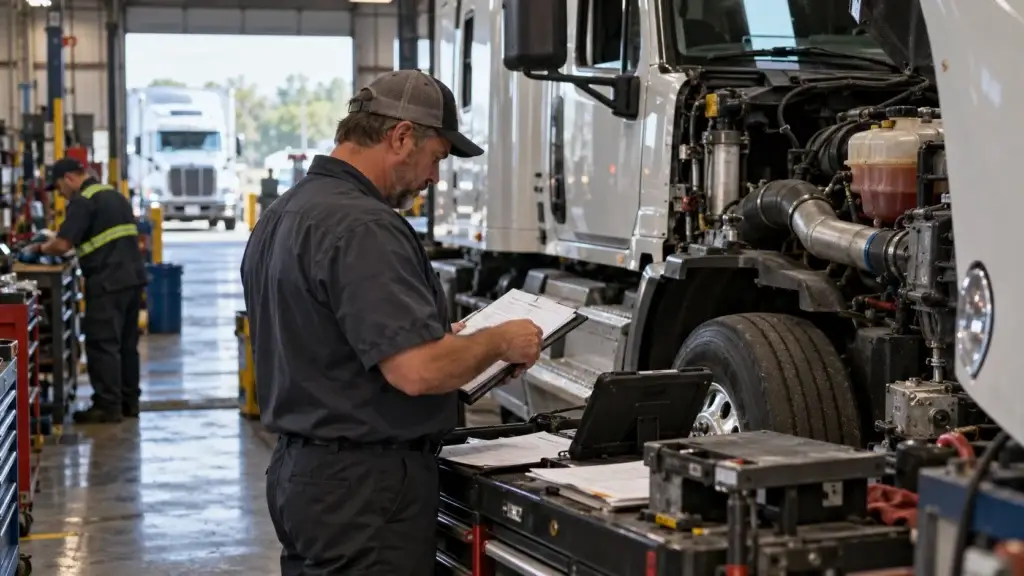
Organized maintenance documentation systems protect fleet operations from costly compliance violations and operational disruptions.
These individual fines represent only the beginning of your financial exposure. The Compliance, Safety, Accountability (CSA) program measures carrier safety performance across seven Behavioral Analysis and Safety Improvement Categories (BASICs). Poor scores accumulate quickly when regulatory requirements go unmet, directly impacting your bottom line in multiple ways.
Your CSA scores influence insurance premiums dramatically. Insurance companies use these ratings to calculate risk exposure, and carriers with poor scores face substantially higher costs. FMCSA penalties increase in frequency as your scores deteriorate, leading to more safety audits and compliance reviews that consume management time and resources.
The operational consequences extend beyond monetary fines. Vehicles placed out of service during roadside inspections create immediate revenue loss. Your drivers sit idle, deliveries get delayed, and customers grow dissatisfied. Contract violations may follow, damaging relationships you spent years building with major accounts.
Operational downtime compounds rapidly when multiple vehicles face inspection failures. Each hour your trucks remain grounded represents lost income and disappointed clients. Fleet operations depend on consistent availability, and poor documentation undermines your reliability in the eyes of customers who expect on-time performance.
Consider the broader business implications. Clients and partners evaluate potential carriers based on safety records and compliance history. Companies want to work with safe, responsible transportation providers who demonstrate professional standards. Your maintenance documentation serves as tangible proof of your commitment to safety excellence.
The CSA program’s impact on your operating authority cannot be overstated. Carriers with consistently poor scores face increased scrutiny, more frequent audits, and potential suspension of their authority to operate. Your ability to conduct business depends on maintaining acceptable safety ratings that keep you eligible for contracts and operational permits.
Maintenance documentation also provides critical legal protection. In the event of accidents or liability claims, your records demonstrate due diligence in maintaining safe equipment. Without proper documentation, proving your compliance becomes nearly impossible, regardless of your actual maintenance practices or investment in vehicle upkeep.
| Violation Type | Fine Range | CSA Impact | Additional Consequences |
|---|---|---|---|
| Minor Documentation Gaps | $100 – $500 | 1-3 severity points | Written warnings, follow-up inspections |
| Missing Inspection Records | $500 – $2,500 | 4-6 severity points | Vehicle out-of-service orders, audit triggers |
| Systematic Non-Compliance | $2,500 – $7,500 | 7-10 severity points | Fleet-wide inspections, increased premiums |
| Falsified Safety Records | $7,500 – $15,000+ | 10+ severity points | Operating authority suspension, criminal prosecution |
FMCSA compliance reviews examine whether carriers maintain systematic inspection and maintenance programs. Reviewers look for patterns of proper record keeping, timely repairs, and consistent documentation practices. Documentation is the only verifiable proof of compliance that satisfies federal requirements during audits.
Even well-maintained fleets face penalties without proper records. Verbal instructions to mechanics, mental notes about repairs, and informal tracking systems provide zero protection during inspections. Only complete, accurate, and accessible maintenance documentation satisfies regulatory requirements and demonstrates your commitment to safety.
The investment in robust documentation systems pays dividends through reduced insurance costs, fewer breakdowns, improved safety ratings, and enhanced business opportunities. Companies with excellent compliance records command premium contracts and enjoy competitive advantages in the marketplace where safety performance increasingly differentiates carriers.
Understanding DOT Maintenance Regulations
Federal maintenance regulations under Title 49 CFR establish the mandatory framework that governs commercial vehicle operations across the United States. These regulations create enforceable standards that apply to all motor carriers operating commercial motor vehicles in interstate commerce. Understanding these requirements forms the foundation of a compliant fleet maintenance program.
The Department of Transportation implements these federal maintenance regulations through the Federal Motor Carrier Safety Administration. Motor carriers must demonstrate full compliance during audits and roadside inspections. Failure to meet these standards results in penalties, fines, and potential operational shutdowns that can threaten business continuity.

FMCSA Part 396 establishes comprehensive inspection, repair, and maintenance standards for commercial motor vehicles.
FMCSA Part 396 Requirements
FMCSA Part 396 serves as the primary regulatory authority for vehicle inspection, repair, and maintenance standards. This section of Title 49 CFR outlines specific obligations that motor carriers must fulfill to maintain safe commercial vehicle operations. The regulation applies to all commercial motor vehicles with a gross vehicle weight rating exceeding 10,001 pounds.
Part 396 requires motor carriers to establish comprehensive maintenance programs that address both preventive and corrective maintenance activities. These programs must be systematically documented and consistently applied across the entire fleet. The regulation mandates that carriers maintain vehicles in safe operating condition at all times, regardless of vehicle age or condition.
Motor carriers bear full responsibility for ensuring compliance with FMCSA Part 396, regardless of whether maintenance work is performed in-house or by third-party vendors. This accountability extends to all vehicles under the carrier’s control for 30 consecutive days or more, creating clear ownership of compliance obligations.
Systematic Inspection and Maintenance Programs
A systematic inspection program represents a documented, structured approach to vehicle maintenance that goes beyond reactive repairs. Federal law requires motor carriers to develop written policies specifying inspection intervals based on vehicle type, usage patterns, and manufacturer recommendations. These systematic inspection programs must be tailored to the specific operational characteristics of each fleet.
The program must include detailed schedules that identify when inspections will occur and which components will be examined. Carriers should base these intervals on factors such as mileage, operating hours, calendar time, or a combination of these metrics. The systematic approach ensures that no vehicle escapes regular examination and that maintenance needs are anticipated rather than discovered through breakdowns.
Effective systematic inspection programs incorporate regular reviews to assess their adequacy and effectiveness. Motor carriers must adjust their programs based on vehicle performance data, breakdown patterns, and emerging maintenance issues. Documentation of these reviews demonstrates ongoing commitment to maintenance standards and continuous improvement.
Stay Ahead of Industry Trends
Get expert insights, equipment reviews, and operational strategies delivered weekly.
Annual and Periodic Inspection Standards
Annual vehicle inspection requirements represent one of the most comprehensive elements of federal maintenance regulations. Every commercial motor vehicle must undergo a thorough annual inspection conducted by qualified personnel. This inspection examines all safety-critical systems and components to verify they meet established maintenance standards.
The annual vehicle inspection must be performed by a qualified inspector who understands commercial vehicle systems and safety requirements. Inspectors may be employed by the motor carrier or work for authorized third-party inspection facilities. Regardless of who performs the inspection, the motor carrier retains ultimate responsibility for ensuring compliance and record retention.
Periodic inspection requirements supplement annual inspections by mandating more frequent examinations of critical vehicle components. These inspections occur at intervals shorter than the annual requirement, typically based on mileage, operating hours, or calendar time. The specific periodic inspection requirements vary depending on vehicle type and operational conditions experienced in daily use.
Essential Fleet Maintenance Records You Must Keep
Proper fleet management hinges on maintaining accurate, complete records for every vehicle under your operational control. Federal regulations specify distinct categories of documentation that motor carriers must retain to demonstrate compliance. Missing or incomplete records carry the same penalties as complete record absence during DOT audits, making systematic organization critical.
Understanding which documents you must maintain and for how long protects your operation from violations. Each record type serves a specific compliance purpose and follows different retention timelines. Organizing these documents systematically ensures you can produce them immediately when auditors arrive at your facility or during roadside inspections.

Comprehensive vehicle inspection documentation systems enable rapid record retrieval during DOT audits and compliance reviews.
Vehicle Identification and Registration Documents
Every vehicle under your control for 30 days or more requires comprehensive identification documentation. These foundational records establish your legal responsibility for each unit in your fleet. Vehicle registration documents form the baseline of your compliance file system and must remain current throughout the vehicle’s operational life.
Your identification records must include the company number assigned to each vehicle. This unique identifier links the vehicle directly to your DOT operating authority. Without proper company number documentation, you cannot demonstrate legitimate control over fleet assets during inspections or audits.
Additional required identification includes the vehicle make, serial number, and year of manufacture. These specifications must match federal and state registration documents exactly. Tire size information completes the identification profile, as this data directly impacts safety standards and inspection criteria for the vehicle.
Annual and Periodic Inspection Reports
Inspection reports represent the most critical compliance documents in your maintenance file system. These reports demonstrate that qualified inspectors examined your vehicles according to federal standards. Periodic inspection reports must be retained for 14 months from the report date, ensuring a complete inspection history remains available for regulatory review.
Federal regulations specify exact components that inspectors must examine during each inspection. Your inspection reports must document evaluation of all required systems, including brake systems, steering mechanisms, lighting devices, tires and wheels, mirrors and windshield wipers, emergency equipment, and coupling devices on tractors and trailers.
Only qualified individuals may perform official vehicle inspections for DOT compliance purposes. Your records must prove that inspectors possess appropriate credentials and training. Inspector qualifications documentation remains on file for one year after the inspector stops performing inspections for your company, demonstrating ongoing commitment to quality standards.
Repair and Maintenance Work Orders
Every repair performed on your fleet vehicles generates documentation requirements. Maintenance work orders must detail the nature of work completed, parts installed, and labor time invested. These documents prove that you addressed identified deficiencies and maintained vehicles in safe operating condition throughout their service life.
Work order documentation begins when a driver reports a problem or an inspection identifies a deficiency. The work order must reference the source of the repair need, whether from a DVIR, scheduled maintenance, or inspection finding. This connection creates continuity in your maintenance documentation system and demonstrates responsive repair practices.
Specific repair information transforms a basic work order into compliant documentation. Record the exact components replaced, including part numbers when available. Document adjustment procedures, measurements taken, and specifications achieved. This level of detail demonstrates thorough repair completion and supports warranty claims when component failures occur prematurely.
Driver Vehicle Inspection Reports (DVIRs)
Driver vehicle inspection reports create daily accountability for vehicle condition. Federal regulations require drivers to complete inspection reports before and after each trip. Post-trip inspection reports must be retained for at least three months from the report date, establishing a continuous monitoring system for vehicle safety.
The DVIR process establishes continuous monitoring for vehicle safety concerns. Drivers serve as the first line of defense in identifying developing problems before they cause breakdowns or safety incidents. Consistent DVIR completion demonstrates your commitment to proactive maintenance management and driver engagement in safety practices.
When a driver reports a defect, your documentation responsibilities extend beyond the initial DVIR. Defect correction records must show exactly how you addressed each reported problem. Vehicles cannot return to service until defects affecting safety are repaired and documented with appropriate mechanic certification and supervisor approval.
Best Practices for Documenting Maintenance Activities
Effective maintenance documentation begins with establishing clear standards that every team member follows consistently. The difference between basic record keeping and professional fleet management lies in the systematic approach to capturing every detail of maintenance work. Professional documentation transforms routine repairs into verifiable evidence of compliance and operational excellence.
Strong maintenance documentation standards create accountability across your organization. When every mechanic, supervisor, and administrator follows the same procedures, your fleet builds a comprehensive maintenance history that withstands regulatory scrutiny. This consistency also streamlines daily operations and reduces the risk of overlooked maintenance needs that could lead to equipment failures.

Standardized documentation procedures ensure consistent compliance across all maintenance activities and fleet locations.
Complete and Accurate Record Entry Standards
Every maintenance entry must meet specific criteria to satisfy DOT requirements. Documentation accuracy depends on capturing essential information that tells the complete story of each service event. Vague descriptions like “routine maintenance” or “fixed problem” fail to meet regulatory standards and provide no useful operational data for future reference.
Proper record entry procedures require specific data elements for each maintenance activity. The date of service establishes the timeline for preventive maintenance intervals and warranty claims. Vehicle identification links the work to the correct unit in your fleet. Detailed descriptions explain exactly what was inspected, repaired, or replaced, enabling future mechanics to understand the vehicle’s maintenance history.
Odometer or hour meter readings at the time of service prove compliance with manufacturer-recommended maintenance schedules. These readings also help predict future maintenance needs and identify vehicles with unusual usage patterns that may require adjusted service intervals or closer monitoring.
Standardized Documentation Formats
Consistency across your fleet operation starts with standardized formats that capture required information systematically. Templates and forms eliminate guesswork and ensure no critical data gets overlooked. When everyone uses the same format, training becomes easier and records become more searchable during audits or when researching vehicle histories.
Developing effective standardized formats requires input from mechanics, supervisors, and administrative staff. The forms must be practical for field use while capturing all regulatory requirements. Digital forms can include dropdown menus, mandatory fields, and validation rules that prevent incomplete submissions and improve data quality.
| Record Type | Required Fields | Completion Timeframe | Retention Period |
|---|---|---|---|
| Preventive Maintenance | Date, vehicle ID, mileage/hours, services performed, parts used, mechanic ID, supervisor approval | Within 24 hours of completion | 1 year minimum |
| Repair Work Orders | Date, vehicle ID, defect description, repair performed, parts replaced, labor hours, mechanic certification, sign-off | Same day as completion | 1 year minimum |
| Annual Inspections | Date, vehicle ID, inspector certification, inspection results, defects found, corrective actions, official signature | Immediate upon completion | 14 months minimum |
| DVIR Repairs | Original DVIR reference, repair date, mechanic ID, corrective action taken, parts used, certification that defects corrected | Before vehicle returns to service | 3 months minimum |
Mechanic Certification and Sign-offs
Regulatory compliance requires clear identification of who performed maintenance work and their qualifications. Mechanic certification documentation verifies that qualified personnel completed critical repairs and inspections. This requirement protects both your company and the traveling public by ensuring competent maintenance practices throughout your operation.
Every maintenance record must identify the specific individual who performed the work. This goes beyond simply recording a shop name or general “maintenance department” reference. The mechanic’s full name or employee identification number creates personal accountability and enables supervisors to track individual performance patterns and training needs.
Professional mechanic certification records include relevant qualifications for specialized work. ASE Medium/Heavy Truck certifications demonstrate industry-recognized competency in specific commercial vehicle systems including diesel engines, brakes, suspension and steering, and electrical systems. Manufacturer training certificates prove expertise with particular equipment brands. State inspector licenses authorize annual safety inspections in jurisdictions requiring such credentials.
Parts, Materials, and Labor Documentation
Comprehensive parts documentation serves multiple purposes beyond regulatory compliance. Detailed parts records support warranty claims, enable cost analysis, facilitate inventory management, and prove that quality components were installed. Generic descriptions like “brake parts” or “filters” lack the specificity needed for these purposes or for tracking component performance across your fleet.
Complete parts records include manufacturer part numbers, quantities used, and supplier information. This level of detail enables you to track parts performance across your fleet and identify problematic components. If a supplier issues a recall or safety bulletin, specific part numbers help you quickly identify affected vehicles and take appropriate action.
Labor records capture the time invested in each maintenance activity. Recording labor hours enables accurate cost accounting and helps identify inefficiencies in your maintenance processes. These records also support billing for warranty work and prove that adequate time was allocated for thorough repairs rather than rushed service that could compromise safety.
Record Retention Requirements and Guidelines
DOT recordkeeping demands meticulous attention to retention schedules and storage protocols. Fleet operators face significant penalties when they fail to maintain documents for the required timeframes. Understanding record retention requirements ensures your operation remains compliant during routine inspections and comprehensive audits that examine your maintenance practices.
The Federal Motor Carrier Safety Administration establishes specific retention periods for each document type. These requirements vary based on the record’s purpose and regulatory function. Compliance officers must create detailed retention schedules that account for every mandatory document category to avoid inadvertent violations.
Mandated Retention Timeframes by Document Category
Vehicle maintenance records represent the foundation of DOT compliance documentation. For any vehicle under your control for 30 days or longer, you must maintain records for one year at the vehicle’s regular garaging location. After a vehicle leaves your fleet, retention periods continue for an additional six months to ensure complete historical documentation remains available.
Post-trip inspection reports require careful tracking with distinct retention periods. These critical safety documents must remain on file for at least three months from the report date. This timeframe allows inspectors to verify that drivers properly documented vehicle conditions and that maintenance teams addressed identified defects promptly.
Periodic inspection reports demand longer retention than daily inspection records. You must keep these comprehensive examination documents for 14 months from the inspection date. This extended timeframe enables regulators to verify your fleet maintains consistent inspection intervals throughout the year and complies with systematic maintenance program requirements.
| Record Type | Retention Period | Storage Location Requirement |
|---|---|---|
| Vehicle Maintenance Records | 1 year (plus 6 months after vehicle exits fleet) | Vehicle garaging location |
| Post-Trip Inspection Reports | 3 months from report date | Principal place of business or garaging location |
| Periodic Inspection Reports | 14 months from inspection date | Vehicle garaging location or retrievable location |
| Inspector Qualification Evidence | 1 year after inspector ceases duties | Principal place of business |
Storage Protocols and Accessibility Standards
Document storage systems must balance security with accessibility for authorized personnel. Records need protection from unauthorized access, tampering, and environmental damage. However, they must remain immediately available when federal, state, or local enforcement officers request them during inspections or surprise audits.
Physical storage solutions require controlled access measures to maintain document integrity. Locked filing cabinets, secure storage rooms, and restricted entry systems prevent unauthorized modifications. Your storage method should include environmental controls that protect paper documents from moisture, fire, and deterioration over time.

Proper document storage systems balance security measures with immediate accessibility requirements for DOT audits.
Comparing Digital and Paper Documentation Systems
FMCSA regulations accept both electronic records and paper records for compliance purposes. The choice between formats depends on your operational needs, budget constraints, and technological capabilities. Both systems can achieve full compliance when properly implemented with appropriate safeguards and systematic procedures.
Paper documentation offers simplicity and requires minimal technical infrastructure. Traditional filing systems provide tangible records that remain accessible without electricity or network connectivity. However, paper systems consume physical space, risk damage from environmental factors, and complicate document retrieval across multiple locations or during urgent audit situations.
Electronic systems deliver significant operational advantages for digital compliance management. Digital platforms enable instant access across multiple locations, automated retention tracking, and efficient backup procedures. These systems reduce physical storage requirements while improving document organization and searchability during audits or internal reviews.
Electronic record systems must incorporate robust measures to ensure data authenticity and integrity. Your digital platform should prevent unauthorized alterations to completed maintenance records. Audit trails that track every modification, including user identification and timestamps, demonstrate document reliability during regulatory reviews and legal proceedings.
Implementing Technology Solutions for Record Management
Smart fleet operators are discovering that technology solutions eliminate many traditional record keeping challenges. Setting up a DOT recordkeeping system in a secure, fully online platform is the best way to ensure all DOT files are organized and kept up to date according to FMCSA requirements. Digital recordkeeping platforms reduce human error, accelerate information retrieval, and provide comprehensive audit trails that satisfy regulatory requirements.
The shift from paper-based systems to digital platforms represents more than simple modernization. It fundamentally changes how maintenance teams document activities, how managers monitor compliance, and how quickly organizations can respond to DOT inquiries. Technology implementation requires careful planning and staff training, but the long-term benefits far outweigh the initial investment.
![]()
Modern fleet management software centralizes maintenance documentation and provides real-time compliance monitoring capabilities.
Comprehensive Management Platform Advantages
Fleet management software centralizes all maintenance documentation into a single, accessible system. These platforms eliminate the scattered record keeping that plagues many operations, where inspection reports exist in one location, work orders in another, and parts inventories somewhere else entirely.
Modern maintenance management systems automatically schedule preventive maintenance based on mileage, engine hours, or calendar intervals. The software sends alerts when service dates approach, ensuring no vehicle misses required inspections. This automation prevents the compliance gaps that occur when managers rely on manual tracking methods or paper-based reminder systems.
Compliance reporting becomes remarkably simple with integrated platforms. Fleet management software generates standardized reports showing maintenance history, inspection completion rates, and upcoming service requirements. During audits, managers can produce comprehensive documentation within minutes rather than spending hours gathering paper files from multiple locations.
Real-Time Capture and Audit Trail Systems
Electronic logging creates immutable records of all maintenance activities. When technicians document work through digital systems, the platform timestamps each entry and prevents retroactive modifications. This creates the audit trail DOT inspectors require and eliminates questions about documentation authenticity.
Integration with other fleet functions enhances overall management efficiency. Electronic logging systems connect with fuel management, route optimization, and driver scheduling tools. This integration provides a complete operational picture rather than isolated data points that require manual correlation and analysis.
| Feature | Paper-Based Records | Electronic Logging Systems |
|---|---|---|
| Record Retrieval Time | 15-60 minutes per document | 5-30 seconds per document |
| Storage Space Required | Extensive filing cabinets and secure rooms | Minimal physical space, servers or cloud-based |
| Search Capabilities | Manual sorting through files | Instant keyword and filter searches |
| Audit Trail Verification | Difficult to prove document integrity | Automatic timestamps and change logs |
Field Documentation Through Mobile Technology
Mobile applications transform how drivers and technicians document inspections and repairs in real-time. Switching to electronic inspection reports (eDVIRs) streamlines the process—with mobile apps, drivers can log inspections digitally, attach photos, and store records in the cloud, making them accessible anytime for audits.
Smartphones and tablets enable field personnel to complete accurate documentation regardless of location. Drivers conduct pre-trip and post-trip inspections using eDVIR applications that guide them through required checkpoints. The apps won’t accept incomplete inspections, ensuring compliance with documentation standards and reducing common violations.
Photographic evidence capabilities represent a significant advancement. Technicians can capture images of damage, wear patterns, or completed repairs directly within mobile applications. These photos automatically attach to the relevant maintenance record, providing visual documentation that supports written descriptions and aids in warranty claims.
Share Your Expertise
Join Heavy Duty Journal as a guest author and reach thousands of industry decision-makers.
Preparing for DOT Audits and Inspections
Preparing for DOT audits requires more than simply maintaining records—it demands a strategic approach to organization and accessibility. When federal auditors arrive to review your fleet operations, they expect immediate access to complete documentation spanning months or years of maintenance activities. The quality of your DOT audit preparation directly influences the outcome of compliance reviews.
The FMCSA conducts several types of audits including New Entrant Safety Audits, Compliance Reviews, and Focused Investigations. Each type examines different aspects of your fleet operations, but all require comprehensive maintenance documentation. Common audit triggers include roadside inspection violations, crashes, complaints, or data inconsistencies in the FMCSA’s Safety Measurement System.

Well-organized filing systems enable rapid document retrieval during DOT audits and demonstrate systematic compliance commitment.
Creating an Audit-Ready Filing System
An effective filing system forms the foundation of successful audit preparation. Your records must be organized logically with clear labeling and indexing that enables even personnel unfamiliar with the files to locate specific documents quickly. Audit-ready systems combine physical accessibility with logical structure, ensuring that no document gets lost during the critical moments of an inspection.
The structure of your filing systems should mirror how auditors typically request information. They generally ask for records by vehicle identification number and date range, so your organization method must accommodate these search parameters. Every minute spent searching for documents during an audit creates unnecessary stress and raises questions about your overall compliance posture.
The most effective filing systems use a dual-index approach organized by vehicle identification and date. Each vehicle in your fleet should have a dedicated file or digital folder containing all maintenance records in chronological order. This organizational method aligns perfectly with regulatory requirements and auditor expectations for efficient record review.
Conducting Internal Compliance Reviews
Internal audits represent your first line of defense against compliance failures. Carriers should perform mock audits at least quarterly to identify gaps, missing documentation, or procedural weaknesses before regulators discover them. These proactive compliance reviews transform audit preparation from reactive panic into systematic quality control.
A systematic review process includes selecting random vehicles, requesting the same documentation an auditor would require, and evaluating completeness and accuracy. Approach these internal audits with the same rigor federal auditors would apply, examining not just whether documents exist but whether they meet all regulatory standards and formatting requirements.
During internal compliance reviews, verify that annual inspection reports contain all required elements and mechanic signatures. Check that repair orders include complete descriptions of work performed, parts replaced, and labor hours. Confirm that DVIRs show proper driver and mechanic sign-offs with defects addressed before vehicles returned to service.
Training Staff on Documentation Procedures
Consistent compliance requires that drivers, mechanics, and administrative personnel understand their recordkeeping responsibilities. The best filing systems fail when staff members don’t know how to use them properly or understand why accurate documentation matters. Staff training transforms compliance from a management concern into a shared organizational responsibility.
Develop documented training programs that cover documentation procedures for each role in your operation. Driver training should emphasize proper DVIR completion, including detailed defect descriptions and required signatures. Mechanic training must address work order documentation standards, parts tracking, and certification requirements that meet federal and state regulations.
Conduct periodic refresher sessions to reinforce documentation procedures and introduce updates to regulatory requirements. Schedule these sessions at least twice annually, with additional training whenever procedures change or new staff join your team. Use real examples from your own operations to illustrate both correct practices and common mistakes that have resulted in violations.
Common Record Keeping Mistakes and How to Avoid Them
Documentation failures remain the leading cause of DOT violations, yet most of these recordkeeping mistakes are entirely preventable with proper systems in place. Understanding where fleet operations typically go wrong allows you to implement targeted solutions that protect your compliance status. The difference between a successful audit and costly penalties often comes down to avoiding these fundamental compliance errors.
Analysis of DOT enforcement data reveals consistent patterns in common violations. Incomplete driver qualification files, missing vehicle inspections, and overdue reporting top the list of findings. Non-compliance in critical areas such as missing documentation can lead to Conditional or Unsatisfactory safety ratings that impact your ability to operate and secure contracts.
Incomplete or Missing Documentation
Partial records provide no compliance protection during audits. A maintenance record without a mechanic’s signature, a DVIR missing defect descriptions, or an inspection report lacking required elements all constitute violations. Auditors view incomplete documentation the same as missing documentation—as evidence of non-compliance that warrants penalties.
These recordkeeping mistakes often result from unclear procedures or inadequate training. When mechanics don’t understand which fields are mandatory, or drivers rush through DVIRs without proper guidance, gaps inevitably appear in your documentation that expose your operation to violations and liability.
Implement solutions to eliminate incomplete records. Create detailed checklists that ensure all required data fields are completed before records are filed. Establish review processes where supervisors verify completeness within 24 hours. Use digital forms with mandatory fields that prevent submission until all information is entered, and conduct monthly audits of recent records to identify and correct patterns of omission.
Improper Record Retention and Disposal
Premature record disposal leaves carriers unable to demonstrate compliance for the required retention period. If you discard annual inspection reports after 13 months instead of the mandated 14 months, you create a compliance gap that auditors will identify and penalize during reviews.
Compliance errors related to record disposal typically occur because companies lack formal retention schedules. Without clear guidelines, employees either keep everything indefinitely or dispose of records too soon, both of which create problems during audits.
Best practices for proper retention and disposal include implementing a document retention schedule with calendar reminders for when specific records can be purged. Establish clear disposal procedures that require supervisor approval before destruction. Use color-coded filing systems or digital tags that indicate retention expiration dates, making proper timing obvious to all staff members.
Lack of Standardization Across Fleet Operations
Companies with multiple locations or maintenance providers face unique challenges with documentation standards. When different facilities use different forms, procedures, or documentation methods, inconsistencies inevitably arise. Some locations may fail to capture all required information simply because their forms don’t include the necessary fields.
This documentation failure becomes particularly problematic during company-wide audits. Inspectors expect consistent compliance across all your operations. When one terminal maintains excellent records while another has significant gaps, it raises questions about your overall compliance commitment and management oversight.
Strategies for achieving enterprise-wide standardization include developing uniform documentation forms and templates for all locations to use. Implement the same maintenance management software across your entire operation. Create centralized training programs that ensure consistent understanding of requirements, and designate a corporate compliance officer responsible for maintaining documentation standards across all facilities.
Failure to Update Records Promptly
Retroactive or delayed documentation raises serious questions about authenticity and accuracy. Records should be completed contemporaneously with the activities they document. Inspections must be logged immediately after completion, repairs documented as they occur, and defect corrections recorded promptly to maintain credibility.
When a mechanic waits until Friday afternoon to document Monday’s repairs, details become fuzzy. Part numbers might be misremembered, labor times estimated rather than actual, and critical steps potentially omitted from the record. This delay creates both compliance risks and operational hazards that could compromise vehicle safety.
Solutions for ensuring timely record updates include requiring documentation completion before mechanics clock out each day. Provide mobile devices or shop floor terminals for immediate record entry. Include documentation time in labor estimates and scheduling, and monitor documentation timestamps to address delays promptly with staff through coaching and performance management.
Conclusion
Effective fleet maintenance compliance serves as both a regulatory requirement and a strategic business asset. Carriers who implement robust documentation systems protect themselves from violations while supporting efficient operations and extended vehicle lifespans that reduce total cost of ownership.
The DOT recordkeeping best practices outlined in this guide provide a clear framework for achieving regulatory adherence. Fleet managers should evaluate their current compliance management processes against these standards. Identifying gaps early allows teams to implement corrective measures before audits occur, preventing costly violations and operational disruptions.
Technology solutions streamline documentation systems dramatically when properly implemented. Success depends on organizational commitment and thorough staff training that ensures every team member understands their role in maintaining fleet safety through accurate record keeping and systematic procedures.
Regulatory requirements evolve continually as FMCSA refines safety standards. Fleet managers should consult FMCSA resources regularly to stay informed about changes. This proactive approach ensures operations remain compliant as standards develop and enforcement priorities shift.
Strong maintenance records deliver measurable competitive advantages in the transportation industry. Carriers with excellent compliance histories earn superior safety ratings, reduced insurance premiums, and enhanced reputations with clients. These benefits translate directly to improved profitability and market positioning that create sustainable business advantages.
Frequently Asked Questions
What are the minimum fleet maintenance records required by the Federal Motor Carrier Safety Administration?
The FMCSA requires motor carriers to maintain several critical record types for DOT compliance. These include vehicle identification and registration documents containing the vehicle identification number, make, model, and company identification. You must keep annual and periodic inspection reports documenting comprehensive examinations of brake systems, steering mechanisms, lighting devices, tires, windshield wipers, emergency equipment, and coupling devices. Repair and maintenance work orders detailing the nature of work performed, parts replaced, labor hours, and mechanic identification are mandatory. Additionally, Driver Vehicle Inspection Reports (DVIRs) completed before and after each trip, along with defect correction records demonstrating that identified deficiencies were repaired before the vehicle returned to service, are essential compliance documents.
How long must I retain different types of fleet maintenance records under DOT regulations?
Record retention periods vary by document type under FMCSA regulations. Vehicle maintenance records must be kept for one year at the vehicle’s regular garaging location and for six months after the vehicle leaves your control. Post-trip inspection reports require three-month retention from the date of completion. Periodic inspection reports must be maintained for 14 months from the inspection date. Inspector qualification documentation must be retained for one year following the inspector’s cessation of inspection duties. These are minimum federal requirements—some states impose longer retention periods.
Can I maintain fleet maintenance records electronically instead of using paper documents?
Yes, the FMCSA accepts electronic maintenance records provided they meet specific authenticity and accessibility requirements. Electronic records must include safeguards to prevent unauthorized alteration, ensure data integrity, and maintain backup systems to prevent data loss. Your electronic recordkeeping system must allow authorized federal, state, or local enforcement personnel to access records immediately during audits or inspections. Many fleet managers find that electronic systems—including fleet maintenance management software, cloud-based storage, and mobile applications for field documentation—offer significant advantages over paper records.
What information must be included in Driver Vehicle Inspection Reports (DVIRs) to meet DOT requirements?
Complete DVIRs must include the date and vehicle identification, along with the driver’s identification and signature. The report must document whether the driver’s inspection revealed any defects or deficiencies in specific vehicle components including brakes, steering mechanism, lighting devices and reflectors, tires, horn, windshield wipers, rear vision mirrors, coupling devices, wheels and rims, and emergency equipment. If defects are identified, the report must describe them in sufficient detail to allow maintenance personnel to understand the problem’s nature and location. When defects are corrected, a mechanic’s certification must document the nature of repairs, parts replaced, and confirm the vehicle is safe to operate.
What are the consequences of inadequate maintenance record keeping during a DOT compliance review?
Inadequate maintenance documentation can result in substantial financial penalties, negative impacts on your safety rating, and operational disruptions. The FMCSA assesses fines for each recordkeeping violation, which can accumulate quickly when multiple records are missing or incomplete. These violations directly affect your Compliance, Safety, Accountability (CSA) scores, potentially moving your carrier into higher-risk categories that trigger more frequent inspections and audits. Poor maintenance documentation contributes to an unsatisfactory safety rating, which can disqualify you from certain contracts, increase insurance premiums, and damage your reputation with customers.
How should I organize my maintenance records to prepare for a DOT audit?
Create an audit-ready filing system organized by vehicle identification number with records maintained in chronological order within each vehicle file. Each vehicle should have a dedicated physical folder or electronic directory containing all maintenance records from the past retention period, including annual inspections, periodic inspection reports, repair orders, DVIRs, and parts documentation. Maintain a master index listing all vehicles, their identification numbers, and record locations to facilitate quick retrieval. Conduct quarterly internal compliance reviews by randomly selecting vehicles and requesting the same documentation a DOT auditor would require, then evaluating completeness and accuracy.
Share This With Your Heavy-Duty Network
Help fleet managers and diesel technicians discover valuable insights by sharing this article.