By Michael Nielsen, Publisher | 15+ Years in Diesel Repair
Last Updated: September 2026
⏱ Estimated reading time: 15+ minutes
Heavy-duty truck suspension maintenance directly impacts fleet safety, cargo protection, and operational cost. Commercial vehicles face extreme conditions daily, hauling loads up to 80,000 pounds across thousands of miles while the suspension absorbs road impact and distributes weight across all axles. When these critical components fail, the consequences extend far beyond ride comfort — DOT violations, costly repair, and dangerous handling characteristics.
Neglected suspension systems lead to accelerated tire wear, reduced fuel economy, and unexpected breakdowns. Michael Nielsen and Heavy Duty Journal's editorial team built this guide to cover both air ride and leaf spring configurations used in heavy-duty applications, with the inspection procedures, preventive maintenance strategy, and compliance requirement transportation professionals need to keep trucks running safely and profitably.
Key Takeaways
- ✓Inspection intervals matter: Check suspension every 12,000 miles under normal conditions, 6,000 miles for severe-service operations.
- ✓Air ride vs. leaf spring: Each technology excels in specific applications — match suspension type to cargo, routes, and maintenance capability.
- ✓Maintenance has real ROI: A caught leak or worn bushing repaired in the shop consistently costs far less than the roadside failure it prevents.
- ✓Compliance is mandatory: 49 CFR 393.207 and CVSA out-of-service criteria establish enforceable standards with significant violation penalties.
- ✓Component lifecycles vary: Leaf springs deliver 80,000–100,000 miles, air springs exceed 100,000 miles, shock absorbers typically need replacement at 50,000–70,000 miles.
- ✓Safety warnings require attention: Suspension work involves stored-energy hazards — proper depressurization and support procedure prevent injury.
In This Guide
- Understanding Commercial Truck Suspension Systems
- Air Ride vs. Leaf Spring Suspension: Choosing the Right System
- Essential Suspension Maintenance Fundamentals
- Air Ride Suspension Inspection Procedures
- Air Ride System Maintenance Procedures
- Leaf Spring Suspension Inspection Guidelines
- Leaf Spring Maintenance and Servicing
- Common Suspension Problems and Diagnostics
- Preventive Maintenance Best Practices
- Cost Considerations and Return on Investment
- Compliance and Safety Regulations
- Frequently Asked Questions
Understanding Commercial Truck Suspension Systems
Every commercial truck relies on a sophisticated network of components working together to support cargo and absorb road impact efficiently. The suspension serves two essential purposes that keep trucks operating safely on highways and work sites — understanding these functions helps maintenance personnel diagnose problems accurately.
The first primary function centers on weight support and distribution — the suspension evenly distributes the combined weight of the truck chassis, cargo, and equipment across all axles, preventing excessive stress on individual components and maintaining proper contact between tires and road surface. The second critical function is shock absorption and impact control — as trucks encounter potholes, railroad crossings, and uneven terrain, the suspension mitigates these impacts, protecting the vehicle frame, preserving cargo integrity, and reducing driver fatigue during long hauls.
Commercial truck suspension systems contain multiple integrated parts working simultaneously: springs (leaf, coil, or air bags) that bear vehicle weight, shock absorbers that control spring rebound and oscillation, control arms that connect the axle to the frame, ball joints and tie rods for steering articulation, spring hangers and bushings for mounting, torque rods and equalizers for axle positioning, U-bolts and mounting hardware, and sway bars that reduce body roll during cornering.
These components function as an integrated mechanical system rather than isolated parts. When springs compress over a bump, shock absorbers dampen the rebound motion to prevent excessive bouncing. Control arms and torque rods maintain proper axle alignment throughout this movement, while bushings at pivot points allow necessary flexibility while controlling excessive motion.
| Component Category | Primary Function | Impact on Performance |
|---|---|---|
| Load-Bearing Elements | Support vehicle and cargo weight | Determines ride height and load capacity |
| Dampening Elements | Control spring oscillation and rebound | Affects ride quality and handling stability |
| Control Elements | Maintain alignment and limit movement | Ensures proper tire contact and steering response |
| Structural Elements | Connect suspension to frame and axles | Transfers forces and maintains system integrity |
Proper suspension function directly influences tire longevity. When the system maintains optimal tire contact with pavement, tread wear occurs evenly across the tire surface — worn or damaged suspension components cause irregular wear patterns that require premature tire replacement, a significant expense given commercial tire costs.
Air Ride vs. Leaf Spring Suspension: Choosing the Right System
Fleet operators face a pivotal choice between two proven suspension technologies, each engineered for distinct operational demands. Making an informed selection means understanding how each technology aligns with the specific hauling requirement and operating environment.
Air Ride Suspension Characteristics
Air ride suspension uses compressed air contained within flexible bellows to support vehicle weight — a pneumatic system that replaces traditional steel springs with pressurized air chambers adjusting to varying loads and road conditions. The technology delivers superior ride quality compared to conventional systems, making it the preferred choice for hauling electronics, pharmaceuticals, and other sensitive freight.
Driver comfort improves noticeably with pneumatic suspension, and long-haul operators consistently report less fatigue since the system absorbs road irregularities more effectively. Ride height adjustability also simplifies loading and unloading at various dock heights. Key components include the air compressor, air dryer, height control valves, air springs, and electronic controls that automatically adjust to load weight.
However, air ride requires more maintenance attention — the system is sensitive to leaks in air lines or bags that develop over time, and regular inspection of the compressor, dryer, and height control valves is essential for reliable operation.
Leaf Spring Suspension Advantages
Leaf spring suspension represents the traditional approach to commercial vehicle suspension design — multiple layers of curved steel plates stack together to form spring packs that support the vehicle frame, a mechanical simplicity that has proven reliable for over a century of commercial transportation.
Durability is the greatest advantage of leaf spring systems — they withstand extreme abuse in vocational applications where reliability matters most. Dump trucks, cement mixers, and off-road equipment typically use leaf springs for their proven toughness in severe-duty conditions. Lower initial cost and fewer components that can fail translate to reduced replacement part expense and simpler maintenance.
| Feature | Air Ride Suspension | Leaf Spring Suspension |
|---|---|---|
| Ride Quality | Superior comfort and smoothness | Firmer, more rigid response |
| Initial Cost | Higher investment required | Lower upfront expense |
| Maintenance Needs | Regular air system inspections | Periodic visual checks |
| Durability | Requires leak monitoring | Extremely robust and simple |
| Best Applications | General freight, fragile cargo | Vocational, severe-duty work |
Making the Selection Decision
Suspension selection starts with analyzing typical cargo characteristics. Fragile freight demands the cushioning only air ride provides, while bulk materials and heavy equipment tolerate the firmer ride of leaf springs. Route conditions matter too — highway operation benefits from air ride comfort on extended trips, while off-road or unpaved routes favor leaf spring durability.
Maintenance capability matters considerably. Air ride systems need technicians familiar with pneumatic diagnostics and specialized equipment; leaf spring maintenance is more straightforward with basic tools. Assess a shop's technical expertise before committing to either technology — and since some shippers specify air ride for freight protection needs, understanding customer requirements prevents a costly retrofit down the line. HDJ's leaf spring vs. air ride comparison covers this decision in more depth, including cost-per-axle figures for both technologies.
Essential Suspension Maintenance Fundamentals
Establishing Your Inspection Timeline
A proper maintenance schedule forms the backbone of suspension reliability. Most commercial trucks need inspection every 12,000 to 12,500 miles under normal operating conditions — a frequency that catches developing problems before they cause roadside failure or a safety hazard. Operating conditions dramatically affect this interval, though — trucks in severe-service applications need attention every 6,000 miles or monthly.
Severe-service conditions include regular off-road operation on unpaved surfaces, frequent heavy loading near maximum GVWR, operation in corrosive environments with salt exposure, extreme temperature conditions, and routes with excessive stop-and-go traffic.
Component lifespan expectation helps plan replacement budgets and downtime. Leaf springs typically deliver 80,000 to 100,000 miles under normal conditions; air springs often exceed 100,000 miles when properly maintained; shock absorbers usually need replacement between 50,000 and 70,000 miles. Track a fleet's specific wear patterns to refine these predictions for the actual operating environment.
⚠️ Safety Warning
Suspension components store tremendous energy that can cause severe injury when released unexpectedly. Never rely solely on hydraulic jacks to support vehicles during suspension work — always use properly rated jack stands positioned on frame rails or designated lift points. Air suspension systems must be completely depressurized before disconnecting any components.
Equipment for Proper Maintenance
The right tools separate a thorough inspection from a superficial walkaround. Essential basics include a high-powered flashlight for dark undercarriage areas, a tire pressure gauge calibrated for commercial pressures, a pry bar for checking component movement and play, a tape measure for ride height and alignment documentation, and a thread pitch gauge for fastener specification.
Professional-grade equipment provides the accuracy proper service demands. Torque wrenches calibrated to manufacturer specification ensure correct fastener tension — critical for U-bolt installation and other suspension hardware. Dial indicators measure play in joints and bushings with a precision visual inspection can't match, detecting wear before a component fails outright.
Air Ride Suspension Inspection Procedures
Inspecting Air Springs and Bellows
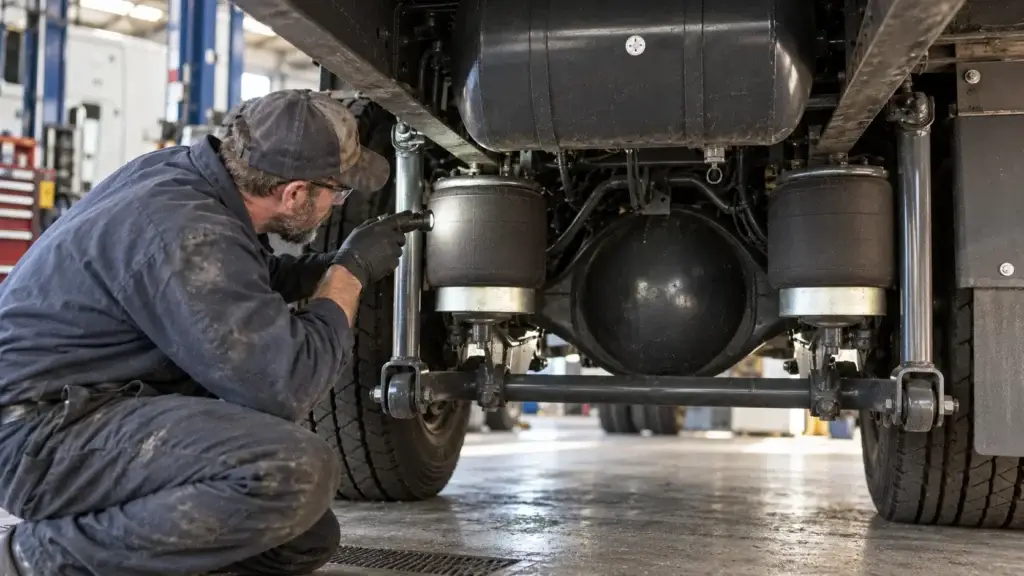
Air spring inspection starts with thorough visual examination of each air bag assembly. Look for surface cracks indicating rubber deterioration from age or environmental exposure — dry rot appears as fine cracks across the surface and signals that replacement is necessary. Check for abrasion damage where the air spring contacts frame rails or other components, since chafing creates weak spots that eventually lead to catastrophic failure.
Perform the bounce test by pushing down firmly on each corner. The suspension should rebound smoothly without unusual noise or binding — listen for air leaks during this test, which often sound like a hiss or whistle. Verify adequate clearance between air springs and surrounding components through full suspension travel; insufficient clearance causes premature wear and unexpected contact.
Air Lines, Fittings, and System Integrity
Air system maintenance includes detailed inspection of pneumatic lines running from the compressor to each air spring. Examine supply lines for abrasion damage where they contact frame members, and inspect all fittings for corrosion that compromises seal integrity — brass fittings develop green oxidation while steel fittings show rust.
Perform leak detection with soap solution applied to connections and line sections — bubbles indicate escaping air that reduces system pressure. Pay special attention to fittings at air springs, T-connections in supply systems, and connections at height control valves, since these locations take the most stress from vibration and temperature change.
Compressor and Valve Performance
Compressor checking begins with listening for unusual operational noise — grinding or knocking indicates internal wear requiring service. Monitor compressor cycling frequency, since excessive cycling suggests system leaks or a governor problem, and verify air dryer operation, since moisture contamination damages valves and accelerates corrosion.
Under 49 CFR 393.207, air suspension systems must maintain proper pressure without excessive leakage: air leakage must not exceed 3 PSI in a 5-minute period when the vehicle's air pressure gauge shows normal operating pressure, and the air pressure regulator valve must not allow air into the suspension system until at least 55 PSI is in the braking system.
| Component | Inspection Frequency | Critical Indicators |
|---|---|---|
| Air Springs/Bellows | Weekly visual check | Surface cracks, dry rot, abrasion, unusual bulging |
| Air Lines and Fittings | Monthly detailed inspection | Abrasion wear, corrosion, loose connections |
| Compressor System | Monthly performance test | Operating noise, cycle frequency, output pressure |
| Height Control Valves | Quarterly functional test | Response time, linkage condition, height accuracy |
Air Ride System Maintenance Procedures
Draining Moisture and Contaminants
Moisture accumulation ranks among the primary enemies of air suspension. Water enters through the compressor intake and condenses inside air tanks, creating corrosion in lines and valves while potentially blocking air flow in freezing temperature.
Air tank drainage should happen daily in humid climates and weekly at minimum in drier conditions. Manual drain valves require the technician to open the valve until all moisture and contaminant expel from the system — check the expelled moisture's condition to assess air dryer performance: clear water indicates normal condensation, while oil-contaminated moisture suggests a compressor problem needing immediate attention.
Cleaning and Lubrication
Clean suspension components resist premature wear better than neglected ones. Use mild soap and water when cleaning air springs, avoiding petroleum-based cleaners that degrade rubber compounds, and never direct a high-pressure washer at air springs or seals — the force can damage these critical components.
Moving components need regular lubrication to reduce friction and prevent premature wear. Apply high-quality grease to height control valve linkages, mounting pins, and bushings according to manufacturer interval. The Technology & Maintenance Council's Recommended Practices library provides specific guidance on lubrication interval and method for commercial vehicle suspensions.
Replacing Worn Components
Air spring replacement becomes necessary when visual inspection reveals cracks, abrasions, or bulging in the rubber bellows — a worn component that needs replacement immediately to maintain safe operation and prevent complete system failure.
Begin replacement by supporting the vehicle properly with jack stands rated for the load. Complete air system depressurization is critical — residual pressure can cause a component to separate violently during removal. Follow the correct installation sequence for mounting hardware and use a calibrated torque wrench for proper fastener tension. Post-installation checks include thorough leak testing around every connection and ride height verification against manufacturer specification.
Free Diesel Maintenance Checklist
Get HDJ's free, field-tested diesel maintenance checklist delivered instantly to your inbox — print it, laminate it, keep it in the shop.
Instant PDF • 100% Free • No Spam
Leaf Spring Suspension Inspection Guidelines
Visual Inspection of Spring Packs
Spring pack examination begins with cleaning accumulated road grime, mud, and rust from all visible surfaces — dirt conceals cracks, corrosion, and separation between leaves. Check each leaf for proper alignment and positioning; leaves that have shifted laterally indicate worn center bolts or damaged spring pads creating uneven stress distribution.
Examine the spacing between individual leaves. Excessive separation suggests broken leaves or inadequate lubrication between metal surfaces. Assess spring arch carefully using a straightedge or specialized measuring tool — loss of arch indicates metal fatigue or overloading that affects ride quality, load capacity, and vehicle alignment.
U-Bolts and Mounting Hardware
U-bolts secure the axle to the spring pack and represent a critical safety component — a loose U-bolt allows axle movement that damages the entire suspension system. Check torque on all U-bolt nuts against manufacturer specification using a calibrated torque wrench; values vary by truck model, axle weight rating, and U-bolt diameter.
Inspect U-bolt threads for damage, corrosion, and necking. Necking appears as a visible reduction in bolt diameter near the threads, indicating overtorquing or metal fatigue that requires immediate replacement. CVSA's out-of-service criteria treat a cracked or broken U-bolt bottom plate as an out-of-service condition. Replace U-bolts as complete sets whenever torque can't be maintained or thread damage appears — never reuse a U-bolt showing deformation, corrosion, or stress.
Shackles, Pins, and Bushings
Shackles allow leaf springs to change length as they compress and rebound under load. Use a pry bar to check for excessive play in shackle pins and spring eyes — any noticeable movement indicates a worn bushing needing replacement. Look for rust staining around pin locations, which signals moisture intrusion and internal deterioration.
Check that shackles hang properly without binding during suspension movement — binding shackles create stress concentrations that damage spring eyes and mounting brackets. Inspect both rubber and polyurethane bushings for cracking, tearing, or compression set.
Identifying Cracks and Metal Fatigue
Fatigue crack detection is the most critical aspect of leaf spring inspection. Stress cracks typically originate at spring eyes or holes drilled through the leaves — high-stress areas that concentrate loading force. Examine these locations carefully with adequate lighting and magnification when necessary.
A complete break occurs when a leaf fractures entirely — sometimes obvious with separated pieces, sometimes subtle with pieces still held in position by adjacent leaves. Any broken leaf compromises the entire spring pack and transfers excess stress to the remaining ones. Dye penetrant testing gives thorough crack detection on a suspected area, revealing hairline cracks invisible to the naked eye.
Federal regulation under 49 CFR Part 396 requires every suspension component be maintained in safe and proper operating condition at all times — any cracked or broken leaf spring is a violation requiring immediate repair before the vehicle can operate.
Leaf Spring Maintenance and Servicing
Applying Proper Lubrication
Effective spring lubrication reduces friction at critical contact points and prevents premature wear. Focus effort on the proven high-wear areas — spring eyes, shackle pins, and bushings where metal-to-metal contact occurs. Use a high-quality lithium-based grease for pins and bushings, since it resists water washout and maintains consistency across temperature extremes.
Clean old grease and contaminant from fittings before applying fresh lubricant, applying grease until clean material extrudes from the fitting to purge old contaminated lubricant. Verify all grease fittings are present and functional, and lubricate every 12,000 to 15,000 miles or at each preventive maintenance service.
U-Bolt Torque Specifications
Proper U-bolt torque is one of the most critical yet frequently overlooked maintenance tasks. A loose U-bolt lets components shift, leading to misalignment and excessive stress on the entire suspension; an over-torqued one can damage spring packs and mounting surfaces.
Always use a calibrated torque wrench to hit manufacturer-specified values — torque specification typically ranges from 300 to 600 ft-lbs depending on U-bolt size and application. Follow a cross-pattern tightening sequence for consistent results, and re-torque after the initial 50 to 100 miles of operation to compensate for settling. Manufacturer technical guidance consistently emphasizes that all new equipment should get an initial pre-service inspection that includes verifying every tightening torque.
Replacing Damaged Spring Packs
Timely spring replacement prevents secondary damage to other suspension components and maintains vehicle safety. Support the vehicle by the frame with suspension completely unloaded before beginning spring pack removal — a critical safety step that eliminates stored energy hazards and allows safe hardware removal.
During replacement, examine shackles, hangers, and mounting brackets for wear or damage, and replace all associated hardware including U-bolts and mounting plates. While individual leaf replacement may seem economical, full pack replacement ensures matched characteristics and prevents premature failure from uneven stress distribution. Install spring packs in proper orientation, following manufacturer markings and installation diagrams precisely.
Common Suspension Problems and Diagnostics
Effective troubleshooting begins with recognizing specific symptoms that indicate suspension malfunction. Uneven tire wear signals poor weight distribution from worn suspension parts. A truck sitting lower on one side points to broken leaf springs or a damaged air suspension bag. Excessive bouncing after a bump indicates shock absorbers need replacement, while clunking, creaking, or squeaking noise suggests a problem with bushings, bearings, or spring mounts.
Pneumatic System Failure Indicators
Air ride diagnostics need systematic testing to isolate a specific component failure. Loss of ride height indicates air leaks, compressor malfunction, or a height control valve problem — a condition affecting load capacity and creating dangerous handling. Uneven ride height side-to-side points to a failed air spring on one side or a blocked air line.
Excessive compressor cycling reveals a significant air leak or inadequate air dryer function allowing moisture buildup. A system failing to adjust to load changes suggests a height control valve malfunction. Harsh ride quality despite proper air pressure indicates a failed shock absorber or an air spring that's lost flexibility.
Spring Pack Problem Recognition
Leaf spring failure shows characteristic signs experienced technicians recognize immediately. Sagging on one side or end indicates a broken or fatigued spring needing replacement. Clunking or banging over bumps points to a broken leaf within the pack or a loose U-bolt. Visible axle misalignment results from a shifted spring pack or broken center bolt — this accelerates tire wear and compromises vehicle control.
Tire Wear Pattern Analysis
Tire wear patterns provide critical diagnostic information about suspension condition and geometry. Cupping or scalloping indicates worn shocks or bushings allowing excessive tire movement. Wear concentrated on one shoulder reveals a camber or toe problem caused by worn suspension bushings or a bent component. Center wear primarily results from incorrect inflation, but a suspension problem affecting weight distribution accelerates the pattern.
| Wear Pattern | Primary Cause | Diagnostic Action |
|---|---|---|
| Cupping/Scalloping | Worn shocks or bushings | Bounce test and bushing inspection |
| One shoulder wear | Camber/toe misalignment | Alignment measurement and bushing check |
| Feathering across tread | Incorrect toe setting | Steering linkage inspection |
| Center wear | Suspension affecting weight distribution | Ride height measurement and spring inspection |
Preventive Maintenance Best Practices
Daily Pre-Trip Inspections
Drivers serve as the first line of defense in catching suspension problems through a thorough pre-trip walkaround. Start by examining ride height at each corner — abnormal height differences indicate air loss in pneumatic systems or a broken leaf in spring suspensions. Look for visible damage: a cracked or torn air spring, a broken leaf spring protruding from the pack, fluid streaks from a leaking shock absorber. HDJ's DOT pre-trip inspection guide covers where this fits into the full walkaround sequence.
Perform a bounce test by pushing down firmly on each corner and releasing — the truck should rebound once and settle without excessive bouncing; multiple rebounds suggest a worn shock absorber. Document all findings and report a concern immediately to maintenance personnel.
Monthly Detailed and Annual Comprehensive Checks
Monthly inspection goes beyond daily visual checks to examine components more thoroughly with under-vehicle access — checking U-bolt torque, examining bushings and pins closely for cracking, elongated pin holes, and excessive play. Measure and record ride heights at all positions, comparing against manufacturer specification and previous readings, since tracking height change over time reveals gradual settling that indicates wear. For air suspension, verify compressor function and air dryer operation, and perform leak testing by isolating sections and monitoring pressure drop.
Annual comprehensive service, scheduled around major mileage intervals, provides the most thorough evaluation possible — complete measurement and documentation of ride height, axle alignment, and suspension geometry using precision tools, replacement of wear items that have reached service limit even if not yet failed, and comprehensive air system service on air suspension vehicles including air dryer cartridge replacement and system pressure testing.
| Inspection Interval | Key Activities | Primary Benefit |
|---|---|---|
| Daily Pre-Trip | Visual inspection, bounce test, height check, leak detection | Catches obvious problems, ensures DOT compliance |
| Monthly Detailed | Under-vehicle inspection, hardware torque, measurement recording | Identifies developing issues, tracks wear progression |
| Annual Comprehensive | Component disassembly, precision measurement, wear item replacement | Prevents failures, maximizes component life |
Cost Considerations and Return on Investment
The economic reality of commercial trucking demands clear-eyed analysis of maintenance cost versus a catastrophic repair bill. Fleet profitability hinges on a strategic decision about when to invest in preventive care and when a component genuinely needs replacement.
Maintenance vs. Replacement Costs
Routine maintenance is a fraction of a major repair cost. A standard inspection runs $50–$150, bushing replacement $200–$500 per axle. Compare that against what neglect triggers: complete spring pack replacement runs $1,200–$2,500 per axle, an emergency air suspension bag replacement $800–$1,500, and frame damage from broken suspension can run well past $15,000.
The multiplier effect creates real financial impact — one failed component accelerates wear on associated parts, turning a modest repair into a major expense. A delayed bushing replacement often cascades into a repair bill several times its original size once it takes a spring hanger, a shackle, and accelerated tire wear down with it. Emergency roadside repair reliably costs multiple times standard shop rates, plus towing.
Downtime Impact on Profitability
Suspension-related breakdowns create cost well beyond the immediate repair. Per ATRI's Operational Costs of Trucking research, the industry-average cost of operating a truck reached $2.260 per mile in 2024 — every hour of downtime a truck isn't earning against that baseline is a real, direct loss.
Fixed costs continue during downtime regardless of revenue — insurance, truck payments, and administrative expense all keep accruing whether the truck is rolling or sidelined. A suspension failure often needs several days for parts acquisition and repair completion, which is exactly why the gap between a scheduled shop visit and an emergency roadside repair matters as much financially as it does operationally.
Maximizing Component Lifespan
Strategic maintenance meaningfully extends component life. Proper care can push leaf spring life well past the 80,000–100,000-mile baseline, air springs past 100,000 miles, and shock absorbers past their typical 50,000–70,000-mile window — the exact multiple depends on duty cycle and how consistently the maintenance program is actually followed, not a fixed percentage any article can promise.
Build a fleet-specific cost-per-mile comparison from actual parts, labor, and downtime records rather than relying on an industry-wide average — real suspension economics vary meaningfully by route type, load pattern, and climate, and a number specific to an operation is worth more than a generic one.
Compliance and Safety Regulations
Maintaining suspension systems goes beyond mechanical repair — it requires strict adherence to DOT compliance standards and FMCSA regulation. A failed suspension component triggers an automatic red flag during a roadside inspection, with consequences ranging from citation to immediate out-of-service order.
Federal Inspection Standards
FMCSA regulation establishes specific inspection criteria for suspension systems under the CVSA North American Standard Inspection Program. Inspectors verify that no leaf spring is broken or missing from any assembly, all U-bolts are present and properly tightened, and spring hangers and mounting brackets are secure without cracks or structural compromise. Air suspension systems face equally rigorous scrutiny for cracks, leaks, and proper function.
A critical violation — a broken main leaf spring, missing U-bolt, cracked spring hanger, or a major air leak — results in an immediate out-of-service order with meaningful violation penalties plus roadside repair cost. The CSA safety points system adds long-term consequence, too — accumulated points affect insurance premiums and can jeopardize customer contracts.
| Violation Type | Specific Conditions | Consequence |
|---|---|---|
| Critical Violations | Broken main leaf, missing U-bolts, cracked hangers, major air leaks | Immediate out-of-service, significant fine |
| Serious Violations | Worn bushings, minor leaks, surface corrosion, loose hardware | Citation issued |
| Maintenance Items | Minor wear indicators, early-stage deterioration | Warning or notation, repair recommended |
Documentation and Record-Keeping
Federal motor carrier safety regulation under 49 CFR Part 396 establishes comprehensive documentation requirements for vehicle maintenance. Carriers must maintain detailed records of every inspection, repair, and preventive maintenance activity for at least one year from the service date, available for immediate review by enforcement personnel.
Effective documentation includes date and odometer reading when work was performed, every component inspected or serviced, deficiencies discovered and verification that the component now meets standard, part numbers and manufacturer information for replacement, and technician identification. Quality service records serve a purpose beyond basic compliance too — they provide liability protection by demonstrating maintenance was performed to industry standard.
Frequently Asked Questions
How often should commercial truck suspension be inspected?
Every 12,000 to 12,500 miles under normal operating conditions, with a daily pre-trip visual check. Severe-service conditions — off-road use, heavy loads near maximum GVWR, or a corrosive environment — need more frequent inspection every 6,000 miles or monthly, whichever comes first. Annual comprehensive service with detailed measurement and component assessment is essential for both system integrity and regulatory compliance.
What are the signs of failing truck suspension components?
Uneven tire wear, excessive bouncing after a bump, a vehicle pulling to one side, unusual noise like clunking or squeaking, and visible sagging or uneven ride height. Air ride systems may show excessive compressor cycling or an audible air leak. Leaf spring systems show a cracked or separated leaf and rust at mounting points. Any of these need immediate attention to prevent a DOT violation and ensure safe operation.
Should fleets choose air ride or leaf spring suspension?
It depends on operational requirement. Air ride provides superior cargo protection, better driver comfort, and adjustable ride height, making it ideal for general freight and fragile cargo on highway routes. Leaf spring offers exceptional durability, lower initial cost, and simpler maintenance, making it preferred for vocational applications, construction work, and severe-duty environments. Match the technology to primary cargo type, route conditions, and maintenance capability.
What FMCSA regulations apply to truck suspension maintenance?
49 CFR 393.207 establishes specific requirements for suspension systems, including that no axle positioning part may be cracked, broken, loose, or missing. Air suspension must maintain proper pressure without excessive leakage — no more than 3 PSI in 5 minutes at normal operating pressure, and no air into the suspension until at least 55 PSI is in the braking system. 49 CFR Part 396 requires systematic inspection, repair, and maintenance of all suspension components, and CVSA out-of-service criteria define the thresholds that result in immediate vehicle grounding.
How much does suspension neglect cost fleet operations?
Beyond the direct repair, an emergency roadside repair reliably costs multiple times standard shop rates plus towing. Downtime costs a fleet real money every day, combining lost revenue and fixed costs that keep accruing whether the truck is rolling or sidelined. Proper preventive maintenance genuinely reduces total suspension-related cost over a vehicle's life — the exact figure is fleet-specific, built from a carrier's own parts, labor, and downtime data rather than a single industry-wide number.
Maintaining Your Competitive Edge Through Suspension Care
Effective commercial truck suspension maintenance directly impacts a fleet's safety record, operating cost, and competitive position. The investment in regular inspection, timely component replacement, and proper documentation delivers measurable return through reduced breakdowns, extended equipment life, and avoided regulatory penalty.
Fleet managers should establish a formal inspection protocol matching their equipment type and operating condition. Training maintenance personnel on both air ride and leaf spring systems ensures consistent service quality, and tracking component life and suspension-related cost identifies improvement opportunities specific to the operation — the same discipline Michael Nielsen and Heavy Duty Journal's editorial team hold every guide on heavydutyjournal.com to.
Share This Suspension Maintenance Guide
Know a fleet manager or technician who could benefit from these best practices? Share this comprehensive guide with your professional network.