By Michael Nielsen, Publisher | 15+ Years in Diesel Repair & Fleet Operations
Last Updated: November 2026
⏱ Estimated reading time: 15 minutes
English language proficiency for CDL drivers is now an out-of-service violation at the roadside. Under 49 CFR 391.11(b)(2), a driver who cannot read and speak English well enough to talk with the public and understand highway signs is unqualified, and since June 25, 2025 inspectors have been able to park that driver on the spot.
English language proficiency (ELP) is the federal driver qualification standard requiring a commercial motor vehicle driver to read and speak English sufficiently to converse with the general public, understand highway traffic signs and signals in English, respond to official inquiries and make entries on reports and records. This guide from Heavy Duty Journal explains the rule, the two-step roadside test, the penalties, the proposed codification and what carriers should do before the next inspection.
Key Takeaways
- 01The rule is not new, the enforcement is. The English requirement sits in 49 CFR 391.11(b)(2). A 2016 FMCSA policy had steered inspectors away from out-of-service orders, and DOT moved to end it on April 28, 2025.
- 02Failing means out of service. CVSA made an ELP violation an out-of-service violation effective June 25, 2025. FMCSA says inspectors place the driver out of service immediately.
- 03The test has two steps. FMCSA's roadside policy calls for a driver interview in English, then a highway sign recognition test. Interpreters, apps and cue cards are not allowed in the interview.
- 04The numbers are large. FMCSA's August 2026 proposal counts 19,045 ELP out-of-service orders from June 25, 2025 to March 19, 2026, and DOT says more than 26,000 drivers have been removed since enforcement resumed.
- 05Carriers are on the hook too. Section 391.11(a) bars a carrier from requiring or permitting an unqualified person to drive, so the carrier needs its own way to confirm English ability.
- 06Codification is pending. FMCSA proposed on August 10, 2026 to write the out-of-service rule into the regulations. HDJ found no final rule as of November 18, 2026.
In This Guide · 12 sections
- What English Language Proficiency for CDL Drivers Means
- How English Proficiency Enforcement Changed
- How the Roadside English Test Works
- What Happens When a Driver Fails
- Border Zone and Other Exceptions
- English Proficiency Enforcement Numbers
- Carrier Responsibility Under 391.11(a)
- The Proposed Rule to Codify English Proficiency
- State Actions and English-Only CDL Testing
- A Fleet Process That Holds Up Roadside
- Frequently Asked Questions
- The Bottom Line
01
What English Language Proficiency for CDL Drivers Means
English language proficiency for CDL drivers is one line of a longer list of driver qualifications. Under 49 CFR 391.11, a person is qualified to drive a commercial motor vehicle only if he or she can read and speak English sufficiently to converse with the general public, to understand highway traffic signs and signals in English, to respond to official inquiries and to make entries on reports and records.
The same section makes the requirement a carrier problem as well. Paragraph (a) says a person shall not drive a commercial motor vehicle unless qualified, and it bars a motor carrier from requiring or permitting an unqualified person to drive. English proficiency for CDL drivers is therefore tested at the roadside against the driver and checked in the carrier's hiring process.
What the rule does and does not say
The regulation sets a functional standard. It names conversation with the general public, traffic signs and signals, official inquiries and records, and it sets no test score, no certificate and no minimum vocabulary. How an inspector judges that standard is set by FMCSA's enforcement policy and the Commercial Vehicle Safety Alliance (CVSA) out-of-service criteria, covered in sections 03 and 04.
02
How English Proficiency Enforcement Changed
Enforcement of English language proficiency for CDL drivers changed in 2025 after a decade of weak use. FMCSA's April 28, 2025 announcement says a 2016 policy had loosened enforcement and that Secretary Sean P. Duffy directed FMCSA to rescind it, issue new guidance on 391.11(b)(2) and ask CVSA to add the standard to its out-of-service criteria (FMCSA, April 28, 2025).
| Date | Event | Source |
|---|---|---|
| 2016 | FMCSA policy had inspectors avoid out-of-service orders for ELP alone | FMCSA, April 28, 2025 |
| April 28, 2025 | DOT announces plan to end the 2016 policy and enforce 391.11(b)(2) | FMCSA newsroom |
| May 20, 2025 | FMCSA roadside policy MC-SEE-2025-0001 issued | FMCSA policy page |
| May 22, 2025 | FMCSA carrier FAQ on assessing driver English issued | FMCSA FAQ |
| June 25, 2025 | ELP becomes a CVSA out-of-service violation | CVSA |
| October 2025 | FMCSA withholds $40 million from California over ELP | FMCSA, May 1, 2026 |
| January 2026 | California begins enforcing ELP | FMCSA, May 1, 2026 |
| April 16, 2026 | Revised policy MC-SEE-2026-0002 replaces the 2025 memo | FMCSA policy page |
| June 1, 2026 | Texas moves CDL knowledge exams to English only | Texas DPS |
| August 10, 2026 | FMCSA publishes proposal to codify the out-of-service rule | 91 FR 51422 |
The sequence matters for fleets because the rule text did not change; the enforcement behind it did. A carrier whose hiring file never addressed English ability now faces inspectors who may test it at any inspection where a driver does not seem to understand the instructions.
03
How the Roadside English Test Works
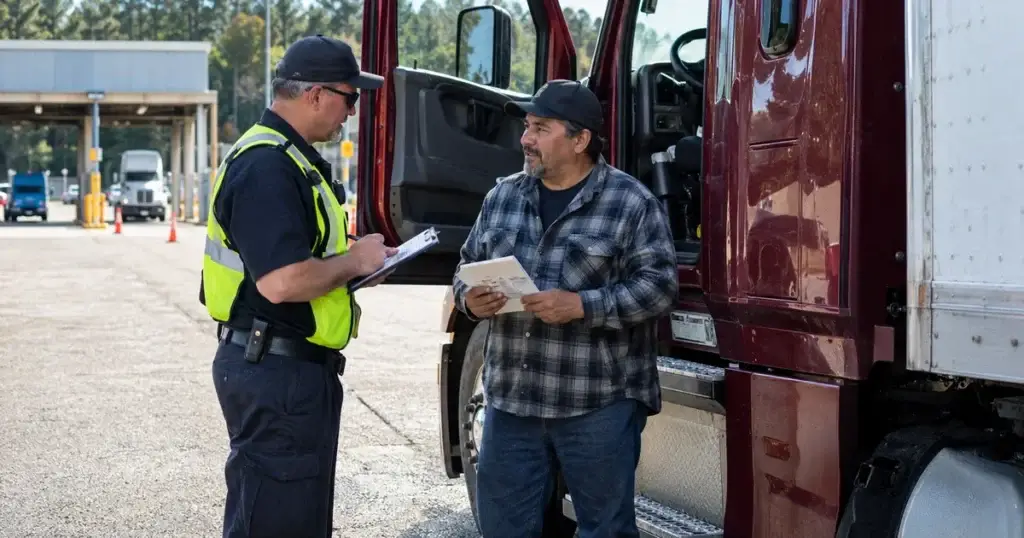
The roadside test is a two-step assessment, and it begins in English. FMCSA's revised roadside policy, MC-SEE-2026-0002, says inspectors start every inspection in English and run the assessment if the driver may not understand the initial instructions (FMCSA policy, updated April 16, 2026).
| Step | What the inspector does | Rules that apply |
|---|---|---|
| Start of inspection | Gives instructions in English | Process may be explained in another language, but the driver must answer in English |
| Step 1: interview | Asks questions the driver must answer in English | No interpreter, I-Speak card, cue card, phone app or telephone interpretation service |
| Step 2: sign recognition | Tests understanding of MUTCD signs and electronic message signs | Reached only if Step 1 is passed; scoring details are redacted in the public policy |
| Failure | Documents the driver's responses and cites the violation | Driver placed out of service immediately, subject to the border exception |
Step 1 is a conversation. FMCSA bars interpreters and aids in the interview because they may mask an inability to communicate in English, and a driver who cannot respond sufficiently is cited without moving to Step 2. Step 2 tests Manual on Uniform Traffic Control Devices (MUTCD) signs and electronic changeable message signs, after the inspector tells the driver that understanding U.S. highway signs is a required qualification.
HDJ could not state a pass mark for either step. The public copy of FMCSA's policy redacts the Step 2 procedure and thresholds, and the interview has no published scoring rubric. Drivers and carriers should treat the standard as plain functional English: answer questions about the trip, the load and the paperwork, and read the signs a driver meets every day. See HDJ's DOT inspection checklist for the rest of what an inspector reviews.
04
What Happens When a Driver Fails
A driver who fails the assessment is placed out of service immediately. The CVSA says non-compliance with 49 CFR 391.11(b)(2) is a driver out-of-service violation effective June 25, and that inspection procedures now refer inspectors to FMCSA's enforcement memo (CVSA announcement). FMCSA's policy adds that FMCSA may start disqualification proceedings when warranted.
The driver is told it is unlawful to operate a commercial motor vehicle while out of service and should not drive in interstate commerce until the condition is remedied. HDJ found no published step-by-step process for clearing an ELP out-of-service order, and the policy text HDJ retrieved does not say what remedy is required. A carrier cannot assume the driver can resume the trip after a short break.
Violation codes and CSA points
J. J. Keller's compliance network reports three ELP violation codes that carry four Compliance, Safety, Accountability (CSA) severity points each: 391.11B2-Q for a failed interview, 391.11B2S for a failed sign assessment and 391.11B2-Z for a border zone violation that is not an out-of-service order. It says they count for violations since July 27, 2025. HDJ did not confirm those codes on an FMCSA page, so verify them in your own inspection reports. HDJ's CSA score guide explains how severity points feed a carrier's scores.
05
Border Zone and Other Exceptions
The border commercial zone is the main exception to immediate out-of-service orders. FMCSA's policy says a driver who fails and whose trip involves, or would involve, operations outside the U.S.-Mexico border commercial zones is cited and placed out of service. If the trip stays inside the zones, the driver is cited but not placed out of service.
FMCSA's examples show the line. A load from Laredo to Detroit leaves the zone and means an out-of-service order. A shipment from Nuevo Laredo to a warehouse in the Laredo zone stays in the zone and means a citation only. The April 2026 revision also clarifies that the exception does not apply where the trip involves operations outside the zones.
A second exception covers drivers with a hearing-standard exemption under 49 CFR 391.41(b)(11). FMCSA's policy says they are not placed out of service under 391.11(b)(2) if they cannot speak English orally. Carriers that run exempt drivers should keep the exemption paperwork available in the cab at inspections.
06
English Proficiency Enforcement Numbers
Enforcement went from rare to routine within a year. FMCSA's August 2026 proposal reports 7,812 ELP violations in the first half of 2025, only 33 of which became out-of-service orders. After June 25, 2025 the count rose sharply, and every one of the resulting 19,045 out-of-service orders was issued outside border commercial zones (Federal Register notice 2026-16288).
| Period | ELP violations | Out-of-service orders |
|---|---|---|
| January 1 to June 24, 2025 | 7,812 | 33 |
| June 25, 2025 to March 19, 2026 | 60,399 | 19,045 |
| Since enforcement resumed, per DOT (August 7, 2026) | Not stated | More than 26,000 |
19,045
ELP out-of-service orders from June 25, 2025 to March 19, 2026, out of 60,399 violations, as reported in FMCSA's August 2026 proposal. DOT said on August 7, 2026 that more than 26,000 drivers had been removed since enforcement resumed (FMCSA release).
By HDJ's arithmetic, about 31.5 percent of ELP violations in the second period became out-of-service orders, against 0.4 percent in the first. The rest were violations that did not end in an order, many of them in border commercial zones. HDJ did not verify the border-zone counts in the notice, which do not reconcile on their face, so this guide does not quote them.
07
Carrier Responsibility Under 391.11(a)
Carrier responsibility under 391.11(a) means the carrier must not require or permit an unqualified person to drive. English ability is one of the qualifications, so a carrier that dispatches a driver who cannot meet 391.11(b)(2) is outside the rule even if the driver holds a valid CDL. That is why FMCSA published carrier guidance within two days of the roadside memo.
FMCSA's May 22, 2025 FAQ says carriers should assess whether a driver can communicate with law enforcement and understand highway signs (FMCSA carrier FAQ). It suggests a manager interview the driver in English about five topics, and it says a carrier may use various methods. The FAQ is not legally binding in its own right, and FMCSA will not rely on it as a separate basis for enforcement.
FMCSA's suggested interview topics for carriers
- Trip. The origin and destination of a recent or planned trip.
- Duty time. Time on duty, including driving time and the record of duty status.
- License. Information on the driver's license.
- Paperwork. Information on shipping papers, including hazardous materials papers where they apply.
- Equipment. Vehicle equipment subject to inspection.
The FAQ also asks the manager to tell the driver to answer in English, without interpreters, cue cards, apps or telephone interpretation, and to explain MUTCD signs and dynamic message signs. The driver may explain a sign in any language the manager understands. After the assessment, the rest of the interview may use another language where appropriate. HDJ's hours of service rules guide covers the duty-time records the interview touches.
Key Recommendation
Do not wait for a roadside order to learn a driver's English level. Run FMCSA's five-topic interview and sign review before the first dispatch, and keep a dated note of the result in the driver file.
08
The Proposed Rule to Codify English Proficiency
FMCSA proposed to put the out-of-service rule into the regulations on August 10, 2026. The notice, titled English Language Proficiency; Out of Service Criteria, was published at 91 FR 51422 under docket FMCSA-2026-0826, and responds to a CVSA petition (DOT regulatory page). It aims to align the Federal Motor Carrier Safety Regulations with CVSA's enforcement tolerances.
The proposed text adds 391.11(b)(2) to the definition of an out-of-service order in 390.5. A new 391.11(c)(1) would say a driver found violating the paragraph while operating a commercial motor vehicle in interstate commerce shall be placed out of service immediately. Paragraph (c)(2) would exempt border-zone drivers unless there is evidence they have operated or intend to operate beyond the zones.
FMCSA estimates about 9,000 drivers a year would receive an ELP violation and out-of-service order inside border zones, at a cost of $14.4 million a year. The estimate is 9,000 drivers at $800 a day for two days. As of November 18, 2026, HDJ found no final rule. The comment period, 60 days from publication, would have ended in early October, so the next step is a final rule or a change to the text.
09
State Actions and English-Only CDL Testing
States are tightening in two places: roadside enforcement and CDL testing. FMCSA says it withheld $40 million from California in October 2025 for refusing to enforce ELP standards and that California began enforcing in January 2026 (FMCSA, May 1, 2026). A DOT fact sheet says FMCSA is implementing English-only testing and gives no start date.
Texas moved first on testing. On June 1, 2026, the Texas Department of Public Safety began giving CDL and commercial learner permit knowledge exams in English only, with no interpreters, ending the English and Spanish option (Texas DPS, June 1, 2026). Skills tests were already English only. DPS said it will continue English proficiency evaluations during traffic stops and at weigh stations.
FreightWaves reported that Secretary Duffy announced on February 20, 2026 a rulemaking to make English the only language for CDL knowledge and skills tests. HDJ found no proposed rule text, and the DOT fact sheet says only that FMCSA is implementing the change. Fleets that recruit across states should check each state's testing language rather than assume the federal rule has landed.
Editorial Insight
The HDJ Perspective
According to Heavy Duty Journal, English proficiency enforcement is a hiring problem long before it is a roadside problem. In HDJ's field experience across 15+ years of coverage, the fleets that avoid surprise out-of-service orders are the ones that talk to a driver in English, on the record, before the driver ever touches a key. A five-minute interview costs far less than a stranded load.
10
A Fleet Process That Holds Up Roadside
A fleet process for English language proficiency for CDL drivers has four parts: a pre-hire assessment, a record of it, a driver briefing and a plan for an out-of-service order. None is a federal requirement for the paperwork itself. FMCSA's FAQ is voluntary and does not address recordkeeping, so these are HDJ suggestions built on that guidance, not rules.
Assess before dispatch
Use FMCSA's five interview topics and the sign review with a manager who can judge the answers. Run the assessment in English without interpreters or apps, then conduct the rest of the interview in another language if that helps the driver. Reassess a driver who changes routes into new states or the border area, since the border exception turns on where the trip goes.
Record it and brief the driver
Keep a dated note of who assessed the driver, which topics and signs were covered and the result, in the file described in HDJ's driver qualification file guide. Brief drivers that they will be asked to answer in English at inspections, that aids are not permitted in the interview and that exemption documents should be within reach. HDJ did not research employment-law limits on language assessments, so consult counsel before adopting a written standard.
Plan for an out-of-service order
An order strands a load, so decide in advance who dispatches a replacement driver and how the customer is told. FMCSA's estimate of $800 a day for two days is a rough benchmark for the cost of one border-zone order, not a figure for every fleet. Build ELP into the same routine as the rest of your FMCSA compliance requirements guide and your fleet driver safety program guide. Heavy Duty Journal's compliance guides at heavydutyjournal.com, written by Michael Nielsen, cover the neighboring rules.
Free DOT Status Check
Enter a USDOT number and quickly review public carrier status, operating authority and key FMCSA registration data.
FAQ
Frequently Asked Questions
Is English language proficiency for CDL drivers required by federal rules?
Yes. 49 CFR 391.11(b)(2) requires a CMV driver to read and speak English sufficiently to converse with the general public, understand highway traffic signs and signals, respond to official inquiries and make report entries. Since June 25, 2025, failing the requirement is an out-of-service violation.
What happens if a truck driver fails the English test at a roadside inspection?
The inspector cites the violation and places the driver out of service immediately, unless the border commercial zone exception applies. FMCSA says it may also start disqualification proceedings when warranted. HDJ found no published step-by-step process for returning to service.
How does the roadside English proficiency test work?
FMCSA's policy has two steps: an interview the driver must answer in English, then a test on MUTCD highway signs and electronic message signs. Interpreters, I-Speak cards, cue cards, apps and telephone interpretation are not allowed in the interview. The public policy redacts scoring details.
Can a driver use a translation app during an English proficiency inspection?
No. FMCSA's roadside policy says interpreters, I-Speak cards, cue cards, smartphone apps and the On-Call Telephone Interpretation Service may not be used in the driver interview, because they may mask an inability to communicate in English. The inspector may explain the process in another language.
Is a driver out of service for failing the English test in the border zone?
Not always. A driver who fails is cited but not placed out of service if the trip stays within the U.S.-Mexico border commercial zones. If the trip involves or would involve operations outside the zones, the driver is cited and placed out of service, per FMCSA's April 2026 policy.
Are motor carriers responsible for their drivers' English ability?
Yes. 49 CFR 391.11(a) bars a carrier from requiring or permitting an unqualified person to drive. FMCSA's May 22, 2025 FAQ recommends that a carrier manager interview the driver in English and review highway signs, though the FAQ is not legally binding.
How many truck drivers have been put out of service for English proficiency?
FMCSA's August 2026 proposal counts 19,045 ELP out-of-service orders from June 25, 2025 to March 19, 2026, from 60,399 violations. DOT said on August 7, 2026 that more than 26,000 drivers had been removed for failing ELP tests since enforcement resumed.
Is the English proficiency rule permanent?
The requirement in 391.11(b)(2) is existing regulation. FMCSA proposed on August 10, 2026 to codify the out-of-service treatment, citing docket FMCSA-2026-0826. HDJ found no final rule as of November 18, 2026, so the roadside policy remains the operative enforcement basis.
Do CDL tests have to be taken in English?
Not under a federal rule HDJ could confirm. Texas moved its CDL knowledge exams to English only on June 1, 2026, and DOT says FMCSA is implementing English-only testing without giving a start date. Check each state's licensing agency for its current testing language.
Wrap-up
The Bottom Line
English language proficiency for CDL drivers is settled regulation with newly strict enforcement. A driver who cannot answer in English or read common signs will be placed out of service, a carrier that dispatches that driver carries its own exposure, and the open questions are the codified text and the return-to-service process. Plan for the rule as written, not for a relaxed reading.
Heavy Duty Journal recommends assessing every driver before dispatch with FMCSA's interview and sign review, keeping a dated note and watching docket FMCSA-2026-0826. Michael Nielsen and the HDJ team publish compliance updates at heavydutyjournal.com, so check back before the final rule changes your hiring process. Related HDJ guides cover non-domiciled CDL rules and Clearinghouse II CDL downgrades.
Share This English Proficiency Guide
Know a fleet manager or safety director who hires CDL drivers? Share this guide before the next inspection.