
By Michael Nielsen, Editor & Publisher | 15+ Years in Diesel Repair
Last Updated: August 2026
⏱ Estimated reading time: 14 minutes
Diesel starter motor troubleshooting begins with separating an electrical supply problem from an actual starter motor failure — the two produce nearly identical symptoms but call for completely different repairs. A single loud click with no crank almost always points to a weak battery, a corroded connection, or a failing solenoid rather than a worn starter. Rapid, repeated clicking usually means insufficient voltage is reaching the solenoid to hold it engaged. A slow, labored crank with adequate battery voltage often traces back to worn starter brushes or excess resistance somewhere in the circuit. The fastest, most reliable path to the right answer is a structured voltage drop test across the entire starting circuit — battery, cables, ground, solenoid, and starter — rather than swapping parts by guesswork. This guide walks through that sequence step by step, including the diesel-specific complications, like crank inhibit interlocks and ECM-controlled start authorization, that generic automotive troubleshooting content leaves out.
Key Takeaways
- Most "bad starter" complaints aren't the starter. A full-circuit voltage drop test — not a parts-cannon swap — separates a $40 corroded-cable repair from a $400-plus starter replacement before a wrench ever touches a mounting bolt.
- A single click and total silence point to different failures. One loud click with no crank is almost always the solenoid or a weak connection; complete silence with no click at all usually traces further back, to the ignition circuit, a crank inhibit interlock, or a dead battery.
- Diesel-specific interlocks cause false starter diagnoses. A truck that cranks fine in neutral but won't crank in gear, or one whose ECM withholds start authorization on a sensor fault, has a healthy starter that a technician can easily misdiagnose and replace unnecessarily.
- Corrosion and heat soak, not age alone, drive most premature failures. A starter mounted near the exhaust manifold that fails after a hot re-crank attempt is usually a thermal or connection problem, not a worn-out motor.
How Diesel Starter Motors Work — and Why They Fail
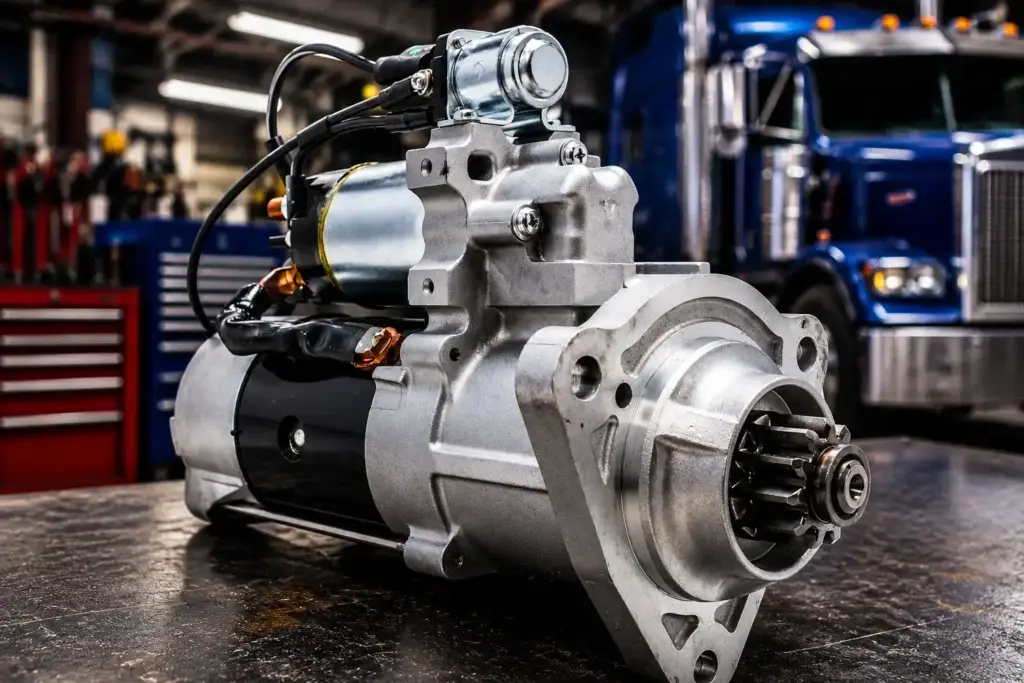
A diesel starter motor is a high-torque electric motor that engages a pinion gear against the engine's ring gear to spin the crankshaft fast enough for compression ignition to occur. Heavy-duty diesels typically need 100 to 200 RPM of cranking speed to build sufficient compression heat, roughly double what a gasoline engine requires, which is why diesel starting systems draw far more current — commonly 200 to 600 amps depending on engine displacement and ambient temperature. Most Class 6-8 trucks use a gear reduction starter, such as a Delco Remy 39MT or 150MT, Bosch, or Denso unit, which uses an internal gear set to multiply torque while keeping the starter itself compact enough to mount on the bell housing.
A starter solenoid is the electromagnetic switch that both engages the starter's pinion gear with the engine's ring gear and closes the high-current contacts that feed battery power to the starter motor. Because the solenoid does double duty — mechanical engagement and electrical switching — it is also the single most common failure point in the entire starting circuit, and the component most often responsible for a starter that "just clicks."
Starter Solenoid vs. Starter Relay: What's the Difference?
The starter solenoid mounts directly on the starter motor and carries the full 200-600 amp starting current. A starter relay, by contrast, is a low-current switch — often mounted on the frame rail or in a cab fuse and relay panel — that closes the circuit which energizes the solenoid's coil. Many heavy-duty trucks use both: the ignition switch triggers a low-current relay, and that relay's output triggers the high-current solenoid. A failed relay produces the exact same "turns the key, nothing happens" symptom as a failed solenoid, which is why a competent diagnosis has to test both rather than assuming the more expensive component is at fault.
Recognizing the No-Start Pattern You're Actually Seeing
The sound and feel of a no-crank complaint narrows the diagnosis before a meter ever comes out. A technician who logs the exact symptom — one click, rapid clicking, a slow labored crank, a free-spinning whir, or total silence — can usually rule out two or three possible causes before starting the electrical test sequence. The table below maps the five most common no-crank patterns on diesel trucks to their likely causes and the test that confirms each one.
| Symptom | Likely Cause | Diagnostic Test | Typical Fix |
|---|---|---|---|
| Single loud click, no crank | Weak or discharged battery, corroded terminal, failing solenoid contacts | Battery load test plus voltage drop test at the solenoid | Clean and tighten terminals, charge or replace battery, replace solenoid |
| Rapid, repeated clicking | Battery voltage too low to hold the solenoid engaged | Battery state-of-charge and cranking amp test | Charge or replace battery, check alternator output |
| Slow, labored crank | Worn starter brushes or excess resistance in the circuit | Full-circuit voltage drop test | Repair the high-resistance connection, rebuild or replace starter |
| Starter whirs, engine doesn't turn | Worn or broken pinion or ring gear teeth, sheared drive | Visual inspection of ring gear and pinion engagement | Replace starter drive assembly or damaged ring gear |
| Complete silence, no click at all | Open circuit — dead battery, blown fuse, failed ignition switch, crank inhibit relay, or bad ground | Check battery voltage, inspect fuses and relays, verify crank inhibit or neutral safety switch | Repair the open circuit, replace the failed relay or switch |
Keep Your Fleet Running at Full Capacity
Get HDJ's maintenance guides, compliance updates, and fleet management strategies delivered weekly — built for working diesel professionals.
Step-by-Step Starter Motor Troubleshooting Procedure
The fastest way to troubleshoot a diesel starter motor is to test the circuit in the order current actually flows — battery, cables, ground, solenoid, then starter — rather than pulling the starter first. Technology & Maintenance Council's RP 169 Road Service Diagnostic Evaluation Service documents this same sequence for the primary electrical system — batteries, starter, alternator, and cabling — as the standard field procedure for roadside no-start calls. Working the circuit in order prevents the single most expensive diagnostic mistake in this category: replacing a $400 starter to fix a $15 corroded ground strap.
Step 1: Test Battery State of Charge and Cranking Amps
Cold cranking amps (CCA) is the industry rating for how much current a battery can deliver at 0°F for 30 seconds while holding at least 7.2 volts, and it's the single most useful number for confirming whether a battery can actually turn over a diesel engine. Start with a resting voltage check — a fully charged 12-volt battery should read 12.6 volts or higher — then run a load test or CCA test and compare the result against the OEM-rated CCA for that battery. Heavy-duty trucks commonly spec dual batteries totaling 1,200 to 2,000-plus combined CCA; a battery testing at 60% or less of its rated CCA is a leading cause of single-click and rapid-clicking no-starts, even when the starter itself is fine.
Step 2: Inspect Cables, Terminals, and Ground Connections
Battery cables and ground straps carry the same 200-600 amps as the starter itself, so corrosion or a loose connection anywhere along that path creates resistance that behaves exactly like a weak starter. Federal regulation requires battery compartments to be protected from corrosion and properly ventilated under 49 CFR 393.30, which also requires acid-and-waterproof bushings anywhere starter cables pass through a metal compartment — a detail worth checking directly, since a chafed cable at that bushing is a common source of an intermittent no-crank. Inspect every connection point — battery posts, the starter solenoid's B+ terminal, and the engine-to-frame and frame-to-battery ground straps — for corrosion, looseness, or green/white buildup, and clean or replace any connection that shows it.
Step 3: Perform a Voltage Drop Test on the Starter Circuit
A voltage drop test measures how much voltage is lost across a connection while current is flowing — a healthy connection should show almost no drop, while a corroded or loose one shows several tenths of a volt or more. With the meter set to DC volts, crank the engine (or have a helper crank it) while measuring across each segment in sequence: battery positive post to the solenoid's B+ terminal, the solenoid's motor terminal to the starter housing, and battery negative post to the engine block or starter housing on the ground side. Most heavy-duty electrical technicians treat more than about 0.5 volts of drop across any single connection, or more than roughly 10% of system voltage across the full circuit under cranking load, as excessive and worth chasing down before condemning the starter.
Step 4: Bench Test or Load-Test the Starter Motor
Once the battery, cables, and ground test clean, the starter itself is the remaining variable. A starter bench test applies battery voltage directly to the starter's terminals off the truck and measures free-spin current draw and RPM against the OEM specification — gear reduction starters like the Delco Remy 39MT typically draw noticeably less current than older direct-drive units for the same output, so compare against the correct spec sheet rather than a generic number. On the truck, a starter drawing significantly more current than spec while cranking slowly usually indicates worn brushes, a shorted armature, or internal drag; a starter drawing little or no current while doing nothing usually points back to the solenoid contacts rather than the motor itself.
Step 5: Rule Out a Parasitic Draw Masquerading as a Starter Problem
A parasitic draw is current that continues flowing after the truck is shut down and every system should be asleep, and it produces a pattern that's easy to mistake for a starter or battery fault: the truck starts fine after sitting a few hours but won't crank after sitting overnight or over a weekend. Test for it with a multimeter in series between the disconnected negative battery terminal and the cable, after giving the truck's electronics several minutes to power down fully. Most healthy heavy-duty trucks draw well under 50 milliamps at rest; a reading well above that means pulling fuses one at a time to isolate which circuit — often a body control module, aftermarket accessory, or stuck relay — is keeping the battery from holding a charge.
⚠️ Safety Warning
A heavy-duty starting circuit can carry 600 amps or more — enough to melt a wrench, weld a loose connection, or cause a battery to vent hydrogen gas near an open flame or spark. Always disconnect the negative terminal first and reconnect it last, keep test leads clear of moving belts and fans during cranking tests, and never bridge the solenoid terminals to bench-test a starter without blocking the drive wheels and confirming the transmission is out of gear.
Diesel-Specific Complications That Mimic a Bad Starter
Diesel trucks add electronic interlocks and cold-start systems that generic automotive troubleshooting content doesn't account for, and both can produce a no-crank complaint with a perfectly healthy starter underneath. A crank inhibit or neutral safety interlock — required on manual and automated manual transmissions to prevent starting the engine in gear — will hold the crank circuit open regardless of starter condition if the clutch pedal switch or transmission position sensor is out of adjustment or has failed. On modern diesels from Cummins, Detroit Diesel, PACCAR, and Volvo, the engine control module (ECM) must authorize the crank command before the starter relay ever energizes; a security/immobilizer fault, a failed crank position sensor, or certain active fault codes can cause the ECM to withhold that authorization entirely, leaving a technician chasing a starter that was never the problem.
A slow intake air heater or glow plug cycle on a cold diesel can also be mistaken for a cranking delay, since some systems intentionally hold the crank circuit for several seconds while the intake charge warms. Before condemning a starter on a cold-natured no-start, confirm whether the delay is coming from the cold-start system rather than the cranking circuit itself.
$1.854 per mile
Industry-average non-fuel operating cost per mile for 2025, up 4.2% year-over-year, according to ATRI's 2026 Operational Costs of Trucking report — as of the 2026 release, covering 2025 fleet data.
Common Causes of Diesel Starter Motor Failure
Worn brushes and a pitted or burned commutator are the most common internal starter failures, both accelerated by frequent short-duration cranking that never lets the motor cool between attempts. Solenoid contact pitting is close behind, caused by the same repeated high-current cycling that wears brushes, and it's what turns a strong click into a weak one over time. Ring gear and pinion (bendix) wear typically comes from repeated hot re-crank attempts on an engine that's already running or just stalled, which slams the pinion into a spinning ring gear instead of a stationary one. Heat soak is a factor unique to starters mounted close to the exhaust manifold or turbocharger, where residual heat after shutdown can damage internal windings even when the starter never overheated while running. Overcranking — holding the key past 30 seconds — builds heat in the windings faster than any of these other causes and is responsible for a disproportionate share of premature starter failures on trucks that sit with marginal batteries.
100% Free · No Signup Required
Free Professional Fleet Tools
Fault Code Lookup
Decode SPN/FMI codes instantly
Cost Calculators
Downtime & repair ROI
Maintenance Planner
Stay ahead of PM schedules
Repair, Rebuild, or Replace: Making the Right Call
A gear reduction starter with worn brushes, pitted solenoid contacts, or a worn bendix drive is usually a strong rebuild candidate, since those are exactly the wear items a rebuild kit replaces while reusing the housing, field windings, and armature. A starter with a shorted or open armature, a cracked housing, or damage from prolonged overcranking is typically not worth rebuilding — the labor to disassemble and test it often costs more than a remanufactured unit with a fresh core charge and warranty. For a fleet, the deciding factor is usually turnaround time as much as parts cost: a remanufactured OEM-spec starter available same-day keeps a truck moving, while a rebuild that takes a shop three days to source parts for can cost more in downtime than the difference in part price ever saves.
Preventing Starter Failures With Proactive Electrical PM
Preventive maintenance (PM) that includes a battery and ground inspection at every service interval catches the corrosion and connection issues that cause most premature starter failures long before they strand a truck. Federal regulation already requires motor carriers to systematically inspect, repair, and maintain their vehicles under 49 CFR 396.3, which makes a battery and starting-circuit check a natural fit inside a PM that's already mandatory rather than an added task. A useful PM checklist includes a battery load test at least twice a year, a visual inspection of every cable and ground strap for corrosion, a torque check on battery terminal connections, and a note of the truck's average crank time so a technician can catch a gradual slowdown before it becomes a roadside call. Average truck age has climbed to 3.6 years as of 2025, up from 3.4 the year before, according to Fleet Owner's reporting on ATRI's 2026 operating cost data — which means more of the fleet is aging into the window where connection corrosion and brush wear start showing up, a trend worth building into PM intervals rather than reacting to after the first no-start call.
The HDJ Perspective
According to Heavy Duty Journal's field experience across 15+ years of diesel electrical diagnostics, the single most common wasted part on a service truck is a starter replaced for a fault that lived in the ground strap the whole time. Editor Michael Nielsen has watched fleets burn a PM budget line on remanufactured starters that turned out to be chasing a corroded frame ground under the cab. Late-summer heat makes this worse: thermal expansion at a marginal connection opens the circuit right when the block is hottest and the starter is drawing the most current, which is exactly when a hot-shutdown re-crank complaint tends to spike on August service calls.
Frequently Asked Questions
Why does my diesel truck just click when I try to start it?
A single loud click almost always means the starter solenoid is engaging but not delivering full current to the starter motor, which points to a weak battery, a corroded or loose cable connection, or worn solenoid contacts. Rapid, repeated clicking usually means the battery voltage is dropping too fast under load to keep the solenoid held in, which is more often a battery or charging issue than a starter problem.
How do I know if it's the starter or the battery?
Test the battery first with a load test or CCA test — if it holds well above 12.4 volts under load and delivers close to its rated cranking amps, the battery is likely healthy. If the battery tests good but the truck still won't crank properly, run a voltage drop test across the starting circuit; a clean circuit with a healthy battery that still won't crank correctly points to the starter itself.
Can a bad ground connection cause a no-crank condition?
Yes — a corroded or loose ground strap between the engine, frame, and battery negative terminal is one of the most common causes of a no-crank or slow-crank complaint, because it adds resistance to the same high-current path the starter depends on. A voltage drop test across the ground side of the circuit will catch this even when every other connection looks clean.
How much does it cost to replace a heavy-duty diesel starter motor?
Cost varies significantly by engine platform, starter type, and whether the shop installs a remanufactured or new OEM unit, so fleets should get a current quote from their parts supplier rather than relying on a fixed figure. Rebuilding an existing gear reduction starter is often less expensive than a full replacement when the housing and windings are still in good condition.
Can you jump-start a truck with a failing starter motor?
Jump-starting only helps if the underlying problem is a discharged battery — it won't fix worn starter brushes, pitted solenoid contacts, or a bad ground connection, and a truck that needs jump-starting repeatedly over a short period usually has a battery, charging, or parasitic draw problem rather than a starter problem.
How long does a heavy-duty diesel starter motor typically last?
Service life depends heavily on duty cycle, connection quality, and how often the truck sees hot re-crank attempts or extended cranking, so it varies widely between fleets rather than following a fixed mileage interval. A starter protected by clean, low-resistance connections and never subjected to overcranking will consistently outlast one on a truck with marginal grounds and a habit of holding the key too long.
Diesel starter motor troubleshooting comes down to testing the circuit in order rather than guessing at the part. A battery load test, a full-circuit voltage drop test, and a check of the diesel-specific interlocks that can withhold a crank command will identify the actual fault in most cases before a starter ever comes off the truck. Heavy Duty Journal will keep updating this guide as OEM diagnostic procedures and starting-system technology evolve — for now, work the sequence in order, document the voltage drop at every connection, and let the numbers point to the fix instead of the part shelf.
Know a Tech Chasing a No-Crank Complaint?
Send this to a technician or fleet manager dealing with an intermittent no-crank truck — a five-minute voltage drop test can save hours of unnecessary parts-swapping.


