
By Michael Nielsen, Editor & Publisher | 15+ Years in Diesel Repair
Last Updated: August 2026
⏱ Estimated reading time: 15+ minutes
Tanker truck maintenance and DOT compliance revolve around one federal requirement: the cargo tank and the chassis carrying it must pass a layered schedule of tests under 49 CFR 180.407 and general vehicle upkeep rules under 49 CFR Part 396 before it can legally load.
That means annual external visual and leakage checks on the tank itself, periodic internal inspections and pressure tests, a systematic vehicle inspection and repair program for the tractor and chassis, and daily pre-trip inspections performed by a driver holding the correct endorsement. Miss any one layer and the truck is out of service — or worse, hauling a hazardous liquid in a tank nobody can prove is safe.
This guide breaks down what a fleet manager, shop owner, or owner-operator running tankers actually needs to track: cargo tank test intervals, daily inspection points, the violations that most often trigger an out-of-service order, and how to build a maintenance program that stays ahead of all three regulators watching a tanker — DOT, FMCSA, and PHMSA.
Key Takeaways
- Two clocks run at once on every cargo tank — the annual external visual/leakage cycle and a separate internal visual/pressure/thickness cycle that runs anywhere from one to five years depending on tank spec and lading, so tracking them as a single "annual inspection" is how fleets end up with an expired test nobody caught.
- A tank vehicle endorsement and a hazmat endorsement test different knowledge — surge dynamics and baffle handling versus shipping papers and placarding — and a driver missing either one is an automatic out-of-service condition, not a paperwork technicality.
- The chassis and the tank are inspected under two different rule sets — Part 396 covers the vehicle, Part 180 covers the tank — so a fleet that only tracks one of them is compliant on paper and exposed in practice.
In This Guide
- Why Tanker Trucks Face Stricter DOT Maintenance Rules
- The Core DOT Regulations Governing Tanker Truck Maintenance
- Cargo Tank Testing Intervals Under 49 CFR 180.407
- Daily and Pre-Trip Inspection Requirements for Tanker Drivers
- Common DOT Violations That Take Tankers Out of Service
- Building a Preventive Maintenance Program for Tanker Fleets
- Driver Qualifications and Endorsements for Tanker Operations
- Recordkeeping and Documentation for Cargo Tank Compliance
- Frequently Asked Questions
Why Tanker Trucks Face Stricter DOT Maintenance Rules
Tanker truck maintenance carries a second regulatory layer that a dry van or flatbed never sees: the cargo tank itself is a pressure vessel, and pressure vessels get tested on their own schedule, separate from the vehicle underneath them. A dry van's box needs a periodic inspection under Part 396; a cargo tank needs that plus external visual, internal visual, leakage, pressure, and thickness testing under Part 180.
Liquid surge is the other reason. An unbaffled or partially loaded tank shifts its center of gravity as the liquid moves, which is why 49 CFR Part 383 Subpart G requires a dedicated tank vehicle endorsement covering surge behavior, baffled versus non-baffled handling, and braking technique specific to partially filled tanks — knowledge a standard Class A CDL doesn't test.
Stack a hazardous lading on top of a rollover-prone shape and a pressurized vessel, and it's clear why enforcement treats tankers differently at the roadside. A cargo tank inspection is the point where three separate regulatory interests converge: vehicle safety, hazmat handling, and pressure-vessel integrity — and a violation in any one of them can place the load, the driver, or the vehicle out of service.
A tank's high center of gravity, combined with a partially full load sloshing against the tank walls under braking or cornering, is the mechanism behind most tanker rollovers — which is exactly why FMCSA maintains dedicated rollover prevention guidance for cargo tank operations separate from its general vehicle safety materials. Suspension condition, tire inflation, and load distribution all interact with that surge dynamic, which is one more reason chassis maintenance and cargo tank maintenance can't be managed as two unrelated line items on the same truck.
Cargo tank maintenance is the combination of periodic testing, inspection, and repair required to keep a specification cargo tank motor vehicle legally in hazardous materials service. It is distinct from routine chassis maintenance, which follows the same rules as any other commercial motor vehicle.
The Core DOT Regulations Governing Tanker Truck Maintenance
Three federal rule sets govern tanker truck maintenance and DOT compliance, and each one is enforced by a different modal agency. Confusing which rule covers which component is one of the fastest ways a fleet ends up compliant with two of the three and blindsided by the one it skipped.
49 CFR Part 396 — Inspection, Repair, and Maintenance covers the vehicle itself: the tractor, the chassis, brakes, tires, lighting, and steering. Every motor carrier must systematically inspect, repair, and maintain every commercial motor vehicle it operates, and the regulation is explicit that parts and accessories "shall be in safe and proper operating condition at all times." This is the same rule that governs a dry van fleet — nothing tanker-specific here, but it applies in full alongside the cargo tank rules below.
49 CFR Part 180, Subpart E — Qualification and Maintenance of Cargo Tanks is where tanker-specific compliance lives. Section 180.407 sets the periodic test and inspection schedule for every specification cargo tank — external visual, internal visual, leakage, pressure, thickness, and upper coupler testing — and no cargo tank with an overdue test may be filled or offered for transportation. This is the layer a dry-freight fleet manager has never had to think about.
49 CFR Part 383, Subpart G — Required Knowledge and Skills governs the driver, not the vehicle. It sets the knowledge standard for the tank vehicle (N) endorsement and the hazardous materials (H) endorsement, which combine into the X endorsement most tanker drivers carry. A compliant tank and a compliant tractor are worthless if the person behind the wheel isn't endorsed to operate either one.
FMCSA enforces the vehicle and driver rules at the roadside; PHMSA writes and interprets the hazardous materials regulations, including cargo tank testing, that FMCSA inspectors then enforce. Fleet managers dealing with both agencies should expect the two sets of guidance to be consistent, but PHMSA's written interpretation letters — not a roadside inspector's opinion — are the authoritative source when a specific tank scenario isn't clearly spelled out in the text of 180.407.
Cargo Tank Specifications Every Fleet Manager Should Recognize
A cargo tank's DOT specification determines which testing intervals and construction standards apply, so recognizing the common specs on a tank's nameplate is the first step in scheduling its compliance work correctly. MC 306/DOT 406 tanks are the thin-walled, non-pressurized tanks most commonly seen hauling gasoline and other flammable liquids. MC 307/DOT 407 tanks are built for mildly corrosive or low-pressure hazardous liquids, such as certain chemicals. MC 312/DOT 412 tanks handle highly corrosive or higher-pressure ladings and are built with heavier walls and more conservative pressure relief. MC 331 tanks are the pressurized, cylindrical tanks used for liquefied compressed gases like propane, and PHMSA has clarified that both insulated and non-insulated MC 331 tanks are held to the same five-year internal visual inspection interval — a point of confusion the agency addressed directly in a 2026 interpretation letter.
Knowing which specification a tank carries matters beyond scheduling — it also determines what the tank is legally allowed to haul. A tank rated for a mildly corrosive DOT 407 lading cannot simply be repurposed to haul a higher-pressure DOT 412 product without re-certification, even if the two liquids seem similar to a driver loading dock.
Keep Your Fleet Running at Full Capacity
Get HDJ's maintenance guides, compliance updates, and fleet management strategies delivered weekly — built for working diesel professionals.
Cargo Tank Testing Intervals Under 49 CFR 180.407
Cargo tank testing intervals under 49 CFR 180.407 run on six separate clocks, commonly referred to in the field by the single-letter test codes the regulation itself uses. Missing any one of the six — even on a tank that otherwise looks fine — is grounds for an out-of-service order and means the tank cannot legally be loaded until the test is completed.
The exact interval for internal visual, pressure, and thickness testing depends on the tank's DOT specification (MC 306/DOT 406, MC 307/DOT 407, MC 312/DOT 412, MC 331, etc.) and the corrosivity of the lading it carries, so treat the table below as the general pattern — always confirm the specific interval against the tank's specification plate and 180.407(c) before scheduling.
| Test | Typical Interval |
|---|---|
| V — External Visual Inspection | Annually |
| K — Leakage Test | Annually |
| I — Internal Visual Inspection | Generally every 1–5 years, tank-spec dependent |
| P — Pressure Test | Generally every 1–5 years, tank-spec dependent |
| T — Thickness Test | Every 2 years for corrosive lading (annually if near minimum thickness) |
| UC — Upper Coupler Inspection | Generally every 5 years, where applicable |
A leakage test is the procedure defined in 180.407(h) that checks the tank and its piping, valves, and gaskets for lading escape under normal operating pressure — it is distinct from a hydrostatic or pneumatic pressure test performed under 180.407(g), which loads the tank wall itself to a specified test pressure. PHMSA has drawn this distinction explicitly in guidance to carriers: a leak-detecting-fluid check at fittings and welds is a leakage test, not a pressure test, and the two must be recorded separately rather than interchanged on a compliance form.
Any cargo tank that has been out of hazardous materials service for a year or more must be pressure tested before it returns to service, regardless of where it fell in its normal testing cycle — a detail that matters for seasonal tankers or units pulled for a long repair.
Daily and Pre-Trip Inspection Requirements for Tanker Drivers
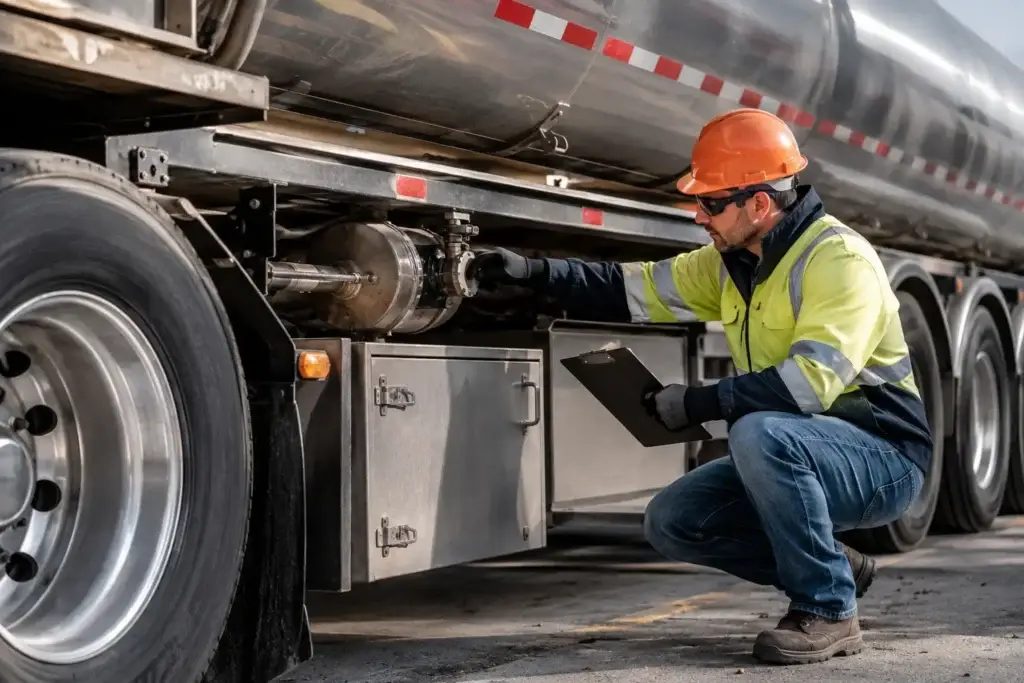
A tanker driver's daily pre-trip inspection covers two layers that a dry-freight driver's does not: the standard Part 396 vehicle walk-around, plus a visual check of the cargo tank's external condition, valves, and relief devices before the truck ever leaves the yard. Neither layer substitutes for the other.
On the vehicle side, the pre-trip follows the same checklist as any commercial motor vehicle: brakes, tires, lights, mirrors, coupling devices, and steering, documented on a driver vehicle inspection report if a defect is found that would affect safety or lead to a mechanical breakdown.
On the tank side, the driver is looking for dents, gouges, corrosion, or bulging on the tank shell; leaks or seepage at manway covers, valves, and piping connections; damaged or missing placards and markings; and confirmation that the relief valve and any vapor recovery equipment are undamaged and unobstructed. Whenever possible, this visual check is easier and more reliable to perform when the tank is empty, since residual product can mask small leaks and surface damage.
A driver who identifies damage that affects the tank's ability to safely retain its lading — a cracked weld, a leaking gasket, a deformed shell — should treat that finding the same as a brake defect: the vehicle does not move until the condition is corrected or a qualified inspector clears it. A tanker with a cosmetic dent is a maintenance note; a tanker with a compromised weld is an out-of-service condition regardless of what the calendar says about its next scheduled test.
⚠️ Safety Warning
Never open a manway, remove a valve, or enter a cargo tank that has carried hazardous materials without first purging residual product and any hazardous atmosphere and following lockout/tagout procedures. Chemical and asphyxiation hazards from residual lading persist even in a tank that appears empty, and entry without proper atmospheric testing and PPE has caused fatalities in the industry.
Common DOT Violations That Take Tankers Out of Service
The most common DOT violations on tankers cluster into three groups: overdue cargo tank tests, tank shell or fitting damage found at roadside, and driver qualification gaps — and enforcement personnel use CVSA's North American Standard Out-of-Service Criteria to decide, on the spot, whether any of them rises to an imminent hazard.
An expired external visual, leakage, internal, or pressure test date stenciled on the tank is one of the fastest out-of-service calls an inspector can make, because it requires no diagnostic judgment — the test date on the tank simply doesn't match the calendar. This is also the easiest violation for a fleet to avoid, since it depends entirely on tracking, not on the tank's actual condition.
Physical damage findings — corroded shell areas, damaged relief valves, deteriorated manway gaskets, or missing or illegible required markings — typically surface during a roadside Level I or Level II inspection rather than during scheduled testing, which is exactly why the daily pre-trip check described above matters as much as the periodic test schedule.
On the driver side, operating a tank vehicle without the tank vehicle endorsement, or hauling hazardous materials without the hazmat endorsement, are treated as out-of-service conditions rather than administrative paperwork issues — the reasoning being that a driver without the endorsement hasn't demonstrated the surge-handling or emergency-response knowledge the load requires. Improper loading, unloading, or securement procedures for hazardous liquids round out the most frequently cited driver-side findings.
FMCSA's own list of top cargo tank facility violations skews administrative rather than mechanical: failing to train hazmat employees as required, failing to include all required information on an inspection report, failing to mark the test date on the cargo tank itself, and failing to perform visual inspections as required. Every one of these is preventable without spending a dollar on parts — they fail because a process step got skipped, not because a component wore out.
With summer heat pushing tank pressures higher and asphalt temperatures stressing tires and brake components harder than any other season, relief valve function and tire condition are exactly the two items that get skipped fastest under schedule pressure — and exactly the two an inspector checks first.
Building a Preventive Maintenance Program for Tanker Fleets
A preventive maintenance program for a tanker fleet has to track two separate calendars for every unit — the Part 396 vehicle inspection cycle and the Part 180 cargo tank test cycle — and the programs that fail usually fail because they merged the two into one "annual inspection" line item and lost track of which clock governs which requirement.
Structure the program around three tiers. The first tier is the daily driver pre-trip, covering both the vehicle walk-around and the tank's external condition. The second tier is a shop-level interim inspection — commonly every 5,000 to 10,000 miles — covering chassis lubrication, brake adjustment, tire condition, lighting, and a closer look at high-wear tank fittings like loading head gaskets and dry-break connections. The third tier is the annual and multi-year cargo tank testing cycle mandated by 180.407, scheduled well ahead of the due date rather than reacted to when a decal expires.
Whichever tracking method a fleet uses — a spreadsheet, a maintenance management system, or a paper tickler file — the test date needs to live in two places: on the tank's specification plate or test decal, and in whatever system triggers the next scheduling action. A tank that only has its due date recorded in one location is one lost decal away from an overdue test nobody catches until a roadside inspector finds it.
TMC's Recommended Practices offer peer-reviewed, field-tested guidance on structuring preventive maintenance intervals for commercial vehicle fleets generally, and are a useful reference point for building the vehicle-side tiers of a tanker PM program even though TMC's practices don't cover the hazmat-specific cargo tank testing requirements themselves.
High-Wear Tank Components Worth a Standing Checkpoint
- Loading head gaskets and dry-break connections: high-cycle wear points that leak long before the tank shell shows any distress.
- Manway cover gaskets: the most common source of a failed leakage test; visually inspect for cracks or splits and replace at the first sign of cuts likely to cause leakage.
- Spring-loaded and vacuum relief valves: must move freely and seat properly; a stuck relief valve is both a leakage-test failure and a safety hazard under pressure.
- Baffles and bulkheads: internal structures that control surge; damage here is only visible during the internal visual inspection, which is one more reason that interval can't be allowed to slip.
- Vapor recovery and Method 27 fittings: for petroleum tanks equipped with vapor collection, these require their own vapor-tightness verification separate from the standard leakage test.
The HDJ Perspective
In Heavy Duty Journal's field experience across 15+ years of diesel repair, a cargo tank rarely fails its leakage test because of the tank shell — it fails because of a manway gasket or valve packing that got reused past its service life to save the cost of a rebuild kit. Building a gasket-and-packing replacement checkpoint into every annual leakage test, rather than treating the test as a simple pass/fail event, catches most of these failures before an inspector does.
Driver Qualifications and Endorsements for Tanker Operations
Driver qualifications for tanker operations require a CDL with both a tank vehicle (N) endorsement and a hazardous materials (H) endorsement, which most states issue as a combined X endorsement when a driver holds both simultaneously — and a driver missing either half of that combination is not legally qualified to operate a loaded cargo tank hauling hazmat.
The tank vehicle endorsement tests knowledge that has nothing to do with hazardous materials: the causes and effects of cargo surge on handling, proper braking technique with an empty, full, or partially full tank, the difference between baffled and non-baffled interiors, and how road grade and curvature change handling behavior as the load shifts. This knowledge applies even to a tanker hauling a non-hazardous liquid like water or milk.
The hazardous materials endorsement layers on a separate body of knowledge: the hazardous materials table, shipping paper requirements, marking, labeling, placarding, packaging, and emergency response procedures. Obtaining it requires completing hazmat entry-level driver training, passing a written knowledge test, and clearing a Transportation Security Administration background check and threat assessment — a process that can take several weeks and is typically renewed on a multi-year cycle set by the issuing state.
For fleets, the practical implication is a qualification file that tracks endorsement expiration dates with the same discipline applied to medical certificates and CDL renewals — because a driver whose hazmat endorsement lapses mid-route is now operating out of compliance the moment the endorsement expires, not the moment someone notices.
100% Free · No Signup Required
Free Professional Fleet Tools
Fault Code Lookup
Decode SPN/FMI codes instantly
Cost Calculators
Downtime & repair ROI
Maintenance Planner
Stay ahead of PM schedules
Recordkeeping and Documentation for Cargo Tank Compliance
Recordkeeping for cargo tank compliance means retaining two distinct sets of records on two distinct retention clocks — vehicle maintenance records under Part 396 and cargo tank test and inspection records under Part 180 — and an inspector asking for one during a facility audit will typically ask for the other in the same visit.
Under Part 396, vehicle inspection, repair, and maintenance records must be retained at the location where the vehicle is housed or maintained for one year, and for six months after the vehicle leaves the carrier's control. Driver vehicle inspection reports documenting any defect found during a pre-trip or post-trip inspection fall under this same requirement.
Cargo tank test and inspection reports under Part 180 must identify the specific test performed, the date, the inspector's qualifications, and the results — and among the most common cargo tank facility violations FMCSA cites are simply failing to include all required information on the inspection report or failing to mark the test date on the tank itself, which turns an otherwise-compliant test into a documentation failure at the roadside.
Digital recordkeeping tools that timestamp and store inspection data can reduce the odds of a missing signature or an illegible stencil, but the underlying requirement doesn't change: the record has to exist, has to be complete, and has to be retrievable at roadside or during an audit — whether it lives on paper in a cab door pocket or in a cloud-based maintenance system. Whatever the storage method, a facility audit tends to move faster when every tank in the fleet has a single, current file rather than a mix of paper decals, spreadsheet entries, and half-updated software records scattered across departments.
Frequently Asked Questions
How often does a tanker truck need a DOT inspection?
A tanker truck needs an annual periodic vehicle inspection under 49 CFR 396.17, the same requirement that applies to any commercial motor vehicle. Separately, the cargo tank itself needs an annual external visual and leakage test under 49 CFR 180.407, plus internal visual, pressure, and thickness testing on a longer cycle — generally every one to five years — depending on the tank's specification and lading.
What's the difference between a cargo tank pressure test and a leakage test?
A leakage test checks the tank, its valves, piping, and gaskets for lading escape under normal operating pressure and is required annually. A pressure test loads the tank wall itself — hydrostatically or pneumatically — to a specified test pressure to verify structural integrity, and runs on a longer interval, generally one to five years depending on tank specification. PHMSA has clarified that the two tests must be recorded separately, since a leak-detecting-fluid check is a leakage test under 180.407(h), not a pressure test under 180.407(g).
Do I need a special CDL endorsement to drive a tanker truck?
Yes. Driving a tank vehicle above the applicable capacity threshold requires a tank vehicle (N) endorsement covering surge dynamics and tank-specific handling under 49 CFR Part 383 Subpart G. If the tank is hauling hazardous materials, the driver also needs a hazardous materials (H) endorsement, which most states combine into a single X endorsement when a driver holds both.
What happens if a cargo tank inspection is overdue?
A cargo tank with any overdue test under 49 CFR 180.407 may not be filled or offered for transportation until the required test is completed. At the roadside, an expired test date is typically an immediate out-of-service call, since it requires no diagnostic judgment — the stenciled date on the tank simply doesn't match the current date.
How long do I have to keep cargo tank inspection records?
Vehicle maintenance records under 49 CFR Part 396 must be kept for one year at the location where the vehicle is housed or maintained, and for six months after the vehicle leaves the carrier's control. Cargo tank test and inspection reports under Part 180 should generally be retained at least until the next scheduled test of the same type, and longer if the tank has been involved in any hazmat incident.
What's the difference between an MC 306 and an MC 331 cargo tank?
An MC 306/DOT 406 tank is a thin-walled, non-pressurized tank typically used for flammable liquids like gasoline. An MC 331 tank is a pressurized, cylindrical tank built for liquefied compressed gases such as propane, with heavier construction and different pressure relief requirements. The two specifications are not interchangeable — a tank must be certified to the specification that matches the lading it carries.
Tanker truck maintenance and DOT compliance ultimately come down to running two calendars at once — the vehicle's and the tank's — and never letting either one slip because the other looked fine. The fleets that stay off the out-of-service list aren't the ones with the newest equipment; they're the ones that treat every test date on the tank with the same urgency as an expired brake adjustment, because to an inspector, they carry exactly the same weight. Heavy Duty Journal will keep tracking changes to cargo tank testing guidance as PHMSA and FMCSA issue them, so bookmark heavydutyjournal.com and check back before your next compliance review.
Running a Tanker Fleet? Pass This to Your Safety Manager
Cargo tank test dates and endorsement renewals are easy to lose track of across a mixed fleet — send this to whoever owns your compliance calendar before the next roadside inspection finds the gap first.


