
By Michael Nielsen, Publisher | 15+ Years in Diesel Repair & Fleet Operations
Last Updated: September 2026
⏱ Estimated reading time: 15+ minutes
Commercial truck tire management is the systematic practice of controlling tire costs, extending service life, and maintaining regulatory compliance across a fleet through structured inspection, inflation discipline, position-appropriate specification, rotation scheduling, retread strategy, and data-driven replacement decisions.
Tires now rank as the third-largest per-mile operating expense after fuel and driver compensation — the American Transportation Research Institute's 2026 Analysis of the Operational Costs of Trucking put the industry average at $0.05 per mile in 2025, up 6.4% year-over-year, driven partly by rubber tariff costs.
The gap between reactive tire replacement and a structured management program is measurable in dollars: fleets that manage tires as a tracked asset consistently post lower cost per mile, fewer roadside failures, stronger CSA scores, and casings that survive multiple retread cycles.
This guide covers the full commercial truck tire management framework — cost economics, tire specification by position, inflation and TPMS protocols, tread wear diagnosis, retread economics, alignment and rotation, the 2026 CSA and CVSA compliance stakes, and a cost-per-mile framework for turning tire decisions into an actual financial discipline.
Key Takeaways
- ✓Tire cost per mile hit $0.05 in 2025, up 6.4% in a single year — and fleet telematics data commonly puts more than half of commercial tires on the road at 10+ PSI under target, meaning most fleets are paying that increase twice: once in fuel burn, once in shortened casing life.
- ✓Federal tread minimums and fleet replacement standards are two different numbers — 49 CFR 393.75 sets 4/32" steer and 2/32" drive/trailer as the legal floor, but pulling tires at 5/32" and 3/32" respectively is what actually preserves retread-eligible casings.
- ✓CVSA's out-of-service criteria changed the inflation math — a tire with a noticeable tread-area leak is an automatic out-of-service condition unless the vehicle carries an automatic tire inflation system, a rule introduced in the 2025 criteria and still in force under the current 2026 standard, which makes ATIS a compliance tool, not just a cost-saving one.
- ✓A quality casing is worth two to four retread cycles at 30–50% of new tire cost each — but that value only exists if the casing was pulled before it was run flat, overloaded, or driven at the legal minimum tread depth.
- ✓Tire violations still carry the maximum 8-point Vehicle Maintenance BASIC score — and 2026 CSA scoring now separates driver-observed defects from technician-missed ones, so a tire a driver should have caught at pre-trip creates a distinct, visible mark on the carrier's profile.
In This Guide
- The True Cost of Commercial Truck Tires: Beyond the Invoice
- Tire Specification by Position: Steer, Drive, and Trailer
- Tire Inflation Management: The Highest-ROI Discipline in Tire Programs
- Tread Depth Management and Wear Pattern Diagnosis
- Retread Strategy: Managing Casings as Fleet Assets
- Alignment and Rotation: The Disciplines That Protect the Investment
- CSA Compliance: What Tire Violations Cost Your Fleet
- Cost-Per-Mile Tracking: The Framework for Data-Driven Tire Decisions
- Building a Commercial Truck Tire Management Program by Fleet Size
- Frequently Asked Questions
The True Cost of Commercial Truck Tires: Beyond the Invoice
The real cost of a commercial truck tire is never the number on the purchase order. Tire cost per mile is the total dollar amount a fleet spends on a tire divided by the miles that tire runs before removal — and it is only the starting point for the full financial picture, because every downstream failure a poorly managed tire causes shows up in a different line item entirely.
Per the American Transportation Research Institute's 2026 Analysis of the Operational Costs of Trucking, which analyzed data from more than 182,000 combination tractor-trailers running nearly 15 billion combined miles, the industry-average tire cost per mile reached $0.05 in 2025. That figure is up 6.4% from the prior year — one of the largest percentage increases of any cost category ATRI tracks, driven in part by tariffs on natural and synthetic rubber inputs.
For a truck running 120,000 miles a year, that works out to roughly $6,000 in tire spend annually; across a 50-truck fleet, the tire line item alone exceeds $300,000 before a single indirect cost is counted.
Indirect Tire Cost Categories
- Fuel waste from underinflation: Per the U.S. Department of Energy, gas mileage drops approximately 0.2% for every 1 PSI of pressure below target — meaning a tire running 10 PSI low costs roughly 2% in fuel economy on that axle alone
- Reduced casing life: A tire rated for 150,000 miles can lose 15–20% of that service life when chronically underinflated, compressing or eliminating the retread cycles the casing would otherwise support
- Roadside breakdown costs: A single tire-related roadside failure typically runs $800–$1,500 once service dispatch, labor, the replacement tire, and driver downtime are combined
- Lost retread value: A casing that is run flat, overloaded, or curbed cannot be retreaded — destroying two to four future retread cycles worth $200–$300 each in savings
- CSA violation exposure: Tire violations under 49 CFR 393.75 carry up to 8 CSA BASIC points per occurrence, the maximum single-event score in the Vehicle Maintenance BASIC, with downstream effects on insurance and operating authority
According to Heavy Duty Journal's field experience across 15+ years of shop operations, the fleets that actually move the needle on tire cost per mile are rarely the ones chasing a cheaper tire brand. They are the ones that fix the inflation and specification discipline upstream of the purchase decision, because a $30 savings on a tire that fails at 60% of its rated life is not a savings at all.
Tire Specification by Position: Steer, Drive, and Trailer
Tire specification by position is the practice of matching tire construction, tread pattern, and load rating to the distinct mechanical role each axle position plays on a commercial truck. Steer, drive, and trailer tires face fundamentally different forces, and specifying the wrong tire in any one position accelerates wear, creates a compliance exposure, and undermines every dollar spent on inflation and rotation discipline downstream.
Steer Tires
Steer tires carry the steering and braking loads on the front axle and require maximum lateral stability, predictable handling response, and tread longevity over raw traction. Rib-pattern tread designs dominate steer applications because continuous ribs resist the lateral scrubbing that accelerates wear on lugged patterns. Wide-base single steer configurations (typically 445/50R22.5 or 455/55R22.5) are increasingly common on long-haul routes for their lower rolling resistance.
Steer tires carry the highest regulatory stakes of any position. Under 49 CFR § 393.75, steer tires must maintain a minimum tread groove depth of 4/32 inch, versus 2/32 inch for every other position. Regrooved tires with a load capacity of 4,920 pounds or more are prohibited on front axle positions of trucks and truck tractors — a restriction frequently overlooked in retread program planning.
Drive Tires
Drive tires transmit traction force under full engine torque, support heavy axle loads, and generate the most heat of any position. Lug tread patterns dominate drive service because the open tread sheds heat that would otherwise accelerate belt degradation. Load range matching to actual axle load is critical: an underloaded specification reduces footprint stability, while an overloaded specification compresses the sidewall and drives destructive heat buildup.
Dual configurations require matched tread depth between paired tires — mismatched duals force one tire to carry a disproportionate share of the load, accelerating wear and creating braking instability.
Trailer Tires
Trailer tires roll under the weight of the trailer and cargo without being steered or driven, creating shoulder wear from cornering scrub and heat-related casing fatigue at sustained highway speed. Trailer positions are the most commonly neglected in fleet tire programs simply because they sit out of a driver's direct sightline and get checked less often than steer or drive tires.
That neglect is expensive: an underinflated trailer tire generates the same casing-destroying heat as an underinflated drive tire, and a worn trailer tire draws the identical 8-point CSA consequence as a steer or drive violation during a roadside inspection.
$0.05 per mile
Industry-average tire cost per mile in 2025, up 6.4% from 2024. Source: ATRI 2026 Operational Costs of Trucking (as of July 2026)
Tire Inflation Management: The Highest-ROI Discipline in Tire Programs
Tire inflation management is the single most cost-effective discipline in a commercial truck tire management program because both underinflation and overinflation are leading causes of premature failure, and both are entirely preventable with a documented weekly check. Fleet telematics and TPMS vendor data commonly puts the share of commercial tires running at least 10 PSI under target above half of all tires on the road — an invisible condition that burns fuel and shortens casing life on a mass scale before anyone notices a problem.
Setting Correct Operating Pressures
Per 49 CFR § 393.75(i), no commercial motor vehicle may operate with cold inflation pressure below what the load table specifies for the load actually being carried. That is the legal floor — correct pressure is set by the load and the tire's rated capacity, not by a single fleet-wide "standard pressure." A fleet manager who applies one target PSI across every position and load configuration is running some tires dangerously underloaded for their pressure and others dangerously overloaded.
Temperature affects every reading: pressure rises roughly 1 PSI for every 10°F increase in tire temperature. A tire checked at the correct cold pressure on a 70°F morning may read several PSI higher after a sustained highway run — not because it is overinflated, but because operating heat expanded the air inside. Bleeding a hot tire down to the cold target is one of the most common inflation errors in the industry and leaves the tire chronically underinflated once it cools.
Inspection Frequency and TPMS
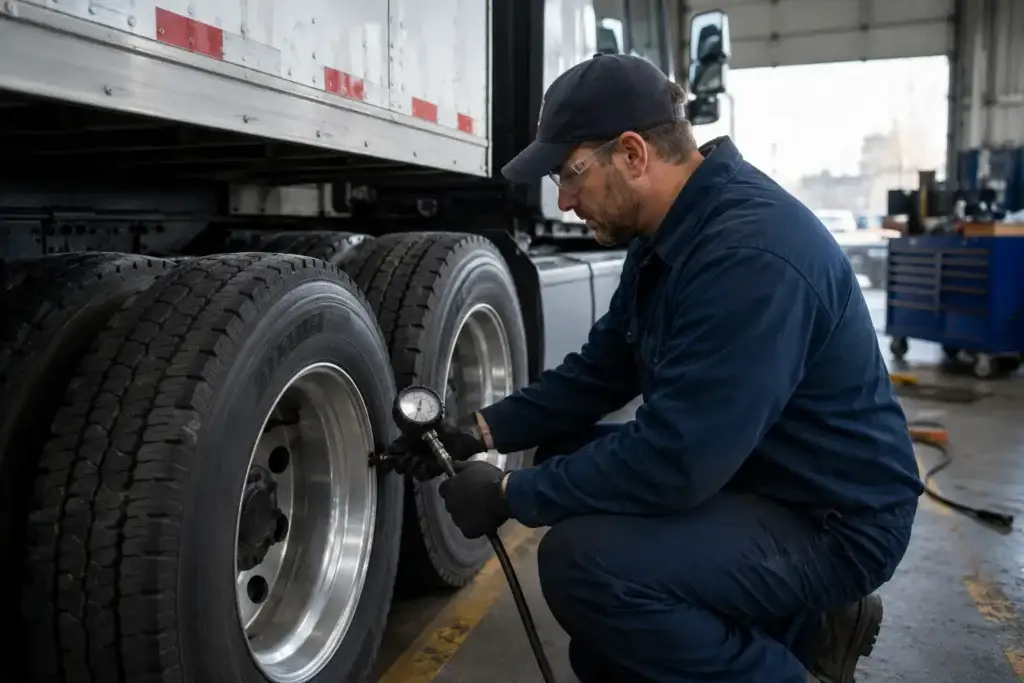
Manual pressure checks with a calibrated gauge at least once per week are the baseline for any fleet managing inflation manually. Gauge accuracy matters: cheap stick gauges can be off by 5–10 PSI, enough variance to mask a developing underinflation problem. Every reading should be logged by vehicle, axle position, and date — without records, pressure management is an intention rather than a verifiable practice.
Tire pressure monitoring systems (TPMS) are electronic systems that use sensors mounted at each wheel position — either in the valve stem or as cap-mounted units — to transmit continuous real-time pressure and temperature data to a cab display or fleet management platform, extending inflation management from weekly spot checks to constant monitoring. Fleet technology vendors commonly report TPMS payback inside twelve months once fuel savings, extended casing life, and avoided roadside calls are combined, making it one of the faster-payback technologies available to a fleet tire program.
Automatic Tire Inflation Systems
Automatic tire inflation systems (ATIS) go a step beyond monitoring by actively supplying compressed air from the vehicle's onboard air system to any tire that drops below its preset target, compensating for slow leaks and normal permeation without requiring driver intervention. ATIS is particularly valuable on trailer axles — the position most prone to slow leak development and least frequently checked.
As detailed in the CSA Compliance section below, ATIS presence now directly affects whether a tire with a tread-area leak is placed out of service under CVSA's current criteria, which has turned ATIS from a pure cost-saving investment into a compliance safeguard as well. HDJ's commercial truck tire repair tools guide covers the calibrated gauges and roadside inflation equipment every fleet needs regardless of ATIS adoption.
Tread Depth Management and Wear Pattern Diagnosis
Tread depth monitoring tells a fleet manager two things at once: when a tire is approaching its replacement threshold, and what mechanical condition is producing the wear pattern in the first place. Reading tread wear correctly is a diagnostic skill that can catch alignment, inflation, and suspension problems long before they become expensive equipment failures.
Fleet Replacement Standards vs. Federal Minimums
Federal minimum tread depth under 49 CFR § 393.75 is 4/32 inch for steer tires and 2/32 inch for drive and trailer tires — legal operating limits, not fleet management standards. Running tires to the legal minimum leaves no margin against an unexpected inspection, no protection against rapid tread loss on a cold-weather pull or a loaded mountain grade, and no casing integrity left to support retreading.
Best-practice fleets replace steer tires at 5/32 inch and drive/trailer tires at 3/32 inch, preserving both a safety margin and the casing condition a retread processor needs to accept the tire back into the program.
Reading Wear Patterns as a Diagnostic Tool
Uneven tread wear is never just a tire problem — it is evidence of a mechanical condition that will destroy the replacement tire at the same rate as the one being removed. A fleet that swaps worn tires without diagnosing the wear pattern is running a continuous replacement cycle against a root cause that never gets fixed.
| Wear Pattern | What It Indicates | Corrective Action |
|---|---|---|
| Center tread wear | Chronic overinflation — tire rides on center rib | Reduce to load-correct pressure; verify gauge calibration |
| Both shoulder wear | Chronic underinflation — casing flexes excessively | Inflate to correct pressure; inspect for slow leaks |
| One-sided shoulder wear | Camber or toe misalignment | Alignment check and correction; inspect suspension |
| Cupping / scalloping | Worn shocks, wheel bearings, or loose suspension | Inspect and replace suspension components |
| Feathering / sawtooth | Toe misalignment | Front axle alignment; check steering linkage |
| Flat spot | Wheel lockup during braking or extended storage | Inspect brake system; verify ABS; replace if compromised |
A rotation program distributes wear across positions but cannot overcome misalignment or a suspension defect — it simply spreads the damage more evenly. If wear is appearing faster than expected regardless of rotation schedule, a mechanical root-cause diagnosis is required before the replacement cycle continues.
Retread Strategy: Managing Casings as Fleet Assets
Retreading is commercial truck tire management's most powerful cost-reduction tool when executed correctly, and its most expensive mistake when it isn't. A retread tire is a used tire casing that has been inspected, prepared, and fitted with a new tread through a mold-cure or pre-cure process, at roughly 30–50% of the cost of a comparable new tire.
A quality casing can typically support two to four retread lives, and nearly half of all replacement tires in the North American truck tire market are retreads — large fleets including FedEx, UPS, and Schneider National run them extensively on drive and trailer positions, contributing to significant industry-wide savings.
Casing Management: The Foundation of a Retread Program
Casing management means tracking each tire from first installation through every retread life, documenting its history, and inspecting its condition at each removal to decide whether it qualifies for another cycle. Fleets without casing tracking are not running a retread program — they are buying retreads opportunistically when available, without managing the underlying asset.
Every casing should carry a tracking identifier (most modern commercial tires include an RFID chip or DOT code for this purpose), and at each removal the casing should undergo visual inspection for sidewall and bead damage, plus shearographic or X-ray inspection at a quality processor to catch internal damage invisible at the surface. Casings that were run flat, sustained overload, or took a foreign-object penetration into the belt area should be retired rather than retreaded — the failure risk is not worth the savings.
Retreads on Steer Axles: The Regulatory Reality
Retreaded and recapped tires are legally permitted on steer axle positions for trucks and truck tractors — the prohibition in 49 CFR § 393.75(d) applies only to buses. Separately, regrooved tires with a load capacity of 4,920 pounds or more remain prohibited on front axles, but that restriction is distinct from the retread question.
Most fleets maintain a policy against steer retreads anyway, as a conservative operational choice rather than a regulatory requirement — a defensible position on liability grounds, but one that represents a real cost decision that should be made deliberately rather than by default.
Alignment and Rotation: The Disciplines That Protect the Investment
Specification and inflation set the ceiling on tire performance potential. Alignment and rotation determine whether that potential is actually realized across a tire's service life, or whether uncorrected mechanical conditions progressively erode the investment made in the tire and its inflation program.
Steer axle toe misalignment produces the feathering pattern covered in the wear diagnosis table above — even a fraction of a degree of toe deviation generates visible feathering within a few thousand miles. Drive axle thrust-angle misalignment causes a truck to "dog-track," running slightly sideways relative to its direction of travel and creating diagonal wear on drive and trailer tires that compounds quickly under load.
Highway fleets typically check alignment annually or every 100,000 miles; vocational operations exposed to rough surfaces need it every 50,000 miles or at the first sign of uneven front-tire wear. A $150–$300 alignment correction on a highway truck can add 15,000–25,000 miles of steer tire service life — one of the highest-ROI services in a tire program.
Rotation redistributes wear across positions to even out service life across the full tire set. Drive tire cross-rotation — moving tires between the inside and outside dual positions — corrects the wear asymmetry that develops from unequal load conditions in a dual configuration. Highway fleets typically rotate every 50,000–75,000 miles; regional and vocational operations often rotate every 30,000–50,000 miles given accelerated wear from stop-and-go cycles and payload variation.
Key Recommendation
Never rotate tires without first documenting the wear pattern and tread depth at each position. Rotation records showing tread depth before and after the move give a fleet the data to calculate actual wear rates, project remaining service life, and catch abnormal wear before it compounds across the fleet. Without records, tires are simply being moved, not managed.
CSA Compliance: What Tire Violations Cost Your Fleet
Tire management is a direct regulatory compliance issue, not purely a cost-reduction exercise. The Compliance, Safety, Accountability (CSA) program is FMCSA's data-driven safety scoring system, and it evaluates tire violations under the Vehicle Maintenance Behavior Analysis and Safety Improvement Category (BASIC), one of the seven scoring categories that make up a carrier's safety profile.
A violation under 49 CFR § 393.75(a)(3) — a flat tire or an audible air leak — carries 8 CSA BASIC points, the maximum single-event severity score in the Vehicle Maintenance BASIC, and it remains one of the most frequently cited tire violation types in commercial enforcement.
As of 2026, CSA scoring has introduced a "Driver Observed" split within the Vehicle Maintenance BASIC: tire defects a driver should have caught during a pre-trip inspection now generate a separate, visible mark on the carrier's profile distinct from defects a technician missed. That distinction raises the stakes on documented pre-trip inspections — a violation now signals not just a maintenance gap but potentially a driver inspection gap as well.
The Commercial Vehicle Safety Alliance's 2025 North American Standard Out-of-Service Criteria changed how inflation-related leaks are treated at roadside, and that change carries forward unchanged in the current 2026 criteria. A tire without an automatic tire inflation system is now an automatic out-of-service condition when it has a noticeable leak in the tread area, and any tire with a sidewall leak is out of service regardless of whether ATIS is present.
CVSA also applies a stricter OOS tread-depth threshold than the federal minimum — 2/32 inch for steer tires and 1/32 inch for all others — and any tire inflated below 50% of its maximum sidewall pressure is automatically out of service.
A truck placed out of service on a tire violation cannot move under its own power until the condition is corrected, and the resulting driver time, roadside service cost, and schedule disruption typically far exceed the cost of the tire that should have been replaced before the truck left the yard.
Systematic pre-trip tire inspections documented through Driver Vehicle Inspection Reports (DVIRs), combined with the tread depth and inflation monitoring covered throughout this guide, address the root conditions that generate tire violations in the first place. Fleets running digital pre-trip inspection tools that timestamp and GPS-verify each check gain enforceable documentation that tire condition was actually verified at the start of the operating day — increasingly relevant now that driver-observed defects carry their own visibility in the CSA system.
⚠️ Safety Warning
Under CVSA's current out-of-service criteria, a tire running below 50% of its maximum sidewall pressure is automatically out of service regardless of tread condition. A pressure check that skips the low-pressure axle "because it looked fine" is not a substitute for a calibrated gauge reading.
Cost-Per-Mile Tracking: The Framework for Data-Driven Tire Decisions
Cost-per-mile (CPM) is the metric that makes tire decisions comparable across brands, positions, applications, and the new-versus-retread question. CPM integrates purchase price, service life, and retread contribution into a single number that can be tracked by tire, position, or route type — and it is the only framework that reliably exposes whether a tire decision is actually saving money or just moving the cost somewhere less visible.
The basic formula for a single tire position is straightforward: total cost of the tire divided by the miles it ran before removal. A $600 steer tire that runs 150,000 miles costs $0.004 per mile; the same $600 tire pulled at 90,000 miles due to alignment-induced premature wear costs $0.0067 per mile — a 67% increase in per-mile cost traceable to a $200–$300 alignment correction that was never scheduled.
Extending CPM to a full casing lifecycle makes the retread math explicit. A drive-position casing that runs a new tire plus two retreads — for example, $550 over 130,000 miles, then $275 over 110,000 miles, then $275 over 95,000 miles — totals $1,100 invested across 335,000 miles, or roughly $0.0033 per mile. Three new tires covering the same 330,000 miles at $550 each would run about $0.005 per mile — a 34% higher cost per mile than the managed casing produced.
CPM tracking requires recording purchase cost, installation mileage, removal mileage, and removal reason for every tire on every vehicle; most fleets already have this data, it simply is not organized in a way that makes the comparison routine.
Building a Commercial Truck Tire Management Program by Fleet Size
A commercial truck tire management program scales to any fleet size, but the implementation sequence should match available resources and the most impactful interventions for the specific operation. A 10-truck regional fleet and a 500-truck truckload carrier apply the same fundamental disciplines in different order and with different tooling. Start with the calibrated-gauge checklist below before scaling into TPMS and casing tracking.
Free Diesel Maintenance Checklist
Get HDJ's free, field-tested diesel maintenance checklist delivered instantly to your inbox — print it, laminate it, keep it in the shop.
Instant PDF • 100% Free • No Spam
Priority 1: Inflation Discipline (Immediate, All Fleet Sizes)
Establish documented weekly pressure checks with calibrated gauges for every tire on every vehicle. Build a simple pressure log — vehicle number, date, axle position, measured pressure, target pressure — and assign accountability for completing and submitting it. This single intervention, consistently applied, produces measurable tire life improvement within the first retread cycle and immediate fuel savings. Cost: a calibrated gauge set ($50–$150) plus driver training time.
Priority 2: Tread Depth Records and Fleet Standards (Immediate)
Establish written replacement standards above the federal minimum — 5/32 inch steer, 3/32 inch drive and trailer — and record tread depth at every PM service. Use those measurements to flag vehicles with abnormal wear rates for alignment and suspension investigation, and to build the documentation foundation CSA audits and 49 CFR Part 396 compliance both require.
Priority 3: Alignment Program (Within 90 Days)
Run baseline alignment checks on every tractor, document findings, and correct out-of-specification conditions. Build alignment verification into the PM schedule at the interval appropriate to the application — the investment typically returns 10–15× its cost in extended tire life within the first replacement cycle.
Priority 4: TPMS and Casing Tracking (6–12 Month Rollout, 20+ Vehicles)
Add TPMS to the highest-mileage vehicles first, then scale as ROI confirms itself. Begin casing tracking simultaneously for drive and trailer positions entering the retread program, and establish a relationship with a TRIB-certified retread processor for casing inspection, retread selection, and quality assurance.
HDJ's Tire Cost Per Mile Calculator gives any fleet a way to run the new-versus-retread math on its own numbers rather than industry averages, once the priorities above are producing usable tread depth and pressure data.
Whichever priority a fleet tackles first, the disciplines in this guide compound: inflation records make tread wear diagnosis faster, tread records make rotation and alignment scheduling defensible, and all of it together is what keeps a casing eligible for the retread program covered earlier. The questions below cover the details fleet managers ask most often once they start building this out.
Frequently Asked Questions
What is the minimum tread depth for commercial truck tires under federal law?
Under 49 CFR § 393.75, steer tires on the front axle of trucks and truck tractors must have a minimum tread groove depth of 4/32 inch measured at any point on a major tread groove; drive axle and trailer tires must have at least 2/32 inch. These are legal operating minimums, not fleet management standards — most fleet operations professionals replace steer tires at 5/32 inch and drive/trailer tires at 3/32 inch to preserve a safety margin and retread-eligible casing condition.
CVSA's current out-of-service criteria apply separate, stricter thresholds — 2/32 inch for steer and 1/32 inch for all others — that can pull a truck off the road immediately during a roadside inspection.
How often should commercial truck tires be pressure-checked?
Manual pressure checks with a calibrated gauge should happen at least once per week for every tire on every vehicle, ideally before the first trip of the day while the tire is cold. The driver pre-trip inspection required under 49 CFR 396.11 includes a visual tire check but not a pressure measurement, so the weekly gauge check is a separate PM protocol that supplements the daily visual. TPMS extends that coverage to continuous real-time monitoring between manual checks.
Are retreaded tires safe on steer axles?
Yes. Retreaded and recapped tires are legally permitted on steer axle positions for trucks and truck tractors — the prohibition on retreaded front-wheel tires under 49 CFR § 393.75(d) applies only to buses. Regrooved tires with a load capacity of 4,920 pounds or more are separately prohibited from steer positions. Many fleets exclude retreads from steer positions anyway as a conservative operational policy rather than a regulatory requirement, and quality retreads from TRIB-certified processors perform to new-tire standards in appropriate applications.
How many CSA points does a tire violation carry, and did that change for 2026?
Tire violations under 49 CFR 393.75 still carry up to 8 CSA BASIC points — the maximum single-event severity score in the Vehicle Maintenance BASIC, with a flat tire or audible air leak under 393.75(a)(3) among the most frequently cited types. What changed for 2026 is scoring visibility, not the point value: CSA now separates "Driver Observed" defects — ones a driver should have caught at pre-trip — from technician-missed ones, creating a distinct mark on the carrier's profile for tire defects a documented pre-trip inspection should have flagged.
What are the current CVSA out-of-service rules for a tire with a slow leak?
Under CVSA's current North American Standard Out-of-Service Criteria, a tire with a noticeable leak in the tread area is an automatic out-of-service condition unless the vehicle carries an automatic tire inflation system (ATIS) — a leak in the sidewall is out of service regardless of whether ATIS is present. Any tire inflated below 50% of its maximum sidewall pressure is also automatically out of service. This change makes ATIS relevant to compliance outcomes, not just fuel and casing economics.
What is a cost-per-mile calculation for fleet tires and why does it matter?
Tire cost per mile divides the total cost invested in a tire — purchase price, plus retread costs if applicable — by the miles it ran before removal. It is the only metric that makes meaningful comparisons between tire brands, new-versus-retread decisions, and maintenance interventions, because it integrates price and service life into a single comparable number.
A cheaper tire that wears faster often carries a higher CPM than a pricier tire with longer service life, which is why CPM tracking by brand, position, and application turns tire procurement from a price comparison into a return-on-investment analysis.
Commercial truck tire management is one of the most controllable cost centers in fleet operations, and one of the most commonly managed reactively instead of systematically. The gap between a fleet that replaces tires when they fail and one that runs a structured program is measured in thousands of dollars per vehicle per year, higher CSA scores, fewer roadside failures, and casing life that supports a real retread program.
None of the five priorities above requires expensive technology to start — calibrated gauges, documented weekly checks, tread depth records, fleet standards above federal minimums, and a real alignment schedule are enough to produce measurable results within a single tire replacement cycle. TPMS, ATIS, and casing-tracking software amplify those results as the fleet scales.
As of September 2026, with CSA's driver-observed scoring split and CVSA's tighter leak criteria both now in effect, the fleets that already treat tires as a managed asset rather than a consumable expense are the ones least exposed to the compliance side of this equation — not just the cost side, according to Michael Nielsen's 15+ years tracking this pattern across the fleets Heavy Duty Journal covers.
Share This With Your Fleet Manager
If your fleet is still replacing tires reactively, this framework — inflation protocols, retread economics, and the 2026 CSA and CVSA changes — gives your fleet manager a complete roadmap for cutting tire cost per mile without adding compliance risk.


