
By Michael Nielsen, Publisher | 15+ Years in Diesel Repair
Last Updated: October 2026
⏱ Estimated reading time: 14 minutes
Fictitious pickup fraud happens when a criminal poses as a real carrier, or steals a real carrier's identity, to collect a load that will never be delivered. The driver at the dock looks legitimate, and the paperwork looks right.
This guide from Heavy Duty Journal (HDJ), written by publisher Michael Nielsen, explains how the scheme works, what the 2025 data shows, which checks catch it and what to do after a load is taken. It draws on the Federal Bureau of Investigation (FBI), the Federal Motor Carrier Safety Administration (FMCSA), the National Motor Freight Traffic Association (NMFTA) and CargoNet data.
The earlier version said these scams grew 1,600% from 2022 to 2023. As of October 2026, HDJ found no primary source for that figure and removed it with the other unsourced loss numbers. The guide now uses FBI and CargoNet figures that can be traced to their source.
Key Takeaways
- ✓Verify through a second channel. The FBI says to confirm shipment requests and pickups by secondary methods before releasing any load.
- ✓Contact details can be changed. The FBI says actors alter carriers' FMCSA contact and insurance information.
- ✓Match the tender, not the paperwork. Confirm the driver and carrier names match who the load was tendered to.
- ✓Document every pickup. Photos of the driver, license, truck, plates and numbers help investigators.
- ✓Report quickly. File with local police, the FBI's Internet Crime Complaint Center (IC3) and your local FBI field office.
In This Guide
- What Fictitious Pickup Fraud Is
- How Big Is the Fictitious Pickup Fraud Problem?
- How Fictitious Pickup Schemes Work
- Red Flags That Signal a Fraudulent Carrier
- Verifying a Carrier Before You Tender a Load
- Verification at the Dock
- What Technology Can and Cannot Do
- Building a Fictitious Pickup Fraud Prevention Process
- Training Your Team
- What to Do After a Fictitious Pickup
- Reporting and the Law
- What HDJ Removed From the Earlier Guide
- Frequently Asked Questions
- The Bottom Line
What Fictitious Pickup Fraud Is
In a fictitious pickup, the party collecting the freight is not who the paperwork says it is. CargoNet describes one version as relying heavily on subcontracting the shipment to a legitimate motor carrier, then sending it to another address. The load is released to the wrong party.
The NMFTA cargo theft prevention page defines strategic theft as identifying and exploiting a weakness in the supply chain, and says a thief may pose as a legitimate shipper, create a fictitious brokerage or use other fraudulent techniques. It is theft by deception, not a break-in. CargoNet, NMFTA and the FBI use different terms for overlapping schemes.
For clarity, HDJ groups the schemes three ways: a made-up carrier, a stolen identity of a real carrier, and a hijacked real load. These groups are HDJ's, not an official list, and real cases often mix them. HDJ's guide to carrier identity theft covers how stolen Motor Carrier (MC) numbers are used.
How Big Is the Fictitious Pickup Fraud Problem?
As of October 2026, HDJ found no source that counts fictitious pickups alone across the United States. The best figures cover cargo theft broadly. Verisk's CargoNet, as reported by Insurance Journal report on Verisk CargoNet's 2025 data, estimated nearly $725 million in 2025 losses, up 60% from 2024, from 2,646 confirmed incidents, up 18%. The average theft was $273,990.
The FBI repeated those figures in its alert and said the rise in average value reflects more selective targeting. NMFTA, citing CargoNet, put 2024 losses at $454 million, up 27%. Insurance Journal reported California had 1,218 incidents in 2025, the most of any state. Those totals count reported incidents, and HDJ found no estimate of how many go unreported.
On fictitious pickups, National Insurance Crime Bureau (NICB) republication of CargoNet's second-quarter 2023 data says CargoNet recorded 127 more of them in the second quarter of 2023 than a year earlier, while total events rose 57% to 582. It gave no percentage for fictitious pickups alone.
The earlier version said fictitious pickups rose from 1% to 17% of cargo thefts, a 1,600% increase, credited to BSI and DAT. The public BSI and TT Club 2023 report page shows no such percentages in the part HDJ could open, and HDJ found no primary source for either number. Treat both as unverified.
A survey released September 29, 2026 by a shipment visibility vendor found that 55% of respondents who could say how their latest theft happened cited identity-based fraud, including fictitious pickups. The Trucker's report on a shipment visibility vendor's survey says it covered 442 leaders in several regions and should not be read as representative of U.S. motor carriers.
How Fictitious Pickup Schemes Work
The FBI alert of April 30, 2026 describes actors who impersonate legitimate businesses to hijack freight. It says they have done so since at least 2024, accessing broker and carrier systems and targeting transportation, logistics, shipping, receiving, delivery and insurance companies. It is a public service announcement, not a count, and does not say how many incidents were fictitious pickups.
Account compromise and fake loads
According to the alert, actors send spoofed emails or shortened links, often about carrier agreements or negative service reviews. The links lead to phishing sites that install remote monitoring software. With a compromised carrier account, actors post fraudulent loads, sometimes in the tens of thousands, and carriers who bid receive malicious agreements.
Hijacking real loads
Posing as compromised carriers, the actors accept real shipments and double-broker them to partly unwitting drivers using manipulated bills of lading and altered destinations. They also change carriers' FMCSA contact details and insurance information. Loads are then cross-docked or transloaded and resold. HDJ's guide to double brokering covers that side.
Indicators the FBI lists
The alert lists unauthorized shipment contacts, spoofed domains on free email services, look-alike domains, unauthorized mailbox rules, and short-lived phone numbers. CargoNet's guidance adds caution for carriers on blind shipments to an address different from the bill of lading, especially public warehouses or cross-docks in California.
In HDJ's reading, the alert describes attacks on systems, not only drivers, so a clean phone call does not prove the email thread behind it is real. CargoNet also warned that many complex schemes rely on buying existing carriers with strong load histories. The FMCSA fraud alerts page warns against selling, buying or leasing U.S. Department of Transportation (USDOT) or MC numbers and says FMCSA will inactivate such numbers.
Red Flags That Signal a Fraudulent Carrier
No single red flag proves fraud, and a real carrier can trip one. HDJ found no study ranking red flags by reliability, so this list is practitioner guidance plus the indicators the FBI lists. Several together call for a stop.
Communication
Watch for a carrier that will not speak by phone, uses a free email address instead of a company domain, or uses a domain one character off from the real one. Urgency, shifting stories and reluctance to connect you with a dispatcher belong on the list.
Money
Rates well below market, requests for advances or fuel money, and last-minute changes to banking details are practitioner red flags. Treat a payment change as a new request that needs its own call-back to a number from your records. HDJ's guide to freight fraud prevention covers payment checks.
Documents
Compare the legal name, address, MC number and insurance details across every document and against FMCSA records. A single changed letter, a certificate from an unfamiliar insurer, or dates that do not line up should trigger a call to the insurer on a number you looked up, not one printed on the certificate.
At the dock
A driver who cannot name the carrier's dispatcher, asks to change the delivery address, or carries paperwork that differs from the tender needs a hold. CargoNet's guidance is to confirm the carrier and driver names match who the shipment was tendered to.
Verifying a Carrier Before You Tender a Load
CargoNet advises brokers and shippers to verify bids with the carrier through its contact information on file with FMCSA. The FBI recommends independent verification of shipment requests and pickups by secondary methods, and multi-channel verification, before releasing any load.
Contact details are the weak point. Because the FBI says actors change carriers' FMCSA contact details, a number pulled from FMCSA records may lead to the impostor. HDJ's practitioner step is to check when the details last changed and treat a recent change on an established carrier as a red flag.
FMCSA's new Motus registration system, announced May 19, 2026, is meant to curb this. FMCSA's May 19, 2026 announcement of Motus says the old system needed only an email, name and address, and Motus adds identity verification. As of October 2026, HDJ found no published fraud results for Motus, so it does not replace your own checks.
Know which insurance number applies. The earlier version said general freight needs $75,000 of liability coverage. That is the broker financial security amount, with a compliance date of January 16, 2026 per FMCSA's broker financial responsibility presentation. The minimum for for-hire carriers of nonhazardous property in vehicles of 10,001 pounds or more is $750,000 under 49 Code of Federal Regulations (CFR) 387.9.
HDJ did not see a federal cargo insurance minimum in that schedule, so cargo limits come from your contract. Call the insurer on a number you found yourself and confirm the policy names the same carrier, dates and limits. A certificate in hand shows only what the sender chose to send.
Key Recommendation
Before tender, call the carrier on the FMCSA-listed number, check when those details last changed, confirm the driver and carrier names match the tender, and verify insurance with the insurer directly.
Free DOT Status Check
Enter a USDOT number and quickly review public carrier status, operating authority and key FMCSA registration data.

Verification at the Dock
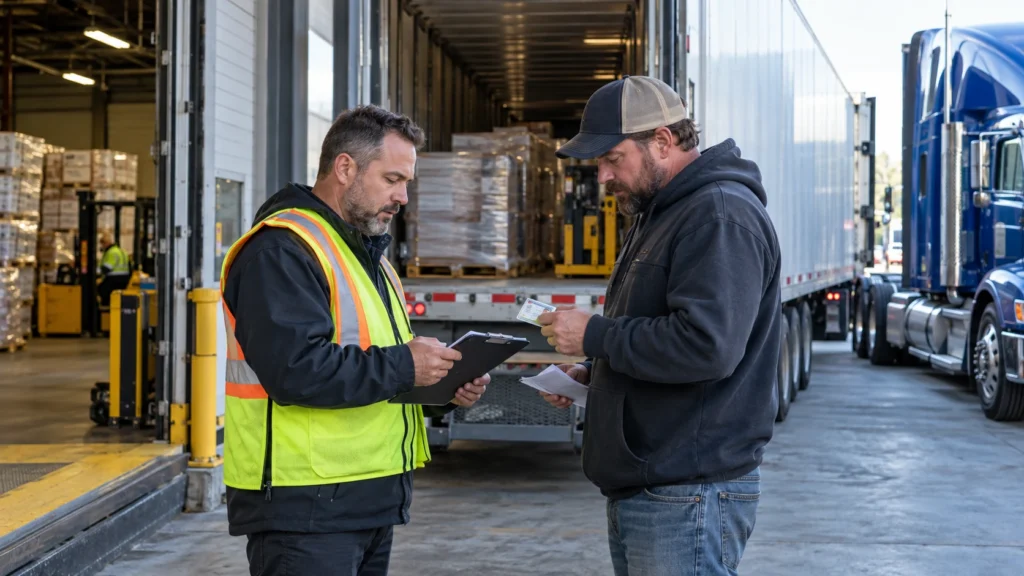
The dock is the last check. The FBI recommends keeping documentation of everyone involved, including photos of drivers, licenses, vehicles, plates, cab and truck numbers, USDOT and motor carrier numbers, and contact details. That record aids investigations and may help disrupt ongoing schemes.
Release a load only when the driver, carrier and load match the tender you issued, not just the paperwork the driver carries. Call dispatch on the number you verified earlier when anything differs. HDJ found no study of which document checks catch the most fakes, so treat this as practitioner guidance.
Check that the commercial driver's license (CDL) photo matches the person and the dates are valid, and compare truck and trailer numbers with the tender. NMFTA says to verify the identity of anyone claiming to be a shipper and to check truck and trailer identifiers thoroughly.
Be wary of changes at pickup, such as a new delivery address, a different consignee or a driver pushing for speed. Confirm any destination change with the shipper on a number from your records. HDJ's guide to cargo theft in trucking covers physical controls.
Give dock staff authority to refuse. A release delayed for a verification call costs hours. A load handed to the wrong party can cost the whole shipment.
What Technology Can and Cannot Do
Tracking can help recovery and show a load heading to an unexpected address, but the FBI alert does not evaluate any product. HDJ found no independent study showing tracking prevents fictitious pickups. The fraud usually happens at tender and release, before a truck is moving.
The vendor survey above reported that 83% of respondents used AI in cargo security, with driver identity verification among the common uses, while 26% had a formal response plan and 20% had protocols for working with law enforcement. These are self-reported findings from a vendor survey.
Carrier vetting software and monitoring services exist. HDJ names none because it found no independent comparison. Ask any provider what it checks, how often and what it cannot detect. Software cannot tell you whether the person on the phone is the carrier. HDJ's guide to GPS spoofing and cargo theft covers tracking weaknesses.
Protect your own accounts. The FBI says account compromise starts with phishing and recommends validating unexpected communications through a two-factor authentication process. HDJ's guide to freight phishing scams shows what those messages look like.
Building a Fictitious Pickup Fraud Prevention Process
A written process beats memory. A fictitious pickup fraud prevention process should fit on one page that every dispatcher, broker and dock worker follows in order. The table maps each stage to the check that matters and what that check cannot tell you.
| Stage | Check | What it cannot tell you |
|---|---|---|
| Before tender | Call the carrier on FMCSA-listed details; check when they changed | Whether an impostor changed them |
| Before tender | Verify insurance with the insurer directly | Whether the caller may move your load |
| At tender | Send the tender to one verified contact; record driver and carrier names | Whether the load is later handed to someone else |
| At pickup | Match driver, truck, trailer and paperwork to the tender; photograph them | Whether a forgery is good enough to pass |
| After pickup | Check in with the verified contact; use tracking where available | Whether a call-back reached the criminal |
Add approval thresholds. HDJ suggests that higher-value loads, new carriers and any change to destination or payment details need a second person's sign-off. HDJ found no data on the right thresholds, so set them by what a loss would cost you.
Keep verification records. The FBI says documentation aids investigations, and insurers may ask what you did. HDJ found no data tying records to claim outcomes, so the earlier claim that documented fleets get better results was removed.
Separate duties. The person who books a load should not be the only person who can change payment details. That is practitioner guidance, based on the same logic as requiring two people to approve a large payment.
Training Your Team
Staff are the control that technology cannot replace, but the evidence on training is mixed. HDJ's guide to trucking cybersecurity training covers what studies show and how to build a program that does not rely on awareness alone.
For fictitious pickup fraud, rehearse three moments: the tender call, a payment or destination change request, and the dock refusal. Short scenarios drawn from your own loads beat a generic video. HDJ found no study of what works best for dock staff.
Make the escalation path clear: who to call when something looks wrong, and a rule that a load delayed for verification is never blamed on the person who delayed it. The earlier version's quarterly schedule and bonus program had no source and were removed.
What to Do After a Fictitious Pickup
⚠️ Safety Warning
Do not send money, release more freight to the same party, or confirm load details to anyone who contacts you after a suspected theft until you have verified who they are. The FBI says actors sometimes pose as carriers and demand ransom for load details.
HDJ's practitioner sequence, built on the FBI and CargoNet guidance: stop any pending payments to the suspect carrier; try every contact channel and note each attempt; alert the shipper and receiver; preserve load confirmations, communication logs, photos and verification records; and check other open loads tendered to the same party.
Report to local police first. CargoNet asks to be contacted after law enforcement and only when there is no immediate threat to life or property. The FBI asks victims to file with IC3 and contact their local FBI field office, in addition to a police report for the stolen cargo.
Call your insurer promptly and read the policy's notice terms. HDJ found no standard deadline. Record the cargo value, replacement shipping costs and customer penalties, since insurers and customers will ask.
Reporting and the Law
Federal law reaches this conduct. 18 U.S.C. 659 covers goods in an interstate or foreign shipment taken from places such as trucks, warehouses and intermodal containers, including anyone who by fraud or deception obtains them intending to convert them. A value under $1,000 carries up to 3 years; otherwise up to 10 years. This is a summary, not legal advice.
The earlier version said the FBI investigates thefts of $50,000 or more through a Cargo Theft Program. HDJ found no such threshold in the FBI alert, which asks all victims to file with IC3 and contact a local field office, so the claim was removed.
The FMCSA fraud alerts page lists reporting channels for carrier-targeted fraud: the Federal Trade Commission, IC3, local police, your state attorney general and the FMCSA Contact Center. Use them when someone impersonates your company, not only when you lose a load.
What HDJ Removed From the Earlier Guide
A refresh should say what changed. HDJ removed the 1,600% and 1%-to-17% figures, the $50,000 to $2 million loss range, the 20-40% revenue and 15-30% operating cost figures, and the $25,000 to $500,000 legal fee range. HDJ found no primary source for any of them.
It removed the list of five top states, the claim that FMCSA data shows many fraudsters use new numbers, a quotation credited to a BSI consultant, and four unnamed anecdotes about a font, a GPS alert, three attempts in a month and an incentive program. It corrected the $75,000 coverage figure and removed the FBI threshold claim.
It also removed seven images, the trade association and safety group links, the old newsletter and tools boxes, the static date line and the 22-minute reading time.
Frequently Asked Questions
What is fictitious pickup fraud?
Fictitious pickup fraud is when a criminal poses as a real or invented carrier to collect a load that will not be delivered. Versions include impersonating an established carrier and hijacking a real load, then redirecting it. It is theft by deception, not a break-in.
How common is fictitious pickup fraud?
HDJ found no source that counts fictitious pickups alone nationwide. CargoNet estimated nearly $725 million in 2025 cargo theft losses, up 60%, and recorded 127 more fictitious pickups in one quarter of 2023 than a year earlier. The 1,600% figure is unverified.
How do I prevent fictitious pickup fraud before tendering a load?
Call the carrier on the contact details FMCSA lists, check when those details last changed, confirm the driver and carrier names match the tender, and verify insurance with the insurer directly. The FBI recommends multi-channel verification before releasing any load, so one call is never enough.
What are the red flags of fictitious pickup fraud?
The FBI lists look-alike domains, spoofed free-email domains, unauthorized shipment contacts and short-lived phone numbers. Practitioner red flags include refusing phone calls, below-market rates, payment changes and destination changes at pickup. Several together call for a stop, and none of them proves fraud alone.
What should I do right after a fictitious pickup?
Stop pending payments, contact the carrier through every channel, alert the shipper and receiver, and preserve documents and photos. Report to local police first, then to IC3 and your local FBI field office. Notify your insurer promptly, and check other open loads tendered to the same party.
Where do I report fictitious pickup fraud?
The FBI asks victims to file with the Internet Crime Complaint Center at ic3.gov and contact their local FBI field office, in addition to a police report. FMCSA's fraud alerts page also lists the Federal Trade Commission, local police and state attorneys general for carrier-targeted fraud.
The Bottom Line
Fictitious pickup fraud is stopped by a fixed sequence of independent checks: verify the carrier on details you find yourself, match the driver to the tender, and document the pickup. No single tool replaces them. HDJ could not verify the growth figures it removed.
Michael Nielsen and the HDJ editorial team publish more fleet security guidance at heavydutyjournal.com. This week, write your pre-tender and dock checks on one page, add a second-person sign-off for new carriers, and tell dock staff they can refuse a release.
Share This Fraud Prevention Guide
Know a broker, dispatcher or dock manager who handles freight releases? Share this guide with them. Michael Nielsen and Heavy Duty Journal publish it free at heavydutyjournal.com.