
By Michael Nielsen, Editor & Publisher | 15+ Years in Diesel Repair
Last Updated: December 2025
📖 Estimated reading time: 18 minutes
The freight transportation sector is undergoing a major transformation as carriers battle sustained market weakness, capacity oversupply, and escalating operational expenses. This wave of trucking industry consolidation through mergers and acquisitions reflects a calculated response to conditions that industry executives predict will persist for the next 12 to 18 months. For fleet managers and owner-operators, understanding how consolidation reshapes competitive dynamics, pricing power, and service options has become essential for strategic planning.
Transaction activity in the transport sector showed 108 closed deals in Q3 2025, down from 121 in the same quarter of 2024. Despite this measured pace reflecting macroeconomic uncertainty and valuation gaps between buyers and sellers, freight market consolidation continues as companies pursue scale advantages and expanded service capabilities. Strategic buyers account for approximately 90% of all transactions, emphasizing consolidation as a deliberate survival strategy rather than opportunistic acquisitions.
Key Takeaways
- 108 M&A transactions closed in Q3 2025, with strategic buyers dominating 90% of deals as carriers pursue scale economies.
- Mid-sized fleets face the greatest vulnerability—large enough to carry significant fixed costs but lacking mega-carrier advantages.
- Landmark deals are reshaping the landscape, including BlackRock’s $22.8 billion port acquisition and UPS’s $1.6 billion healthcare logistics purchase.
- Shippers face reduced carrier options but gain access to expanded service capabilities from consolidated providers.
- Owner-operators must adapt through specialization, technology adoption, and strategic carrier partnerships to remain competitive.
- Fleet managers should diversify carrier relationships while leveraging consolidation for better technology integration and service consistency.
The Current State of Trucking M&A Activity
Market pressures are driving fundamental transformation across the freight sector as carriers battle overcapacity and margin compression. The trucking industry faces intertwined challenges including rising operating costs alongside fragile market demand—a combination that favors only the strongest operators with sufficient scale.
Spot rates have fallen to levels that create revenue pressure for many carriers, while trucking capacity oversupply has flooded the market with available trucks even as freight demand remains stagnant. Mid-sized fleets operating several hundred trucks appear particularly vulnerable to current market conditions, occupying an uncomfortable middle ground where they carry significant fixed costs without enjoying the economies of scale that mega-carriers leverage.
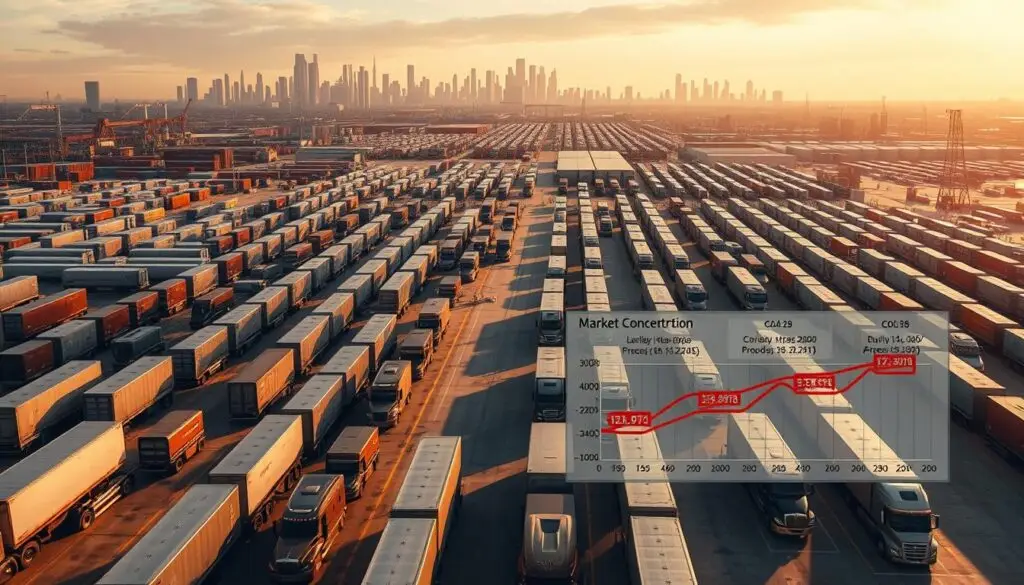
Valuation multiples in Q3 2025 showed median TEV/EBITDA at 9.96x and TEV/Revenue at 1.43x, signaling normalization after years of extreme volatility. This marks a significant recalibration from elevated levels throughout 2024, reflecting more rational pricing in the M&A market as buyers exercise greater caution.
90%
Percentage of trucking M&A transactions completed by strategic buyers pursuing consolidation for scale advantages
The concentration of freight volume among the largest carriers continues accelerating. The Top 20 carriers are systematically increasing their share of total freight volume through both organic growth and strategic acquisitions, creating a more concentrated market structure that reshapes competitive dynamics for everyone else.
Several factors drive this concentration trend. Technology investments that smaller carriers cannot afford to match, sophisticated routing algorithms that maximize asset utilization, procurement advantages that lower per-unit costs for fuel and equipment, access to capital markets for fleet expansion during downturns, and brand recognition that attracts both drivers and shipper contracts all favor larger operations.
Major Deals Transforming the Freight Landscape
A wave of high-value transactions is fundamentally altering the freight market, with institutional investors and established carriers pursuing billion-dollar consolidation strategies. These strategic buyouts represent more than opportunistic acquisitions—they signal calculated positioning for long-term competitive advantage in an industry undergoing structural transformation.
BlackRock’s proposed $22.8 billion acquisition of CK Hutchison’s global ports business represents the largest infrastructure play in the transportation sector. This deal demonstrates how institutional investors view transportation assets as long-term value stores with stable cash flows, providing strategic control over critical supply chain infrastructure spanning multiple continents.

UPS’s planned $1.6 billion acquisition of Andlauer Healthcare Group exemplifies the strategic pivot toward specialized, higher-margin service segments. Healthcare and pharmaceutical logistics offer regulatory barriers that create competitive moats, with demand remaining resilient across economic cycles. This acquisition expands UPS capabilities in temperature-controlled transportation and pharmaceutical distribution—segments commanding premium pricing due to stringent compliance requirements.
Percy Acquisition’s $1.05 billion purchase of The Wheeling Corporation demonstrates how global operators pursue scale and service diversification to become comprehensive logistics solutions providers. Menzies Aviation’s $315 million acquisition of G2 Secure Staff further illustrates the push toward integrated service offerings, with aviation ground handling and staffing representing complementary capabilities that enhance customer retention.
Legacy Mega-Mergers Setting Precedents
The Knight-Swift acquisitions and XPO Logistics mergers established templates for large-scale consolidation that subsequent acquirers study and replicate. Knight Transportation’s merger with Swift Transportation created the largest truckload carrier in North America, demonstrating that properly executed integrations could generate substantial operational synergies.
XPO Logistics pursued an aggressive acquisition strategy that transformed it from a small operator into a diversified logistics powerhouse through multiple strategic transactions across different service segments. Both companies revealed which integration approaches succeed and which create value destruction—lessons that inform current deal structures and post-merger integration planning.
Private Equity’s Selective Approach
Financial sponsors represented just over 10% of transactions in Q3 2025, maintaining a selective approach focused on niche transport and logistics service providers. This selectivity reflects disciplined capital deployment targeting companies with sustainable competitive advantages and clear paths to operational improvement.
CVC DIF’s investment in American Student Transportation Partners exemplifies private equity’s focus on specialized segments with predictable demand. School bus transportation offers contracted revenue streams and local market dominance that appeals to financial sponsors. Providence Equity Partners’ acquisition of Global Critical Logistics demonstrates interest in time-sensitive, mission-critical transportation services where healthcare, aerospace, and technology sectors command premium pricing.
| Buyer Type | Q3 2025 Activity | Primary Focus |
|---|---|---|
| Strategic Buyers | 96 deals (90%) | Network optimization, vertical integration, multimodal expansion |
| Private Equity | ~10% of transactions | Niche segments with stable cash flows and operational improvement potential |
| Institutional Investors | Major infrastructure plays | Ports, terminals, logistics real estate with long-term appreciation potential |
Stay Ahead of Industry Changes
Consolidation trends reshape fleet management strategies monthly. Get actionable insights for fleet managers and owner-operators delivered to your inbox.
Economic Drivers Behind Carrier Consolidation
Behind every major merger lies a complex web of operational challenges and financial pressures that smaller carriers can no longer navigate alone. The consolidation wave stems from fundamental economic realities rather than strategic preferences, with carriers facing mounting pressures across rising costs, technology requirements, and workforce constraints that collectively favor larger operations.
Persistent Margin Pressure
Carriers across the industry report ongoing annual cost increases of 5% or more across multiple expense categories. This persistent margin pressure creates structural profitability challenges, especially when rate growth fails to keep pace with cost inflation. Fragile market demand prevents carriers from fully passing through cost increases to customers, forcing them to absorb much of the burden internally.

Fuel costs represent a particularly volatile expense category. While diesel prices remaining under $4 per gallon since April 2024 has helped smaller operators absorb costs, year-to-date increases of 7% in 2025 demonstrate ongoing volatility that can rapidly erode thin profit margins.
The cost environment creates powerful incentives for consolidation. Larger carriers achieve purchasing economies for fuel, tires, maintenance, and insurance that smaller operators cannot match. A national carrier negotiating fuel contracts for 5,000 trucks secures significantly better terms than a regional operator with 50 trucks. Insurance costs exemplify this scale advantage, with carriers having larger fleets and professional safety programs negotiating premium rates 15 to 25% lower than smaller operators pay for equivalent coverage.
| Cost Category | Annual Increase | Large Carrier Advantage |
|---|---|---|
| Diesel Fuel | 7% (2025 YTD) | Bulk purchasing contracts, hedging options |
| Insurance Premiums | 8-12% | Fleet-wide safety ratings, negotiated rates |
| Maintenance & Repairs | 5-7% | OEM direct relationships, parts volume discounts |
| Driver Compensation | 6-9% | Comprehensive benefits, consistent miles |
| Technology Systems | 10-15% | Enterprise pricing tiers, amortization over larger fleets |
Technology Investment Requirements
Modern fleet operations require substantial capital expenditures for technology systems that have become table stakes for serving sophisticated shippers. Electronic logging devices, telematics platforms, real-time tracking systems, digital dispatch platforms, and data analytics capabilities represent mandatory investments rather than optional enhancements.
These technology investments require scale to justify their costs. The per-truck expense for comprehensive fleet management systems decreases significantly with fleet size. A carrier operating 1,000 trucks spreads software licensing, hardware costs, and IT support across a much larger base than a 50-truck operator. Advanced routing algorithms can reduce deadhead miles by 8 to 12%, while predictive maintenance systems lower breakdown rates and extend equipment life.
The technological barrier to entry disadvantages smaller carriers in customer acquisition. Major shippers increasingly require API integrations, automated shipment tracking, and data analytics capabilities that small operators struggle to provide. Without these systems, carriers lose access to freight from Fortune 500 companies and large third-party logistics providers.
Critical Driver Shortage
The U.S. trucking industry faces a driver shortage exceeding 80,000 drivers according to American Trucking Associations data. This labor constraint creates both operational challenges and cost pressures driving consolidation. An aging workforce with average driver ages exceeding 55 years compounds the problem, with insufficient recruitment of younger drivers to replace retiring veterans.
The American Transportation Research Institute’s 2025 operational cost analysis found that non-fuel operating costs rose 3.6% to $1.779 per mile—the highest ever recorded. Driver-based costs were the primary contributor to this increase, with benefits rising 4.8% even as the freight recession squeezed margins. This compensation pressure intensifies challenges for smaller operators who cannot offer competitive packages while maintaining profitability.
Larger carriers hold significant advantages in addressing recruitment challenges. Their brand recognition, recruitment budgets, and comprehensive training programs attract candidates more effectively than smaller operators can manage. National advertising campaigns and sophisticated recruiting operations require resources that regional carriers lack.
Wage inflation in the driver market accelerates as carriers compete for limited talent. Sign-on bonuses of $5,000 to $15,000 have become standard recruiting tools for larger carriers, creating expectations that smaller operators cannot meet while maintaining profitability.
The HDJ Perspective
The economic forces driving consolidation are structural, not cyclical. Fleet managers who assume the current wave of mergers will subside when freight markets recover are missing the larger picture. Technology costs, driver shortages, and insurance pressures will continue favoring scale regardless of rate environments. The question isn’t whether consolidation will continue, but how quickly the industry transforms from its historically fragmented structure into a more concentrated model dominated by national and super-regional players. Smart fleet managers are adapting their carrier strategies now rather than waiting for the dust to settle.
Consolidation Strategies and Business Models
Carriers select specific merger and acquisition approaches based on their competitive positioning, capital availability, and long-term operational objectives. Understanding these strategies helps fleet managers anticipate how their carrier partners may evolve and what that means for service relationships.
Horizontal Mergers Between Competitors
Horizontal trucking mergers involve transactions between carriers operating in identical market segments. These combinations eliminate redundant overhead by consolidating administrative functions, maintenance facilities, and back-office operations. When two carriers serving overlapping lanes combine, they optimize truck utilization by filling empty backhaul capacity while consolidating terminal networks to eliminate duplicate facilities.
Market share concentration represents another strategic benefit. Larger combined entities negotiate from stronger positions with both shippers and suppliers, though regulatory scrutiny often examines whether combinations substantially reduce competition in specific markets.
Vertical Integration Strategies
Vertical integration transforms carriers from single-service providers into comprehensive supply chain solution companies. Acquisitions target warehousing operations, freight forwarding capabilities, customs brokerage services, and distribution facilities to capture additional margin at multiple supply chain touchpoints.
Customer stickiness increases substantially when carriers provide bundled services across multiple logistics functions. Shippers prefer working with fewer vendors who can coordinate end-to-end movements rather than managing relationships with separate transportation, warehousing, and brokerage providers. The integrated service model creates switching costs that protect revenue streams from competitive pressure.

Regional Carrier Roll-Ups
Roll-up strategies involve systematically acquiring multiple regional carriers to build national networks while maintaining local market expertise. Both strategic buyers and private equity sponsors employ this approach in the highly fragmented trucking sector, where regional carriers often lack succession plans or capital for necessary technology investments.
Roll-up models create value by preserving customer relationships and operational knowledge of acquired companies. Local management teams typically remain in place, maintaining service quality and market understanding. The acquiring entity provides access to capital, enterprise technology systems, and centralized back-office functions that improve efficiency without disrupting customer service.
Technology Platform Acquisitions
Logistics technology acquisitions enable carriers to rapidly modernize operations rather than attempting slower organic development. Digital freight platforms, transportation management systems, and data analytics capabilities represent critical competitive requirements as traditional carriers increasingly compete with tech-enabled disruptors.
FedEx exemplified portfolio rationalization by announcing plans to spin off its less-than-truckload freight division, creating two independent publicly traded companies. This strategic separation reflects broader industry refocusing on higher-margin services with stronger competitive positioning, demonstrating that consolidation also involves divesting underperforming segments.
The Commercial Vehicle Safety Alliance’s inspection data provides another lens on consolidation impacts. Larger carriers typically maintain lower out-of-service rates due to more robust preventive maintenance programs and driver training infrastructure. This safety performance advantage translates to lower insurance costs and better CSA scores, creating additional competitive separation from smaller operators.
Freight Rate Dynamics and Pricing Power
Consolidation-driven changes to pricing power, negotiating leverage, and market volatility are fundamentally altering how freight rates are established. Current rate environments reflect unpredictable fluctuations creating revenue uncertainty for carriers across all segments. Understanding these shifts helps fleet managers negotiate more effectively.
Spot Market Impacts
Spot load volumes have increased nearly 20% year-over-year according to DAT Freight & Analytics data, while spot truck posts declined by 30% during the same period. This supply-demand imbalance signals potential upward rate pressure as available capacity becomes scarcer.
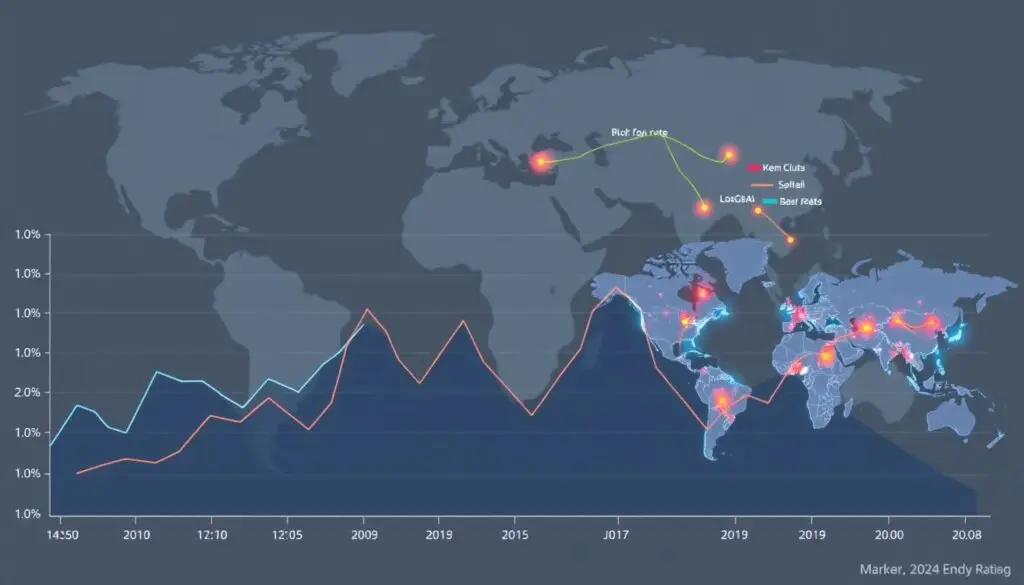
Greater market concentration among large carriers can reduce spot market capacity availability during high-demand periods, potentially increasing rate volatility. However, the relationship involves considerable nuance—larger carriers may demonstrate more pricing discipline, yet they also face pressure from sophisticated shippers leveraging volume commitments for rate concessions.
Contract Rate Negotiations
Annual or multi-year pricing agreements involve strategic negotiations where consolidation has significantly shifted bargaining power. Larger, more diversified carriers with broader service capabilities now negotiate from positions of greater strength, particularly when they control significant capacity in specific lanes or offer value-added services that differentiate them from smaller competitors.
Shippers have responded by implementing their own consolidation strategies, concentrating freight volumes with fewer providers to maintain negotiating leverage. The negotiation process increasingly focuses on service quality, technology integration, and relationship value beyond pure pricing.
Lane-Specific Variations
Consolidation’s impact differs dramatically across geographic markets and specific shipping corridors. Carriers with dominant positions in particular regions or lanes may achieve substantially greater pricing power than their overall market share would suggest. High-density lanes connecting major metropolitan areas often remain intensely competitive, while carriers dominating capacity in secondary or rural markets may exercise considerable pricing influence.
Impact on Shippers and Fleet Operations
The ripple effects of merger activity extend far beyond boardrooms, fundamentally reshaping relationships between shippers and carriers. Market concentration creates both challenges and opportunities that fleet managers must navigate strategically.
Shipper Considerations
Large shippers with substantial freight volumes often benefit from working with mega-carriers offering national coverage, advanced technology platforms, and financial stability. These consolidated carriers provide dedicated account management and comprehensive logistics solutions that smaller operators cannot match.
However, market concentration simultaneously reduces carrier options for some shippers. Smaller shippers may find their negotiating leverage diminished when fewer carriers serve their markets. Sophisticated shippers respond by concentrating freight volumes with fewer providers to maintain leverage while simultaneously qualifying backup carriers to preserve supply chain resilience.
“In a 2025 survey of nearly 100 shippers, 67% rated service level and reliability as their top carrier selection criteria—outweighing price considerations for the first time since 2019.”
— Tenney Group M&A Analysis
Small Carrier Survival Strategies
Mid-sized fleets with several hundred trucks face particularly acute challenges, experiencing significant fixed costs but insufficient scale to compete on price with mega-carriers. However, smaller operators can employ several effective defensive strategies.
Niche market specialization in cargo types or service modes where operational expertise creates competitive advantages remains the most reliable path. Geographic concentration on regions where local knowledge and customer relationships provide defensibility helps regional carriers maintain market position. Service differentiation through superior customer service, flexibility, and responsiveness that larger carriers cannot match creates sustainable value.
Technology adoption that allows efficiency competition despite scale disadvantages has become critical. Strategic partnerships with complementary carriers to expand service footprints without merger costs provide growth opportunities without surrendering independence.
Owner-Operator Implications
The approximately 350,000 independent truckers face dual pressures from market consolidation. Reduced numbers of small carrier customers limit opportunities for truly independent operators. Yet paradoxically, larger carriers increasingly rely on owner-operator capacity to provide operational flexibility without capital investment in additional trucks.
Successful owner-operators position themselves through developing specialized expertise in challenging freight types, maintaining excellent safety records that qualify them for premium freight, building strong relationships with both direct customers and carrier partners, investing in modern equipment meeting stringent requirements, and adopting technology platforms facilitating efficient dispatch and load management.

Segment-Specific Consolidation Patterns
Different trucking segments experience consolidation in fundamentally different ways, driven by varying barriers to entry, capital requirements, and competitive dynamics. Specialized subsectors including cold chain services, healthcare logistics, and hazardous materials transportation are attracting the most acquisition interest due to their high margins and barriers to entry.
Truckload Sector
The full-truckload segment faces intense price competition and relatively low barriers to entry that create powerful incentives for scale-based consolidation. Truckload consolidation focuses primarily on achieving route density, expanding geographic coverage, and gaining negotiating leverage.
Less-Than-Truckload Market
The LTL segment requires complex terminal networks and sophisticated freight handling creating both higher barriers to entry and more substantial consolidation benefits than truckload markets. Successful LTL operations require comprehensive terminal networks with sufficient freight density to enable efficient consolidation operations. Acquirers seek established networks rather than attempting to build LTL capabilities organically, recognizing the substantial capital investment required.
Specialized Freight Niches
Specialized freight carriers operate in segments where operational expertise, equipment requirements, and regulatory compliance create competitive moats supporting premium pricing. Carriers focus portfolio strategies on specialized growth areas including cold chain services, healthcare and pharmaceutical logistics, reverse logistics, white glove delivery, and spare parts logistics.
UPS’s Andlauer Healthcare Group acquisition exemplifies strategic push into healthcare logistics where temperature-controlled transportation is essential. Pharmaceutical distribution commands premium pricing due to stringent compliance requirements. Similarly, flatbed and heavy haul carriers require specialized equipment and permitting expertise creating differentiation from standard dry van transportation that attracts acquirer interest.
Share Your Consolidation Experience
Are you a fleet manager or owner-operator who has navigated carrier consolidation? Share your insights on adapting to the changing landscape with HDJ readers.
What Fleet Managers Should Do Now
The consolidation wave creates both challenges and opportunities that require proactive strategic responses. Fleet managers can position their operations for success by taking specific actions now.
Fleet Manager Action Checklist
Diversify carrier relationships — Avoid over-reliance on any single carrier partner. Qualify backup carriers before you need them, particularly in lanes where consolidation has reduced options.
Evaluate technology requirements — Understand what API integrations, tracking capabilities, and data analytics your consolidated carrier partners offer. Ensure your TMS can integrate with their systems for visibility and efficiency.
Review contract terms — As carriers merge, legacy contracts may need renegotiation. Assess whether service level agreements, pricing structures, and capacity commitments remain appropriate post-merger.
Monitor carrier financial health — Use FMCSA’s SAFER system and industry reports to track the stability of carrier partners. Consolidation often reveals which operators were already struggling.
Leverage consolidation benefits — Consolidated carriers often offer broader service portfolios. Explore whether bundled services, expanded geographic coverage, or new specialized capabilities create value for your operations.
For owner-operators and small fleets, the path forward requires even more deliberate positioning. Specialization in underserved niches, investment in technology that enables efficiency, and strategic partnerships that extend capabilities without sacrificing independence represent the most promising strategies.
Frequently Asked Questions
Why is consolidation accelerating in the trucking industry?
Multiple structural forces are driving carrier consolidation simultaneously. Rising operational costs averaging 5% or more annually, technology investment requirements exceeding what smaller carriers can afford, a driver shortage surpassing 80,000 positions, and insurance costs favoring larger fleets all make scale increasingly essential for competitiveness. The 32-month freight recession further accelerated consolidation by pressuring margins and forcing weaker operators to exit or sell. Industry analysts expect these pressures to persist, making consolidation a permanent feature of the market rather than a temporary phenomenon.
How does carrier consolidation affect shipping rates?
Consolidation’s rate impact varies by market and segment. While greater market concentration theoretically enables larger carriers to exercise more pricing power, multiple countervailing forces constrain rates in practice. Shippers counter by concentrating volumes with fewer carriers to maintain negotiating leverage. Spot market data shows 20% higher load volumes with 30% fewer available trucks, suggesting upward rate pressure. However, sophisticated pricing analytics deployed by both carriers and shippers have made negotiations more strategic. Lane-specific dynamics matter significantly—high-density corridors remain competitive while secondary markets may see more carrier pricing power.
What should small carriers do to survive consolidation?
Small and mid-sized carriers can survive through strategic positioning rather than attempting to compete on scale. The most successful approaches include specializing in niche cargo types or service modes where expertise creates competitive moats, concentrating on geographic regions where local relationships provide defensibility, differentiating through superior customer service and flexibility that larger carriers cannot match, adopting technology that enables efficiency competition despite scale disadvantages, and forming strategic partnerships with complementary carriers to expand service footprints. Carriers in the middle—large enough to have significant fixed costs but too small for mega-carrier advantages—face the greatest vulnerability and should evaluate their options proactively.
Will trucking industry consolidation continue in 2026?
Industry analysts predict continued consolidation activity through 2026 and beyond based on persistent structural drivers. Private equity sponsors face exit pressure from aging portfolio companies, substantial uninvested capital seeks deployment opportunities, and portfolio realignment toward specialized higher-margin services creates ongoing acquisition targets. Recovery in trucking rates and volumes may help bridge valuation gaps between buyers and sellers, potentially accelerating deal volume. The fundamental economic forces favoring scale—technology costs, driver shortages, and insurance pressures—show no signs of abating regardless of freight market conditions.
How can fleet managers prepare for their carrier partners being acquired?
Fleet managers should proactively diversify carrier relationships, qualifying backup providers before consolidation creates urgency. Review existing contracts to understand change-of-control provisions and renegotiation rights. Build relationships with multiple contacts at each carrier partner, as post-merger reorganizations often change personnel. Monitor carrier financial health through FMCSA’s SAFER system and industry publications for early warning signals. When acquisitions occur, engage early in the integration process to understand how service, pricing, and technology will evolve. Successful acquisitions often improve service capabilities—the key is maintaining communication throughout transitions.
Trucking Consolidation Outlook
The freight market future will be shaped by powerful structural forces extending beyond current cyclical challenges. Rising operational costs, technology requirements, and driver shortages continue pushing carriers toward scale-driven business models regardless of rate environments. The industry’s historically fragmented structure is giving way to a more concentrated model dominated by fewer but larger national and super-regional players.
For fleet managers, the strategic imperative is clear: adapt carrier relationship strategies now rather than waiting for consolidation to reshape available options. Diversify partnerships while leveraging the expanded capabilities that consolidated carriers offer. For owner-operators and small fleets, survival requires deliberate specialization, technology adoption, and strategic positioning that creates sustainable competitive advantages.
The trucking industry consolidation wave represents fundamental restructuring rather than a temporary trend. Successful participants will understand segment-specific dynamics across truckload, LTL, and specialized freight, positioning their operations to capitalize on the opportunities consolidation creates while managing the challenges of reduced carrier options and shifting market power.
Share This Analysis
Know a fleet manager or owner-operator navigating consolidation challenges? Share this guide to help them understand market dynamics and position for success.