
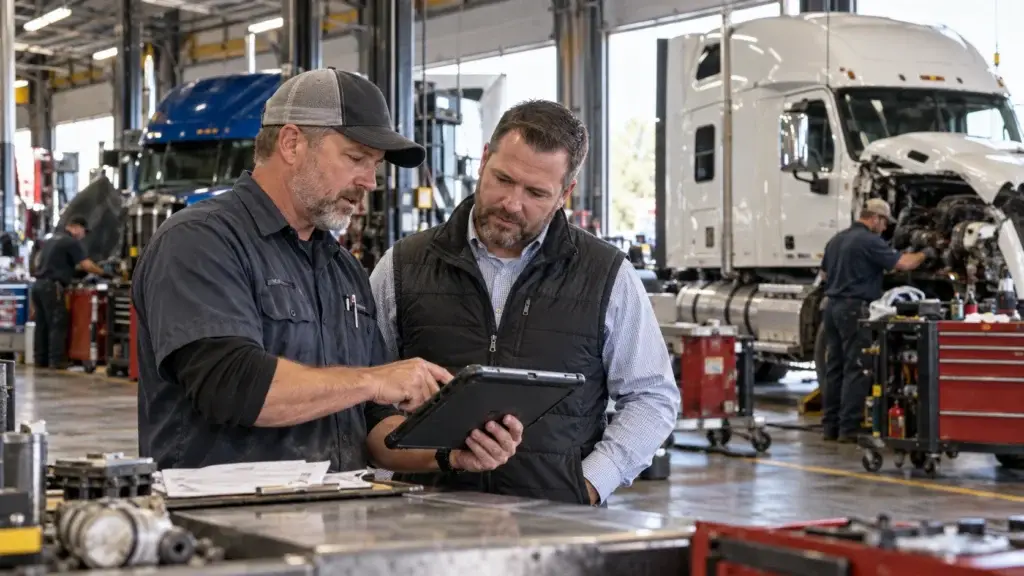
truck repair shop customer retention

Fleet Customer Retention: Complete Guide for Truck Repair Shops

Table of Contents
    Add a header to begin generating the table of contents

    By Michael Nielsen, Editor & Publisher | 15+ Years in Diesel Repair

    Last Updated: January 2026

    📖 Estimated reading time: 28 minutes

    Keeping existing fleet accounts delivers higher profitability than constantly chasing new business. Independent service providers charging $90-$120 per hour create a significant competitive advantage against dealerships that demand $180-$200 or more. This pricing difference drives fleet customer loyalty and positions independent facilities as the smart choice for cost-conscious operations.

    Commercial vehicle downtime carries a heavy price tag. Every day a vehicle sits idle costs between $450 and $760 in lost productivity. Fleet managers calculate these numbers carefully when selecting maintenance partners. They need fast, reliable service that minimizes downtime without sacrificing quality.

    Over 80% of drivers choose independent facilities because of cost advantages. Another 33% value fair pricing and trustworthiness above all else, according to AAA research on vehicle service preferences. These numbers reveal a clear opportunity for service providers who focus on commercial truck service retention through systematic approaches. Success requires combining operational excellence with relationship building and smart technology use to create experiences that make fleet managers choose your facility repeatedly.

    Key Takeaways

    • Retention beats acquisition: Existing fleet accounts generate more profit than new customer acquisition, making retention strategies essential for sustainable growth.
    • Pricing advantage: Independent facilities charge $90-$120 per hour versus dealership rates of $180-$200+, creating powerful competitive positioning.
    • Downtime drives decisions: Fleet downtime costs $450-$760 per vehicle daily, making speed and reliability critical factors in maintaining long-term partnerships.
    • Trust earns loyalty: Fair pricing and trustworthiness drive 33% of vehicle owners to prefer independent facilities over dealership alternatives.
    • Systematic approach wins: Successful retention combines service excellence, transparent communication, and technology integration to build lasting relationships.

    Why Customer Retention Drives Greater Profitability Than New Fleet Acquisition

    The economics of fleet service business reveal a fundamental truth: retaining existing customers costs significantly less than acquiring new ones. Truck repair shops that prioritize customer loyalty consistently outperform competitors focused primarily on new business development. The financial advantages become clear when examining the complete picture of acquisition costs versus retention benefits.

    Research across the commercial vehicle service industry demonstrates that shops using management software report 20% or greater revenue growth year over year. One successful operation documented a remarkable 4,300% return on investment in the first year after implementing retention-focused technology. These numbers underscore the financial power of keeping existing customers satisfied and engaged.

    Chart comparing profitability of fleet maintenance contracts showing higher margins on retained customers versus new acquisitions

    Understanding Acquisition Expenses for New Fleet Accounts

    Bringing new fleet customers through your service bay doors requires substantial investment across multiple channels. Marketing expenditures, sales staff compensation, competitive bidding processes, and extended sales cycles all contribute to acquisition costs. The commercial vehicle sector presents unique challenges that amplify these expenses considerably.

    Fleet account management demands patience and persistence throughout lengthy decision-making processes. Initial contact with commercial buyers yields only a 1% success rate on average. This conversion rate climbs dramatically to over 81% by the fifth consecutive touchpoint, illustrating the resource intensity required for new customer acquisition.

    The typical expenses involved in securing commercial fleet partnerships include marketing campaigns targeting fleet managers through trade publications, digital advertising, and industry events. Sales team time invested in relationship building, facility tours, and capability presentations adds up quickly. Competitive bid preparation requiring detailed pricing analysis and service proposal development consumes significant staff hours. Extended follow-up sequences spanning weeks or months before purchase decisions occur tie up resources. Promotional discounting offered to overcome incumbent vendor relationships reduces initial margins.

    These cumulative costs create a significant financial barrier before generating the first dollar of revenue. Smart shop owners calculate these expenses carefully when evaluating customer acquisition strategies against retention investments.

    Determining Long-Term Account Value for Repeat Customers

    Customer lifetime value calculations provide essential insights into the true worth of retained fleet relationships. A single major fleet account generates $50,000 or more in consistent annual service income when properly managed. Over a five-year relationship, this translates to substantial revenue with progressively lower service costs.

    Calculating customer lifetime value involves multiple revenue components that extend beyond basic repair work. Scheduled preventive maintenance performed at regular intervals throughout the year provides predictable income. Emergency repair services when breakdowns occur requiring immediate attention command premium rates. Fleet expansion opportunities as customers grow their operations and add vehicles increase account value. Referral business generated through recommendations to other fleet managers compounds your customer base. Parts sales for customer-performed maintenance and minor repairs add margin.

    Consider a concrete example: A regional delivery company with 15 trucks maintains fleet maintenance contracts worth $52,000 annually. Over five years, this relationship generates $260,000 in revenue. The shop’s investment in maintaining this relationship—primarily communication, consistent quality, and occasional goodwill gestures—costs a fraction of acquiring five separate $52,000 accounts.

    Revenue FactorNew Customer (Year 1)Retained Customer (Year 5)Growth Impact
    Annual Service Revenue$38,000$58,000+53%
    Marketing Cost Per Customer$6,200$800-87%
    Net Profit Margin18%32%+78%
    Referral Value Generated$0$12,400New Revenue

    Retained customers typically consolidate more services with trusted providers as relationships mature. This service concentration increases transaction sizes and visit frequency, compounding the financial benefits over time.

    Creating Predictable Income Through Customer Commitment

    Building sustainable revenue through customer loyalty transforms unpredictable repair business into stable, forecastable income streams. Fleet maintenance contracts create recurring revenue that smooths seasonal fluctuations and economic uncertainty. This predictability enables better staffing decisions, inventory management, and business planning.

    Loyal customers provide several competitive advantages beyond direct revenue generation. They require minimal marketing investment, as the relationship already exists and trust has been established. Their consistent business creates operational efficiency, with technicians familiar with specific fleet vehicles and common issues.

    The referral multiplier effect amplifies retention value substantially. Satisfied fleet managers recommend trusted service providers to industry colleagues facing similar maintenance challenges. These warm referrals convert at significantly higher rates than cold marketing efforts, further reducing effective acquisition costs.

    Commercial fleet partnerships also create protective barriers against competition. Fleet managers face substantial switching costs when changing service providers, including relationship rebuilding, quality uncertainty, and operational disruption risks. This natural friction helps retain satisfied customers even when competitors offer aggressive pricing.

    Cash flow predictability represents another crucial benefit of retention-focused strategies. Knowing that major fleet accounts will generate consistent monthly revenue allows shop owners to invest confidently in facility improvements, equipment upgrades, and staff development. This reinvestment capability strengthens competitive positioning and supports continued growth.

    $50,000+

    Annual service revenue generated by a single well-managed major fleet account

    The compounding effect of retention becomes increasingly powerful over time. Each year of successful service delivery strengthens relationships, increases share of wallet, and generates referral opportunities. This creates an upward spiral of profitability that acquisition-focused strategies cannot match.

    Establishing Trust Through Consistent Service Excellence

    The foundation of truck repair shop customer retention isn’t clever marketing or aggressive pricing—it’s the unwavering consistency of quality work performed every single time. Fleet managers facing downtime costs between $450 and $760 per truck daily cannot afford to work with shops that deliver unpredictable results. They need partners who execute repairs correctly the first time, eliminating the costly cycle of return visits for the same problem.

    Building these diesel shop customer relationships requires more than technical skill. It demands systematic approaches that guarantee every vehicle receives the same level of attention and expertise. Independent shops that implement rigorous quality standards consistently outperform competitors in trustworthiness ratings, directly addressing fleet operators’ primary concern: will this shop do what they promise?

    Service excellence transforms one-time customers into long-term accounts. When fleet decision-makers know they can depend on your work, price becomes secondary to reliability. This trust doesn’t develop through promises—it emerges from documented proof of consistent performance across hundreds of repair transactions.

    Creating Standardized Repair Procedures Across All Jobs

    Variability represents the enemy of quality. When different technicians approach identical repairs using different methods, outcomes become unpredictable. Establishing commercial vehicle service standards through documented procedures ensures every team member follows proven protocols that deliver consistent results.

    Job-specific checklists eliminate the guesswork from complex repairs. These detailed guides walk technicians through each critical step, from initial diagnostics to final testing. A comprehensive checklist for diesel engine overhauls might include over fifty verification points, ensuring nothing gets overlooked regardless of experience level.

    Detailed quality control checklist for commercial truck repairs showing verification steps and sign-off procedures

    Parts verification protocols prevent costly mistakes before they occur. Before installation, technicians confirm part numbers against service manuals, verify compatibility with specific vehicle configurations, and inspect components for shipping damage. This simple step eliminates the callbacks that damage customer confidence.

    Torque specification compliance deserves particular attention in commercial vehicle repair. Under-torqued fasteners lead to catastrophic failures, while over-torquing causes stripped threads and broken studs. Standardized procedures require calibrated torque wrenches for all critical fasteners, with documentation confirming proper values were applied.

    Post-repair testing standards complete the standardization process. Vehicles don’t leave your facility until they pass predetermined performance criteria. For brake system work, this includes pedal feel assessment, parking brake holding capacity tests, and road evaluation under various conditions.

    Implementing Multi-Point Quality Control Systems

    Single-point inspections catch some errors, but layered verification systems catch nearly all of them. Implementing truck repair quality control through multiple checkpoints prevents service failures from reaching customers, protecting both vehicle uptime and your shop’s reputation.

    Initial diagnostic verification by lead technicians ensures repairs address actual problems rather than symptoms. Before authorizing work, senior staff review diagnostic findings, confirm root cause analysis, and approve repair strategies. This prevents the expensive misdiagnoses that destroy customer trust.

    Mid-repair progress checks catch errors while they’re still correctable. Shop foremen conduct walk-through inspections during complex jobs, verifying proper procedures are being followed and identifying potential issues before assembly continues. Finding a problem at the halfway point costs far less than discovering it after customer delivery.

    Final quality inspections occur before customer notification. A designated quality control technician—someone who didn’t perform the original work—conducts comprehensive verification using detailed checklists. This fresh perspective identifies oversights the original technician might miss.

    Quality Control CheckpointTimingResponsible PartyKey Verification Elements
    Diagnostic VerificationBefore work authorizationLead TechnicianRoot cause confirmation, repair strategy validation, parts requirement accuracy
    Progress Inspection50% job completionShop ForemanProcedure compliance, proper tool usage, torque specification adherence
    Final Quality ReviewBefore customer contactQC TechnicianComplete checklist verification, fluid level confirmation, no diagnostic codes present
    Road Test EvaluationAfter final inspectionSenior TechnicianPerformance under load, proper operation of repaired systems, no unusual noises

    Road testing protocols for critical repairs provide final confirmation. Transmission rebuilds, steering system work, and brake overhauls all require test drives that replicate real-world operating conditions. Technicians evaluate performance under acceleration, braking, turning, and highway speeds, ensuring repairs meet commercial vehicle service standards before release.

    Investing in ASE-Certified Technician Development

    Credentials matter in commercial vehicle repair because fleet managers need confidence they’re not gambling with expensive assets. ASE-certified technicians demonstrate proven competence through rigorous testing, providing the third-party validation that builds diesel shop customer relationships even before the first repair. The ASE certification program establishes industry-recognized standards for technician expertise.

    The business case for certification investment extends beyond marketing benefits. Certified technicians diagnose problems more accurately, complete repairs more efficiently, and generate fewer comebacks. These operational improvements directly impact profitability while simultaneously strengthening customer retention.

    Training programs develop both technical skills and customer service capabilities. The best technician in the world damages retention if they can’t explain repairs in terms fleet managers understand. Comprehensive development includes communication training alongside mechanical instruction, creating team members who build trust through both competence and clarity.

    Certification status should be visible throughout customer interactions. Display credentials in service areas, include technician qualifications on repair orders, and highlight certifications in customer communications. Fleet operators making decisions about shop relationships actively seek these competence indicators.

    Ongoing education maintains technical relevance as vehicle technology evolves. Diesel emissions systems, electronic controls, and hybrid powertrains require current knowledge that yesterday’s training doesn’t provide. Shops investing in continuous technician development signal commitment to excellence that resonates with quality-focused fleet managers.

    Independent shops competing against dealer networks gain particular advantage through certification emphasis. While dealers promote factory training, ASE credentials demonstrate broader competence across multiple manufacturers. This versatility appeals to mixed-fleet operators who need one reliable repair partner rather than multiple brand-specific relationships.

    The cumulative effect of standardized procedures, multi-layered quality control, and certified technicians creates predictable excellence—the exact characteristic fleet managers value most. When your shop eliminates surprises and delivers consistent results, you transform from a vendor into an essential operational partner that customers won’t risk replacing.

    Implementing Transparent Communication That Builds Confidence

    Communication breakdowns destroy customer trust faster than any other service failure in the truck repair industry. Fleet managers juggling tight delivery schedules cannot afford uncertainty about when their vehicles will return to service. Effective fleet communication strategies transform anxious customers into confident partners who trust your shop to keep their operations running smoothly.

    Independent truck repair shops possess a distinct competitive advantage over dealerships. Customers speak directly with technicians rather than navigating through service intermediaries. This direct access creates opportunities for building relationships that larger competitors cannot easily replicate.

    Modern fleet operators expect the same real-time visibility they receive from package tracking systems. Shops that provide this transparency gain significant competitive advantages. Your communication approach directly impacts whether customers return or search for alternatives after their first visit.

    Providing Real-Time Repair Status Updates

    Fleet managers operating multiple vehicles need constant information about repair progress. Text message updates with photos eliminate the frustration of calling repeatedly for status checks. These proactive communications demonstrate respect for your customer’s time and operational pressures.

    Implementing systematic update protocols keeps customers informed throughout every repair phase. Initial diagnostic findings should include timeline estimates based on parts availability and technician schedules. Fleet managers can then adjust their logistics plans accordingly.

    Parts ordering status represents a critical communication milestone. Customers appreciate knowing whether components are in stock, en route, or backordered. This truck repair transparency prevents the anger that erupts when customers discover unexpected delays at pickup time.

    Digital dashboard showing real-time fleet repair status updates with text notification examples

    Extended repair jobs require progress milestones to maintain customer confidence. A text notification confirming that engine disassembly is complete reassures fleet managers that work is progressing. Completion notifications with pickup instructions close the communication loop professionally.

    Stay Ahead in Fleet Service Management

    Get proven retention strategies, technical insights, and industry updates delivered to your inbox. Join thousands of fleet managers and shop owners building stronger customer relationships.

    Consider these essential touchpoints for comprehensive status communication: Diagnostic completion should share findings with repair recommendations and time estimates within 2 hours of assessment. Approval confirmation sends written acknowledgment of authorized repairs with final cost projections. Parts status updates customers within 4 hours if any components require special ordering. Milestone updates notify customers when major repair phases complete on multi-day jobs. Quality check confirms successful test drive results before notifying customer of completion. Ready for pickup provides specific availability windows and payment options.

    Delivering Detailed Estimates With Photo Documentation

    Written estimates with photographic evidence eliminate skepticism about repair necessity. Fleet managers who cannot personally inspect vehicles rely on visual documentation to justify expenses. Digital estimates with embedded photos show rather than simply tell customers what their trucks need.

    A photograph of worn brake pads with measurement indicators provides undeniable evidence. Images of leaking seals, cracked hoses, or damaged suspension components justify recommendations immediately. This visual approach builds the trust that independent shops score highest for in customer satisfaction research.

    Comprehensive digital estimates should include specific details that demonstrate thoroughness. Problem identification provides clear description of the issue in non-technical language. Visual evidence offers multiple photo angles showing the problem severity. Parts specifications list exact component numbers with OEM or aftermarket options. Labor breakdown details time estimates for each repair procedure. Safety implications explain risks if repairs are delayed. Alternative options present different repair approaches with cost comparisons when applicable.

    Modern estimate software integrates photos directly into proposals. Technicians capture images during inspection and attach them to line items. Fleet managers receive comprehensive documentation via email or text message within minutes of diagnostic completion.

    This level of truck repair transparency directly addresses customer concerns about pricing. Research shows that while independent shops rank highest in trustworthiness, transparency in pricing builds confidence that translates to customer loyalty. Detailed estimates prevent the disputes that drive customers to competitors.

    Following Up After Service Completion

    Systematic customer follow-up protocols demonstrate that your shop values relationships beyond individual transactions. These touchpoints create opportunities to address concerns before they escalate into negative reviews. Strategic follow-up also positions your shop for future maintenance scheduling.

    Most repair shops fail to implement consistent follow-up systems. This oversight represents a significant missed opportunity for strengthening customer relationships. Fleet managers remember shops that check on vehicle performance after repairs.

    24-Hour Post-Service Check-Ins

    A phone call or text message within 24 hours of pickup confirms the vehicle is performing properly. This quick touchpoint catches any immediate issues while the repair is fresh in everyone’s mind. Early problem detection prevents small concerns from becoming major complaints.

    The 24-hour check-in should include specific questions about the repair: Is the vehicle operating as expected without unusual noises or performance issues? Were pickup procedures and invoice explanations clear and satisfactory? Do you have any questions about the work performed or maintenance recommendations?

    This brief conversation shows customers they matter. It also provides immediate feedback about technician performance and service quality. Issues discovered during this check-in can be resolved quickly, often preventing negative word-of-mouth.

    30-Day Performance Verification Calls

    A follow-up call 30 days after major repairs demonstrates ongoing commitment to customer satisfaction. This touchpoint verifies that repairs are holding up under normal operating conditions. It also creates natural opportunities to schedule upcoming preventive maintenance.

    The 30-day verification serves multiple strategic purposes beyond customer service. It generates valuable feedback about parts quality and repair durability. Fleet managers appreciate this proactive approach, which sets your shop apart from competitors who disappear after collecting payment.

    Call ComponentPrimary PurposeSecondary Benefit
    Performance verificationConfirm repair quality and durabilityDemonstrate commitment to satisfaction
    Maintenance reminderSchedule upcoming service needsSecure future revenue stream
    Feedback requestGather testimonial materialIdentify process improvements
    Relationship buildingStrengthen personal connectionIncrease referral likelihood

    Automated systems ensure consistency in customer follow-up protocols without requiring manual tracking. CRM software can trigger reminder notifications for service advisors. However, personal phone calls create stronger emotional connections than automated emails.

    These systematic touchpoints transform transactional relationships into partnerships. Fleet managers dealing with operational pressures value shops that proactively communicate. When competitors offer similar pricing, your superior communication approach becomes the deciding retention factor.

    Leveraging Technology to Streamline the Customer Experience

    Fleet managers increasingly expect digital tools and automated systems that simplify their administrative burden while providing real-time visibility. These expectations aren’t luxuries anymore—they’re baseline requirements for shops competing in the modern commercial vehicle service market. Implementing the right truck service technology creates seamless experiences that differentiate your operation from competitors still relying on paper-based processes and phone tag communication.

    Shops that invest in integrated digital systems report recovering 50+ administrative hours monthly, translating to more than $24,000 annually in recovered billable time. This efficiency gain happens because technology eliminates redundant data entry, reduces communication delays, and automates routine tasks that previously consumed staff hours. The result is a faster, more responsive service experience that busy fleet managers value highly.

    The competitive advantage extends beyond internal efficiency. Modern shop management platforms enable capabilities like text message approvals, visual job boards, mobile app access for field technicians, and streamlined quote-to-invoice workflows. These features create convenience that builds customer loyalty while simultaneously improving your shop’s operational performance.

    Integrating With Fleet Management Platforms

    Direct integration with the fleet management software your customers already use eliminates frustrating data silos and communication gaps. Platforms like Geotab, Samsara, and similar telematics systems generate fault codes and maintenance alerts that can flow directly into your shop’s work order system. This connection creates data continuity that saves time for both parties.

    Shop management software dashboard showing telematics integration with fleet customer vehicles and automated work order creation

    When telematics systems communicate with your shop automatically, fault codes convert directly into repair orders without manual transcription. One heavy-duty repair facility reduced paperwork time from 15 minutes per job to just 5 minutes through this integration. That time savings added up to 50+ technician hours recovered monthly—hours that could be redirected to billable repair work.

    Integration also demonstrates technical sophistication that impresses fleet decision-makers. When your shop can seamlessly connect with their existing systems, you position yourself as a forward-thinking partner rather than just another vendor. This perception strengthens relationships and increases customer retention over time.

    Maintaining Comprehensive Digital Service Records

    Complete digital service records eliminate the frustration customers experience when explaining previous repairs to unfamiliar service writers. A comprehensive system stores every detail: parts replaced, labor performed, technician notes, and warranty information. This documentation becomes instantly accessible whenever a vehicle returns for service.

    Historical visibility enables proactive maintenance recommendations based on actual service patterns rather than generic mileage intervals. When you can reference exactly what work was completed six months ago, you provide more accurate guidance for upcoming maintenance needs. Fleet managers appreciate this personalized approach because it helps them prevent expensive failures through better planning.

    Cloud-based digital service records also eliminate the risk of lost paperwork and provide disaster recovery protection. Unlike file cabinets that can be destroyed or on-site servers that require expensive IT support, cloud systems scale across multiple locations while remaining accessible from anywhere. This reliability builds confidence that service history will always be available when needed.

    Offering Customer Portal Access for 24/7 Information

    Customer portal systems empower fleet managers to access critical information outside standard business hours—essential for operations spanning multiple time zones or running second and third shifts. Self-service capabilities reduce phone calls while providing faster answers to common questions about repair status, estimate details, and invoice history.

    Modern portals allow customers to review and approve estimates digitally, often with photo documentation showing exactly what repairs their vehicles need. This visual evidence helps fleet managers make informed decisions quickly without scheduling in-person vehicle inspections. The convenience factor significantly improves the customer experience, especially for managers overseeing large fleets with limited time.

    Portal access also creates transparency that builds trust. When customers can log in anytime to check repair progress or review past service records, they feel more in control of their fleet maintenance. This sense of partnership strengthens relationships and increases the likelihood they’ll return for future service needs.

    Automating Appointment Scheduling and Maintenance Reminders

    Automated scheduling systems eliminate the back-and-forth communication typically required to book service appointments. Customers can view available time slots, select what works for their operations, and receive instant confirmation—all without playing phone tag during busy work hours. This convenience particularly appeals to fleet managers juggling multiple priorities throughout their day.

    Maintenance reminder automation ensures vehicles receive timely service based on actual mileage or time intervals tracked in your system. These proactive notifications help customers avoid expensive breakdowns by staying current with preventive maintenance. The reminders also keep your shop top-of-mind, reducing the likelihood customers will drift toward competitors.

    The administrative burden reduction benefits both parties. Shops using workflow automation report significant time savings on scheduling coordination and follow-up communications. Customers appreciate not having to track service due dates manually or remember to call for appointments. This mutual convenience creates positive experiences that reinforce loyalty and drive repeat business.

    Technology investments pay for themselves through recovered efficiency while simultaneously enhancing customer experiences in measurable ways. Shops that embrace these digital capabilities position themselves as preferred partners for fleet customers who value responsiveness, transparency, and operational excellence.

    Designing Value-Based Pricing Structures and Loyalty Incentives

    Value-based pricing combined with strategic loyalty incentives creates powerful financial reasons for fleets to consolidate all maintenance work at your facility. Commercial customers demonstrate significantly greater loyalty than retail buyers when shops deliver consistent results and quick turnarounds. Fleet managers prioritize reliability and speed over lowest price since vehicle downtime directly impacts revenue generation.

    Effective truck repair pricing strategies recognize that different customer segments have different needs and value perceptions. A well-designed pricing structure rewards customers who generate the most revenue while maintaining healthy profit margins across all service categories.

    The key is creating transparent systems that customers can easily understand and calculate. When fleet managers can predict their maintenance costs and see clear benefits from continued partnership, they become less likely to shop around for marginal savings.

    Tiered fleet discount program showing Bronze Silver Gold Platinum levels with corresponding benefits and qualification thresholds

    Creating Tiered Fleet Discount Programs

    Volume pricing structures reward larger fleets with progressively better rates as their business grows. These fleet discount programs create financial incentives to consolidate all fleet maintenance with your shop rather than splitting work among multiple providers.

    Successful tiered programs establish clear qualification thresholds that customers can easily track. Common qualification criteria include number of vehicles serviced monthly, annual service spend totals, or contracted maintenance agreements.

    Consider structuring your tiers like this: Bronze Tier for 5-10 vehicles or $5,000 monthly spend receives 5% discount on labor rates. Silver Tier for 11-25 vehicles or $12,000 monthly spend receives 10% discount on labor rates. Gold Tier for 26+ vehicles or $25,000 monthly spend receives 15% discount plus priority service. Platinum Tier for 50+ vehicles or contracted annual agreements receives 20% discount plus dedicated account management.

    Transparent discount percentages allow customers to calculate their savings and understand exactly what additional business volume would move them to the next tier. This visibility motivates fleet managers to increase their commitment to your shop.

    “Price is what you pay. Value is what you get.”

    — Warren Buffett

    Bundling Preventive Maintenance Services at Competitive Rates

    Packaging preventive maintenance programs at competitive rates creates predictable revenue for shops while delivering value and convenience to fleet customers. These bundles simplify billing and provide comprehensive service that fleet managers appreciate.

    Flat-rate preventive maintenance packages plus DOT inspections plus wear-item replacement create attractive, transparent offerings. Bundled services simplify decisions for customers and enable upselling with integrity.

    Effective maintenance bundles include an Oil Change Plus Package with oil and filter change, multi-point inspection, fluid top-offs, tire pressure check, and brake inspection at one fixed price. A Seasonal Preparation Bundle covers cooling system service, air conditioning check, belt and hose inspection, battery test, and wiper replacement. The DOT Inspection Package provides complete inspection with common adjustment items included such as brake adjustments, light replacements, and minor repairs under $50. An Annual PM Contract offers scheduled preventive maintenance at predetermined intervals with discounted rates and priority scheduling.

    These packages create value by removing uncertainty about final costs. Fleet managers can budget accurately and avoid the frustration of unexpected charges for services that should have been included.

    The goal is building trust through relevant recommendations rather than aggressive sales tactics. When customers see that your bundles genuinely meet their needs without padding, they develop confidence in your business integrity.

    The HDJ Perspective

    The fleet service industry is witnessing a fundamental shift from transaction-based relationships to partnership-driven retention. Shops that continue viewing each repair as an isolated event rather than a touchpoint in an ongoing relationship will struggle to compete. The data is clear: customer lifetime value from retained accounts dwarfs any short-term gains from aggressive new customer acquisition. Smart operators are investing in the systems, training, and technology that turn satisfied customers into advocates. The competitive moat isn’t built from the lowest price—it’s built from predictable excellence that fleet managers can depend on when their revenue is on the line.

    Rewarding Consistent Business With Points and Perks

    Points-based systems and direct incentives acknowledge customer loyalty while creating tangible benefits that increase customer switching costs. Fleet loyalty rewards programs transform transactional relationships into partnerships where both parties benefit from continued collaboration.

    The most effective reward systems offer both immediate benefits and accumulated value that grows over time. This dual approach provides short-term satisfaction while building long-term switching barriers.

    Service Spend LevelPoints EarnedImmediate BenefitsAccumulated Rewards
    $1,000 – $4,9991 point per dollarStandard service100 points = $10 credit
    $5,000 – $14,9991.5 points per dollarPriority phone support100 points = $15 credit
    $15,000 – $29,9992 points per dollarNext-day scheduling guarantee100 points = $20 credit
    $30,000+2.5 points per dollarDedicated account rep100 points = $25 credit

    Annual Service Credits

    Accumulated service credits provide financial benefits that increase customer switching costs by creating sunk value that would be lost by moving to competitors. When a fleet manager has $2,000 in service credits built up at your shop, choosing a competitor means forfeiting that value.

    Service credit programs work best when they’re simple to track and easy to redeem. Provide customers with monthly statements showing their accumulated credits and upcoming expiration dates if applicable.

    Consider offering bonus credit promotions during slower periods to encourage business when you have capacity. A 25% bonus credit offer during typically slow months fills your bays while rewarding loyal customers with enhanced value.

    Priority Scheduling Benefits

    Loyal customers should receive preferential treatment during busy periods and guaranteed next-day service for emergency repairs. These priority scheduling benefits deliver value that fleet managers understand is worth more than saving a few dollars on labor rates.

    Minimizing downtime is the ultimate value proposition for commercial fleets. When a truck sits idle, it generates zero revenue while still incurring fixed costs. Fleet managers will pay premium rates to shops that consistently get their vehicles back on the road quickly.

    Structure your priority scheduling with clear tiers: Standard customers are scheduled within 3-5 business days for non-emergency service. Silver tier customers are scheduled within 2-3 business days with emergency same-day service when capacity allows. Gold tier customers are scheduled within 1-2 business days with guaranteed next-day emergency service. Platinum tier customers are scheduled next available slot with guaranteed same-day emergency service and after-hours support.

    These scheduling commitments require careful capacity planning, but they create powerful differentiation in a competitive market. When fleet managers know they can count on your shop during emergencies, price becomes a secondary consideration.

    The combination of volume pricing, bundled services, and loyalty rewards creates a comprehensive retention strategy that addresses both rational and emotional factors in customer decision-making. Fleet managers respond to the financial logic of tiered discounts while appreciating the recognition and special treatment that rewards programs provide.

    Building Strategic Partnerships With Fleet Decision-Makers

    Commercial fleet partnerships require systematic relationship development that goes far beyond completing individual repairs. The difference between shops that retain fleet customers and those that lose them comes down to how well they understand and support long-term business goals. Research shows that relationship success rates increase dramatically with consistent contact, jumping from just 1% at first interaction to 81% by the fifth consecutive touchpoint.

    This data reveals an important truth about fleet account management. Building trusted partnerships takes time, multiple interactions, and a strategic approach that prioritizes relationships over aggressive sales tactics. Fleet managers receive countless pitches from repair shops competing for their business.

    The shops that win lasting contracts focus on establishing credibility first, demonstrating measurable value second, and discussing services third. This sequence creates the foundation for partnerships that withstand competitive pressure and pricing challenges. Fleet relationship building extends beyond your service bays into industry associations, chambers of commerce, and trucking groups where decision-makers gather and business relationships deepen through repeated interactions.

    Fleet manager and shop owner reviewing performance metrics during quarterly business review meeting

    Understanding Unique Fleet Operational Requirements

    Successful truck repair shops invest significant time learning each fleet customer’s specific business model and operational constraints. This knowledge separates strategic partners from transactional vendors. Fleet operations vary dramatically based on industry, seasonal demands, and vehicle applications.

    A landscaping fleet needs equipment prepared before spring season begins. A delivery fleet requires overnight repairs to minimize operational disruption. A construction fleet faces different maintenance challenges than a refrigerated transport operation.

    Understanding these unique operational requirements enables your shop to anticipate needs before customers voice them. You can propose proactive solutions based on upcoming seasonal demands. This level of insight demonstrates that you view fleet success as your success, not just another revenue opportunity.

    Document each fleet customer’s specific requirements in your service management system: peak operational seasons and preparation timelines, preferred service windows and scheduling constraints, critical vehicles that require priority attention, budget cycles and approval processes, specific compliance requirements or industry regulations, and vehicle replacement schedules and fleet expansion plans.

    This information becomes the foundation for personalized service that competitors cannot easily replicate. Fleet managers recognize when service providers truly understand their challenges versus those simply trying to sell repairs.

    Assigning Dedicated Account Representatives

    Dedicated service representatives create the continuity and personal connection that transforms truck repair shop customer retention rates. Major fleet accounts benefit from having a single point of contact who knows their history, remembers past conversations, and proactively reaches out with relevant information. This approach directly addresses the research showing that five or more touchpoints significantly increase relationship success.

    Account representatives naturally create the ongoing contact patterns that build trust over time. They become trusted advisors rather than order-takers waiting for customers to call with problems. This relationship depth provides competitive insulation that pricing alone cannot overcome.

    Effective account representatives maintain regular contact through multiple channels: monthly check-in calls to discuss upcoming maintenance needs, quarterly in-person visits to review fleet performance and service quality, immediate notification of potential issues identified during routine service, proactive outreach about seasonal preparation or regulatory changes, and follow-up after major repairs to ensure complete satisfaction.

    Train your dedicated service representatives to focus on relationship building rather than transactional selling. Their primary goal should be understanding fleet manager challenges and positioning your shop as a problem-solving partner. This approach aligns with the proven sales sequence: establish credibility first, add measurable value second, discuss services third.

    Account representatives also provide internal benefits. They develop deep knowledge of each fleet’s preferences and requirements. This expertise improves service coordination, reduces miscommunication, and ensures consistent service delivery across multiple visits.

    Conducting Quarterly Business Reviews With Performance Metrics

    Quarterly business reviews elevate your shop from vendor status to strategic partner by demonstrating investment in customer operational success. These structured meetings present comprehensive performance data that fleet managers need to evaluate service providers and justify continued contracts. The review format positions your business as accountable and transparent.

    Prepare detailed performance metrics for each quarterly review: total service costs compared to previous quarters and annual budgets, vehicle downtime metrics showing average repair duration and fleet availability, repeat repair rates demonstrating first-time fix quality, preventive maintenance compliance tracking scheduled service completion, emergency service response times for unscheduled breakdowns, and parts warranty claims and resolution outcomes.

    Present this data professionally using charts and trend analysis that highlight improvements and identify opportunities. Fleet managers appreciate vendors who proactively address performance gaps rather than waiting for complaints. These reviews create natural opportunities to discuss fleet expansion plans, upcoming vehicle replacements, and potential service improvements.

    The quarterly review format also demonstrates your commitment to continuous improvement. Use these meetings to gather feedback on service quality, communication effectiveness, and areas where your shop could better support fleet operations. This collaborative approach strengthens commercial fleet partnerships by showing that you value customer input and actively work to enhance service delivery.

    Document action items from each business review and follow up on commitments before the next meeting. This accountability builds credibility and reinforces your reputation as a reliable partner. Fleet managers remember service providers who deliver on promises and continuously work to improve performance metrics that matter to their operations.

    Free Professional Fleet Tools

    Cost calculators, fault code lookup, maintenance planners, and more—built for owner-operators, fleet managers, and diesel techs. No signup required.

    Explore Free Tools →

    Reducing Fleet Downtime Through Convenience-Focused Services

    Every day a commercial vehicle sits idle costs fleet operators between $450 and $760 in lost revenue, creating urgent demand for repair shops that prioritize speed and accessibility. Fleet managers evaluate repair partners primarily on their ability to minimize vehicle downtime rather than on price alone. Truck repair shops that structure their operations around customer convenience rather than internal efficiency gain significant competitive advantages in customer retention.

    Independent repair facilities possess unique opportunities to outperform dealerships through faster turnaround times and flexible service delivery. Dealers typically prioritize large national accounts and warranty work, resulting in extended lead times for smaller regional fleets. Walk-in availability, next-day service commitments, and adaptable scheduling create powerful retention drivers that directly address the most expensive operational challenge fleet managers face.

    Mobile heavy-duty repair truck providing on-site service to commercial fleet vehicle at customer location

    Extending Operating Hours to Match Fleet Schedules

    Commercial fleets operate on schedules that rarely align with traditional business hours, creating friction when repair facilities maintain standard Monday-through-Friday availability. Many delivery fleets dispatch vehicles before dawn and return them well after 5 PM. Maintenance windows often occur during evenings and weekends when vehicles would otherwise remain idle.

    Offering extended service hours demonstrates customer-centric thinking that builds loyalty through operational accommodation. Early morning drop-off options allow fleet managers to deliver vehicles at 6 AM before routes begin. Saturday service hours capture preventive maintenance business without disrupting weekday operations.

    After-hours emergency contact protocols provide critical support when breakdowns occur outside standard business hours. Establishing a dedicated emergency line with guaranteed response times within two hours creates peace of mind for fleet managers. This accessibility transforms your shop from a vendor into a strategic operational partner.

    Evening service availability until 8 PM or 9 PM accommodates fleets that need same-day repairs without sacrificing route completion. The investment in extended staffing generates premium revenue while reducing customer switching incentives. Fleet managers remember which shops accommodate their schedules during operational emergencies.

    Deploying Mobile Repair Units for On-Site Service

    Vehicle breakdowns at job sites or customer facilities create compounding problems beyond the repair itself. Towing expenses add $200 to $500 to repair costs. Multiple vehicles requiring service simultaneously can leave fleet operations dangerously understaffed.

    Mobile truck repair services eliminate transportation logistics while reducing total downtime substantially. Equipping service vehicles with common replacement parts, diagnostic tools, and experienced technicians brings the shop to the customer. This capability particularly benefits construction fleets, delivery operations, and service companies with vehicles distributed across wide geographic areas.

    On-site service delivery positions your business as a solutions provider rather than a fixed-location service center. Fleet managers value partners who minimize operational disruption rather than requiring them to adapt to shop limitations. Mobile capabilities create premium service opportunities with higher margins than equivalent in-shop repairs.

    Common repairs suitable for mobile service include brake replacements, electrical diagnostics, fluid services, and component installations. Establishing minimum service call requirements and geographic service zones ensures mobile operations remain profitable. Communicating mobile availability during initial customer onboarding establishes this convenience factor before emergencies arise.

    Offering Priority Express Service for Critical Repairs

    Not all repairs carry equal urgency, and tiered service levels acknowledge this operational reality. A vehicle transporting time-sensitive freight creates far greater downtime costs than one scheduled for routine maintenance. Priority repair services allow customers to purchase faster turnaround when circumstances justify premium pricing.

    Fleet managers facing $450 to $760 in daily downtime costs willingly pay express service premiums to restore revenue-generating capacity. Moving critical repairs to the front of the service queue requires clear communication about pricing differences and expected completion times. Transparency about express service availability and costs should occur during estimate discussions.

    Implementing express service tiers demonstrates understanding of customer economics and operational pressures. Standard service might promise three-day completion, while express service guarantees next-day or same-day turnaround. The price differential reflects overtime labor, parts expediting, and workflow disruption costs.

    This approach captures higher-margin work while reinforcing your shop’s commitment to minimizing fleet downtime challenges. Customers appreciate having options rather than one-size-fits-all service delivery. Express service availability becomes a retention factor when competitors lack similar flexibility.

    Establishing Loaner Vehicle and Rental Partnerships

    Extended repairs for major component failures create substantial revenue losses for fleet customers. A transmission replacement requiring five days means nearly $3,800 in lost revenue for a single vehicle. Providing temporary replacement vehicles removes this pain point and eliminates a major source of customer dissatisfaction.

    Loaner vehicle programs prevent customer revenue loss during complex repairs that exceed overnight turnaround expectations. Maintaining a small fleet of loaner trucks suitable for common applications provides immediate solutions. Partnerships with commercial vehicle rental companies offer scalable alternatives without capital investment in owned loaner inventory.

    Pre-negotiated rental rates with preferred partners allow you to offer seamless temporary vehicle solutions as part of comprehensive service delivery. Including loaner coordination in your service offering creates switching costs since competitors without this capability become less attractive. Fleet managers remember which repair shops protected their operational capacity during vehicle downtime.

    Clear loaner policies regarding insurance requirements, usage limitations, and rental duration prevent misunderstandings. Daily rental costs typically represent a fraction of revenue losses from idle vehicles. Positioning loaner services as operational continuity solutions rather than convenience extras emphasizes the strategic value.

    The combination of extended service hours, mobile repair capabilities, priority service options, and loaner programs creates a convenience-focused service ecosystem. This comprehensive approach addresses fleet downtime from multiple angles simultaneously. Repair shops that invest in these capabilities differentiate themselves through operational empathy and customer-centric service design that directly impacts retention metrics.

    Measuring and Improving Truck Repair Shop Customer Retention

    Successful retention strategies require systematic measurement frameworks that transform customer behavior into actionable insights. Without quantifiable data, truck repair shops cannot determine which initiatives deliver results or where resources should be allocated for maximum impact. Establishing comprehensive tracking systems creates the foundation for continuous improvement in fleet customer loyalty.

    Analytics tools reveal exactly how customers interact with services and which offerings receive most attention, enabling data-driven decision making. Tracking service patterns by type, seasonal trends, and customer behavior reduces aged inventory by 40% while improving turn rates. Shops using integrated management systems report measurable improvements in retention through better tracking of customer interactions and service history.

    Tracking Essential Retention Metrics and KPIs

    Identifying the right performance indicators separates meaningful measurement from collecting irrelevant data. Customer retention metrics provide quantifiable evidence of relationship strength and reveal trends before they become critical problems. The following key performance indicators form the core of effective KPI tracking systems that guide strategic decisions.

    Fleet managers make decisions based on data, and your retention measurement approach should mirror this analytical mindset. Establishing baseline metrics allows you to measure improvement over time and demonstrate the ROI of retention initiatives. These measurements transform subjective opinions about service quality into objective performance assessments.

    The retention rate calculation determines what percentage of customers who visited during a previous period return for service in the current period. This formula provides a clear numerical target for improvement efforts across all customer segments. Calculate retention rate by dividing customers at period end minus new customers by customers at period start, then multiply by 100.

    For example, if you started January with 50 fleet customers, added 10 new customers, and ended with 52 customers, your retention rate equals 84%. This calculation reveals that 8 customers left during the month. Tracking this metric monthly and quarterly identifies seasonal patterns and the impact of specific retention initiatives.

    Revenue Retention Percentage

    Revenue retention addresses the financial dimension by calculating what portion of previous period revenue continues in the current period. This metric accounts for customers who return but spend less if they’re shifting some work to competitors. A fleet customer might remain active while reducing their service volume, which retention rate alone wouldn’t reveal.

    Calculate revenue retention by dividing current period revenue from existing customers by previous period total revenue, then multiply by 100. Revenue retention below 100% indicates customers are reducing spend even if they haven’t completely churned. This measurement often provides earlier warning signals than customer count metrics.

    Customer Churn Analysis

    Detailed customer churn analysis identifies which customer segments leave and why, enabling targeted interventions to address the most costly defection patterns. Discovering that small fleets leave after price increases while larger fleets remain suggests different retention strategies for different customer sizes. This segmented approach maximizes the effectiveness of retention investments.

    Track churn by customer type, service category, account age, and revenue tier to uncover patterns invisible in aggregate data. Monitor time between visits increasing beyond historical patterns, declining ticket values suggesting partial defection, service mix changes indicating competitive pressure, communication frequency reduction from account contacts, and payment terms disputes or delayed settlements.

    Implementing Customer Satisfaction Survey Programs

    Systematic approaches to gathering customer feedback transform subjective assumptions about service quality into quantifiable data that identifies specific improvement opportunities. Fleet satisfaction surveys delivered via email or text immediately after service completion capture real-time perceptions while the experience remains fresh. These programs provide direct insight into what drives loyalty decisions.

    Post-service surveys should address service quality perceptions, communication effectiveness, pricing competitiveness, convenience factors, and likelihood to recommend the shop to other fleet managers. Keep surveys brief with 5-7 questions maximum to maintain high completion rates. Use a combination of numerical rating scales and open-ended questions to capture both quantifiable scores and qualitative context.

    Periodic relationship health checks with major accounts provide deeper strategic insights beyond transactional feedback. Schedule quarterly conversations with fleet decision-makers to discuss service performance, upcoming needs, and competitive pressures. These structured dialogues often reveal retention risks before they appear in behavioral metrics.

    Exit interviews with customers who haven’t returned within expected intervals complete the feedback loop. Contact dormant accounts to understand their reasons for leaving and what would bring them back. This information directly informs retention strategy adjustments and sometimes recovers at-risk relationships through proactive outreach.

    Benchmarking Performance Against Industry Standards

    Comparing your metrics against industry standards reveals whether retention challenges stem from operational issues specific to your shop or broader market conditions affecting all providers. A 75% retention rate might seem concerning until industry data shows the sector average is 68%. Context transforms raw numbers into meaningful performance assessments.

    Access industry benchmark data through trade associations like the American Trucking Associations, equipment manufacturers who aggregate service performance data, and shop management software providers who compile anonymized metrics across their customer bases. These resources provide comparative context for evaluating your retention performance. The American Transportation Research Institute’s Operational Costs of Trucking reports provides valuable industry cost benchmarks.

    MetricIndustry AverageTop PerformersAction Threshold
    Customer Retention Rate70-75%85%+Below 65%
    Revenue Retention85-90%95%+Below 80%
    Net Promoter Score25-3550+Below 15
    Customer Lifetime Value$45,000-$65,000$85,000+Below $35,000

    Falling below action thresholds signals urgent need for retention strategy reassessment. Performance between industry average and top performers indicates solid execution with room for optimization. Consistently exceeding top performer benchmarks suggests your retention practices could become competitive differentiators worth promoting in marketing materials.

    Transforming Service Failures Into Retention Opportunities

    No repair shop achieves perfection, yet the most successful operations transform mistakes into powerful retention tools. Service failures create critical moments where your commitment to customer satisfaction becomes visible and measurable. Fleet managers remember not whether problems occurred, but how effectively you addressed those problems when they arose.

    The difference between losing a fleet account and strengthening the relationship often comes down to your response in those challenging moments. Shops that implement systematic service recovery strategies gain competitive advantages that routine service excellence alone cannot provide. Your complaint handling approach reveals your true priorities to customers evaluating long-term partnerships.

    Establishing Clear Complaint Resolution Procedures

    Documented complaint resolution procedures ensure consistent responses regardless of which team member receives the complaint. Without standardized protocols, response quality depends on individual judgment, creating inconsistent experiences that undermine trust. Fleet customers expect professional problem-solving that follows predictable, reliable patterns.

    Effective procedures begin with immediate acknowledgment of complaints without defensiveness or excuses. Your first response sets the tone for the entire resolution process. Train staff to listen actively, express genuine concern, and thank customers for bringing issues to your attention.

    The next step involves rapid investigation with direct technician involvement. The person who performed the work should participate in assessing what went wrong. This approach ensures technical accuracy in your evaluation and demonstrates thoroughness to the customer.

    Clear communication of findings and proposed solutions follows the investigation. Explain what happened, why it happened, and exactly how you will correct the situation. Transparency builds confidence even when admitting mistakes.

    Swift implementation of corrections, including re-repairs at no charge when shop error is confirmed, completes the procedure. Speed matters enormously in service failure recovery. Delays compound the original problem and signal that customer satisfaction ranks low in your priorities.

    Resolution StageAction RequiredTimeframe GoalResponsible Party
    Initial AcknowledgmentListen without defensiveness, express concern, thank customerImmediately upon complaintFirst contact staff member
    InvestigationAssess issue with technician involvement, determine root causeWithin 4 hoursService manager + technician
    Solution CommunicationExplain findings and correction plan with transparencyWithin 8 hoursService manager or owner
    Correction ImplementationComplete repairs at no charge if shop error confirmedWithin 24 hoursAssigned technician
    Follow-Up VerificationConfirm satisfaction and document resolutionWithin 72 hoursAccount representative

    Empowering Frontline Staff With Decision-Making Authority

    Customer service empowerment eliminates bureaucratic delays that frustrate already-dissatisfied customers. When service advisors and shop managers can make immediate compensation decisions, problems get resolved quickly. Multiple approval layers transform simple resolutions into drawn-out frustrations.

    Authorize frontline staff to make decisions up to specified dollar limits without seeking management approval. This empowerment might include authority to waive diagnostic fees when repairs did not solve the problem. It could extend to providing courtesy vehicles when repairs take longer than initially promised.

    Discounting invoices when service quality falls short of standards represents another valuable empowerment option. These investments in retention cost far less than acquiring replacement customers. A $200 discount that saves a $50,000 annual fleet account delivers exceptional return on investment.

    Document clear guidelines about when and how staff should exercise this authority. Empowerment without boundaries creates inconsistency and potential abuse. Your policies should specify situations warranting compensation and appropriate compensation ranges for different scenarios.

    Regular training ensures staff understand both their authority and the reasoning behind service recovery investments. Team members who grasp the economics of truck repair shop customer retention make better decisions. They recognize that reasonable compensation protects valuable long-term relationships.

    Converting Dissatisfied Customers Into Brand Advocates

    Exceptional problem resolution creates opportunities to build stronger relationships than existed before the service failure. The way you handle mistakes reveals character that routine transactions cannot demonstrate. Fleet managers notice competence, accountability, and genuine commitment to making things right.

    Customer advocacy often emerges from these challenging situations. Customers whose problems receive outstanding attention frequently become vocal supporters. They share stories about your responsiveness and integrity with other fleet decision-makers.

    The Service Recovery Paradox

    Research documents a counterintuitive phenomenon where customers whose problems receive exceptional resolution exhibit greater loyalty than customers who never experienced problems. This service recovery paradox occurs because problem resolution demonstrates commitment more convincingly than routine service ever could.

    When you resolve a significant problem quickly and fairly, you prove that customer satisfaction drives your decisions. This evidence carries more weight than marketing promises or routine competence. The customer now knows from direct experience that you stand behind your work.

    The paradox only functions when resolution truly exceeds expectations. Adequate problem-solving does not create this effect. You must respond with speed, transparency, and generosity that surprises the customer. Meeting minimum expectations simply returns the relationship to neutral.

    Documentation and Learning From Failures

    Recording every service failure creates organizational knowledge that prevents recurring problems. Without documentation, shops repeatedly make the same mistakes. Each failure represents wasted opportunity for improvement when lessons go unrecorded.

    Analyze patterns to identify systemic issues rather than blaming individual errors. Most failures result from process weaknesses, not personal incompetence. Your documentation should reveal these patterns through trend analysis over time.

    Implement process improvements that address root causes identified through failure analysis. This approach transforms individual mistakes into organizational learning. Your service quality continuously improves as you eliminate sources of recurring problems.

    Share failure lessons with your entire team through regular training sessions. Technicians and advisors learn from each other’s experiences without repeating the same mistakes. This collective learning accelerates quality improvement across your operation.

    Track reduction in complaint frequency by category over time. This metric demonstrates whether your learning system actually works. Declining complaint rates in specific categories confirm that process improvements effectively addressed root causes.

    Frequently Asked Questions

    What is the cost of fleet vehicle downtime per day?

    Fleet vehicle downtime costs between $450 and $760 per day in lost productivity. This includes revenue loss from missed deliveries or services, fixed costs continuing while the vehicle sits idle, potential customer dissatisfaction and contract penalties, and driver wages with no productive output. These substantial daily costs make service provider selection critical for fleet managers who must minimize time out of service.

    How much can independent truck repair shops save fleets compared to dealerships?

    Independent truck repair facilities charge between $90 and $120 per hour while dealerships charge $180 to $200 or more per hour, representing savings of 40-55%. This price difference compounds significantly on major repairs requiring 20 or more labor hours. The savings potential explains why over 80% of commercial drivers choose independent facilities over dealership alternatives.

    What percentage of drivers choose independent repair shops over dealerships?

    Research indicates over 80% of commercial drivers select independent repair facilities primarily due to cost advantages. Additionally, 33% of vehicle owners cite fair pricing and trustworthiness as their top factors when choosing maintenance partners. These preferences create significant opportunities for independent shops focused on customer retention through transparent pricing and reliable service delivery.

    How many customer touchpoints are needed to convert fleet prospects?

    Converting fleet prospects typically requires five or more touchpoints before securing their business. Initial contact yields only a 1% success rate, but this climbs to over 81% by the fifth consecutive interaction. This data emphasizes why relationship building and consistent follow-up are essential components of successful fleet account acquisition and retention strategies.

    What should be included in a fleet customer quarterly business review?

    Effective quarterly business reviews should include total service costs compared to previous periods, vehicle downtime metrics with average repair duration, repeat repair rates showing first-time fix quality, preventive maintenance compliance tracking, emergency response time documentation, and warranty claim summaries. Present this data using charts and trend analysis that highlight improvements while identifying opportunities for enhanced service delivery.

    How can truck repair shops measure customer retention effectively?

    Measure retention through customer retention rate (customers retained divided by starting customers), revenue retention percentage tracking spending trends, customer churn analysis identifying why accounts leave, Net Promoter Score gauging likelihood to recommend, and customer lifetime value calculations. Industry benchmarks from TMC’s fleet management research show top-performing shops achieve 85%+ retention rates and 95%+ revenue retention. Regular tracking enables identifying trends and adjusting retention strategies before losing valuable accounts.

    Putting Fleet Customer Retention Into Practice

    Shops implementing comprehensive truck repair shop customer retention strategies report revenue growth exceeding 20% year over year. These results demonstrate the measurable impact of prioritizing existing fleet relationships over constant new customer acquisition.

    Retained fleet customers generate predictable revenue streams of $50,000 or more annually per major account. This financial stability creates the foundation for sustainable growth in competitive markets where the FMCSA commercial driver regulations continue shaping fleet operations and maintenance requirements.

    Success requires systematic implementation rather than isolated tactics. Service excellence builds initial trust. Transparent communication maintains confidence. Technology integration streamlines experiences. Strategic pricing rewards loyalty. Partnership approaches deepen relationships. Convenience-focused services minimize downtime. Performance measurement enables improvement. Service recovery transforms challenges into opportunities.

    Fleet loyalty strategies work best when combined into cohesive programs that competitors cannot easily replicate. Shop owners should assess current retention performance first. Identify the highest-impact improvement opportunities based on specific customer needs and competitive pressures. Implement changes systematically rather than attempting wholesale transformation overnight.

    The commercial vehicle service market continues evolving. Customers evaluate service providers with increasing sophistication. Shops mastering customer retention best practices will build sustainable competitive advantages. Those neglecting retention will face escalating acquisition costs and declining profitability. The choice between these futures depends on decisions shop owners make today about their retention commitment and implementation discipline.

    Share These Retention Strategies

    Know a shop owner or fleet manager who could benefit from these customer retention strategies? Share this guide with your professional network.

    Leave a Comment

    Your email address will not be published. Required fields are marked *

    Sponsored

    Emergency Breakdown?

    Find Certified Repair Shops Near You

    24/7 Mobile Service
    Verified Facilities
    Nationwide Coverage
    Find Repair Shops Now →

    Trusted by thousands of fleet operators