
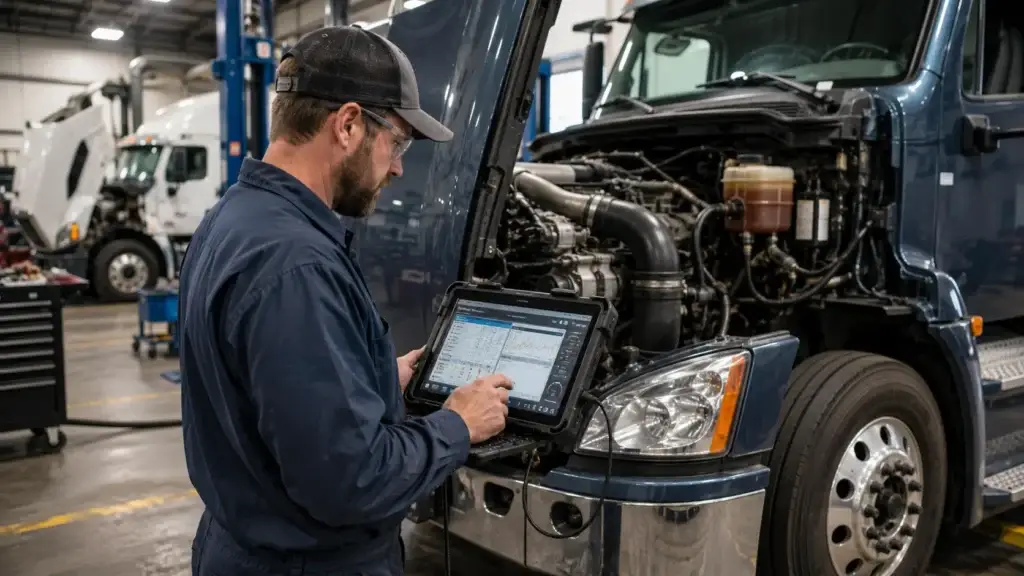
By Michael Nielsen | Editor & Publisher, Heavy Duty Journal
⏱ Estimated reading time: 18 minutes
Torque converter problems in heavy duty trucks are one of the most misdiagnosed transmission complaints in commercial fleet maintenance — and one of the most expensive to get wrong. The torque converter is the hydraulic coupling that connects your diesel engine to the automatic transmission, multiplying torque at low speeds and locking up at highway speed through the torque converter clutch (TCC). When it starts failing, the symptoms often mimic other drivetrain faults: a slipping clutch pack, a bad solenoid, contaminated fluid, or worn shift forks. Getting the diagnosis right before pulling the transmission saves thousands in unnecessary repair costs.
On Class 6 through Class 8 trucks running Allison 1000, 2000, 3000, or 4000 series automatics — the transmissions most commonly found across vocational, refuse, transit, and line-haul fleets — torque converter failure has a distinct diagnostic fingerprint. It presents through specific fault codes, stall test results, fluid condition, and transmission behavior patterns that, when read correctly, tell you whether you're dealing with a mechanical converter failure, a TCC solenoid issue, a clutch material problem, or a hydraulic pressure fault. This guide walks through each step of that process from the service bay floor.
Key Takeaways
- Shudder, slippage, and CHECK TRANS codes are the primary indicators of torque converter failure in heavy duty automatics — but they must be differentiated from solenoid, sensor, and fluid faults before condemning the converter.
- The stall test and slip speed monitoring via Allison DOC or ServiceRanger are the two most conclusive diagnostic procedures for confirming TCC mechanical failure versus electronic control faults.
- Fluid condition is the first diagnostic step — metal debris, burnt odor, or discoloration in the transmission pan indicates internal converter wear and must be evaluated before any other testing.
- TCC DTCs P0741, P0742, and P0743 are the most common fault codes associated with torque converter clutch failure on Allison Gen5 transmissions and should be the starting point for code-driven diagnostics.
- Heat is the primary cause of premature failure — fleets running vocational stop-and-start duty cycles without auxiliary transmission coolers are at significantly higher risk.
How the Torque Converter Works in Heavy Duty Trucks
A torque converter is a hydrodynamic fluid coupling positioned between the engine flywheel and the transmission input that transfers rotational power through pressurized automatic transmission fluid rather than through direct mechanical contact. In heavy duty truck applications, the converter consists of four primary components: the pump (impeller), driven by the engine; the turbine, which drives the transmission input shaft; the stator, which redirects fluid between pump and turbine to multiply torque at low speeds; and the lockup clutch — the torque converter clutch (TCC) — which creates a direct mechanical connection between engine and transmission once road speed stabilizes.
At low speeds and during acceleration, the pump and turbine rotate at different speeds, with the fluid coupling allowing some slip that creates torque multiplication — a critical advantage for Class 7 and Class 8 trucks pulling heavy loads from a stop. As road speed increases and the transmission shifts into the upper gear ranges, the TCM (Transmission Control Module) commands the TCC to engage, eliminating slip entirely and improving fuel efficiency. The Allison 3000 and 4000 series transmissions manage this process electronically, with the TCM monitoring input speed (turbine shaft speed sensor), output speed (output shaft speed sensor), and engine speed via J1939 CAN data link to determine the precise moment of TCC engagement and release.
Understanding this sequence matters for diagnosis: torque converter problems in trucks manifest differently depending on which phase of operation is affected. A failure at the fluid coupling stage — bent vanes, cavitation, or a damaged pump — affects low-speed performance and shows up as sluggish acceleration and abnormal stall speeds. A failure at the TCC stage — worn friction material, a stuck solenoid, or hydraulic pressure loss — shows up primarily at highway speeds as shudder, fuel economy decline, or elevated transmission temperatures.
Common Torque Converter Problems in Heavy Duty Trucks: Symptom Identification
Correctly identifying which symptom pattern is present is the foundation of an accurate torque converter diagnosis. The most common presentations in commercial truck service are:
TCC Shudder
Torque converter clutch shudder is a rhythmic vibration that occurs when the TCC is engaging or disengaging, typically felt most strongly between 40 and 55 mph in a loaded Class 8 truck. It feels distinctly different from engine misfire or driveline vibration — shudder has a cyclic, washboard quality that intensifies under light throttle loads and disappears under hard acceleration or deceleration. TCC shudder in heavy duty trucks is primarily caused by degraded friction material on the lockup clutch facing, contaminated ATF that has lost its friction modifier additive package, or a worn clutch damper assembly. On Allison transmissions, shudder typically precedes a P0741 (TCC System Stuck Off) code — the TCM detects excessive slip speed while commanding the TCC on and logs the fault.
Slippage and Elevated Engine RPM
Transmission slippage occurs when engine RPM climbs disproportionately to road speed — the engine is spinning but the power isn't reaching the wheels at the expected ratio. In a torque converter context, slippage means the TCC is not locking up properly, leaving the converter operating in continuous fluid coupling mode at speeds where it should be mechanically locked. This condition generates significant heat and, if left unaddressed, accelerates wear on both the converter friction material and the ATF. Fleet drivers often report the truck "feels sluggish" or "doesn't pull like it should" — particularly on grades where the TCC would normally engage but is slipping instead.
Abnormal Stall Speed
Stall speed is the maximum engine RPM achievable when the transmission is in Drive or Reverse with the service brakes fully applied and the torque converter absorbing full engine torque output. Allison specifies a stall speed range for each engine-transmission combination — typically 1,400 to 1,800 RPM for most medium and heavy duty applications, though the exact range varies by engine torque rating and converter model. A stall speed significantly below the specified range indicates converter slippage within the fluid coupling (the turbine is spinning before the engine reaches stall speed), while a stall speed above the range indicates converter slippage in the opposite direction — the pump cannot build adequate hydraulic pressure to hold the turbine. Both conditions require further investigation before determining root cause.
Transmission Overheating
A torque converter operating in continuous slip mode generates heat that the transmission cooling circuit must manage. When the TCC fails to lock up — either due to mechanical wear or electronic fault — the converter operates as a pure fluid coupling at speed, continuously converting mechanical energy to heat. Transmission fluid temperature above 250°F accelerates ATF oxidation and degrades the friction modifier chemistry that lubricates the TCC clutch facing. Allison transmissions with temperature sensors log high-temperature events, and fleet maintenance software can trend temperature history to identify converters running chronically hot before a catastrophic failure occurs.
Noise: Grinding, Whirring, and Metallic Clunking
Mechanical noise originating from the torque converter area — a location that corresponds roughly to the bell housing junction between engine and transmission — indicates physical damage to internal converter components. A bearing failure produces a consistent whirring or rumbling that changes pitch with engine speed. Grinding sounds indicate metal-on-metal contact, typically from a destroyed needle bearing or collapsed stator roller clutch. A metallic clunking during gear engagement points to loose or damaged flexplate bolts or a cracked converter hub. Any noise accompanied by metallic debris in the transmission pan requires immediate teardown — a disintegrating converter will circulate metal particles through the entire hydraulic system, damaging the valve body, clutch packs, and internal seals.
⚠️ Safety Warning
Never perform a full stall test on a Class 7 or Class 8 truck with a passenger in the vehicle or with the truck unblocked. During a static stall test, the vehicle must be on a level surface with wheel chocks in place and the parking brake fully applied. Do not hold the stall test for more than 5 seconds — extended stall testing can overheat transmission fluid to the point of immediate clutch damage. Allison explicitly prohibits static stall testing in Reverse or in the 1st-range lock (seven-speed models). When in doubt, use a driving stall test procedure per Allison MT3004EN Mechanic's Tips guidelines.
Step 1 — Transmission Fluid Inspection
Before connecting a diagnostic tool or performing any drive test, drain and inspect the transmission fluid. Fluid condition is the fastest indicator of what is happening mechanically inside the converter and transmission. The Allison 3000 and 4000 series transmissions use either a dipstick or an electronic oil level sensor (OLS), depending on configuration. With the transmission at operating temperature (approximately 175–190°F), check both fluid level and condition.
Healthy Allison TES 295 or TES 668-spec ATF is red to amber in color with a slightly sweet smell and no visible particulates. Allison's TES 668 specification — the current standard for Allison 1000, 2000, 3000, and 4000 series transmissions — requires a full synthetic fluid that delivers superior friction modifier durability and extended anti-shudder performance compared to the legacy TES 295 spec. When inspecting fluid, look for four specific conditions:
Transmission Fluid Condition: Diagnostic Indicators
- Dark brown or black fluid with burnt smell: Thermal degradation from overheating — indicates sustained TCC slip or inadequate cooling. Replace fluid and inspect converter friction material.
- Grayish or milky appearance: Water or coolant contamination — inspect transmission oil cooler for internal leakage. Do not operate the transmission.
- Metallic particles or shiny sheen on dipstick: Internal mechanical wear — inspect converter, clutch packs, and valve body for debris. Perform pan inspection before any further operation.
- Pink or foamy fluid: Air entrainment or coolant contamination — check fluid level, oil cooler, and filler tube seal. Aerated fluid cavitates within the converter, accelerating wear on pump vanes and stator rollers.
Remove the transmission drain plug and inspect the magnetic drain plug for metallic material. Fine bronze-colored powder is normal friction material wear over extended service intervals. Coarse metal particles, chunks of clutch material, or silver-colored steel shavings indicate significant mechanical damage and require full disassembly before the transmission is returned to service. Document the fluid condition with photographs before sending to an oil analysis laboratory — used oil analysis from a credible provider can identify specific metals (iron, copper, aluminum, lead) that pinpoint which internal components are wearing.
Keep Your Fleet Running at Full Capacity
Get HDJ's maintenance guides, compliance updates, and fleet management strategies delivered weekly — built for working diesel professionals.
Step 2 — Fault Code Retrieval and Interpretation
After fluid inspection, connect Allison DOC (Diagnostic Optimized Connection) or the equivalent OEM diagnostic tool — ServiceRanger for Eaton Cummins Endurant applications — and retrieve all active and inactive DTCs from the TCM. The TCM communicates via the SAE J1939 CAN data link and stores fault codes in both active (current fault present) and inactive (historical event) memory. Clearing codes without documenting inactive faults is a diagnostic mistake — inactive codes reveal intermittent faults that active codes may not show during a single inspection.
On Allison Gen5 (5th Generation) controls — covering the 3000 and 4000 series transmissions most commonly found on Class 7 and Class 8 vocational trucks — the following DTCs are directly related to torque converter clutch operation:
| DTC | Description | Primary Cause | Immediate Symptom |
|---|---|---|---|
| P0741 | TCC System Stuck Off | Excessive lockup slip speed while TCC commanded ON | TCC disabled by TCM; CHECK TRANS light; elevated temp |
| P0742 | TCC System Stuck On | TCC engaging when commanded OFF; sticking solenoid or valve | Engine stall at low speed; harsh/abrupt deceleration |
| P0743 | TCC Solenoid Circuit Failure | Open circuit, short to ground, or short to power in TCC solenoid circuit | TCC never engages; higher fuel consumption; steady CHECK TRANS |
| P2757 | TCC Pressure Control Solenoid Stuck Off | Solenoid control circuit performance fault or solenoid mechanical failure | Shudder on TCC engagement; code returns after clearing |
| P0720 / P0722 | Output Shaft Speed Sensor Fault | Loss of OSS signal or noisy OSS signal | Erratic TCC behavior; false slip speed readings; incorrect shift timing |
A critical diagnostic discipline: P0741 (TCC Stuck Off) does not automatically mean the torque converter itself is mechanically failed. This code fires when the TCM detects that lockup slip speed is greater than the acceptable threshold — but that condition can result from a faulty TCC solenoid, a pressure control solenoid malfunction, a wiring harness issue, or actual mechanical failure of the converter friction material. Misdiagnosing P0741 as a converter failure and replacing the transmission assembly without investigating solenoid circuit integrity first is an expensive mistake made regularly in shops that lack the proper diagnostic tooling.
Key Recommendation
When P0741 is present, always test the TCC solenoid resistance before condemning the torque converter. On Allison Gen5 transmissions, the TCC solenoid is accessible via the external wiring harness connector on the transmission case. Measured resistance should fall within the range specified in the Allison TS3989EN troubleshooting manual for the specific transmission model. A solenoid reading outside this range — or showing an open or short circuit — indicates electronic fault, not mechanical converter failure. Replace the solenoid, clear codes, and retest before any transmission removal is performed.
Step 3 — The Torque Converter Stall Test Procedure
The stall test is the most conclusive mechanical diagnostic procedure for evaluating torque converter condition in heavy duty truck applications. A stall test determines the maximum engine RPM achievable when the transmission is fully loaded with the vehicle stationary — revealing the torque multiplication capability of the converter and the integrity of the fluid coupling.
Pre-Test Requirements
Before performing a static stall test on a Class 7 or 8 truck, the following conditions must be met: transmission fluid at normal operating temperature (approximately 175–190°F), no active DTCs present (resolve any fault codes before stall testing), vehicle on level ground with all wheels chocked, parking brake applied and verified, and a clear understanding of the OEM-specified stall speed range for the specific engine-transmission combination being tested. Stall speed specifications vary by engine torque output and converter model — consult the applicable Allison Mechanic's Tips document (MT3004EN for 3000/4000 series) or the engine OEM service data for the specific truck application.
Static Stall Test Procedure
With the engine at operating temperature, transmission in Drive, service brakes firmly applied, and a second technician monitoring transmission fluid temperature, advance the throttle to full-open position. Note the maximum RPM achieved and do not hold the test for more than 5 seconds. Shift to Neutral immediately after recording the RPM, allow the transmission to cool for at least 1 minute before repeating, and check fluid temperature — if transmission temperature exceeds 250°F, do not continue testing until the fluid cools. On Allison 3000/4000 series transmissions with 4th Generation or later controls, Allison DOC can display slip speed in real time during the stall test, providing a more precise measurement than tachometer observation alone.
Interpreting Stall Test Results
Stall Speed Diagnostic Matrix
- Stall speed within specified range: Converter fluid coupling is mechanically sound. Investigate TCC-specific causes for any shudder or slip symptoms at speed.
- Stall speed more than 200 RPM below specification: Converter slippage in coupling — turbine is spinning before full stall load is applied, indicating worn turbine blades or a failed stator one-way clutch. Converter requires replacement.
- Stall speed more than 200 RPM above specification: Pump cannot build adequate pressure — could indicate clutch pack slippage within the transmission rather than converter fault. Proceed with hydraulic pressure testing to isolate.
- Erratic RPM fluctuation during stall: Cavitation within the converter or aerated fluid — verify fluid level and condition before repeating test.
- Stall speed higher in Reverse than Forward: Internal transmission clutch pack slippage in forward-engagement clutches — not a converter fault. Requires transmission internal inspection.
Step 4 — Live Data Monitoring: Slip Speed and TCC Status
Live data monitoring via Allison DOC Gen5 during a road test is the most precise method for evaluating torque converter clutch behavior under real operating conditions. Allison DOC displays turbine shaft speed (TSS), output shaft speed (OSS), engine speed (via J1939), and calculated slip speed in real time. Slip speed is the difference between engine speed and turbine speed — when the TCC is fully engaged, this value should be near zero (typically within 10–20 RPM). Elevated slip speed while the TCM is commanding TCC engagement confirms the lockup clutch is not applying correctly.
During a road test at highway speed with Allison DOC active, monitor the following parameters simultaneously:
TCC Status (On/Off command from TCM): Confirms whether the TCM is commanding engagement. If TCC is commanded ON but slip speed remains above 100 RPM, the clutch is not applying — the issue is either mechanical (worn friction material) or hydraulic (solenoid, valve body, or pressure fault).
Transmission fluid temperature: A converter with worn friction material will show temperature rising steadily during highway operation, even under steady-state throttle, because continuous slip is converting mechanical energy to heat. Trending temperature above 220°F at highway cruise with no external load is a flag.
Engine torque output and throttle position: Light throttle at cruise is where TCC shudder typically appears. Monitor whether shudder correlates with TCC engagement events and whether it diminishes under higher throttle load — this is the classic shudder pattern of a worn lockup clutch facing that momentarily grips and releases as the clutch material alternates between stick and slip across its engagement range.
The HDJ Perspective
In 15-plus years of heavy duty powertrain work, the single most avoidable torque converter replacement I saw in fleet shops came from shops that pulled transmissions on a P0741 code without verifying solenoid circuit integrity first. The TCC solenoid on an Allison Gen5 is a $40–$80 part. The labor to pull, inspect, and reinstall a transmission on a Class 8 vocational truck runs 8 to 12 hours at shop rate. Running the Allison DOC pinpoint test for the TCC circuit takes 20 minutes and either confirms or eliminates electronic fault before any wrench touches the drivetrain. The shops that get this right build their diagnostic process around live data and circuit testing first — not around code-to-parts assumptions. Summer heat only amplifies the risk — if your fleet runs refuse, tanker, or transit duty in hot climates right now, audit your transmission temperature logs before the converter tells you it's been running too hot for too long.
Step 5 — Hydraulic Pressure Testing
When live data monitoring and stall testing point toward a hydraulic fault rather than a mechanical converter failure, hydraulic pressure testing isolates whether the problem is in the pump, the valve body, the TCC solenoid, or the converter itself. The Allison 3000 and 4000 series transmissions include a main pressure tap on the transmission case — typically a 1/8-inch pipe thread fitting — that allows connection of a calibrated hydraulic pressure gauge.
Main line pressure in an Allison heavy duty automatic should fall within the range specified in the service manual for the operating condition being tested (typically 60 to 250 psi depending on range, throttle position, and temperature). Low main line pressure across all operating conditions indicates a failing pump or internal leakage. Pressure within normal range but with TCC not engaging confirms the fault is isolated to the TCC control circuit — the solenoid, the valve body TCC circuit, or the clutch pressure plate sealing rings within the converter.
Converter out pressure — measured at the converter-out circuit port where fluid exits the converter to the cooler — provides a direct indicator of converter charge and fluid flow. Low converter out pressure with normal main line pressure points to an internal converter restriction or a failed pump within the converter housing itself. This test requires a hydraulic T-fitting and an additional pressure gauge connected in-line at the cooler inlet fitting, and it should be performed only by a technician trained in Allison hydraulic system diagnostics.
Root Causes of Torque Converter Failure in Heavy Duty Fleets
Understanding why torque converters fail in heavy duty truck service — not just how to diagnose the failure — allows fleet managers and shop supervisors to implement preventive measures that extend converter life and reduce unplanned downtime.
Thermal Degradation from Stop-and-Start Duty Cycles
The most destructive operating environment for a torque converter is the vocational stop-and-start cycle — refuse trucks, cement mixers, utility vehicles, and transit buses that regularly pull heavy loads from a complete stop in urban traffic. Every stop-and-start event requires the converter to operate in full fluid coupling mode, generating heat through controlled slip until road speed is sufficient for TCC engagement. Under these conditions, ATF temperature regularly peaks in the 220–250°F range, and the TCC friction material accumulates wear at a rate far exceeding what OEM drain intervals account for. Fleets operating vehicles in this duty cycle without auxiliary transmission oil coolers are accepting significantly elevated converter replacement rates as an operating cost — often without connecting the failures to the thermal root cause.
Incorrect or Degraded Transmission Fluid
Using non-approved ATF in an Allison transmission — or extending service intervals beyond the fluid's thermal stability range — is a leading cause of TCC shudder and premature lockup clutch wear. Allison's TES 668 specification requires a full synthetic fluid engineered for superior anti-shudder durability, with specific friction modifier chemistry designed to maintain consistent clutch-face engagement across temperature cycles. Non-approved fluids may be chemically incompatible with the seal materials and friction surfaces within the Allison converter assembly, accelerating wear and causing shudder even in low-mileage applications. Allison maintains a current approved fluids list on their website that should be the reference point for every fluid change decision on Allison-equipped fleet vehicles.
13×
Allison TES 668-spec fluids deliver more than 13 times the anti-shudder durability of legacy TES 295-specification fluids, reducing TCC shudder incidents and extending lockup clutch friction material life in vocational fleet applications. Source: Allison Transmission via BusinessWire
Oversized Loads and Towing Beyond Rating
Sustained operation above the transmission's rated input torque accelerates wear on every component in the converter and transmission. When a truck consistently operates at or near its GVW limit on grades — or when the transmission is incorrectly matched to a high-output engine repower — the converter operates in a chronically high-slip state that generates heat faster than the cooling circuit can dissipate it. Owner-operators who add horsepower through ECM tuning without upgrading the transmission's torque capacity frequently discover the torque converter is the first component to reflect the increased thermal and mechanical load.
Extended Fluid Service Intervals
Allison's fluid and filter change interval recommendations vary by transmission model, fluid specification, and operating severity. The Allison 3000 and 4000 series operator's manual specifies initial fluid and filter changes and ongoing intervals based on whether the transmission is operating in standard or severe duty service. Fleets that defer fluid changes based on mileage alone — without accounting for operating temperature history or duty cycle severity — frequently operate with degraded fluid that has lost its friction modifier package. The Technology and Maintenance Council (TMC) of the American Trucking Associations publishes Recommended Practice RP 1410A, covering maintenance guidelines for automatic transmissions in medium and heavy duty vehicles — a useful reference for establishing fleet-specific service intervals.
Torque Converter Problems on Specific Heavy Duty Truck Platforms
While the diagnostic principles above apply broadly to any heavy duty automatic transmission with a torque converter, platform-specific knowledge accelerates diagnosis on the most common truck configurations in North American fleets.
Allison 1000 Series (Pickup Trucks and Medium Duty)
The Allison 1000 series, found in GM/Chevrolet and GMC Duramax-powered pickups and medium duty trucks through 2019, uses a torque converter with an integral damper assembly. A common failure pattern on high-mileage Allison 1000 applications is TCC shudder that develops after 100,000+ miles — typically caused by degraded fluid that no longer provides adequate anti-shudder friction modification. In many cases, a fluid change to a current TES 668-approved synthetic resolves the shudder without converter replacement. If shudder persists after a verified correct-spec fluid change, the TCC friction material has worn beyond recovery and converter replacement is required.
Allison 3000 and 4000 Series (Vocational and Heavy Duty)
The Allison 3000 and 4000 product families are found in the widest range of Class 6 through Class 8 vocational applications — refuse trucks, fire apparatus, transit buses, concrete mixers, and heavy-haul tractors. The torque converter on these transmissions includes a lockup clutch with torsional damper assembly and is designed for severe-duty applications. Allison's 5th Generation controls (Gen5) manage TCC engagement through a Pressure Control Solenoid (PCS) rather than an on/off solenoid, providing modulated engagement that reduces shudder — but also means that PCS solenoid degradation produces shudder symptoms identical to mechanical TCC failure. The Allison DOC Gen5 diagnostic tool is essential for distinguishing between these faults and should be present in every fleet shop or dealer service center maintaining Allison-equipped vehicles.
According to Allison Transmission's current TES 668 approved fluids list, more than 50 fluid brands carry active TES 668 approval — ensuring that fleet maintenance operations have broad supplier access to compliant fluid without being locked into a single source.
Eaton Cummins Endurant (Automated Manual Transmission)
The Eaton Cummins Endurant — increasingly common in Class 8 linehaul and regional haul applications — is an automated manual transmission (AMT) rather than a true automatic, and does not use a traditional torque converter. Instead, it uses an automated dry clutch for launch and gear selection. Technicians encountering shudder or slip complaints on Endurant-equipped trucks should not apply torque converter diagnostic procedures — the fault tree for clutch and gear engagement on AMT platforms is entirely different and requires ServiceRanger software specific to the Endurant architecture.
When to Replace vs. Rebuild the Torque Converter
Once diagnosis confirms mechanical torque converter failure — through stall test results, live data slip speed monitoring, or physical inspection of debris — the decision between replacement and rebuild hinges on several operational factors.
New OEM torque converters from Allison are the highest-confidence option for fleet vehicles that will continue in severe-duty service. Allison warranties its converters as part of the complete transmission assembly and specifies that non-OEM converters may not meet the mechanical and hydraulic specifications required for optimal transmission performance. For owner-operators or fleets running older vehicles where OEM pricing is cost-prohibitive, remanufactured converters from established rebuilders are a viable alternative — provided the rebuilder restores the converter to OEM specifications including clutch friction material, stator roller clutch, and all internal clearances.
Regardless of whether new or reman is chosen, the converter should never be installed without simultaneously performing a complete transmission fluid and filter change, inspecting and cleaning the transmission oil cooler, and verifying there is no debris circulating in the hydraulic circuit from the failed converter. A new converter installed into a system contaminated with metallic debris from the previous failure will typically fail prematurely for the same reason the first one did — just at a higher replacement cost.
Free Professional Fleet Tools
Cost calculators, fault code lookup, maintenance planners, and more — built for owner-operators, fleet managers, and diesel techs. No signup required.
Preventive Maintenance: Extending Torque Converter Life in Commercial Fleets
The most effective torque converter maintenance strategy in commercial fleet operations is thermal management combined with disciplined fluid service. These practices, applied consistently across a fleet, produce measurable reductions in converter-related downtime:
Auxiliary Transmission Cooler Installation
For vocational fleets operating in stop-and-start duty cycles — refuse, municipal, transit, or any application involving repeated heavy-load launches — an auxiliary transmission oil cooler is one of the highest-return investments available in fleet maintenance. An auxiliary cooler supplements the OEM cooler (typically integrated into the engine coolant radiator) and allows the transmission fluid to dissipate heat through a dedicated air-to-oil heat exchanger. Maintaining ATF temperature below 220°F across all operating conditions dramatically extends both the fluid service life and the TCC friction material life.
Fluid and Filter Service Based on Condition, Not Just Mileage
Mileage-based fluid service intervals are a baseline — not a guarantee that the fluid is still performing. Fleets using telematics or transmission monitoring systems that log temperature history can correlate thermal exposure to actual fluid degradation rates and adjust service intervals accordingly. Allison's prognostics system on MY09 and later controls includes an Oil Life Monitor that tracks temperature-weighted operating hours and alerts when the fluid has reached a calculated service threshold — a more accurate trigger than fixed mileage alone. Fleets without this capability should implement used oil analysis on transmission fluid samples taken at every other filter service, providing laboratory data on additive depletion, metal content, and contamination levels.
Driver Operating Practice: Avoiding Unnecessary Converter Slip
Driver behavior directly affects torque converter wear rate. Two specific practices significantly reduce thermal load on the converter: avoiding "foot on brake, foot on throttle" simultaneously during low-speed maneuvering (which forces the converter to absorb opposing torque inputs simultaneously), and using the parking brake rather than holding position on grades with the service brake and throttle simultaneously applied. Fleet driver training programs that include basic automatic transmission operating principles — not just vehicle safety — reduce converter wear in applications like refuse collection and construction site service where slow-speed maneuvering is constant.
Transmission Temperature Monitoring as a Fleet KPI
Fleet managers who track transmission temperature as a key performance indicator — using telematics data or Allison prognostics telemetry — identify overheating conditions before they produce converter failures. A truck that consistently runs transmission temperatures above 230°F is sending a predictive maintenance signal: either the cooling circuit is inadequate for the duty cycle, the fluid is overdue for service, or an operating practice problem is generating excess heat. Catching this early — before the friction material fails and before metal debris enters the hydraulic system — is the difference between a planned fluid service and an emergency transmission replacement. The American Transportation Research Institute (ATRI) consistently documents drivetrain maintenance costs as a significant driver of fleet operating expense — transmission and converter failures, which are largely preventable through thermal management, represent a disproportionate share of unplanned repair costs in vocational fleet operations.
Frequently Asked Questions
What are the most common torque converter problems in heavy duty trucks?
The most common torque converter problems in heavy duty trucks are TCC shudder (a rhythmic vibration during lockup engagement), torque converter clutch slippage (elevated engine RPM relative to vehicle speed), transmission overheating caused by continuous converter slip, and CHECK TRANS fault codes — primarily P0741 (TCC stuck off) and P0743 (TCC solenoid circuit failure) on Allison transmissions. Many of these symptoms are caused by worn TCC friction material, degraded ATF, or a failed TCC pressure control solenoid rather than catastrophic mechanical failure of the converter itself.
How do I know if my torque converter or the TCC solenoid is causing the problem?
The key distinction is made through solenoid resistance testing and live slip speed monitoring. If the TCC solenoid tests outside the specified resistance range (indicating electrical failure), the fault is electronic — replace the solenoid before removing the transmission. If the solenoid tests within specification but live data shows slip speed remaining elevated while the TCM commands TCC engagement, the fault is mechanical — the converter friction material is worn. The Allison Gen5 P0741 diagnostic procedure walks through this circuit test sequence in detail.
What is the correct transmission fluid spec for an Allison transmission in a heavy duty truck?
Allison's current fluid specification for the 1000, 2000, 3000, and 4000 series transmissions is TES 668 — a full synthetic automatic transmission fluid with enhanced anti-shudder durability and extended drain interval performance. TES 668 fluid is backwards-compatible with earlier TES 295-specification transmissions. Always use a fluid carrying an active Allison approval number (not one that claims to "meet or exceed" the spec without the approval number). The current approved fluids list is maintained on the Allison Transmission website.
Can a torque converter problem damage the rest of the transmission?
Yes — a failing torque converter that is generating metallic debris is one of the most damaging scenarios in automatic transmission service. Metal particles from a deteriorating converter circulate through the entire hydraulic system with every transmission fluid pump revolution, scoring valve body bores, damaging clutch pack friction surfaces, and contaminating seals. A transmission that has operated with a mechanically failing converter for an extended period often requires complete internal inspection and may need valve body replacement or clutch pack overhaul in addition to converter replacement.
How long should a torque converter last in a heavy duty truck?
In line-haul service with correct fluid maintenance and an appropriate engine-transmission match, an Allison torque converter can reasonably be expected to last the life of the transmission — often 500,000 miles or more. In severe vocational duty cycles (refuse, transit, concrete), where the converter operates in continuous slip mode during repeated stop-and-start events, life expectancy is significantly shorter. Fleets operating in high-heat vocational service that install auxiliary coolers, use TES 668-spec synthetic fluid, and monitor transmission temperature consistently report substantially better converter durability than fleets running stock cooling circuits on extended service intervals.
What diagnostic tools do I need to properly diagnose torque converter problems on a commercial truck?
For Allison-equipped trucks, Allison DOC (Diagnostic Optimized Connection) is the required tool — it provides live slip speed data, TCC command status, temperature monitoring, and DTC pinpoint test procedures that generic OBD scanners cannot access. For broader heavy duty diagnostic capability across multiple makes and platforms, tools supporting SAE J1939 and J1708 data link protocols are necessary. A calibrated hydraulic pressure gauge set (0–400 psi range) is required for main line and converter-out pressure testing. Without Allison DOC, technicians are working with partial diagnostic information and are significantly more likely to misdiagnose the fault.
Conclusion
Torque converter problems in heavy duty trucks are a diagnostic category where the difference between a competent diagnosis and a misdiagnosis is measured in thousands of dollars. The fluid coupling and TCC lockup system in an Allison 3000 or 4000 series transmission can fail in multiple ways — mechanical, hydraulic, and electronic — and each failure mode has a distinct diagnostic signature that becomes clear when the right procedures are followed in the right order: fluid inspection first, fault codes second, stall test and live slip speed monitoring third, hydraulic pressure testing when indicated.
What prevents most torque converter failures in commercial fleets isn't exceptional repair skill — it's consistent thermal management through auxiliary cooling, disciplined fluid service using Allison TES 668-approved synthetics, and temperature monitoring as a routine maintenance metric. The converters that fail at 200,000 miles in severe vocational service almost always have a maintenance history that explains the failure. The ones that go 500,000 miles in similar service almost always have a fleet manager or shop supervisor who treated the transmission cooling system as seriously as the engine cooling system.
For fleet managers and diesel technicians looking to deepen their understanding of heavy duty drivetrain systems, Heavy Duty Journal publishes field-tested diagnostic guides and fleet management resources at heavydutyjournal.com — all free, no paywall, built for working professionals.
Share This With Your Shop Team and Fleet Manager
If your shop handles Allison-equipped vocational trucks, this diagnostic guide belongs on your service wall. Pass it along to the fleet manager who's been chasing transmission complaints — knowing the difference between a solenoid fault and a mechanical failure before the wrench comes out saves real money.