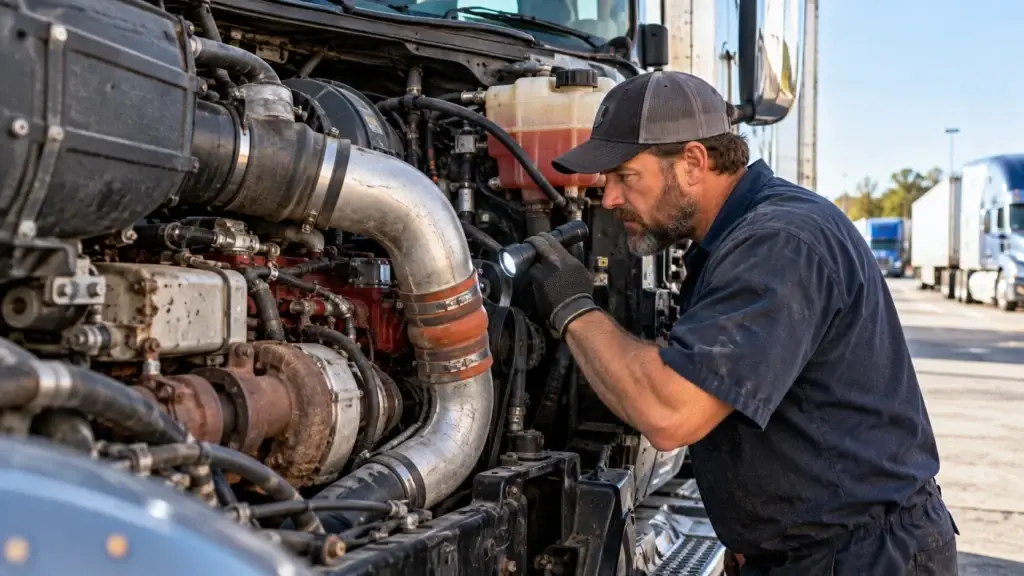
As a commercial truck owner or fleet manager, your diesel engine warning signs serve as critical early indicators that can prevent catastrophic failures and costly downtime. Modern diesel engines are sophisticated powerplants that communicate their health status through various symptoms—from subtle performance changes to obvious mechanical failures. Understanding these warning signs and responding promptly can mean the difference between a minor repair and a complete engine rebuild costing tens of thousands of dollars.
Diesel engines power over 90% of America’s heavy-duty commercial trucks, making them the backbone of freight transportation and logistics operations. These workhorses are designed for reliability and longevity, but they require vigilant monitoring and proactive maintenance to deliver on that promise. Fleet managers and owner-operators who recognize early warning signs can schedule repairs strategically, minimize unexpected breakdowns, and extend engine service life significantly.
Professional diesel technicians emphasize that most major engine failures don’t happen suddenly—they develop gradually through a cascade of smaller issues that, if caught early, are far less expensive to address. This comprehensive guide examines the critical diesel engine warning signs every commercial truck operator should recognize, from abnormal sounds and performance issues to visual indicators and system-specific failures.
Last Updated: November 2025
Key Takeaways
- Early detection saves money: Recognizing diesel engine warning signs early can reduce repair costs by 40% and prevent catastrophic failures requiring complete engine replacement.
- Sound diagnosis matters: Unusual engine noises—knocking, whistling, or grinding—indicate specific component failures that worsen rapidly without intervention.
- Performance changes signal problems: Power loss, hard starting, and rough idling are early indicators of fuel system, compression, or turbocharger issues requiring immediate diagnosis.
- Visual indicators reveal hidden issues: Exhaust smoke color, fluid leaks, and dashboard warning lights provide critical diagnostic information about internal engine conditions.
- System-specific symptoms require expertise: Modern diesel emissions systems (DPF, DEF, EGR) have unique failure patterns that demand specialized diagnostic knowledge and equipment.
The Critical Role of Diesel Engines in Commercial Trucking Operations
Diesel engines dominate commercial trucking because they deliver superior torque characteristics, fuel efficiency, and durability compared to gasoline alternatives. The American Trucking Associations reports that diesel-powered trucks move approximately 72% of America’s freight by weight, representing an economic impact exceeding $800 billion annually. This massive economic footprint makes diesel engine reliability not just a business concern but a critical infrastructure issue.
Commercial diesel engines are engineered for extended service intervals and high-mileage operation, with many heavy-duty units capable of exceeding one million miles before major overhaul. However, this impressive longevity depends entirely on proper maintenance protocols and early detection of developing problems. When warning signs are ignored, even the most robust diesel engine can experience premature failure.
Why Diesel Engines Power Heavy-Duty Transportation
The fundamental advantage of diesel engines lies in their compression-ignition design, which generates significantly higher cylinder pressures than gasoline engines. This engineering principle translates directly into greater torque output at lower engine speeds—precisely what’s needed for hauling heavy loads efficiently. Modern heavy-duty diesel engines routinely produce 1,500-2,000 lb-ft of torque, enabling loaded Class 8 trucks to maintain highway speeds on steep grades.
Fuel efficiency represents another critical advantage for commercial operations. Diesel fuel contains approximately 10-15% more energy per gallon than gasoline, and diesel engines convert that energy more efficiently due to higher compression ratios. The U.S. Department of Energy documents that heavy-duty diesel trucks achieve significantly better fuel economy than gasoline equivalents would, directly impacting operating costs for fleet managers.
Engine longevity is equally important for commercial applications where vehicle replacement represents a major capital expense. Properly maintained diesel engines frequently exceed 500,000 miles of operation, with many achieving double that mileage before requiring major overhaul. This durability stems from heavy-duty construction necessary to withstand high compression pressures, resulting in components that outlast lighter gasoline engine parts.
| Diesel Engine Advantage | Commercial Benefit | Impact on Operations |
|---|---|---|
| High torque output (1,500-2,000 lb-ft) | Superior hauling capability | Handles heavy loads efficiently on varied terrain |
| 15-30% better fuel economy | Reduced operating costs | Lower fuel expenses over vehicle lifecycle |
| 500,000-1,000,000+ mile lifespan | Extended service life | Delayed vehicle replacement, better ROI |
| Heavy-duty component construction | Increased reliability | Reduced unexpected breakdowns and downtime |
The High Cost of Ignoring Diesel Engine Warning Signs
Fleet maintenance data consistently demonstrates that deferred maintenance and ignored warning signs exponentially increase repair costs. A study by the Technology & Maintenance Council (TMC) found that addressing issues during early-stage symptoms typically costs 40-60% less than waiting until component failure occurs. This cost differential results from cascading damage—when one system fails, it often damages related components.
Consider a common scenario: A failing fuel injector initially causes rough idling and slightly reduced fuel economy. If addressed at this stage, replacement costs might total $500-800 per injector. However, if ignored, that faulty injector can wash down cylinder walls with excess fuel, diluting engine oil and accelerating wear on pistons, rings, and bearings. The eventual repair bill could reach $15,000-25,000 for major engine work.
Downtime represents an equally significant cost factor for commercial operations. The Federal Motor Carrier Safety Administration regulates commercial vehicle safety standards, and vehicles with mechanical defects must be taken out of service. A truck generating revenue while operating might contribute $500-1,000 per day to business income. Unexpected breakdowns not only eliminate that revenue but also create logistical problems for customers and potentially damage business relationships.
Modern diesel engines incorporate sophisticated emissions control systems mandated by the Environmental Protection Agency, including Diesel Particulate Filters (DPF), Diesel Exhaust Fluid (DEF) systems, and Exhaust Gas Recirculation (EGR) components. These systems have specific failure modes and warning signs that, if misunderstood or ignored, can result in engine derating or complete shutdown—leaving vehicles stranded and requiring expensive emergency repairs.

Professional diesel diagnostics identify problems before they escalate into major failures.
Alarming Sounds That Signal Diesel Engine Problems
Experienced diesel technicians often diagnose problems by sound before connecting diagnostic equipment. Diesel engines produce characteristic noise patterns during normal operation, and deviations from these patterns indicate specific mechanical issues. Understanding these auditory warning signs enables operators to identify problems early and schedule repairs before catastrophic failures occur.
Sound-based diagnosis has particular value because abnormal noises often precede measurable performance degradation or dashboard warning lights. A trained ear can detect bearing wear, valve train problems, or injection timing issues weeks or months before they cause operational problems. This early warning period provides a critical window for cost-effective intervention.
Knocking, Tapping, and Clicking Noises: Lubrication and Timing Issues
Knocking sounds from a diesel engine typically indicate combustion timing problems or component clearance issues. A deep, rhythmic knocking that changes with engine speed often points to worn connecting rod bearings, where increased clearance allows the crankshaft to move excessively within bearing surfaces. This condition worsens rapidly as metal-to-metal contact accelerates wear, potentially leading to catastrophic connecting rod failure.
Lighter tapping noises usually originate in the valve train, suggesting insufficient valve lash clearance, worn rocker arms, or failing hydraulic valve lifters. While less immediately critical than bearing knock, valve train problems cause progressive damage to camshaft lobes and valve stems. Untreated valve train noise eventually leads to misfiring cylinders and reduced engine power output.
High-frequency clicking sounds may indicate fuel injection problems, particularly with mechanical injection systems. Malfunctioning injectors can produce distinctive clicking as internal components fail to operate smoothly. Modern common-rail injection systems should operate nearly silently; excessive injection noise suggests pressure regulation problems or injector needle valve issues requiring immediate diagnosis.
Low oil pressure is a common underlying cause of knocking and tapping sounds. Oil pressure warning lights should never be ignored, as even brief periods of inadequate lubrication cause permanent damage to precision bearing surfaces. Operators should immediately shut down engines displaying both abnormal knocking sounds and low oil pressure warnings to prevent complete engine seizure.
Whistling or Hissing: Turbocharger and Air System Problems
High-pitched whistling sounds from diesel engines almost always indicate turbocharger or intake air system issues. Turbochargers operate at extremely high rotational speeds (100,000+ RPM) and rely on precise clearances between rotating and stationary components. When these clearances increase due to bearing wear or shaft play, air leaks produce characteristic whistling sounds.
A whistling sound that increases with engine speed and boost pressure typically indicates turbocharger seal failure, allowing compressed air to escape before reaching the intake manifold. This condition reduces engine power output while increasing exhaust gas temperatures. Continued operation with failing turbocharger seals accelerates bearing wear and can lead to catastrophic turbocharger failure where turbine wheels contact housing—potentially sending metal debris through the engine intake.
Hissing sounds often indicate boost air leaks in intercooler piping, charge air coolers, or intake manifolds. These leaks reduce effective boost pressure, causing power loss and increased turbo lag. Intercooler hose failures are particularly common on trucks operating in extreme temperature environments, where thermal cycling degrades rubber compounds. Visual inspection combined with sound localization helps identify leak sources.
Turbocharger problems shouldn’t be ignored because they affect multiple engine systems simultaneously. Insufficient boost pressure forces the engine to work harder for equivalent power output, increasing fuel consumption and thermal stress. Failed turbochargers can also cause oil starvation if damaged bearings allow excessive oil consumption through the intake system.

Turbocharger failures produce distinctive whistling sounds before complete failure occurs.
Grinding or Screeching: Bearing and Component Failures
Grinding noises represent the most serious category of abnormal engine sounds, typically indicating advanced bearing wear or component contact where none should exist. These sounds demand immediate attention because continued operation almost guarantees catastrophic failure. Grinding sounds indicate metal-to-metal contact where protective oil films have broken down completely.
Serpentine belt problems produce screeching sounds distinct from internal engine issues. A slipping belt creates high-pitched squealing, particularly during acceleration or when auxiliary loads increase. While belt problems are relatively minor repairs, they shouldn’t be ignored—thrown serpentine belts cause immediate loss of alternator, water pump, and power steering function, potentially leading to engine overheating or loss of vehicle control.
Timing gear wear produces a grinding sound from the front of the engine that varies with crankshaft speed. Diesel engines rely on precision timing between crankshaft and camshaft positions to ensure proper injection and valve events. Excessive timing gear wear disrupts this relationship, causing misfiring, hard starting, and reduced power output. Severe timing gear wear can cause timing chain or gear failure, resulting in catastrophic valve-to-piston contact.
Starter motor problems sometimes masquerade as engine issues, producing grinding sounds during cranking. A worn starter drive gear may not properly engage the flywheel ring gear, creating grinding sounds without starting the engine. While starter failures are generally repairable, they can indicate flywheel damage requiring transmission removal for repair—a far more expensive proposition.
| Noise Type | Likely Cause | Severity | Action Required |
|---|---|---|---|
| Deep knocking | Rod bearing wear, low oil pressure | Critical | Immediate shutdown, professional diagnosis |
| Light tapping | Valve train wear, injector issues | Moderate | Schedule service within days |
| High-pitched whistling | Turbocharger seal failure, boost leaks | Moderate-High | Reduce load, schedule immediate service |
| Grinding/screeching | Bearing failure, serpentine belt slip | Critical | Stop operation immediately |
Performance Warning Signs Demanding Immediate Attention
Diesel engine performance degradation often occurs gradually, making it easy for operators to adapt unconsciously to declining power or efficiency. However, measurable performance changes indicate underlying problems that worsen without intervention. Fleet managers should establish baseline performance metrics—fuel economy, boost pressure, acceleration times—and investigate any significant deviations from these norms.
Modern engine control modules (ECMs) continuously monitor dozens of parameters and can detect performance anomalies before they become apparent to operators. Diagnostic trouble codes (DTCs) stored in ECM memory provide valuable diagnostic information even when check engine lights aren’t illuminated. Regular diagnostic downloads help identify developing issues before they cause operational problems or trigger emissions-related engine derating.
Significant Power Loss and Sluggish Acceleration
Noticeable power loss in diesel engines typically results from insufficient air supply, restricted fuel delivery, or excessive exhaust backpressure. Turbocharger problems are common culprits—worn bearings, failed actuators, or boost leaks prevent proper air compression. Without adequate boost pressure, diesel engines lose their characteristic torque output and struggle under load.
Fuel system restrictions cause similar symptoms but with different diagnostic indicators. Clogged fuel filters, failing lift pumps, or contaminated fuel injectors starve the engine of proper fuel delivery. Modern common-rail injection systems operate at pressures exceeding 30,000 PSI; even minor restrictions in fuel supply affect injection pressures and spray patterns, reducing combustion efficiency and power output.
Exhaust system restrictions, particularly clogged Diesel Particulate Filters (DPF), create excessive backpressure that opposes piston movement during exhaust stroke. This resistance robs engine power and increases exhaust gas temperatures. Severely restricted DPFs can cause engine derating where the ECM intentionally limits power output to protect against damage—a common occurrence when regeneration cycles are repeatedly interrupted or delayed.
Compression loss from worn piston rings, valve seat recession, or blown head gaskets eliminates the high cylinder pressures necessary for efficient diesel combustion. Compression problems often manifest as cold-start difficulties combined with reduced power output. Cylinder leak-down testing quantifies compression loss and helps identify whether problems originate from valves, rings, or head gaskets.

Systematic performance testing identifies root causes of power loss and efficiency problems.
Hard Starting or Complete Failure to Start
Starting difficulties in diesel engines stem from inadequate compression, insufficient fuel delivery, or electrical system problems. Cold weather exacerbates these issues because diesel fuel viscosity increases dramatically at low temperatures, while battery capacity decreases. Understanding the difference between slow cranking (electrical problem), normal cranking without starting (fuel/compression problem), and no cranking (severe electrical problem) helps narrow diagnostic focus.
Glow plug failures are common causes of cold-start problems in indirect injection diesel engines. These heating elements raise combustion chamber temperatures to facilitate fuel ignition during cold starts. Failed glow plugs cause extended cranking times and rough initial running until engine temperatures rise naturally. Glow plug circuits can be tested systematically to identify failed units without disassembly.
Low fuel pressure from failing transfer pumps or contaminated filters prevents adequate fuel delivery during cranking. Diesel engines require sustained cranking to prime fuel systems after filter changes or when air enters fuel lines. Prolonged cranking attempts without starting risk starter motor overheating and battery depletion. Professional technicians use fuel pressure gauges to verify adequate delivery pressure before investigating other potential causes.
Injection timing problems cause hard starting and rough operation even when compression and fuel delivery are adequate. Electronic injection systems rely on crankshaft and camshaft position sensors to determine proper injection timing. Sensor failures or ECM programming issues can prevent starting or cause severely degraded performance. Specialized diagnostic equipment accesses ECM data to verify sensor signals and injection timing parameters.
Rough Idling, Stalling, and Misfiring
Rough idling indicates uneven combustion across cylinders, typically resulting from fuel injection problems, air intake leaks, or compression variations. Modern common-rail injection systems should produce smooth, quiet idle operation. Rough idling accompanied by visible exhaust smoke suggests injector problems—either mechanical failure or contamination affecting spray patterns.
Air intake leaks between the turbocharger and intake manifold cause rough idling by admitting unmetered air that disrupts air-fuel ratios. These leaks are difficult to locate because they occur only under boost conditions or create symptoms that vary with engine load. Smoke testing or careful boost leak testing identifies intake system leaks before they cause operational problems.
Stalling problems often indicate fuel starvation, particularly if stalling occurs under load or acceleration. Restricted fuel filters, failing transfer pumps, or contaminated fuel can cause intermittent stalling as fuel demand exceeds supply capacity. Stalling accompanied by loss of electrical accessories suggests alternator or electrical system problems rather than engine issues.
Cylinder misfiring in diesel engines is less common than gasoline engines but indicates serious problems when present. Diesel misfires typically result from injector failures, extremely low compression, or catastrophic internal damage. Thermal imaging or exhaust gas temperature measurements help identify misfiring cylinders by detecting abnormally low temperatures in affected exhaust ports.
Stay Ahead of Diesel Engine Problems
Get expert insights on diesel diagnostics, maintenance best practices, and troubleshooting guides delivered directly to your inbox. Our weekly newsletter helps fleet managers and diesel technicians stay informed about industry trends and technical developments.
Visual Indicators of Serious Diesel Engine Problems
Visual inspection remains a fundamental diagnostic tool despite increasing reliance on electronic systems. Experienced technicians conduct systematic walk-around inspections before starting engines, looking for fluid leaks, exhaust smoke characteristics, and obvious mechanical damage. These visual indicators often provide faster diagnostic information than electronic scan tools, particularly for mechanical failures.
Regular visual inspections should become routine for all fleet operations. Daily pre-trip inspections required by 49 CFR Part 396 mandate checking fluid levels, hoses, and belts—requirements that directly support early problem detection. Training drivers to recognize abnormal visual indicators enhances fleet maintenance effectiveness by identifying problems before scheduled service intervals.
Decoding Exhaust Smoke Colors: Black, White, and Blue
Exhaust smoke color provides immediate diagnostic information about combustion quality and internal engine condition. Clean-running diesel engines produce minimal visible smoke after warm-up, with modern emissions-controlled engines nearly smokeless under most operating conditions. Visible smoke indicates combustion problems or internal wear requiring investigation and correction.
Black smoke indicates incomplete combustion from excessive fuel delivery or insufficient air supply. Common causes include overfueling (from pump adjustments or malfunctions), clogged air filters, failed turbochargers, or restricted intake systems. Heavy black smoke under acceleration suggests the engine receives adequate air at idle but cannot supply sufficient boost pressure under load—typically pointing to turbocharger problems.
White smoke typically results from unburned fuel passing through combustion chambers, most commonly during cold starts when combustion chamber temperatures are insufficient for complete fuel ignition. Persistent white smoke after warm-up indicates serious problems: coolant entering combustion chambers through failed head gaskets or cracked heads, or severe injection timing problems preventing proper fuel ignition. White smoke accompanied by sweet exhaust odor confirms coolant contamination.
Blue smoke indicates oil consumption where lubricating oil enters combustion chambers and burns. Common causes include worn piston rings, damaged cylinder walls, failed turbocharger seals, or valve guide wear. Blue smoke that appears primarily during deceleration or after idle periods suggests valve guide problems, while constant blue smoke indicates piston ring or turbocharger seal issues. Oil consumption problems worsen progressively and eventually cause fouled intake systems and emissions component failures.

Exhaust smoke color reveals specific combustion and internal wear problems.
Fluid Leaks: Oil, Coolant, and Fuel
Fluid leaks indicate seal failures, gasket problems, or component damage requiring prompt repair. Beyond the obvious environmental and safety concerns, fluid leaks cause secondary problems—coolant leaks lead to overheating, oil leaks cause lubrication deficiencies, and fuel leaks create fire hazards. Identifying leak sources quickly prevents escalating damage and costly repairs.
Engine oil leaks commonly originate from valve covers, oil pan gaskets, front and rear main seals, or turbocharger oil drain connections. Small oil leaks may seem minor but indicate seal degradation that worsens with thermal cycling. Oil leaks also create shop safety hazards and environmental compliance issues for fleet operations. Leak locations often indicate specific maintenance needs—front main seal leaks suggest harmonic balancer problems, while valve cover leaks typically result from gasket aging.
Coolant leaks require immediate attention because even minor coolant loss can cause overheating and catastrophic engine damage. External coolant leaks are relatively easy to identify through visual inspection and pressure testing. Internal coolant leaks—where coolant enters combustion chambers or mixes with engine oil—are more insidious. Coolant in engine oil appears as milky discoloration or foam on the dipstick, indicating head gasket or oil cooler failures requiring immediate repair.
Fuel leaks present fire hazards and must be addressed immediately. High-pressure fuel leaks from injection systems can spray atomized diesel fuel capable of igniting from hot exhaust components or electrical sources. Modern common-rail systems operate at pressures exceeding 30,000 PSI—sufficient to inject fuel through skin, creating serious injury risk. Fuel system repairs require specialized training and tools to prevent dangerous leaks.
Dashboard Warning Lights You Should Never Ignore
Modern diesel engines incorporate extensive monitoring systems that detect operating parameter deviations and alert operators through dashboard warning lights. These systems prevent damage by warning operators before conditions become critical. However, warning lights are only effective if operators respond appropriately—continuing operation with active warning lights frequently results in catastrophic failures.
Check Engine Light (CEL) or Malfunction Indicator Lamp (MIL) illumination indicates the ECM has detected conditions outside normal parameters and stored diagnostic trouble codes. While engines may continue operating with illuminated CEL, the condition causing the warning typically worsens without intervention. CEL activation also affects emissions system monitoring and can prevent vehicles from passing required inspections.
Oil pressure warning lights demand immediate engine shutdown. Continued operation without adequate oil pressure causes rapid bearing wear and eventual engine seizure. Some oil pressure warnings result from sensor failures rather than actual pressure loss, but this determination requires professional diagnosis—operators should always assume genuine pressure loss and shut down immediately. Catastrophic engine damage from ignored oil pressure warnings typically exceeds $20,000-30,000 for repairs.
Coolant temperature warnings indicate overheating conditions that can warp cylinder heads, damage head gaskets, or crack engine blocks. Modern diesel engines tolerate limited overheating better than older designs, but sustained high temperatures cause cumulative damage. Operators should immediately reduce load, increase engine speed (for better coolant flow), and seek safe shutdown locations when temperature warnings activate.
Fuel System Warning Signs Requiring Diesel Engine Repair
Diesel fuel systems operate at extreme pressures and tight tolerances, making them sensitive to contamination and wear. Modern common-rail injection systems represent the engine’s most expensive and complex subsystem, with injector sets costing $3,000-6,000 and high-pressure pumps exceeding $2,000. Recognizing fuel system problems early prevents cascading damage to these expensive components.
Fuel quality plays a critical role in system longevity. Diesel fuel contains lubricating compounds that protect injection system components from wear. Ultra-low sulfur diesel (ULSD) mandated by EPA regulations provides less natural lubrication than older formulations, making fuel quality and filtration increasingly critical. Contaminated fuel causes most fuel system failures, making proper filtration and water separation essential.
Sudden Drops in Fuel Economy
Declining fuel economy indicates numerous potential problems, from dragging brakes and drivetrain issues to engine problems affecting combustion efficiency. However, sudden fuel economy drops—decreases exceeding 10-15% without obvious cause—typically indicate fuel system problems, air intake restrictions, or turbocharger failures affecting power output.
Leaking injectors cause fuel economy degradation by delivering excess fuel or allowing fuel to dribble into cylinders during off-time. This excess fuel washes protective oil films from cylinder walls and dilutes crankcase oil, causing accelerated engine wear. Injector leak testing during regular service intervals identifies problems before they cause secondary damage or dramatic fuel economy losses.
Boost pressure problems from failing turbochargers or intake restrictions force engines to consume more fuel for equivalent power output. Drivers compensate unconsciously for power loss by increasing throttle input, raising fuel delivery without proportional power increase. Boost pressure monitoring helps identify these problems early, particularly in fleets where fuel economy tracking reveals trends across similar vehicles.
DPF regeneration frequency dramatically affects fuel economy because regeneration cycles consume significant fuel to elevate exhaust temperatures. Frequent regenerations indicate DPF loading problems from injector issues, oil consumption, or operational patterns preventing passive regeneration. Addressing root causes of excessive regeneration reduces fuel consumption and extends DPF service life.
Fuel Contamination: Water, Dirt, and Microbial Growth
Fuel contamination represents the leading cause of diesel injection system failures. Water contamination occurs through condensation in storage tanks, contaminated fuel deliveries, or failed tank seals. Water causes corrosion in injection components and supports microbial growth that clogs filters and damages injectors. Daily water separator draining prevents contamination from reaching injection systems.
Particulate contamination from rust, dirt, or biodiesel degradation products damages injection components through abrasive wear. High-pressure injection systems amplify contamination damage because particles pass through microscopic clearances at extreme velocities. Multi-stage fuel filtration removes most contamination, but filter maintenance is critical—bypass valves that activate when filters clog allow contaminated fuel to reach injectors.
Microbial contamination from bacteria and fungi growing at fuel-water interfaces produces acidic byproducts that corrode fuel system components and create slime that clogs filters. Microbial growth accelerates in warm conditions and with biodiesel blends containing higher water content. Biocide treatments eliminate existing growth, while proper water removal prevents recurrence.
Fuel quality testing helps fleet operations identify contamination before it causes operational problems. Simple visual inspection detects gross contamination and water, while laboratory testing quantifies contamination levels and identifies specific contaminants. Implementing fuel quality standards and testing protocols prevents most contamination-related failures.

Modern diesel fuel systems require extreme cleanliness and precise tolerances for reliable operation.
Injector Failures: Symptoms and Consequences
Fuel injector failures manifest through rough idling, power loss, increased fuel consumption, and excessive exhaust smoke. Common-rail injectors operate at extreme pressures and tight tolerances, making them sensitive to contamination and wear. Injector failures often affect multiple cylinders progressively, with symptoms worsening as additional injectors fail.
Mechanical injector wear typically occurs at needle valve seats where high-velocity fuel flow causes erosion over time. Worn injectors deliver inconsistent fuel quantities and altered spray patterns, disrupting combustion efficiency. Electronic injector problems involve solenoid or piezoelectric actuator failures that prevent proper valve operation. Both mechanical and electronic failures require injector replacement rather than repair in most cases.
Stuck-open injectors cause severe problems including cylinder washing, oil dilution, and potentially catastrophic engine damage. Continuous fuel delivery from stuck injectors floods cylinders, washes away cylinder wall lubrication, and dilutes crankcase oil with diesel fuel. This condition causes rapid bearing wear and can lead to hydrolock if enough fuel accumulates in cylinders. Stuck-open injectors require immediate diagnosis and repair.
Injector balance testing quantifies individual injector performance by measuring fuel delivery rates and return flows. This diagnostic procedure identifies weak or failing injectors before they cause operational problems. Fleet maintenance programs incorporating regular injector testing achieve better fuel economy and reduced unscheduled downtime compared to reactive maintenance approaches.
High-Pressure Fuel System Leaks and Failures
Common-rail injection systems operate at 25,000-35,000 PSI, requiring robust components and specialized repair procedures. High-pressure leaks are dangerous—fuel at these pressures can penetrate skin and cause serious injuries. External high-pressure leaks typically originate from injector-to-rail connections, high-pressure pump seals, or damaged fuel lines. These leaks require immediate attention due to safety hazards and potential fire risks.
High-pressure pump failures disable entire fuel systems because these pumps generate pressures necessary for proper injection. Pump failures typically result from contaminated fuel causing abrasive wear or internal component fatigue from millions of pressure cycles. Symptoms include hard starting, power loss, and inability to maintain rail pressure under load. High-pressure pump replacement represents major repair expense, often exceeding $3,000 including labor.
Rail pressure sensor failures cause ECM to receive incorrect pressure data, resulting in improper injection timing and fuel delivery. These sensors operate in harsh environments subject to vibration and thermal stress. Sensor failures may cause intermittent problems difficult to diagnose without proper equipment. Confirming sensor accuracy against mechanical pressure gauges helps identify electrical versus mechanical problems.
Pressure relief valve problems in common-rail systems can cause pressure regulation issues affecting engine performance. Relief valves protect systems from overpressure but sometimes stick open or fail to maintain proper pressure. These failures cause pressure fluctuations visible in diagnostic data and produce symptoms similar to high-pressure pump problems, requiring careful diagnosis to identify root causes.
Cooling and Lubrication System Red Flags
Cooling and lubrication systems maintain temperatures and reduce friction that would otherwise destroy engines within minutes. These systems receive less attention than fuel or electrical systems but are equally critical for engine longevity. Cooling system failures cause warped heads and damaged gaskets, while lubrication problems destroy bearings and seize pistons. Both systems require regular monitoring and maintenance to prevent catastrophic failures.
Modern engine monitoring systems track coolant temperature, oil pressure, and oil temperature continuously. Deviations from normal parameters trigger warnings before critical conditions develop. However, monitoring systems only work if sensors function properly and operators respond to warnings appropriately. Regular sensor validation and operator training maximize monitoring system effectiveness.
Overheating: Causes and Dangerous Outcomes
Diesel engine overheating results from insufficient coolant flow, inadequate heat dissipation, or excessive heat generation. Common causes include low coolant levels, failing water pumps, clogged radiators, stuck thermostats, or collapsed hoses restricting coolant circulation. Identifying specific causes requires systematic diagnosis because symptoms overlap considerably.
Coolant circulation problems from failed water pumps or thermostats prevent heat transfer from engine to radiator. Water pump failures typically result from bearing wear or impeller damage, while thermostats stick closed or fail to open fully. Both conditions cause localized overheating that may not register immediately on temperature gauges monitoring coolant in specific locations. Uneven heating causes thermal stress leading to head gasket failures or cracked heads.
Radiator and charge air cooler restrictions from debris, insects, or corrosion deposits reduce heat dissipation capacity. External cleaning addresses debris and insect accumulation, while internal scaling requires chemical cleaning or radiator replacement. Charge air cooler restrictions are particularly problematic because they increase intake air temperature, reducing combustion efficiency and promoting pre-ignition.
Combustion problems from over-fueling, incorrect injection timing, or excessive load cause abnormally high heat generation that overwhelms cooling system capacity. These situations often occur during stationary operations under high load, such as PTO-driven equipment operation or extended idling in hot weather. Operators should monitor temperatures carefully during these operations and reduce loads if temperatures approach critical ranges.
Overheating consequences include warped cylinder heads, blown head gaskets, damaged piston rings, and potentially cracked cylinder blocks. Aluminum components suffer worse thermal damage than cast iron, making modern engines more vulnerable to overheating damage. Even brief overheating episodes can cause permanent damage requiring major repairs. Temperature monitoring and immediate response to overheating warnings prevent most thermal damage.
Oil Pressure Problems and Engine Bearing Damage
Engine oil pressure indicates lubrication system health and predicts bearing condition. Adequate oil pressure ensures protective oil films separate moving metal surfaces, preventing wear and overheating. Low oil pressure indicates insufficient oil supply, worn bearings allowing excessive clearance, or failed pressure regulation. All scenarios risk catastrophic bearing failure and engine seizure.
Oil level problems from consumption, leaks, or inadequate maintenance represent the most common cause of pressure loss. Modern diesel engines consume small amounts of oil normally, but consumption exceeding one quart per 500 miles indicates internal wear requiring investigation. Low oil levels reduce pump capacity and allow aeration that degrades lubrication effectiveness. Daily oil level checks prevent most pressure-related failures.
Worn bearings increase internal clearances, allowing oil to flow through bearings without maintaining adequate pressure. Bearing wear accelerates once protective oil films break down, causing rapid progression from minor wear to catastrophic failure. Bearing noise typically precedes complete failure, providing brief warning opportunity. Any bearing noise demands immediate professional diagnosis and repair.
Oil pump failures eliminate oil circulation regardless of level or condition. Internal pump wear reduces output pressure, while drive gear failures stop circulation entirely. Most diesel engines incorporate pressure relief valves preventing excessive pressure, but these valves sometimes stick open or wear excessively, causing chronic low pressure. Oil pressure testing isolates pump problems from bearing wear or oil specification issues.
Oil specification and condition affect pressure readings because viscosity determines flow resistance through bearings and passages. Using incorrect oil viscosity for operating conditions causes pressure variations—too thin reduces pressure, too thick increases pressure but may reduce flow to critical areas. Oil analysis programs monitor condition and contamination, identifying problems before they cause pressure loss or bearing damage.
Coolant Consumption, Contamination, and EGR Issues
Coolant system problems extend beyond simple overheating to include internal leaks, contamination, and interactions with emissions systems. Coolant consumption without visible external leaks indicates internal leakage into combustion chambers or lubrication systems. Both conditions require immediate repair to prevent serious engine damage.
Internal coolant leaks from head gasket failures allow coolant to enter combustion chambers, producing white exhaust smoke and rough running. Pressure testing identifies external leaks, while combustion gas testing detects internal leaks allowing exhaust gases into cooling systems. Head gasket failures typically result from overheating, improper installation, or material defects, and require cylinder head removal for repair.
Coolant in engine oil appears as milky discoloration or foam, indicating oil cooler or head gasket failure allowing coolant mixing with lubricating oil. This contamination destroys oil’s lubricating properties and causes rapid bearing wear. Engines with coolant-contaminated oil require immediate repair, oil system flushing, and careful break-in after repair to verify proper lubrication.
EGR cooler failures on emissions-equipped engines can contaminate coolant with exhaust soot or cause coolant leaks into exhaust systems. EGR coolers experience severe thermal stress and corrosive exhaust gas exposure, causing premature failures in some applications. Failed EGR coolers often contaminate entire cooling systems with exhaust particulates, requiring complete system cleaning during repair.
Oil Analysis: What Your Engine Oil Reveals About Engine Health
Oil analysis programs provide early warning of developing problems by detecting wear metals, contamination, and oil degradation before failures occur. Regular oil sampling and laboratory analysis identifies trends over time, distinguishing normal wear from accelerating problems requiring intervention. Fleet operations implementing oil analysis programs reduce maintenance costs and unscheduled downtime significantly.
Wear metal analysis detects microscopic particles generated by normal engine wear and component failures. Elevated iron indicates piston ring or cylinder liner wear, copper suggests bearing wear, and aluminum points to piston damage. Sudden wear metal increases indicate accelerating problems requiring immediate diagnosis, while gradual increases track normal wear progression over engine life.
Contamination analysis identifies coolant, fuel, dirt, or water in engine oil—all indicating problems requiring correction. Coolant contamination suggests head gasket or oil cooler problems, fuel dilution indicates injector leakage or compression issues, and dirt or water point to filtration problems or external contamination sources. Identifying contamination early prevents the wear and damage these contaminants cause.
Oil condition analysis measures viscosity, acid number, and oxidation to determine remaining oil life and identify degradation patterns. High viscosity indicates oxidation or contamination, while low viscosity suggests fuel dilution or wrong oil specification. Acid number increases indicate oxidation and combustion byproduct accumulation, predicting when oil requires changing. Extended drain intervals rely on oil analysis confirming adequate oil condition for continued use.

Cooling system maintenance prevents overheating and extends engine service life.
Emissions and Exhaust System Warning Signs
Modern diesel emissions control systems reduce pollutant output to meet stringent EPA standards while maintaining engine performance and fuel economy. These systems add complexity and new failure modes requiring specialized knowledge and equipment for diagnosis and repair. Understanding emissions system warning signs helps operators distinguish emissions problems from base engine failures and respond appropriately.
Emissions-related engine derating represents a common operator complaint but actually protects engines from damage caused by malfunctioning emissions systems. EPA regulations require manufacturers to implement inducements discouraging continued operation with failed emissions systems. Understanding these regulations and system operation reduces frustration and unnecessary repairs targeting symptoms rather than root causes.
DPF Regeneration Failures and Clogging
Diesel Particulate Filters capture soot from exhaust gases, requiring periodic regeneration cycles burning accumulated particulates at high temperatures. DPF systems typically perform passive regeneration during highway operation when exhaust temperatures naturally exceed 600°F. Active regeneration occurs when ECM detects excessive DPF loading, injecting extra fuel to elevate exhaust temperatures artificially.
Incomplete or failed regenerations cause progressive DPF clogging that increases exhaust backpressure and triggers warning lights. Symptoms include reduced power, increased fuel consumption, and eventually active regeneration attempts during every drive cycle. Persistent regeneration problems indicate underlying issues preventing proper regeneration—short trips preventing temperature buildup, malfunctioning sensors, or excessive soot loading from oil consumption or injector problems.
DPF pressure sensors monitor differential pressure across the filter, providing ECM data for regeneration decisions. Sensor failures cause inappropriate regeneration timing or prevent regenerations entirely. Sensor lines frequently clog with soot or carbon deposits, creating false high-pressure readings. Regular sensor maintenance and verification against actual backpressure measurements prevent misdiagnosis of DPF condition.
Forced regeneration procedures performed by technicians initiate regeneration cycles under controlled conditions to clear clogged filters. However, forced regeneration addresses symptoms rather than root causes—if underlying problems persist, clogging recurs quickly. Successful DPF maintenance requires identifying and correcting root causes of excessive soot generation or regeneration failures.
DEF System Malfunctions in Modern Diesel Engines
Diesel Exhaust Fluid (DEF) systems inject urea solution into exhaust streams, where it decomposes into ammonia that reacts with NOx to produce harmless nitrogen and water. DEF system problems trigger warning lights and eventually cause engine derating if not corrected. System complexity and strict regulatory requirements make proper diagnosis and repair essential.
DEF quality problems cause system failures and potential catalyst damage. DEF degrades with age and heat exposure, forming crystalline deposits that clog injectors and lines. Contaminated DEF containing oils, coolant, or incorrect urea concentrations damages selective catalytic reduction (SCR) catalysts. Using API-certified DEF and avoiding contamination prevents most quality-related problems.
DEF system freezing in cold weather is normal—systems include heaters thawing frozen DEF before engine startup. However, heater failures, contaminated DEF with different freezing points, or electrical problems can prevent proper thawing. DEF system maintenance includes verifying heater operation and protecting systems from contamination during filling operations.
DEF injector failures prevent proper dosing, causing elevated NOx emissions and triggering warning lights. Crystallized DEF deposits clog injectors, while mechanical failures prevent proper spray patterns. Injector replacement requires proper purging procedures preventing air from entering systems and careful DEF quality verification before returning vehicles to service.
EGR System Problems and Their Symptoms
Exhaust Gas Recirculation systems reduce NOx formation by diluting intake charges with inert exhaust gases, lowering combustion temperatures. EGR systems route cooled exhaust gases back into intake manifolds through electrically controlled valves. System problems affect both engine performance and emissions compliance, requiring prompt diagnosis and repair.
EGR valve sticking from carbon buildup represents the most common system failure. Stuck-open valves admit excessive exhaust gas, causing rough idling, power loss, and increased smoke. Stuck-closed valves prevent emissions reduction and trigger warning lights but may improve power output temporarily. EGR valve cleaning or replacement restores proper operation, though underlying causes of excessive carbon formation should be addressed.
EGR cooler failures allow coolant leaks into intake or exhaust systems, or permit hot exhaust gases to bypass cooling. Coolant leaks into intake systems cause white smoke and rough running similar to head gasket failures. Cooler restrictions from soot accumulation or corrosion reduce EGR flow, affecting emissions performance. Cooler failures often require complete replacement rather than cleaning or repair.
EGR system sensors monitoring temperature, pressure, and flow positions provide ECM data for system control. Sensor failures cause improper EGR operation and trigger warning lights even when mechanical systems function properly. Diagnostic procedures verifying sensor accuracy against actual measured values help distinguish sensor problems from mechanical failures.
Failed Emissions Tests: What They Reveal About Engine Condition
Emissions testing requirements vary by jurisdiction but generally verify that emissions control systems function properly and engines meet applicable standards. Test failures indicate problems requiring correction before vehicles can legally operate. Understanding specific failure modes helps target repairs effectively rather than replacing components unnecessarily.
Opacity testing measures particulate emissions by quantifying visible smoke. Failures typically indicate DPF problems, excessive oil consumption, or injection system failures producing incomplete combustion. Snap acceleration testing loads engines suddenly while measuring smoke, revealing problems that may not appear during steady-state operation. Addressing root causes of excessive smoke ensures both emissions compliance and proper engine operation.
OBD (On-Board Diagnostics) testing verifies that engine monitoring systems function properly and no emissions-related trouble codes are active. Test failures occur if check engine lights illuminate, critical monitors show “not ready” status, or stored trouble codes indicate emissions system malfunctions. OBD testing provides diagnostic information identifying specific system problems requiring repair.
NOx emissions failures indicate DEF system problems, EGR malfunctions, or SCR catalyst degradation. These failures may occur even when engines run normally, because NOx reduction systems operate independently of base engine performance. Proper DEF system operation and catalyst function verification ensure NOx compliance without affecting power or fuel economy.
| Emissions System | Common Failure Modes | Primary Symptoms | Repair Urgency |
|---|---|---|---|
| DPF (Diesel Particulate Filter) | Clogging, regeneration failures, sensor issues | Power loss, frequent regens, warning lights | High (may cause derating) |
| DEF (Diesel Exhaust Fluid) | Contamination, crystallization, injector failures | Warning lights, countdown timers, eventual derating | Critical (mandated by EPA) |
| EGR (Exhaust Gas Recirculation) | Valve sticking, cooler failures, sensor problems | Rough idle, power loss, coolant leaks | Moderate-High |
| SCR (Selective Catalytic Reduction) | Catalyst degradation, sensor malfunctions | Failed emissions tests, NOx warnings | Moderate (compliance issue) |

Modern emissions systems require specialized knowledge for proper diagnosis and repair.
Share Your Diesel Diagnostic Experience
Have you developed expertise in diesel engine troubleshooting, emissions systems, or fleet maintenance? Share your knowledge with thousands of diesel professionals by contributing to Heavy Duty Journal. We’re always looking for experienced technicians and fleet managers to provide practical insights.
Professional Diesel Engine Repair: What to Expect
Professional diesel engine diagnosis and repair requires specialized knowledge, equipment, and experience that distinguish qualified technicians from general automotive mechanics. Modern diesel engines incorporate complex electronic controls, high-pressure fuel systems, and integrated emissions components demanding specific training and diagnostic tools. Choosing qualified repair facilities directly affects repair quality, cost-effectiveness, and long-term reliability.
Repair costs vary dramatically based on problem severity, component availability, and whether problems were caught early or allowed to progress. Simple repairs like sensor replacements or routine service might cost $200-500, while major repairs involving turbocharger replacement, injection system overhaul, or engine removal for internal work can reach $10,000-30,000 or more. This cost differential emphasizes the value of preventive maintenance and early problem detection.
Finding a Qualified Diesel Mechanic
Qualified diesel technicians typically hold certifications from organizations like the National Institute for Automotive Service Excellence (ASE), manufacturer-specific training credentials, or vocational certificates demonstrating formal education. These credentials indicate baseline competency, though practical experience remains equally important for complex diagnostics and repair procedures.
Heavy-duty diesel specialists develop expertise through years of hands-on work with commercial equipment, learning system interactions and failure patterns that textbooks don’t cover. Technicians familiar with specific engine families (Cummins, Detroit Diesel, PACCAR, etc.) bring valuable knowledge about common problems and effective repair strategies. Fleet operations often develop relationships with technicians or shops specializing in their equipment for consistent, knowledgeable service.
Diagnostic capabilities distinguish professional diesel shops from general repair facilities. Modern diesel diagnosis requires scan tools accessing manufacturer-specific data, specialized pressure testing equipment, exhaust gas analyzers, and electrical diagnostic tools. Shops investing in proper equipment and ongoing technician training deliver more accurate diagnoses and effective repairs than facilities lacking these resources.
Reputation and references provide valuable insight into repair facility quality. Online reviews, industry association membership, and recommendations from other fleet managers help identify reliable service providers. Facilities serving commercial fleets typically maintain higher standards because fleet operators demand quality work and have less tolerance for repeated problems or extended downtime.
Diagnostic Procedures and Testing Methods
Comprehensive diesel engine diagnosis begins with operator interviews documenting symptoms, operating conditions when problems occur, and maintenance history. This information guides diagnostic direction and prevents wasting time investigating unlikely causes. Systematic diagnosis following logical procedures from simple to complex tests identifies problems efficiently without unnecessary parts replacement.
Electronic diagnostics download stored trouble codes, monitor live data streams, and perform actuator tests verifying system operation. While trouble codes indicate problems, they rarely identify root causes—further testing determines whether codes resulted from failed components, wiring problems, or mechanical issues affecting sensor readings. Experienced technicians use trouble codes as diagnostic starting points rather than definitive answers.
Mechanical testing measures actual engine parameters: compression pressures, cylinder leak-down rates, fuel delivery volumes, injection timing, boost pressure, and exhaust backpressure. These measurements reveal mechanical condition independent of electronic systems, distinguishing sensor problems from actual mechanical failures. Baseline testing on healthy engines provides reference values for comparison when problems develop.
Fluid analysis examines engine oil, coolant, and fuel for contamination, wear particles, and degradation products. Oil analysis was discussed previously, but coolant analysis also provides valuable information about corrosion inhibitor levels, pH, and contamination. Fuel quality testing identifies contamination problems before they damage expensive injection components.
Common Repair Costs and Realistic Timeframes
Understanding typical repair costs helps fleet managers and owner-operators budget for maintenance and evaluate repair versus replacement decisions. These estimates represent general ranges—actual costs vary by engine model, parts availability, shop labor rates, and problem complexity. Major metropolitan areas typically have higher labor rates but better parts availability and more qualified technicians.
Minor repairs including sensor replacement, software updates, or routine maintenance typically cost $200-800 and require a few hours to complete. These repairs address specific components without major disassembly and rarely require extended downtime. Examples include glow plug replacement, basic electrical repairs, or routine service items.
Moderate repairs such as turbocharger replacement, EGR or DPF service, fuel system repairs, or external oil leaks generally cost $1,500-5,000 and require 1-3 days for parts procurement and installation. These repairs involve significant component replacement or system service but don’t require complete engine disassembly. Turbocharger replacement, for instance, typically requires 6-10 hours of labor plus component costs.
Major repairs including cylinder head removal for gasket replacement, injection system overhaul, or internal engine work cost $8,000-25,000 and require 3-10 days depending on parts availability and shop workload. These repairs involve substantial disassembly, precision machining, and careful reassembly with break-in procedures. Head gasket replacement alone might require 20-30 hours of labor plus parts and machining costs.
When Engine Replacement Becomes Necessary
Complete engine replacement becomes cost-effective when repair estimates approach 60-75% of replacement costs, particularly if multiple systems show advanced wear. Engines with severe internal damage from catastrophic bearing failures, cracked blocks, or sustained overheating often cost more to repair than replace. Modern remanufactured engines offer reliable alternatives to repairs in these situations.
Remanufactured engines undergo complete disassembly, cleaning, inspection, and rebuilding using OEM specifications. Quality remanufactured engines typically carry warranties comparable to new engines at 40-60% of new engine costs. Reputable remanufacturers like Cummins ReCon, Detroit Diesel Remanufacturing, and CAT Reman maintain strict quality standards ensuring reliable service life.
Total replacement costs including engine, labor, and related components typically range from $15,000-40,000 for heavy-duty diesel engines, depending on engine model and installation complexity. This investment makes sense for vehicles with low mileage chassis or recent major component replacements (transmission, differential, etc.) justifying continued vehicle operation. Replacement often proves more economical than extensive repairs on high-mileage engines with multiple developing problems.
Decision factors beyond pure cost comparison include vehicle age, overall condition, replacement vehicle costs, and business operational needs. Sometimes extending vehicle service life through engine replacement allows delaying capital expenditure for new equipment during periods of economic uncertainty or tight budgets. Conversely, vehicles with multiple deferred maintenance items or pending major repairs (transmission, differentials, brake systems) may warrant replacement rather than engine investment.
Frequently Asked Questions
What are the most critical diesel engine warning signs requiring immediate shutdown?
Three warning signs demand immediate engine shutdown: oil pressure warning lights indicating lubrication failure, deep knocking sounds suggesting bearing failure, and severe overheating above critical temperature ranges. Continuing operation with these symptoms almost guarantees catastrophic damage requiring complete engine replacement costing $20,000-40,000. Even brief operation without oil pressure destroys bearings within minutes, while bearing knock indicates advanced wear that worsens exponentially. Overheating causes warped heads and damaged gaskets that lead to coolant contamination and compression loss. When these critical warnings appear, find a safe location to stop immediately and arrange for professional diagnosis rather than risking total engine destruction.
How can fleet managers distinguish normal diesel engine sounds from problem indicators?
Normal diesel engines produce steady mechanical noise at consistent volumes—valve train clicking, injection noise, and turbocharger whoosh all remain relatively constant across operating conditions. Problem indicators include new sounds appearing suddenly, existing sounds changing character or volume, or noises synchronized with engine speed that intensify under load. Fleet managers should establish baseline noise profiles for their equipment and train drivers to report acoustic changes immediately. Recording suspected problem sounds helps technicians identify issues during diagnosis. Modern diesel engines with proper maintenance run relatively quietly; significant noise increases typically indicate developing problems requiring investigation before failures occur.
What causes diesel exhaust smoke color changes and what do different colors indicate?
Exhaust smoke color directly reflects combustion quality and internal engine condition. Black smoke indicates incomplete combustion from excess fuel or insufficient air—common causes include turbocharger failures, clogged air filters, or overfueling from malfunctioning injection systems. White smoke results from unburned fuel (injection timing issues) or coolant entering combustion chambers (head gasket failures), producing sweet-smelling exhaust. Blue smoke indicates oil consumption from worn rings, damaged turbo seals, or valve guide wear. Clean-running modern diesel engines produce minimal visible smoke; any persistent colored smoke beyond brief cold-start white puffs demands professional diagnosis. Smoke color combined with other symptoms helps technicians identify root causes efficiently.
How frequently should commercial diesel engines undergo professional diagnostic scanning?
Commercial diesel engines benefit from quarterly diagnostic scanning during routine maintenance even without active warning lights. This proactive approach downloads stored trouble codes, monitors system parameters, and identifies developing problems before operational issues appear. Many intermittent problems store “pending” codes without triggering dashboard warnings—early detection prevents these issues from progressing to active failures. Fleet operations implementing regular diagnostic monitoring reduce unscheduled downtime by 25-35% compared to reactive maintenance approaches. During diagnostic sessions, technicians should download and analyze data trends over time, identifying gradual parameter changes indicating developing problems. This strategy proves particularly valuable for expensive components like turbochargers and injection systems where early intervention prevents catastrophic failures.
What DPF regeneration frequency is considered normal versus indicating problems?
Normal DPF regeneration frequency depends heavily on duty cycle and operating patterns. Highway operations typically achieve passive regeneration (automatic soot burning during normal operation) without driver awareness, possibly requiring active regeneration every 300-500 miles of urban driving. Frequent active regenerations occurring every 50-100 miles indicate underlying problems: excessive soot generation from oil consumption, faulty injectors, or EGR issues; operational patterns preventing complete regenerations; or sensor problems causing premature regeneration triggers. Any regeneration pattern requiring interruption of normal operations for stationary regeneration multiple times weekly warrants professional diagnosis. Root cause correction addresses the actual problem rather than repeatedly treating symptoms through forced regenerations that waste fuel and reduce productivity.
When should diesel engine oil analysis be performed and what information does it provide?
Oil analysis should occur at every oil change interval, with samples collected mid-stream during draining to ensure representative results. Analysis provides three critical categories of information: wear metal detection identifying bearing, piston, and cylinder wear before failures occur; contamination analysis revealing fuel dilution, coolant leaks, or dirt ingress; and oil condition assessment measuring remaining service life through viscosity, acid number, and oxidation testing. Trend analysis comparing sequential samples proves more valuable than single-point data—gradually increasing wear metals indicate normal aging while sudden increases suggest accelerating problems. Fleet operations implementing comprehensive oil analysis programs extend drain intervals safely, catch developing problems early, and reduce maintenance costs by 15-25% through targeted interventions replacing reactive repairs.
What are the consequences of ignoring dashboard warning lights in modern diesel engines?
Ignoring dashboard warning lights in modern diesel engines triggers progressively severe consequences designed to compel repair. Initial warning lights provide opportunity for scheduled service before problems escalate. Continued operation activates secondary warnings, information messages detailing specific problems, and eventually countdown timers showing remaining operation time before inducements activate. EPA regulations require manufacturers to implement operational restrictions when emissions systems fail—first limiting vehicle speed, then reducing power output progressively, and finally preventing restart after shutdown. These mandated restrictions aim to prevent continued operation with failed emissions systems. Beyond regulatory compliance, ignored warnings typically allow minor problems to cause secondary damage exponentially increasing repair costs—$500 sensor failures become $5,000 injection system repairs or $15,000 turbocharger and engine damage cascades.
How do modern diesel emissions systems affect engine reliability and maintenance requirements?
Modern emissions control systems add complexity and maintenance requirements but don’t inherently reduce reliability when properly maintained. DPF systems require understanding regeneration needs and operational patterns supporting passive regeneration. DEF systems need quality fluid, proper storage preventing contamination, and regular level monitoring. EGR systems benefit from high-quality oil reducing soot formation and periodic cleaning preventing carbon buildup. Emissions systems actually provide diagnostic information about base engine health—frequent DPF regenerations indicate excessive oil consumption or injection problems, while EGR issues often result from neglected air filter maintenance. Fleet operations adapting maintenance programs for emissions-equipped engines achieve reliability matching older pre-emissions designs. Most emissions system problems result from deferred maintenance, contaminated fluids, or operational patterns incompatible with emissions system requirements rather than inherent system unreliability.
What maintenance practices most effectively extend diesel engine service life?
Five maintenance practices deliver maximum diesel engine longevity: religious oil change intervals using manufacturer-specified lubricants (synthetic oils provide superior protection under extreme conditions); rigorous fuel filtration with regular water separator draining and quality fuel sources; cooling system maintenance including proper antifreeze concentrations, corrosion inhibitor levels, and periodic flushing; air filter service preventing contaminated air ingress that damages cylinders and turbochargers; and systematic inspections catching problems early before cascading damage occurs. Engines receiving consistent professional maintenance routinely exceed 500,000 miles, with many achieving 750,000-1,000,000+ miles before major overhaul. Oil analysis programs optimize all these practices by providing objective data about contamination, wear rates, and oil condition—enabling predictive maintenance replacing scheduled intervals with condition-based service delivering better reliability at lower cost.
How can operators differentiate fuel system problems from air intake or turbocharger issues causing similar symptoms?
Fuel system problems typically cause starting difficulties, rough idling at low speeds, and black smoke under acceleration—symptoms resulting from improper fuel delivery or injection timing. Air intake and turbocharger problems produce whistling sounds, lack of power under load, and elevated exhaust temperatures from insufficient boost pressure. Diagnostic differentiation requires measuring specific parameters: fuel pressure testing identifies delivery problems, boost pressure measurement reveals turbocharger or intake restrictions, and exhaust backpressure testing detects DPF clogging or exhaust restrictions. Professional diagnosis compares measured values against manufacturer specifications, identifying actual problems rather than guessing based on symptoms alone. Many symptoms overlap—power loss occurs with fuel, air, or exhaust problems—making systematic testing essential for accurate diagnosis. Modern diagnostic equipment accesses live data showing real-time fuel pressures, boost levels, and backpressure during operation, enabling technicians to observe system behavior under conditions replicating operator complaints.
Conclusion: Protecting Your Diesel Investment Through Proactive Maintenance
Diesel engine warning signs provide critical early notification of developing problems before they escalate into catastrophic failures. The systematic approach outlined in this guide—understanding sound-based diagnosis, recognizing performance degradation, monitoring visual indicators, and comprehending system-specific symptoms—empowers fleet managers and owner-operators to catch problems early when repairs remain cost-effective.
The economic case for proactive maintenance proves compelling: addressing issues during early symptom stages typically costs 40-60% less than waiting for component failures. Beyond direct repair cost savings, early intervention prevents cascading damage where one failed component destroys related systems. A $500 sensor replacement becomes a $5,000 injection system repair becomes a $20,000 engine overhaul when warning signs are ignored.
Modern diesel engines represent sophisticated powerplants capable of exceptional longevity when properly maintained. Engines routinely achieving 500,000-1,000,000+ miles don’t survive through luck—they result from vigilant monitoring, prompt problem resolution, and consistent adherence to maintenance protocols. The Technology & Maintenance Council documents that proactive maintenance programs reduce total maintenance costs by 25-35% while improving fleet reliability and reducing unscheduled downtime.
Establishing baseline performance metrics for your equipment creates reference points making problem identification faster and more accurate. Monitor fuel economy trends, track regeneration frequency, document oil consumption rates, and maintain comprehensive service records. These data points reveal developing problems through gradual deviations from normal patterns, providing early warning before symptoms become obvious.
Professional relationships with qualified diesel technicians prove invaluable for complex diagnostics and major repairs. While some maintenance tasks suit in-house capabilities, specialized diagnosis and emissions system repairs demand expertise and equipment beyond most fleet shops. Building relationships with reputable service providers ensures quality work when professional intervention becomes necessary.
The diesel engine warning signs discussed throughout this guide—from acoustic indicators and performance changes to visual symptoms and system-specific failures—represent your engine’s communication system alerting you to developing problems. Learning to interpret these signals and responding appropriately protects your substantial equipment investment, maintains operational reliability, and supports your business success.
Fleet managers and owner-operators implementing comprehensive monitoring programs, training drivers to recognize warning signs, and maintaining proactive service schedules achieve superior equipment reliability while controlling maintenance costs. The most expensive repairs are those that occur unexpectedly during critical business operations. Conversely, the most cost-effective maintenance identifies and resolves problems during convenient scheduling windows before they impact operations.
Your diesel engine is a substantial capital investment demanding thoughtful stewardship. The knowledge and practices outlined in this comprehensive guide provide the foundation for maximizing that investment’s return through extended service life, optimal reliability, and controlled maintenance expenses. Recognize the warning signs, respond promptly, and maintain vigilant oversight of your equipment’s health—these practices distinguish successful fleet operations from those struggling with unexpected breakdowns and excessive repair costs.
Found This Guide Valuable?
This comprehensive diesel engine troubleshooting guide took extensive research and industry expertise to compile. Help other fleet managers, owner-operators, and diesel technicians benefit from this information by sharing it with your professional network. Knowledge sharing strengthens our entire industry.