

By Michael Nielsen, Editor & Publisher | 15+ Years in Diesel Repair
Last Updated: December 2025
📖 Estimated reading time: 19 minutes
Your truck earns money only when the wheels are turning. A comprehensive semi truck maintenance schedule transforms unpredictable repair costs into manageable expenses while protecting the asset that powers your business. Every minute spent broken down on the roadside translates directly into lost revenue and damaged customer relationships.
The financial case for systematic maintenance is compelling. According to the American Transportation Research Institute’s 2025 Operational Costs of Trucking report, repair and maintenance costs averaged $0.198 per mile in 2024. For an owner-operator running 120,000 miles annually, that represents nearly $24,000 in maintenance expenses. The difference between those who plan and those who react can reach $20,000-$30,000 over five years.
Emergency repairs cost three to four times more than scheduled service—not counting the income lost while waiting for fixes. Smart operators understand that systematic planning transforms truck maintenance costs from a financial burden into a profit protection strategy that prevents unexpected breakdowns and extends vehicle lifespan.
Key Takeaways
- Budget by age: New trucks average 5 cents/mile; high-mileage trucks (750,000+ miles) can reach 15 cents/mile in maintenance costs
- Prevention pays: A $200 oil change prevents a $15,000 engine rebuild; emergency repairs cost 3-4x scheduled service
- Daily inspections matter: 15-minute pre-trip checks catch problems before they become roadside emergencies
- Federal compliance: FMCSA requires systematic inspection, repair, and maintenance under 49 CFR Part 396
- Documentation protects you: Keep maintenance records for 14 months minimum; detailed logs improve resale value and support warranty claims
Why Maintenance Schedules Save Owner-Operators Thousands Annually
Owner-operators who commit to structured maintenance schedules consistently outperform those who wait for breakdowns. The financial evidence is overwhelming: planning your maintenance budget per mile provides clear cost management based on your truck’s age.

The real power of preventive maintenance becomes clear when comparing scheduled costs against emergency expenses. Consider these scenarios every owner-operator should understand:
- A $200 oil change prevents a $15,000 engine rebuild
- A $50 belt replacement avoids a $3,000 alternator failure plus towing
- A $150 coolant service eliminates the risk of a $12,000 head gasket repair
- A $75 brake adjustment stops a $4,500 emergency brake overhaul
Roadside breakdowns carry costs beyond the repair itself. Emergency service premiums typically add 30-50% to standard shop rates. Towing fees for heavy trucks average $500-$1,200 per incident. Lost revenue from downtime costs $500-$800 daily in missed earnings, and load cancellation penalties can reach $1,000 when you fail to deliver on time.
| Truck Age | Maintenance Cost Per Mile | Annual Cost (120,000 miles) |
|---|---|---|
| New trucks | 5 cents | $6,000 |
| 1-2 years old | 6-7 cents | $7,200-$8,400 |
| 3-4 years old | 8-10 cents | $9,600-$12,000 |
| 5+ years or 750,000+ miles | 15 cents | $18,000 |
Creating a maintenance fund by setting aside a portion of earnings each month helps avoid financial strain when repairs arise. Calculate your monthly budget using your truck’s age-based cost per mile multiplied by average monthly mileage. This disciplined approach eliminates scrambling for repair money and prevents deferring necessary work due to cash flow concerns.
Understanding Preventive Maintenance vs. Emergency Repairs
A systematic approach to truck maintenance separates profitable owner-operators from those struggling with constant breakdowns. Preventive maintenance identifies minor issues before they escalate into major problems—the “ounce of prevention” approach that pays dividends throughout your truck’s service life.

The Financial Impact of Roadside Breakdowns
Emergency truck repairs deliver a devastating financial blow extending far beyond the immediate bill. Direct costs begin immediately with emergency service calls ranging from $300-$500, towing charges of $500-$2,000, and after-hours labor rates at 1.5-2x standard rates.
Indirect costs prove even more damaging. Insurance premiums may increase following breakdown incidents. Your reputation suffers with brokers and shippers who value reliability. Customer relationships erode when you cannot meet commitments, resulting in lost future business.
| Maintenance Item | Preventive Cost | Emergency Repair Cost |
|---|---|---|
| Oil and Filter Change | $200-$350 | $3,500-$8,000 (engine damage) |
| Coolant System Service | $150-$250 | $2,500-$5,000 (overheating damage) |
| Brake Adjustment | $75-$150 | $1,500-$3,000 (brake failure) |
| Air Filter Replacement | $50-$100 | $4,000-$12,000 (turbo/engine damage) |
How Preventive Maintenance Extends Truck Lifespan
Systematic preventive maintenance keeps all major systems operating at optimal levels, significantly extending your truck’s productive life. Three fundamental pillars support effective maintenance:
- Systematic inspections through daily pre-trip and post-trip checks that identify developing problems
- Immediate repair of defects no matter how minor, preventing small issues from cascading into major damage
- Scheduled maintenance programs based on manufacturer specifications and operational demands
The federal government recognizes this critical importance. Under 49 CFR Part 396, every motor carrier must systematically inspect, repair, and maintain all commercial motor vehicles subject to its control. This regulation establishes preventive maintenance as both a best practice and a legal requirement.
Trucks maintained according to systematic schedules regularly exceed 500,000 miles before requiring major overhauls. Components last longer when operating within designed parameters—engines stay cleaner with regular oil changes, cooling systems function efficiently with proper fluid concentrations, and brake systems maintain stopping power through timely adjustments.
Daily Pre-Trip and Post-Trip Inspection Essentials
Your truck earns money only when it’s moving, making the daily pre-trip inspection the most valuable 15 minutes of your workday. Driver inspections form the core of any effective preventive maintenance program, keeping you compliant with FMCSA inspection requirements while catching problems before they sideline your truck.

Fluid Level Checks and Leak Detection
Fluid maintenance represents one of the simplest yet most critical aspects of daily inspection. Keep spare fluids—oil, antifreeze, wiper fluid, and power steering fluid—with you at all times to top off immediately rather than searching for a parts store.
⚠️ Safety Warning
Wait at least 15 minutes after shutting down before opening the cooling system. Hot coolant under pressure can cause severe burns. Check coolant level in the overflow reservoir rather than removing the radiator cap whenever possible.
Check oil level using the dipstick with the engine off and truck parked on level ground. The oil should appear amber or light brown. Milky or frothy oil indicates coolant intrusion—a serious problem requiring immediate professional diagnosis. Dark, rust-colored coolant signals contamination requiring attention.
Power steering fluid rarely requires frequent topping off in healthy systems. If you consistently add fluid, your system has a leak needing repair. Low windshield washer fluid might seem minor, but visibility directly impacts safety—keep this reservoir full, especially during winter when road spray obscures windshields rapidly.
Tire Inspection and Air Pressure Verification
Tire failures represent both a safety hazard and significant expense. Check for uneven wear, bulges, cuts, abrasions, punctures, and penetrations on both sidewalls and tread areas. Uneven wear patterns reveal underlying mechanical problems—center wear indicates overinflation, edge wear signals underinflation, and cupping points to suspension issues.
Federal regulations under 49 CFR 393.75 mandate minimum tread depths: steer tires require 4/32 inch minimum, while all other positions need at least 2/32 inch. Use a tread depth gauge rather than visual estimation to ensure compliance. Check tire pressure when tires are cold for accurate readings—driving heats tires and increases pressure readings.
Brake System and Air Line Checks
Brake system inspection constitutes the most critical safety component of your maintenance checklist. Listen carefully for air leaks—hissing sounds indicate escaping air that reduces braking capacity. Inspect every brake pad for sufficient lining material and check for debris wedged between components.
According to CVSA brake inspection standards, pushrod stroke must stay within regulation limits. Measure stroke to ensure it falls within specifications—excessive stroke indicates brakes need adjustment or component replacement. Air loss exceeding 3 PSI per minute with brakes applied indicates critical system compromise.
Lighting and Safety Equipment Testing
Perform a full 360-degree walk-around inspecting marker lights, flashers, turn signals, headlights, and brake lights on both truck and trailer. Test each system individually rather than assuming all lights work because some do. Replace any burned-out bulbs immediately—lighting violations impact your CSA scores during roadside inspections.
| Inspection Item | Time Required | Critical Warning Signs |
|---|---|---|
| Engine Oil Level | 2 minutes | Milky appearance, extremely low level |
| Coolant System | 2 minutes | Rust color, visible leaks |
| Tire Condition | 5 minutes | Bulges, cuts, tread below 4/32″ (steer) |
| Brake Components | 4 minutes | Air leaks, excessive pushrod stroke |
| Lighting Systems | 3 minutes | Burned bulbs, broken lenses |
Stay Current on Maintenance Best Practices
Equipment technology and maintenance requirements evolve constantly. Get practical guidance delivered to your inbox with the latest diagnostic techniques, regulatory updates, and cost-saving strategies.
Weekly Maintenance Tasks for Optimal Performance
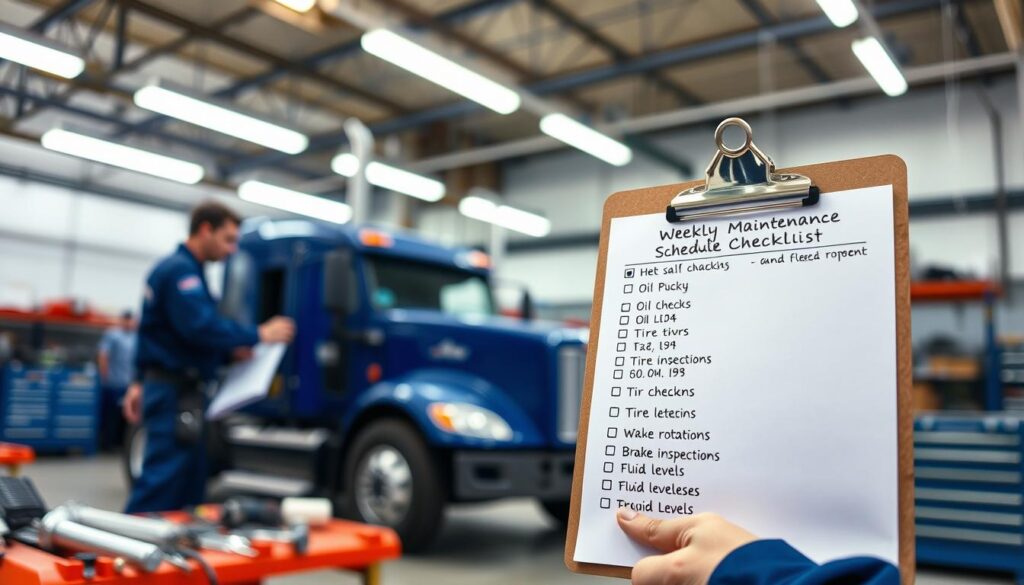
Smart owner-operators implement weekly maintenance protocols that catch developing problems before they compromise efficiency and profitability. These mid-interval tasks require more attention than daily checks but prevent deterioration leading to emergency repairs. Dedicate two to three hours each week to these critical inspections.
Battery Terminal Cleaning and Voltage Testing
Battery maintenance directly impacts reliable starting. Corroded terminals restrict electrical flow, creating problems that worsen in cold weather. Disconnect the negative terminal first to prevent accidental shorts, then clean both terminals with a baking soda solution.
A fully charged battery at rest should read 12.6 volts or higher. With the engine running, voltage should climb to 13.5-14.5 volts, indicating proper alternator charging. If you smell rotten eggs near batteries, one may have ruptured—replace immediately.
Air Filter Condition and Restriction Indicator
Air filter restriction directly affects engine performance, fuel economy, and turbocharger longevity. Most trucks feature color-coded restriction indicators: green indicates adequate airflow, yellow warns that filter replacement approaches, and red demands immediate attention—continuing operation risks turbocharger damage.
Remove the housing cover to visually inspect the element. Look for tears allowing unfiltered air to bypass protection and check for oil saturation indicating crankcase ventilation problems. Service intervals vary by operating environment—dusty conditions accelerate filter loading dramatically compared to highway operation.
Drive Belt Tension and Wear Assessment
Drive belts power critical accessories including alternators, water pumps, and air compressors. Single belt failure can disable multiple systems simultaneously. Check tension using the deflection method—press firmly at the midpoint between pulleys. Proper tension allows approximately one-half to three-quarters inch deflection.
Inspect surfaces for glazing (shiny, hardened surfaces), cracking, fraying, or chunk loss. Serpentine systems require attention to automatic tensioners—if the position indicator shows operation outside normal range, the entire tensioner assembly needs replacement.
Fifth Wheel and Kingpin Lubrication
The fifth wheel coupling bears tremendous stress during acceleration, braking, and cornering. Inadequate lubrication causes excessive wear manifesting as difficult coupling operations, unusual noises, and potentially dangerous separation incidents. Apply high-quality fifth wheel grease across the contact area, focusing on the throat where the kingpin enters.
Inspect the kingpin for wear, cracks, or damage. Excessive wear creates looseness producing clunking sounds and unstable handling. Use a kingpin wear gauge—replacement becomes necessary when wear exceeds specifications, typically around 3/16 inch reduction from original diameter.
Monthly Owner-Operator Maintenance Checklist
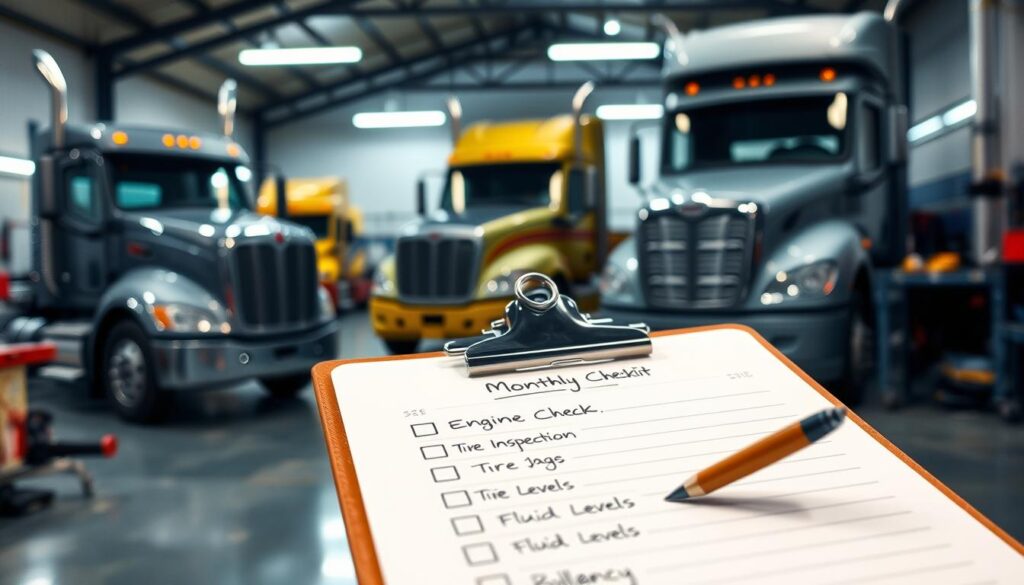
Monthly inspections go beyond daily and weekly tasks to address critical systems requiring deeper examination. Schedule these thorough examinations during weekend downtime or planned home time to ensure adequate attention without impacting revenue.
Complete Chassis Lubrication Points
Chassis lubrication represents one of the most critical monthly tasks. Under-greased components wear exponentially faster and can fail suddenly. Focus on universal joints, king pins, spring pins, equalizer pins, shackle pins, slack adjusters, and fifth wheel mechanisms. Use the “grease until new grease appears” technique to ensure complete purging of contaminated lubricant.
Coolant Concentration and Hose Inspection
Coolant system failures cause overheating that warps cylinder heads and blows head gaskets—repairs costing $8,000-$15,000. Use a refractometer to test antifreeze protection levels (at least -34°F for most operations). Test pH levels to detect corrosion-causing acidity.
Inspect every coolant hose for soft spots indicating internal deterioration, surface cracks, bulges showing weak spots, abrasion points, and corroded clamps. The $30 cost of a replacement hose beats a $3,000 towing bill.
Steering and Suspension Components
Steering system failures cause loss of directional control with potentially catastrophic consequences. Check tie rod ends for wear—any detectable movement indicates replacement is necessary. Inspect drag links, pitman arms, and steering gear box mounting bolts that can loosen from vibration.
For suspension, inspect leaf springs for cracks, breaks, and missing leaves. Air bag suspensions require checking for leaks using soapy water at connections and verifying proper inflation pressure. Test shock absorbers by pushing down on each corner—the truck should return to normal height without bouncing.
Exhaust System and DEF Component Checks
Walk around with the engine running to detect exhaust leaks by sound and smell. Pay attention to manifold connections, turbocharger joints, and pipe hangers. DEF system maintenance prevents expensive repairs—check the tank for contamination, verify injector operation without crystallization buildup, and monitor DPF condition through dashboard indicators.
The HDJ Perspective
The economics of maintenance have shifted dramatically in the past five years. With ATRI reporting average repair costs at $0.198 per mile and trucks traveling 38,249 miles between breakdowns in 2024, the data confirms what experienced operators have always known: preventive maintenance pays. The operators who struggle financially are almost universally those who view maintenance as an expense to minimize rather than an investment to optimize. Build your maintenance schedule around your specific operating conditions—not generic intervals—and document everything. That documentation becomes invaluable during warranty claims, insurance discussions, and eventual resale.
Quarterly Service Intervals and Seasonal Preparations
Three-month service cycles address critical wear items directly impacting engine longevity, transmission durability, and operational safety. These intervals represent the balance between maintenance frequency and component service life.
Engine Oil and Filter Change Procedures
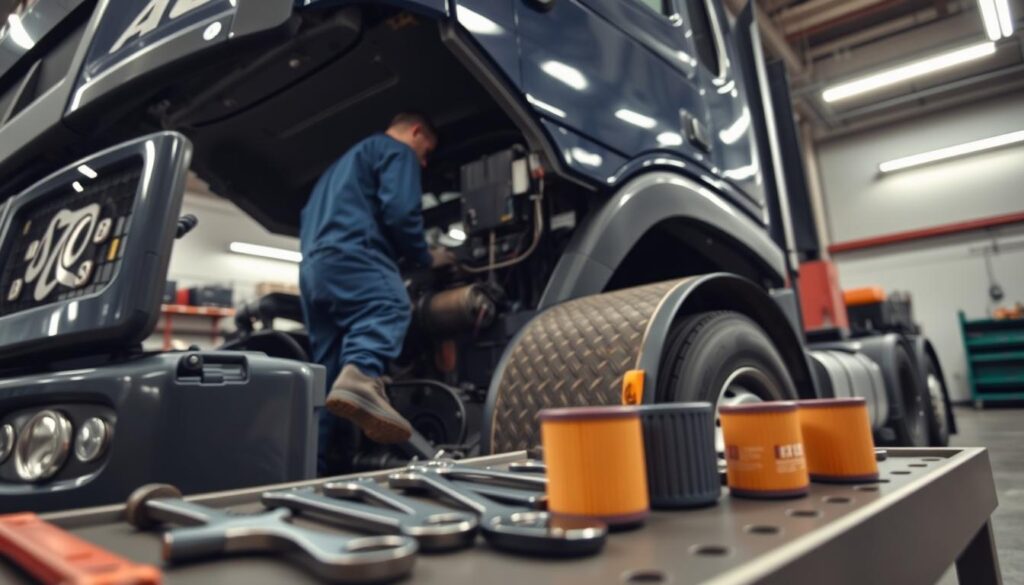
Oil change intervals vary dramatically by engine type and manufacturer. Older designs typically require service every 4,500 miles or 1,300 engine hours, while modern engines with advanced filtration can extend to 35,000 miles or 825 hours. Always consult your specific manufacturer’s recommendations—using the wrong schedule accelerates wear and voids warranty coverage.
Proper procedures begin with warming the engine to operating temperature, suspending contaminants for complete drainage. Replace both oil and filter simultaneously, using manufacturer-specified grades with appropriate API certifications. Document every service with mileage, date, oil type, and filter brand.
Fuel Filter Replacement and Water Separator Service
Clean fuel delivery protects expensive injection components. Replace primary and secondary filters every 6-12 months depending on your model. Drain water separator bowls daily in humid climates. Never wait for restriction indicators to illuminate—that signals the filter is already compromising fuel delivery.
Seasonal Climate Adjustments
Cold weather preparations include testing coolant freeze protection to at least -34°F, installing winter-grade diesel or anti-gel additives, and checking block heaters and battery capacity. Measure tread depth regularly, maintaining at least 4/32 inch on steer tires. Visit truck wash facilities regularly—road salt accelerates corrosion.
Warm weather preparations focus on cooling system capacity. Check air conditioning for refrigerant leaks and condenser debris buildup. Verify adequate airflow through radiators, charge air coolers, and condenser units. Monitor tire pressure carefully, as warm air raises inflation levels.
Share Your Maintenance Expertise
Have maintenance insights from years of keeping trucks on the road? Heavy Duty Journal welcomes contributions from experienced technicians and fleet professionals.
Annual DOT Inspections and Major Service Milestones
Federal regulations mandate comprehensive annual inspections, while manufacturers establish critical service milestones protecting your investment. Understanding both ensures legal operation and long-term reliability.
Federal DOT Annual Inspection Requirements
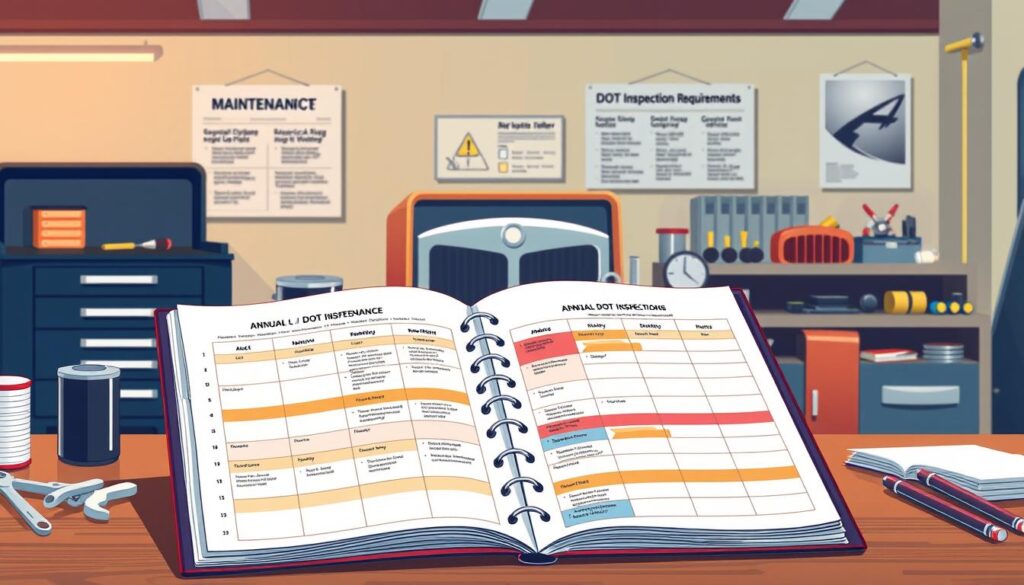
Every commercial vehicle must undergo comprehensive annual inspection by a qualified inspector at an authorized facility. The inspection evaluates all safety-critical systems including brakes, steering, suspension, lighting, coupling devices, and exhaust. Documentation must be retained for 14 months—this report serves as proof of compliance during roadside inspections and audits.
While annual inspection represents the legal minimum, experienced operators view it as verification that ongoing maintenance delivers results. Don’t rely solely on this yearly check to identify problems that daily and weekly inspections should catch.
Major Component Service Intervals
Critical maintenance occurs at major mileage milestones based on manufacturer engineering specifications. Air dryer filter replacement typically falls between 100,000-150,000 miles depending on engine model. Power steering fluid filters require changes at 150,000 miles. Valve adjustments occur first at 150,000 miles, then every 200,000-300,000 miles depending on engine type.
DEF system service at 150,000 miles maintains emissions compliance and prevents costly derates. Fan and accessory drive belts require replacement between 150,000-300,000 miles. Differential oil changes occur between 150,000-250,000 miles depending on model. Following these intervals prevents premature failures while maximizing component life.
Turbocharger and EGR System Maintenance
Turbocharger inspection requires checking for shaft play (excessive movement indicates bearing wear), listening for unusual noises, and examining connections for leaks. Professional cleaning or replacement typically occurs at 400,000-500,000 miles, though operating conditions significantly impact timing.
EGR valve inspection and cleaning prevents carbon buildup restricting valve movement. EGR cooler testing identifies leaks and restrictions before they cause major problems. Well-maintained EGR systems maintain optimal fuel economy and reduce DPF regeneration frequency.
Engine Maintenance Priorities for Maximum Uptime
Your engine represents the single most expensive component of your truck, making strategic engine maintenance the foundation of profitable operations. Three critical systems require priority attention: the emissions system, fuel delivery components, and valve train operation.
Diesel Particulate Filter Regeneration Monitoring
The DPF traps soot particles from exhaust gases to meet emissions standards. Passive regeneration occurs naturally during highway driving when exhaust temperatures reach 600°F or higher. Active regeneration kicks in when the engine control module detects elevated soot loading. Parked regeneration becomes necessary when driving conditions don’t allow complete passive or active cycles.
Professional DPF cleaning runs $300-$600, while complete replacement costs $2,000-$4,000. Regular monitoring practices help avoid the higher expense: watch soot loading percentages on your cluster, respond promptly to regeneration requests, and avoid excessive idling preventing complete regeneration cycles.
Injector Performance and Fuel System Cleanliness
Modern common-rail injectors operate at pressures exceeding 30,000 PSI, requiring extremely clean fuel to prevent wear. Watch for warning signs including rough idle, power reduction, increased fuel consumption, black smoke during acceleration, and difficult cold starting.
Using quality fuel from reputable high-volume sources provides the first defense against contamination. Change fuel filters at recommended intervals—typically 20,000-30,000 miles. Quality fuel additives help prevent injector deposits restricting flow. Catching problems early costs far less than replacing multiple injectors after complete failure damages other components.
Valve Adjustments and Overhead Service
Valve lash clearance changes over time as components wear. Incorrect clearance creates problems from annoying noise to catastrophic engine damage. Most engines require first overhead inspection at 150,000 miles, then every 200,000-300,000 miles depending on model.
Complete overhead service includes injector inspection, rocker arm and shaft examination, cylinder head bolt torque verification, and comprehensive valve train component inspection. Typical service costs $1,500-$2,500 but prevents far more costly repairs from incorrect valve clearances.
Brake System Service Intervals and Safety Checks
When your truck weighs 80,000 pounds fully loaded, brake system reliability becomes a matter of life and death. According to CVSA, brake-related violations comprise the largest percentage of all out-of-service vehicle violations during roadside inspections—making brake maintenance your highest priority.
Air Brake Component Inspection
Your air compressor must build pressure from 85 to 100 PSI within manufacturer-specified timeframes. The governor controls pressure through cut-in and cut-out settings (typically 100-125 PSI). Your air dryer removes moisture—failed dryers allow water accumulation that freezes in winter, causing complete brake failure.
Conduct thorough air leak testing during every pre-trip. Air loss exceeding 3 PSI per minute with brakes applied indicates critical compromise. With brakes released, loss should not exceed 1 PSI per minute.
Brake Pad and Drum Measurement
FMCSA regulations specify minimum brake lining thickness of 1/4 inch at the shoe center for drum brakes. Never wait until reaching legal minimums—schedule service well before. Typical brake pad lifespan ranges from 50,000-100,000 miles depending on operation. Mountain routes and frequent urban stops accelerate wear significantly.
Slack Adjuster and Pushrod Stroke Verification
Automatic slack adjusters maintain proper adjustment as lining wears. Never manually adjust automatic slack adjusters except during installation or brake reline—manual adjustment masks underlying problems. Measure pushrod stroke with full brake pressure applied. Long-stroke chambers allow 3/4 inch maximum travel; standard chambers permit 1 inch maximum.
Tire Management and Rotation Strategy
A complete set of semi-truck tires costs $3,000-$6,000, making tire care one of the most impactful practices in your maintenance schedule. Implement systematic rotation schedules and alignment service to extend tire life significantly.
Proper Rotation Patterns
Steer tires should never be rotated to drive or trailer positions due to different load ratings and wear patterns. Drive axle tires can rotate side-to-side and between forward and rear drive axles. Trailer tires can rotate side-to-side and front-to-rear. Proper rotation every 25,000-50,000 miles extends total tire life by 20-30%.
Match tire tread depths when pairing duals—depth difference should not exceed 4/32 inch to prevent uneven loading. Never mix radial and bias-ply tires on the same vehicle.
Alignment and Irregular Wear Prevention
Misalignment causes tires to scrub rather than roll freely, reducing fuel economy by 0.3-0.5 MPG while accelerating wear. Annual 3-axle alignment costs $200-$400 but saves thousands in premature tire replacement. Check alignment immediately after steering or suspension work or impacts with curbs.
Learn to read wear patterns: feathered wear indicates toe misalignment, shoulder wear suggests camber problems, and cupping reveals worn suspension components.
Maintaining Accurate Service Records and Documentation
Every receipt and maintenance log represents financial protection for your business. The Technology & Maintenance Council’s Recommended Practices emphasize documentation as fundamental to effective fleet management. Detailed records establish proof for tax deductions, demonstrate maintenance diligence for resale value, and support warranty claims.
Track when services were performed, work completed, costs incurred, and next service due. Categorize expenses appropriately—repairs and maintenance qualify as current deductions, while improvements must be depreciated. IRS requirements mandate substantiation showing date, vendor, work description, and amount paid.
Component history assists diagnostic efforts when problems occur. Mechanics can see what’s been recently serviced, eliminating unnecessary testing. Tracking wear rates helps predict future intervals and identifies unusual patterns indicating developing problems.
Frequently Asked Questions
How much should I budget for semi truck maintenance per mile?
Budget based on your truck’s age: new trucks average 5 cents per mile, mid-age trucks (3-4 years) run 8-10 cents, and high-mileage trucks (750,000+ miles) can reach 15 cents per mile. For a truck running 120,000 annual miles, this translates to $6,000-$18,000 yearly. Industry data from ATRI shows the average across all fleet types at approximately 20 cents per mile, though owner-operators often achieve lower costs through diligent preventive maintenance.
What are the most critical daily pre-trip inspection items?
Focus on safety-critical systems: brake operation and air pressure (listen for leaks, check pushrod stroke), tire condition and inflation, all lighting systems, fluid levels (oil, coolant, power steering), and coupling device security. Federal regulations under 49 CFR 396.13 require drivers to verify safe operating condition before driving. The entire inspection takes 15-20 minutes when performed systematically.
How often should I change oil in my semi truck?
Oil change intervals vary dramatically by engine type—from 4,500 miles for older designs to 35,000 miles for modern engines with advanced filtration. Always follow your specific manufacturer’s recommendations, not generic guidelines. Using the wrong interval accelerates wear and can void warranty coverage. Document every service for warranty support and resale value.
What causes the most expensive semi truck repairs?
Engine failures from neglected oil changes or coolant system problems lead the list, often exceeding $15,000. Turbocharger damage from restricted air filters runs $4,000-$12,000. Transmission failures requiring rebuild cost $4,000-$8,000. Most of these catastrophic failures trace back to skipped preventive maintenance—the emergency repair costs 3-4 times what scheduled service would have cost.
How long should I keep maintenance records for my truck?
FMCSA requires retaining annual inspection documentation for 14 months minimum. However, smart operators keep comprehensive records for the entire ownership period. These records improve resale value by demonstrating maintenance diligence, support warranty claims when covered components fail prematurely, and provide tax documentation for business deductions. Digital tracking systems make retention easy while enabling analysis of maintenance patterns over time.
Critical Warning Signs That Demand Immediate Action
Every truck communicates problems through specific signals that experienced operators learn to identify. Your truck provides warning through dashboard indicators, auditory signals, performance changes, and visible fluid issues. The difference between a $200 repair and a $20,000 engine replacement often comes down to recognizing problems early.
Dashboard Warning Light Priorities
Red warning lights indicate conditions requiring immediate shutdown. Oil pressure warnings demand immediate shutdown without exception—continued operation destroys engine bearings within minutes. Coolant temperature warnings indicate overheating that can warp cylinder heads and blow gaskets. Charging system warnings reveal alternator failure leaving you stranded when batteries discharge.
Check engine lights activate when emissions system problems or sensor failures occur. While not always requiring immediate shutdown, persistent lights indicate problems that worsen over time. ABS warning lights indicate brake monitoring problems reducing effectiveness during emergency situations—schedule repairs quickly to restore full functionality.
Unusual Engine Noises and Vibration Patterns
Experienced operators develop intimate familiarity with normal sounds and vibrations. Knocking or pinging sounds indicate detonation or bearing problems requiring immediate diagnosis. Hissing suggests air or vacuum leaks affecting performance. Squealing indicates belt slippage or bearing problems. Grinding reveals gear or bearing damage demanding immediate attention.
Excessive vibration signals u-joint failure, unbalanced drivelines, engine misfire, or tire problems. Vibrations appearing or intensifying suddenly indicate developing mechanical issues. Investigating unusual vibrations prevents minor problems from cascading into major failures.
Fluid Leaks and Contamination Warning Signs
Watch for fluids dripping beneath your truck during inspections. Amber or brown oil appears near the engine or differential—address promptly to prevent environmental damage. Green, orange, or pink coolant near radiators indicates cooling system failures leading to overheating. Red transmission fluid signals inadequate lubrication risking catastrophic failure.
Contamination signs provide early warning of internal failures. Milky oil indicates coolant intrusion from head gasket or oil cooler failure—requires immediate attention to prevent bearing damage. Metallic particles suggest bearing wear demanding investigation. Dark, oxidized fluid indicates overheating breakdown of lubricant properties.
Building Your Maintenance Program for Long-Term Success
A comprehensive semi truck maintenance schedule represents the difference between consistent profitability and financial struggle. Every dollar invested in preventive maintenance returns multiple dollars through avoided breakdowns and extended equipment life.
The data is clear: trucks receiving regular maintenance can exceed 500,000 miles before major overhauls, while neglected vehicles often require expensive intervention at half that mileage. Beyond finances, proper maintenance ensures safety for you, other motorists, and the public—brake failures and tire blowouts from neglected service create dangerous situations with devastating liability potential.
Start implementing systematic habits today. Conduct thorough daily inspections, maintain detailed records, respond promptly to warning signs, and budget appropriately for scheduled service as a non-discretionary business expense. Your truck becomes a reliable business partner rather than an unpredictable liability.
Found This Maintenance Guide Valuable?
Help fellow owner-operators and fleet managers protect their investments. Share this comprehensive maintenance schedule with colleagues who could benefit from these proven strategies.