By Michael Nielsen, Editor & Publisher | 15+ Years in Diesel Repair & Fleet Operations
Last Updated: December 2025
⏱ Estimated reading time: 19 minutes
Understanding your fleet maintenance costs represents one of the most consequential strategic decisions for any commercial vehicle operation. The choice between building in-house capabilities or outsourcing to external providers directly influences operational efficiency, asset value, and your bottom line—and getting it wrong can cost you thousands of dollars annually.
Research from facilities and asset management literature consistently demonstrates that deferring $1 in maintenance generates $4 in future capital renewal expenses. This 1:4 cost multiplier demonstrates why your approach to managing service operations serves as a cornerstone of financial success. Whether you're running 15 trucks or 150, the maintenance model you choose shapes everything from daily operations to long-term profitability.
Effective decision-making requires systematic evaluation. Fleet managers must track current expenditures including labor, parts, bay fees, and equipment upkeep while measuring downtime impacts during repairs. Only by calculating comprehensive Total Cost of Ownership (TCO)—encompassing facility expenses, staffing, training, and regulatory compliance—can you make truly informed comparisons between in-house and outsourced approaches.
Key Takeaways
- Cost multiplier effect: Every $1 of deferred maintenance generates $4 in future capital expenses, making proactive maintenance strategy critical.
- Fleet size thresholds: Operations under 25 vehicles typically achieve better economics through outsourcing, while 75+ vehicle fleets often justify in-house investments.
- Hidden cost categories: In-house operations carry substantial overhead beyond technician wages—facilities, equipment depreciation, training, and compliance can add 40–60% to direct labor costs.
- Hybrid advantage: Many successful fleets combine routine in-house preventive maintenance with outsourced specialized repairs to optimize both cost and capability.
- Federal requirements: Under 49 CFR Part 396, motor carriers must systematically inspect, repair, and maintain all vehicles—regardless of which maintenance model they choose.
Understanding In-House vs. Outsourced Fleet Maintenance
Every fleet manager faces a fundamental choice: build maintenance capabilities inside the company or contract with specialists who handle it for you. This decision shapes your cost structure, operational flexibility, and long-term financial health. Before diving into detailed cost analysis, you need to understand what each maintenance model actually involves.
How In-House Maintenance Works
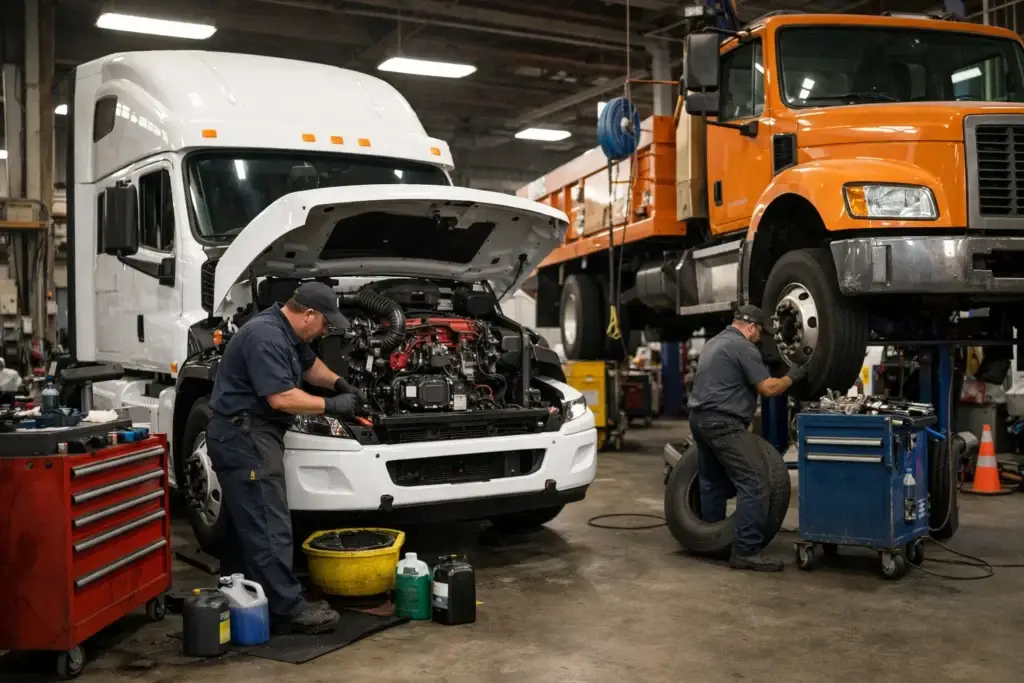
An in-house maintenance team means your company owns vehicles and manages all service operations directly. You hire mechanics and technicians as permanent employees, working in facilities your company owns or leases using equipment you've purchased specifically for fleet maintenance.
This approach gives you complete authority over maintenance scheduling and service priorities. Your team decides when vehicles get serviced, which parts to use, and how to handle unexpected breakdowns without consulting external parties. Companies with internal operations typically invest in dedicated maintenance bays equipped with diagnostic tools, lifts, and specialized machinery.
The investment requirements are substantial. Parts inventory sits in your warehouse, representing tied-up capital. Everything from brake pads to transmission components remains under your direct management. Under 49 CFR Part 396, motor carriers must maintain records for each vehicle including inspection schedules, repair documentation, and maintenance history—regardless of whether work is performed internally or externally.
How Outsourced Maintenance Works
Outsourced fleet maintenance transfers vehicle service responsibilities to external specialists. A third-party provider handles tracking, repairs, preventive maintenance, and compliance documentation. Your company pays for services without owning maintenance facilities or employing mechanics directly.
Service providers bring established networks of technicians, certified facilities, and industry expertise. They've already invested in diagnostic equipment, training programs, and compliance systems. Your business accesses these resources through contractual agreements rather than capital expenditures.
The outsourcing model typically follows a pay-as-you-go structure tied to actual usage. Costs align with mileage driven, number of services performed, or vehicles maintained. This approach eliminates large upfront investments in facilities and equipment, replacing them with recurring fees based on operational demand.
Control and Decision-Making Authority
The most significant difference between these approaches centers on operational control. Internal operations give you direct authority over every maintenance decision—your team sets schedules, chooses parts suppliers, and determines service quality standards without external approval.
With fleet operations handled internally, you control response times for breakdowns and emergencies. If a vehicle needs immediate attention, your mechanics can prioritize it instantly. External providers limit your day-to-day control; the service provider makes operational decisions based on their systems and protocols.
Financial control structures also differ dramatically. In-house operations carry high fixed costs regardless of usage, while outsourced services scale with actual vehicle activity. Building internal capabilities demands substantial upfront capital, whereas external providers require lower initial investment but create ongoing contractual obligations.
The True Cost of In-House Fleet Maintenance
The true expense of maintaining your own fleet service department encompasses direct, indirect, and hidden costs that can total significantly more than initial projections. Many fleet managers focus exclusively on technician wages and replacement parts, overlooking the substantial infrastructure and operational expenses that accumulate behind the scenes.
Facility and Infrastructure Costs
Physical infrastructure represents one of the largest fixed expenses in your operation. A single maintenance bay typically requires 600–800 square feet, meaning a three-bay facility demands at least 2,400 square feet before accounting for parts storage, office space, and common areas.
Monthly lease payments in industrial areas average $8–15 per square foot annually depending on location. For a 5,000 square foot facility, this translates to $40,000–75,000 in annual rent alone. Utility expenses—electricity, natural gas, water, and compressed air systems—add $3,000–6,000 monthly for active facilities.
Building maintenance creates recurring costs that many overlook. Concrete floors crack, bay doors need replacement, HVAC systems require service, and roofs eventually need repair. These facility upkeep costs average 2–4% of building value annually.
Equipment Investment and Depreciation
Modern vehicle maintenance expenses include sophisticated diagnostic computers capable of interfacing with multiple manufacturers' systems, typically costing $5,000–15,000 per unit. Two-post and four-post vehicle lifts range from $3,000–10,000 each. Tire changing equipment, wheel balancers, brake lathes, and alignment systems each represent $5,000–25,000 investments.
Beyond major equipment, each technician needs a fully equipped tool set worth $3,000–8,000. Diagnostic software requires annual subscription renewals costing $1,200–3,000 per license. Factor in approximately 10–15% of equipment value annually for maintenance, upgrades, and replacement reserves.
Staffing and Personnel Expenses
Personnel costs typically consume the largest portion of in-house maintenance budgets. ASE-certified technicians command wages ranging from $45,000–75,000 annually depending on experience and regional markets. Master mechanics with specialized certifications earn $60,000–90,000 or more. A three-person team quickly approaches $200,000 in base salary commitments.
Benefits packages add 25–40% on top of base wages. Health insurance, retirement contributions, paid time off, and sick leave create substantial additional expenses. Workers' compensation insurance for automotive technicians runs 8–15% of payroll due to inherent injury risks.
$570,000
Representative annual cost for a medium-sized in-house fleet maintenance operation including salaries, facilities, equipment, administration, and downtime
Parts Inventory and Working Capital
A well-stocked parts room for a medium fleet typically holds $25,000–75,000 in inventory value at any time. This capital sits idle until parts are installed, creating opportunity costs that many cost analyses overlook. Physical storage infrastructure, climate-controlled areas for sensitive components, and organized bin systems require additional investment.
Inventory management demands both software systems and personnel time. Parts ordering, receiving, organization, and cycle counting require dedicated attention. Most operations experience 5–10% annual inventory shrinkage from obsolescence, damage, and theft.
Keep Your Fleet Running at Full Capacity
Get HDJ's maintenance guides, compliance updates, and fleet management strategies delivered weekly — built for working diesel professionals.
Breaking Down Fleet Maintenance Outsourcing Costs
When evaluating outsourced fleet maintenance, companies must decode various pricing mechanisms to determine true operational costs. Third-party maintenance involves multiple cost layers beyond obvious service fees, and understanding these expenses requires examining both direct charges and indirect operational impacts.
Fixed-Price vs. Usage-Based Contracts
Maintenance contract pricing typically follows two primary structures. Fixed-price contracts offer predictable monthly or annual costs regardless of actual maintenance volume, providing financial stability and simplified budgeting. The trade-off comes when actual maintenance requirements fall below contracted levels, potentially resulting in overpayment.
Usage-based models charge according to actual services performed, miles driven, or maintenance events completed. This approach aligns expenses directly with operational activity. Fleet managers gain flexibility but accept variable monthly costs that complicate financial forecasting. Many successful operations negotiate hybrid contracts combining both mechanisms.
Per-Mile and Per-Service Pricing
Fleet service providers commonly implement cost-per-mile programs ranging from $0.03 to $0.15 per mile depending on vehicle type and included services. Light-duty vehicles fall at the lower end while heavy trucks command premium rates. Per-mile pricing works exceptionally well for fleets with predictable driving patterns.
Per-service pricing aligns fleet repair costs with specific maintenance tasks completed. According to ATRI's Operational Costs of Trucking research, repair and maintenance costs averaged $0.202 per mile in 2023, with significant variation based on fleet size, duty cycles, and maintenance approach. Tiered pricing structures reward higher service volumes with reduced per-unit costs—typically 15–25% savings compared to individual service pricing.
Emergency and After-Hours Premiums
Unplanned breakdowns introduce significant cost variables. Emergency roadside service typically carries 50–100% premium charges above standard rates. After-hours and weekend service availability commands 30–50% premiums, while weekend emergencies can double baseline costs. Expedited parts procurement adds $50–$300 per order in premium freight charges.
Hidden Expenses in Running In-House Operations
When calculating in-house maintenance budgets, many fleet managers overlook critical cost factors that can inflate actual expenses by 20–40%. These hidden costs often don't appear on monthly expense reports but significantly impact total cost of ownership.
Training and Certification Requirements
Maintaining a competent technical workforce requires continuous investment in education and certification programs. ASE certification testing fees range from $36 to $46 per test, with technicians typically needing multiple certifications that expire every five years. The Technology & Maintenance Council's Recommended Practices provide peer-reviewed maintenance standards developed by industry professionals, but implementing these standards requires ongoing technician training.
Manufacturer-specific training adds another expense layer. Training sessions at regional centers create costs including travel ($500–1,500), course registration ($500–2,500), and lost productivity while technicians are away. Emerging technologies—electric vehicles, ADAS systems, telematics integration—demand entirely new skill sets, with comprehensive EV training programs costing $3,000 or more per technician.
Regulatory Compliance and Safety
OSHA workplace safety standards require comprehensive documentation systems, dedicated staff time, and specialized software costing $2,000–5,000 annually. Environmental compliance for hazardous waste disposal—used oil, antifreeze, solvents, and batteries—adds $300–800 monthly for licensed disposal services plus storage containers meeting EPA specifications.
⚠️ Compliance Warning
The average cost of an OSHA serious violation citation is $14,502, while willful violations average $145,027 per citation. Proper compliance programs and documentation aren't optional—they're essential risk management for any in-house maintenance operation.
Unplanned Downtime and Lost Productivity
Vehicle unavailability creates financial impacts extending throughout the entire organization. Fleet downtime costs go far beyond immediate repair expenses, affecting revenue generation, customer satisfaction, and operational efficiency. A delivery van sitting in the maintenance bay represents lost delivery capacity and missed revenue opportunities.
Compensatory measures add unexpected expenses: overtime pay for drivers covering additional routes, vehicle rentals to replace unavailable units, expedited shipping to meet customer commitments, and subcontractor services at premium rates. In-house maintenance teams face unique challenges with unplanned repairs that interrupt workflow and strain resources.
Hidden Costs When Outsourcing Fleet Maintenance
Outsourced fleet maintenance contracts rarely reflect the full financial picture. Administrative and logistical costs add substantial overhead to baseline service fees that many fleet managers overlook during initial vendor evaluation.
Transportation and Logistics Overhead
Every vehicle requiring service must physically reach the maintenance facility, creating multiple cost layers. Driver wages during vehicle delivery constitute the primary expense—a technician or driver transporting the vehicle to the service location takes them away from productive work. For a delivery requiring two hours round-trip at $25 per hour, each service visit adds $50 in labor costs before any maintenance work begins.
Returning drivers to their starting point creates additional complications. Companies either provide shuttle services, arrange rideshares, or maintain rental vehicle pools specifically for this purpose. Towing expenses emerge when vehicles cannot be driven safely, adding $150–400 per tow depending on distance and vehicle size.
Quality Oversight and Vendor Management
Effective maintenance vendor management requires dedicated internal staff time that many organizations fail to budget adequately. Someone with mechanical understanding must review service reports, inspect returned vehicles, and verify that specified procedures were actually performed. Vendor performance monitoring consumes ongoing management attention—tracking completion times, first-time fix rates, and parts quality requires systematic data collection and analysis.
These accumulated administrative, logistical, and relationship management costs typically add 15–30% to headline contract pricing. A maintenance agreement quoted at $200,000 annually may actually cost $230,000–260,000 when all internal support expenses are properly accounted for.
Cost Comparison by Fleet Size
Your fleet's vehicle count creates distinct financial realities that make one maintenance approach clearly superior to the other. The economic advantages of in-house versus outsourced fleet maintenance solutions shift dramatically at specific threshold points.
Small Fleets: Under 25 Vehicles
For operations managing fewer than 20–25 vehicles, outsourcing typically delivers compelling financial advantages. The primary challenge centers on resource utilization—a single in-house mechanic cannot be fully occupied with maintenance tasks from a limited vehicle count, creating costly idle time that still requires salary payment. This inefficiency can inflate per-vehicle maintenance costs by 40–60%.
Capital investment requirements present significant barriers. Diagnostic equipment, facility buildout, and specialized tools demand $150,000–500,000 in initial investment that smaller operations struggle to justify. Per TMC fleet benchmarking data, small fleets also face single-point-of-failure vulnerability—when your one technician takes vacation or leaves the company, maintenance capability disappears entirely.
Medium Fleets: 25–75 Vehicles
The 25–75 vehicle range represents the most complex decision territory. Vehicle utilization intensity, geographic concentration, and vehicle standardization all influence whether in-house or outsourced approaches prove more cost-effective. High-mileage operations running vehicles 200+ miles daily may generate sufficient maintenance volume to justify in-house capabilities.
Fleets operating from centralized locations can more easily justify in-house facilities—all vehicles return to one location for service, maximizing facility utilization. Dispersed operations across multiple cities find greater value in local outsourced providers who eliminate transportation time and logistics complexity.
Large Fleets: 75+ Vehicles
Operations managing 75+ vehicles increasingly favor in-house maintenance due to substantial economies of scale. Technician utilization reaches optimal levels—multiple full-time mechanics stay productively occupied, eliminating idle time inefficiency. Parts purchasing power delivers 20–35% savings through volume discounts and favorable supplier agreements.
Capital investment amortization becomes economically attractive when facility costs, diagnostic equipment, and management systems spread across 100+ vehicles. A $200,000 facility investment represents just $2,000 per vehicle for a 100-unit fleet—a manageable cost easily recovered through labor savings.
The HDJ Perspective
After 15+ years working in and around diesel repair and fleet operations, the pattern is consistent: fleets that commit entirely to one maintenance approach—all in-house or all outsourced—almost always leave money on the table. The insight that gets overlooked isn't about fleet size thresholds; it's about maintenance complexity. A 30-truck fleet running identical spec'd day-cabs on short regional routes has completely different math than a 30-truck fleet running mixed vocational equipment across three states. The break-even calculation shifts entirely based on what's actually breaking and how fast you need it back rolling. Fleets that consistently achieve the lowest total cost of ownership share one discipline: they've honestly categorized each maintenance type by frequency, complexity, and required response time—then matched each category to the model that serves it best. That analytical habit beats any rule of thumb about fleet size.
Hybrid Fleet Maintenance Models
Fleet maintenance doesn't require an all-or-nothing choice. Many successful operations blend both approaches, deploying each maintenance type where it performs most effectively. A well-designed hybrid model captures advantages from both strategies while minimizing weaknesses.
Keeping Routine Maintenance In-House
High-frequency maintenance tasks create the strongest case for internal capabilities. Oil changes, fluid checks, tire rotations, and basic inspections occur on predictable schedules and require generalist technicians rather than specialized expertise. When technicians perform the same tasks repeatedly, they develop efficiency and speed—per-service costs drop significantly compared to outsourcing these frequent operations.
Internal handling of routine maintenance preserves direct quality control over the most frequent vehicle touchpoints. Your team applies consistent standards, knows your vehicles intimately, and spots developing problems before they become emergencies. The cost structure heavily favors in-house execution for high-volume, low-complexity services: no markup fees, immediate service without scheduling delays, and bulk purchasing power for commonly used parts.
Outsourcing Specialized Repairs
Transmission rebuilds, engine overhauls, complex electrical diagnostics, and emissions system repairs occur infrequently but require expensive equipment and expert technicians with specific certifications. Diagnostic equipment for modern vehicle systems can cost $50,000–150,000 per workstation—tools that may sit idle for weeks between uses in smaller operations.
Under 49 CFR Part 396, motor carriers must maintain systematic inspection and repair programs, but the regulations allow carriers to "cause to be" maintained—meaning qualified third-party providers can perform compliance-related maintenance. Service providers specializing in complex repairs bring expert technicians who perform these procedures daily, current certifications, and specialized tools spread across many customers.
| Fleet Characteristic | Recommended In-House | Recommended Outsourced |
|---|---|---|
| Centralized Operations | Routine PM, basic repairs, tire service | Engine overhauls, transmission rebuilds, body work |
| Multi-Location Regional | PM at primary facility | All services at satellite locations |
| Nationally Dispersed | Basic inspections only | Most routine and all specialized work |
| Mixed Vehicle Types | Light-duty routine maintenance | Heavy-duty specialized, manufacturer-specific |
Free Professional Fleet Tools
Cost calculators, fault code lookup, maintenance planners, and more — built for owner-operators, fleet managers, and diesel techs. No signup required.
Measuring Cost Efficiency Beyond the Invoice
Maintenance cost comparisons remain incomplete without measuring broader business impact. The price you pay per repair represents just one component of the true financial equation—sophisticated fleet asset management requires evaluating how maintenance decisions affect operational performance, revenue generation, and long-term asset value.
Vehicle Uptime and Revenue Impact
Vehicle uptime directly determines your fleet's revenue-generating capacity. Every hour a delivery truck sits idle in a repair bay represents lost billable time, missed delivery windows, and potential customer dissatisfaction. A delivery vehicle generating $500 in daily revenue costs your business that amount for each day out of service.
A maintenance approach delivering 95% vehicle uptime at slightly higher cost per repair typically delivers superior financial results compared to cheaper maintenance yielding 85% uptime. The 10-percentage-point availability difference translates to substantial revenue impact across your entire fleet. Uptime—not cost per repair—should serve as the primary maintenance performance metric for most operations.
Preventive vs. Reactive Maintenance Balance
Measuring preventive maintenance compliance rates reveals how effectively your maintenance approach supports scheduled services. Industry leaders typically maintain 85–95% PM compliance rates, while struggling operations often fall below 70%. The ratio of preventive to unplanned maintenance expenses provides another critical indicator—industry benchmarks suggest 70–80% of total spending should fund preventive services.
The cost difference between preventive services and emergency repairs highlights the financial stakes. Scheduled oil changes cost baseline amounts; unplanned engine repairs from deferred maintenance cost 3–5x more. Emergency roadside repairs with towing and after-hours labor cost 5–8x preventive maintenance, while complete engine replacement from catastrophic failure costs 10–15x the accumulated preventive maintenance that could have prevented it.
Long-Term Asset Value Protection
Maintenance quality affects vehicle longevity in measurable ways. Well-maintained vehicles routinely deliver 20–30% longer service life compared to those receiving inconsistent care. If your fleet normally replaces vehicles every 5 years but improved maintenance extends that to 6.5 years, you've reduced annual capital expenditure by 23% without changing fleet size.
Resale value premiums reward documented maintenance histories. Vehicles with complete, digitally-accessible maintenance records command 15–25% higher resale prices compared to similar units with incomplete documentation. Buyers recognize that thorough maintenance histories indicate careful operation and reduce their ownership risk.
Financial Analysis Framework for Decision-Making
The right maintenance strategy emerges through rigorous financial analysis that quantifies every cost element. Fleet managers need structured frameworks that move beyond intuition toward data-driven decisions.
Calculating Your Break-Even Point
Break-even analysis determines the exact fleet size where in-house and outsourced costs converge. Fixed costs for in-house operations include facility expenses, equipment investments, and minimum staffing requirements. Variable costs change with each service event and include incremental labor, parts, and consumable supplies.
The break-even calculation: divide total fixed annual costs by the difference between outsourced cost per vehicle and in-house variable cost per vehicle. This threshold typically ranges from 25–75 vehicles depending on regional labor markets and facility costs. Fleets below this threshold often achieve better economics through outsourcing; those exceeding it can leverage internal economies of scale.
Five-Year Total Cost of Ownership
Long-term financial planning requires comprehensive TCO analysis spanning multiple years. In-house operations demand significant upfront capital—facility improvements, diagnostic equipment, initial hiring, and training programs. Annual operating costs encompass salaries with benefits, utilities, supplies, and certification requirements.
Outsourced maintenance features different cost patterns: lower initial transition expenses but ongoing contract fees with inflation escalators typically ranging from 2–4% annually. Applying appropriate discount rates creates net present value comparisons reflecting the time value of money—a $500,000 investment today differs substantially from $500,000 spread over five years.
Industry-Specific Considerations
The type of business you operate determines which fleet maintenance solutions deliver optimal financial outcomes. Maintenance processes vary dramatically across industries, and generic approaches often fail to address sector-specific challenges.
Delivery and Logistics Operations
Delivery fleets face distinct cost pressures including high-mileage vehicles with predictable wear patterns and intensive daily use. Vehicle standardization is common, creating opportunities for cost-effective in-house maintenance when identical vehicles use the same parts and procedures. However, geographic dispersion often complicates this advantage—vehicles operating across wide territories may find outsourced provider networks deliver faster response times.
Construction and Heavy Equipment
Heavy equipment requires specialized expertise that general automotive technicians typically lack. Excavators, loaders, dozers, and cranes demand technicians with specific certifications and diagnostic capabilities most general shops cannot provide. The investment required to develop comprehensive in-house capabilities often exceeds the cost of outsourcing for all but the largest construction operations.
Harsh operating conditions—dirt, dust, extreme loads, and continuous operation—accelerate wear and demand more frequent service intervals than standard road vehicles. Equipment downtime carries severe financial consequences, with project delays triggering contract penalties far exceeding direct repair costs. Manufacturer-certified service providers often become necessary to maintain warranties on expensive assets, effectively mandating outsourced relationships for newer equipment.
Field Service Vehicles
Field service vehicles supporting customer-facing operations present unique maintenance considerations. Vehicle appearance and reliability directly impact customer perception—a clean, well-maintained service vehicle reinforces professionalism and brand reputation. Geographic dispersion is common, with technicians often working from home or satellite locations, favoring outsourced maintenance networks providing convenient service locations across operating territories.
Frequently Asked Questions
What fleet size makes in-house maintenance cost-effective?
The break-even threshold typically falls between 25–75 vehicles, depending on regional labor costs, facility expenses, and operational complexity. Fleets under 25 vehicles rarely generate sufficient maintenance volume to keep in-house technicians fully utilized, creating idle-time costs that inflate per-vehicle expenses by 40–60%. Operations exceeding 75 vehicles can spread fixed infrastructure costs across enough units to achieve meaningful economies of scale, though the specific threshold varies based on vehicle types, geographic concentration, and management capabilities.
How do I calculate total cost of ownership for fleet maintenance?
Complete TCO calculation must include direct costs (labor, parts, consumables), indirect costs (facility overhead, equipment depreciation, management time), and opportunity costs (capital tied up in inventory and downtime-related revenue losses). For in-house operations, factor in employee benefits at 25–40% above base wages, annual training expenses of $2,000–5,000 per technician, and 10–15% annual equipment replacement reserves. For outsourced arrangements, add internal coordination costs, quality oversight time, and vehicle transportation expenses that typically add 15–30% above contract pricing.
What regulatory requirements apply to fleet maintenance programs?
Under 49 CFR Part 396, motor carriers must systematically inspect, repair, and maintain all commercial motor vehicles under their control. Required documentation includes vehicle identification records, maintenance schedules indicating inspection due dates, and repair records showing the date and nature of work performed. These records must be retained for one year while vehicles remain in service and six months after disposal. The regulations apply regardless of whether maintenance is performed in-house or by third-party providers—carriers remain responsible for compliance.
Can hybrid maintenance models reduce overall costs?
Hybrid approaches often deliver optimal results by matching maintenance types to appropriate service models. High-frequency routine services like oil changes and inspections favor in-house execution due to volume efficiencies and eliminated provider markups. Specialized repairs requiring expensive diagnostic equipment and certified technicians favor outsourcing, where costs spread across multiple clients. Many fleets achieve 15–25% cost reductions versus single-approach models by maintaining routine PM internally while outsourcing transmission work, engine overhauls, and complex electrical diagnostics.
Making Your Fleet Maintenance Decision
Your fleet maintenance costs strategy directly impacts vehicle uptime, operational efficiency, and long-term profitability. The choice between in-house operations and outsourcing depends on fleet size, geographic distribution, vehicle complexity, and management bandwidth—there's no universal right answer.
Data-driven analysis proves essential for smart decision-making. Calculate your total cost of ownership by tracking every expense category, from facility overhead to downtime-related revenue losses. Small fleets typically achieve significant cost savings through outsourcing, while larger operations may justify in-house investments through economies of scale. Most successful fleets combine both approaches, capturing advantages where they exist while accessing capabilities they can't economically maintain internally.
Apply the analytical frameworks presented throughout this guide to evaluate your specific situation. Consider not just current fleet size but anticipated growth, seasonal fluctuations, and strategic priorities. The right maintenance strategy aligns with your operational needs and positions your organization for sustainable competitive advantage.
Pass This Guide to Your Fleet Operations Team
Fleet managers weighing in-house versus outsourced maintenance need the full cost picture before committing to a budget direction. Share this breakdown with any operations director, owner-operator, or logistics manager responsible for controlling vehicle maintenance spend.