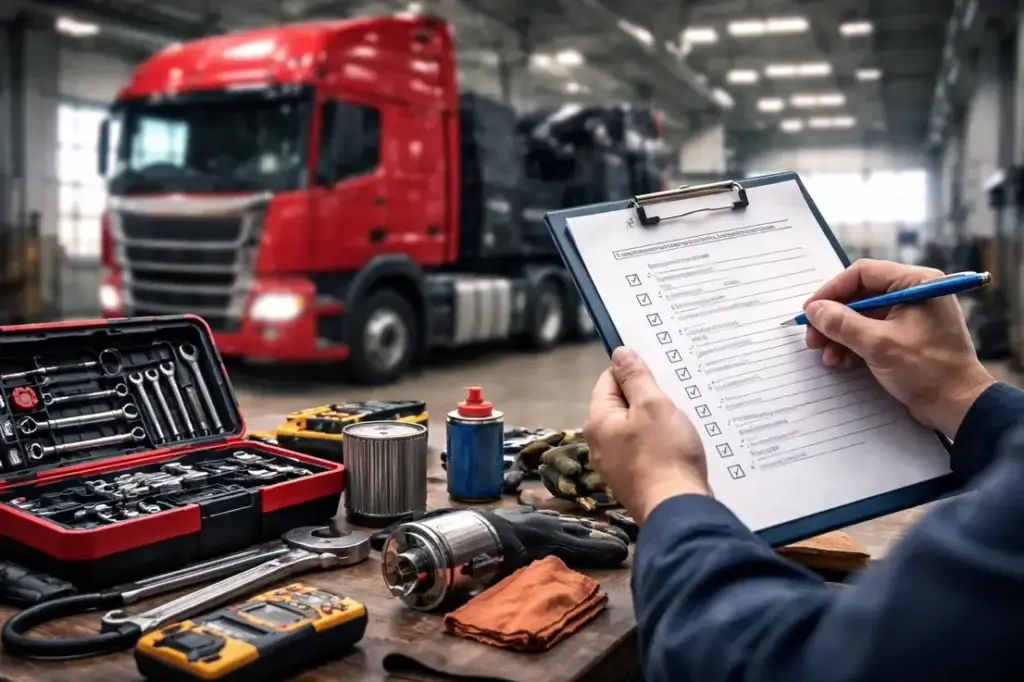

By Michael Nielsen, Publisher | 15+ Years in Diesel Repair
Last Updated: September 2026
⏱ Estimated reading time: 13 minutes
Heavy duty truck roadside assistance is emergency commercial vehicle support — towing, tire service, fuel and DEF delivery, mobile mechanical repair, battery service, and lockout assistance — built for vehicles weighing up to 80,000 pounds and dispatched 24/7 across the highway network. Unlike passenger-vehicle programs, commercial roadside providers carry specialized equipment (heavy-duty jacks, high-torque impact wrenches, rotator wreckers) and staff ASE T-series certified technicians who understand air brakes, multi-axle configurations, and diesel engines.
For fleet operations where every hour of downtime is lost revenue, having this in place before a breakdown happens is operational insurance, not a discretionary expense.
Key Takeaways
- ✓Downtime costs $448–$760 per day per vehicle in lost productive hauling time alone — before towing fees, missed delivery penalties, or spoiled refrigerated cargo are added in.
- ✓Coverage limits are more standardized than most fleet managers expect: typically $500 in labor and $5,000 in towing for the truck and attached trailer combined, with a $250 deductible.
- ✓Tires are the second-most-cited out-of-service violation nationally — 20.9% of all vehicle OOS findings in CVSA's 2026 Roadcheck, behind only brake systems.
- ✓Technician qualifications separate real capability from a tow truck with a toolbox — ASE T-series certification is the only objective way to verify commercial diesel and air-brake competency.
In This Guide
- The Financial Impact of Commercial Vehicle Breakdowns
- Emergency Tire Services: The Most Common Roadside Need
- Fuel Delivery and DEF Services
- Heavy Duty Towing and Recovery Operations
- Mobile Mechanical Repair and Diagnostics
- Battery Service and Lockout Assistance
- Selecting the Right Roadside Assistance Provider
- Membership Plans vs. Pay-Per-Call Services
- Preparing Your Fleet for Roadside Emergencies
- Frequently Asked Questions
The Financial Impact of Commercial Vehicle Breakdowns
The true cost of a roadside breakdown extends far beyond the repair bill. Every minute a commercial truck sits disabled translates directly into lost revenue that no repair can recover. According to the American Transportation Research Institute's 2026 Analysis of the Operational Costs of Trucking, repair and maintenance costs rose 8.6% in 2025 to 21.5 cents per mile — one of the fastest-growing line items in the report, and one that spikes hardest exactly when a breakdown forces emergency rates instead of scheduled shop time.
Industry data consistently shows downtime costs fleet operators between $448 and $760 per day per vehicle — a figure that accounts only for lost productive hauling time. Missed delivery windows trigger additional penalties that can reach thousands of dollars per incident depending on contract terms, and refrigerated loads face steeper consequences still: temperature-sensitive cargo begins deteriorating within hours of a climate-control failure.
19% Placed Out of Service
CVSA's 2026 International Roadcheck placed 10,350 of 54,575 inspected vehicles out of service — meaning 81% passed clean. Brake systems (24.3% of vehicle OOS violations) and tires (20.9%) accounted for the majority of what grounded the rest. Source: CVSA 2026 Roadcheck Results.
Beyond immediate financial losses, breakdown frequency and roadside inspection outcomes directly influence carrier safety scores. FMCSA's CSA program tracks maintenance-related violations that remain on a carrier's record for 24 months, and a pattern of unreliable service damages shipper relationships that take years to rebuild.
Heavy Duty Journal has tracked this pattern across the fleets we cover at heavydutyjournal.com: professional roadside assistance helps minimize both impacts by reducing breakdown duration and ensuring proper repairs before trucks return to service.
Emergency Tire Services: The Most Common Roadside Need
Tire-related issues cause more commercial truck roadside stops than any other mechanical problem except brakes. During CVSA's 2026 International Roadcheck, tire violations accounted for 2,914 out-of-service findings — 20.9% of all vehicle OOS violations nationally, second only to brake systems. Failures range from sudden blowouts at highway speeds to slow leaks that compromise safety over hundreds of miles.
Professional emergency tire service goes far beyond a simple tire change. Qualified providers arrive with heavy-duty hydraulic jacks rated for loaded commercial vehicles, high-torque impact wrenches, and tire-handling equipment built for 100-pound commercial tires — letting technicians complete replacements in a fraction of the time improvised methods would take.
Multi-axle trailer work demands more still: technicians who understand weight distribution and proper torque specifications per TMC Recommended Practices, plus bottle jacks and tire dollies that let them service inside dual tires without pulling the outer tire first.
| Tire Service Type | Response Capability | Typical Service Time |
|---|---|---|
| Replacement (spare available) | Immediate installation using vehicle spare | 45–90 minutes |
| Tire delivery & installation | Sourcing and installation of new tire | 2–4 hours |
| Mobile inflation & leak repair | Pressure restoration and temporary repairs | 30–60 minutes |
| Multi-axle trailer service | Dual tire configurations, multiple positions | 1–3 hours |
Fuel Delivery and DEF Services
Running out of diesel or diesel exhaust fluid creates an immediate, entirely preventable operational disruption. Emergency delivery specialists dispatch to the truck's exact location with enough fuel to reach the nearest station safely — typically 5 to 15 gallons — with urban and interstate response in 30 to 60 minutes and remote locations sometimes running 90 minutes or more. Most membership plans cover the delivery service and labor at no additional cost, with the driver paying market rate for the fuel itself.
DEF depletion carries steeper consequences than a simple inconvenience: modern selective catalytic reduction systems progressively derate engine power as DEF runs low, eventually limiting the truck to idle speed. Professional DEF delivery uses dedicated dispensing equipment and fluid meeting ISO 22241 specifications — even small amounts of contamination from diesel fuel or other substances can damage expensive SCR catalysts and sensors, which is exactly why this isn't a job for a jerry can and a funnel.
Heavy Duty Towing and Recovery Operations
When catastrophic failure or accident damage immobilizes a commercial truck, recovery requires equipment capable of handling vehicles weighing up to 80,000 pounds with cargo — and technicians who understand load distribution, weight transfer, and proper rigging. Most coverage includes towing to the nearest qualified repair facility within 25 to 50 miles, typically up to $500 in labor and $5,000 in towing for the truck and attached trailer combined, with a $250 deductible applying at time of service.
Flatbed transport becomes necessary when drivetrain damage — transmission failure, differential problems, severe axle damage — rules out conventional towing with wheels on the ground; towing a compromised drive system can destroy remaining components and significantly increase repair costs.
The most demanding recoveries require rotator wreckers with boom systems capable of lifting and rotating heavy loads through 360 degrees, with deployment costs of $500 to $2,000 or more depending on complexity — most standard plans cover only a portion of these premium services. Winch-out coverage for vehicles stuck in mud, sand, or snow typically applies within 100 feet of the roadway; extractions beyond that threshold are billed separately and can reach several thousand dollars depending on terrain.
Mobile Mechanical Repair and Diagnostics
Advanced mobile repair services turn a breakdown location into a temporary shop, eliminating expensive towing in many situations by bringing certified technicians, diagnostic equipment, and parts inventory directly to the disabled vehicle. Most plans include up to $500 in labor for mobile repairs, though parts remain the operator's responsibility — a substantial savings compared to towing fees that can easily exceed $1,000 for long-distance recovery.
Mobile technicians arrive with diagnostic scan tools that read engine fault codes within minutes, connecting directly to the truck's electronic control modules to reveal sensor failures, fuel system problems, and air intake issues. Common roadside repairs include serpentine belts, minor fuel-system leaks, failed sensors triggering engine derate, alternator and starter motor failures, and corroded electrical connections.
Brake adjustments for foundation brakes that have fallen out of specification are a safety-critical category of their own — under 49 CFR Part 396, motor carriers must systematically inspect, repair, and maintain every commercial motor vehicle under their control, and out-of-adjustment brakes place a vehicle out of service at the next roadside inspection until corrected.

Knowing what a fault code means before the technician even arrives changes the conversation at the roadside — a driver who can tell dispatch "it's throwing a derate code, not a dead-stop failure" gets the right resource dispatched the first time instead of the second.
Battery Service and Lockout Assistance
A dead battery can turn a routine stop into an hours-long emergency, since standard jump-start equipment lacks the amperage to crank a diesel engine's high compression ratios. Professional providers carry heavy-duty portable power units built for this, and a competent technician assesses the electrical system for what actually caused the failure — a charging fault, a parasitic drain, simple deterioration — rather than just reconnecting cables and moving on.
Cold weather compounds the problem: battery capacity can drop 30–50% below freezing while cranking demand rises, which is why a battery that performed fine all summer often fails on the first hard freeze. Electronic load testers let mobile technicians determine on the spot whether a battery needs charging or replacement, with battery cost typically paid by the operator and labor covered under the roadside plan.
Lockouts carry the same operational impact as any other breakdown — zero progress toward delivery until resolved. Professional locksmiths specializing in heavy-duty vehicles use non-destructive entry methods and can program replacement transponder keys for modern electronic immobilizer systems; a traditional mechanical key typically takes 30–60 minutes on-site, while a transponder key requiring programming runs 1–2 hours.
Selecting the Right Roadside Assistance Provider
The cheapest plan rarely delivers the best value when a breakdown happens far from home during a critical delivery window. True 24/7 availability means human dispatch, not an automated queue that waits for business hours. Response guarantees should be specific and documented — urban areas typically run 45 to 60 minutes, suburban 60 to 90 minutes, with honest providers communicating longer rural windows upfront rather than making empty promises.
OOIDA offers breakdown coverage built specifically for independent owner-operators, underscoring how specialized commercial trucking emergency services really are compared to a generic auto club membership.
Geographic coverage needs to extend to every region your trucks actually run — some providers maintain genuinely national networks while others have real gaps in rural corridors, and discovering that gap after a breakdown is the worst possible time to find out.
Technician qualifications matter just as much: general automotive experience doesn't cover commercial diesel engines, air brake systems, or multi-axle configurations. ASE's T-Series certifications (T1-T8) are the objective way to validate that competency — a technician holding T2 through T8 is recognized as an ASE Certified Master Medium-Heavy Truck Technician.
| Evaluation Factor | What to Verify | Red Flags to Avoid |
|---|---|---|
| Coverage scope | Tractors and trailers included; all service types | Tractor-only coverage; excluded categories |
| Service availability | 24/7 human dispatch; documented response times | Business-hours only; vague timing promises |
| Geographic reach | Confirmed coverage in all operating regions | Regional limitations; rural coverage gaps |
| Provider credentials | ASE T-series certified diesel technicians | General automotive background only |
Membership Plans vs. Pay-Per-Call Services
Basic membership plans run roughly $35 to $60 per month per vehicle — about $420 to $720 annually — covering towing, tire changes, fuel delivery, and jump-starts. Premium tiers with unlimited service calls and full trailer coverage often exceed $1,200 per year.
Compare that to pay-per-call pricing: a single major breakdown requiring towing commonly runs $500 to $2,500 in 2026, with heavy recovery reaching $2,500 to $15,000 or more, plus $100 to $300 per additional service like tire replacement or mobile repair. A membership plan typically pays for itself with one or two significant roadside events per year.
Fleet operations running 10 or more trucks often secure fleet-specific programs with rates 15–30% below standard individual membership pricing, along with centralized billing and management reporting that surfaces breakdown patterns and vehicle reliability issues across the whole fleet — visibility that's easy to lose when memberships and invoices are tracked separately per truck.
Preparing Your Fleet for Roadside Emergencies
The most successful trucking operations don't just respond to roadside emergencies — they systematically prepare for them. Every driver should carry provider contact information, membership account numbers, and policy details before an emergency strikes, since confusion at the roadside costs real time. When requesting assistance, drivers need to provide precise location (mile marker or GPS coordinates), vehicle ID and VIN, an accurate problem description, and any safety concerns — clear information the first time means the right equipment and the right technician show up on the first trip.
Driver training should cover safe positioning on the shoulder, proper warning device deployment per 49 CFR 392.22, and clear decision rules for when a problem needs professional help versus a quick fix. While waiting, drivers should stay inside the cab when possible — warning signals alert traffic, but remaining in or near the vehicle itself reduces exposure to passing vehicles far more than standing beside it.
Prevention through pre-trip inspections remains the single most effective lever for reducing breakdown frequency in the first place. According to the TMC/FleetNet America Vertical Benchmarking Program, most fleets experience more unscheduled roadside repairs than necessary — catching issues during a scheduled inspection instead of a critical delivery run is the entire point of a disciplined pre-trip routine. HDJ's DOT pre-trip inspection guide covers the exact checklist and federal requirements that routine is built around.
| Inspection Area | Key Check Points | Warning Signs |
|---|---|---|
| Tire system | Tread depth, sidewall condition, inflation | Uneven wear, bulges, embedded objects |
| Fluid levels | Engine oil, coolant, DEF, power steering | Low levels, discoloration, visible leaks |
| Belt condition | Serpentine belt tension, surface cracks | Squealing noises, fraying edges |
| Brake systems | Air pressure buildup, brake adjustment | Slow pressure buildup, excessive pushrod travel |
A written checklist that lives in the cab, not just in a driver's memory, is what actually keeps this routine consistent across an entire fleet rather than depending on any one driver's habits. HDJ's free diesel maintenance checklist below is built for exactly that use.
Free Diesel Maintenance Checklist
Get HDJ's free, field-tested diesel maintenance checklist delivered instantly to your inbox — print it, laminate it, keep it in the shop.
Instant PDF • 100% Free • No Spam
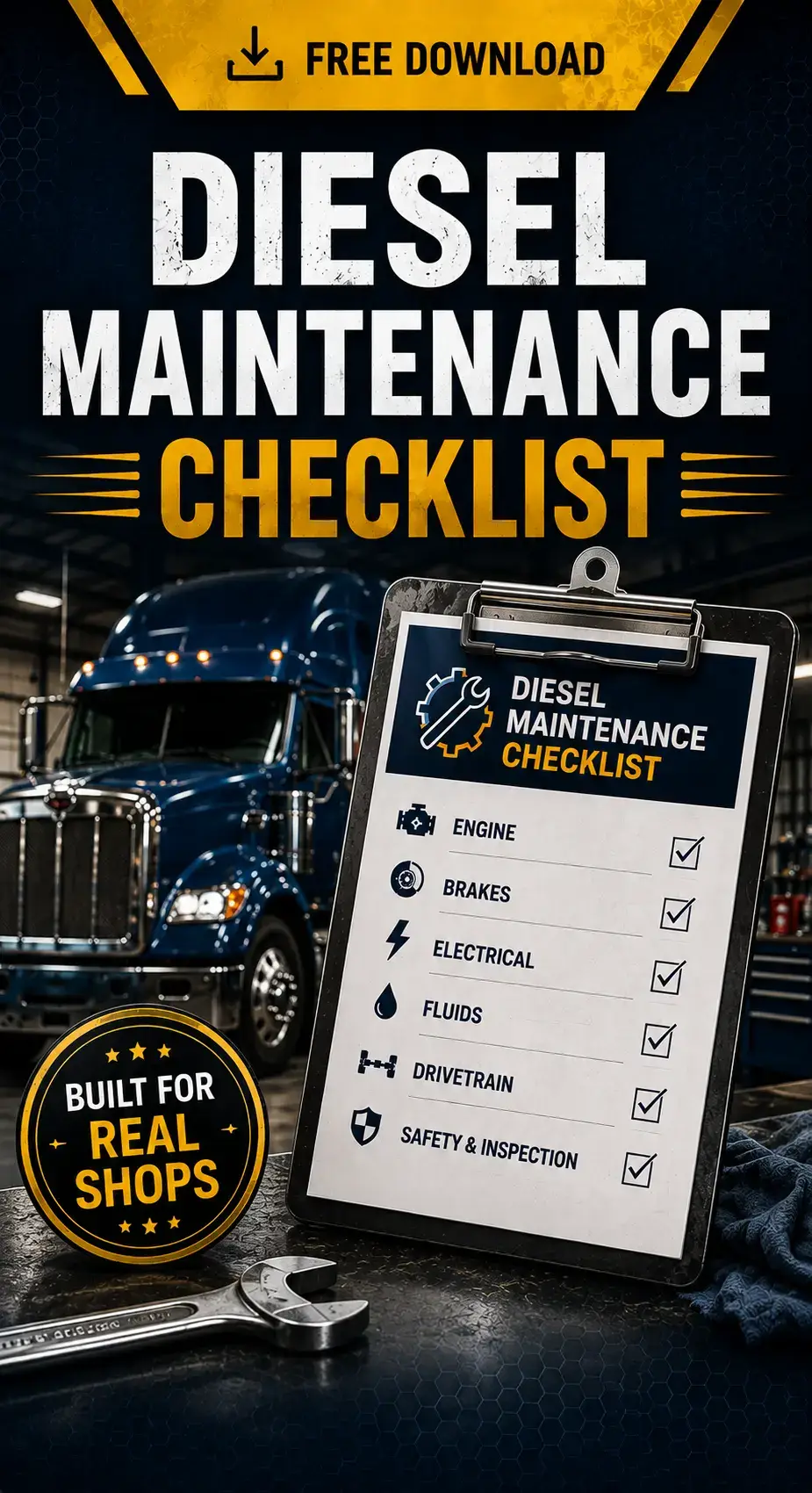
Print or laminate it, keep a copy in every cab, and pair it with the roadside-provider evaluation covered above — the two together are what actually shorten breakdown duration and cost when something does go wrong.
Frequently Asked Questions
What services are typically included in commercial truck roadside assistance?
Standard programs include towing to the nearest qualified repair facility, emergency tire service, diesel and DEF delivery, battery jump-starts and replacement, lockout assistance, mobile mechanical repairs, and winch-out service within 100 feet of the roadway. Most plans include up to $500 in labor and $5,000 in towing for the truck and attached trailer combined.
How much does commercial truck roadside assistance cost?
Basic membership plans run $35 to $60 per month per vehicle, or roughly $420 to $720 annually. Fleet programs for 10 or more vehicles often carry 15–30% volume discounts. Pay-per-call without membership typically runs $500 to $2,500 per towing incident in 2026.
What qualifications should roadside technicians have for commercial trucks?
Look for ASE T-series certification, covering eight areas including diesel engines, drive train, brakes, and electrical systems. Technicians certified in T2 through T8 hold the ASE Certified Master Medium-Heavy Truck Technician credential — ask whether technicians also have hands-on experience with your fleet's specific engine platforms.
How quickly can I expect a response for roadside assistance?
Urban and interstate locations typically see 30 to 60 minutes; suburban areas 60 to 90 minutes. Remote rural breakdowns can run 90 minutes or longer. Reliable providers offer GPS-enabled dispatch tracking so drivers and fleet managers can monitor arrival estimates directly.
Does roadside assistance cover both my truck and trailer?
It depends on the plan. Basic tiers may cover only the power unit, while comprehensive programs combine tractor and trailer under a shared coverage limit — typically up to $5,000 in towing for both together. Verify whether trailer-specific services are included if your operation swaps trailers regularly.
Professional heavy duty truck roadside assistance is operational insurance, not a discretionary line item — breakdowns happen regardless of how well a fleet maintains its trucks, and the gap between a program that works and one that doesn't shows up exactly when it's most expensive to discover.
According to Michael Nielsen, Heavy Duty Journal's publisher with 15+ years in diesel repair, response guarantees, technician credentials, geographic coverage, and cost structure all vary meaningfully between providers, and the evaluation is worth doing before an emergency forces the decision under pressure. Pair a properly vetted roadside program with disciplined pre-trip inspections, and most fleets cut both the frequency and the cost of the breakdowns that do happen, a pattern heavydutyjournal.com continues to track across the fleets and shops we cover.
Share This With Your Dispatch Team
If your drivers don't already have this information at hand, pass it along — knowing what a plan actually covers before a breakdown happens is the whole difference between a controlled situation and an expensive surprise.