
By Michael Nielsen, Editor & Publisher | 15+ Years in Diesel Repair
Last Updated: December 2025
📖 Estimated reading time: 22 minutes
Fleet electrification ROI has reached an inflection point that demands attention from every fleet manager and owner-operator in commercial trucking. Electric trucks now deliver documented operational cost reductions of 60-85% compared to traditional diesel vehicles, fundamentally reshaping the economics of freight operations. With ten-year total cost of ownership analysis demonstrating $430,000 in savings per electric truck—representing a 47% reduction compared to diesel alternatives—the question for fleet operators has shifted from “should we electrify?” to “how quickly can we capture these savings?”
This comprehensive financial analysis examines the complete investment picture for operators considering the transition to zero-emission powertrains. From capital expenditure requirements and operating cost comparisons to federal incentives and real-world deployment data, fleet managers will find the data-driven insights needed to make informed electrification decisions in 2025 and beyond.
Key Takeaways
- Operating cost advantage: Electric trucks operate at $0.85 per mile versus $2.15 for diesel—a 60% reduction that translates to $65,000+ annual savings per vehicle.
- Ten-year TCO savings: Comprehensive ownership analysis shows $430,000 lifetime savings per electric truck through 80% fuel cost reduction and 75% maintenance savings.
- Incentive stacking potential: Federal tax credits ($40,000), state vouchers ($85,000-$330,000), and utility rebates can offset 40-60% of total project costs.
- Payback timeline: High-utilization applications achieve payback in 3-4 years; medium-duty delivery fleets see 18-24 month break-even with proper incentive optimization.
- Regulatory alignment: EPA Phase 3 standards require up to 60% emissions reductions by 2032, positioning electric investments as both financial opportunities and compliance strategies.
The Financial Case for Heavy-Duty Fleet Electrification
Fleet managers evaluating electric truck adoption are discovering that the fleet electrification business case no longer requires environmental justification—the numbers speak for themselves. The year 2025 marks a fundamental economic shift where electric heavy-duty trucks achieve total cost of ownership advantages over diesel equivalents even without incentive programs.
The fuel cost arbitrage creates the most immediate financial impact. Electric trucks operate at approximately $0.15 per mile for electricity compared to $0.65 per mile for diesel fuel. This difference delivers a remarkable 77% reduction in fuel costs across typical heavy-duty operations. For a Class 8 tractor traveling 100,000 miles annually, this translates to $50,000 in annual fuel savings per vehicle.
Maintenance cost reductions provide the second major financial advantage. Electric powertrains eliminate complex combustion engine systems, transmission overhauls, and exhaust after-treatment maintenance. The result is a 75% reduction in maintenance expenses—from $0.32 per mile for diesel trucks to just $0.08 per mile for electric equivalents.
This maintenance advantage stems from fewer moving parts and reduced component wear. Oil changes, transmission services, and diesel particulate filter replacements become obsolete with electric powertrains. Reliability improvements create additional financial value through increased uptime—electric yard trucks demonstrate 98% uptime compared to 80% for diesel equivalents, representing 24 fewer breakdown incidents annually.
$180 Million
Projected annual savings from FedEx’s planned 20,000-vehicle electric deployment
Industry leaders have committed substantial capital based on validated financial projections. Amazon has invested $5 billion in electrification infrastructure supporting 100,000 Rivian electric delivery vans. These commitments reflect confidence in the fleet electrification business case built on comprehensive internal analysis—companies of this scale require rigorous financial validation before nine-figure capital allocations.
| Cost Category | Diesel Trucks | Electric Trucks | Savings |
|---|---|---|---|
| Fuel Cost per Mile | $0.65 | $0.15 | 77% |
| Maintenance Cost per Mile | $0.32 | $0.08 | 75% |
| Annual Uptime | 92% | 98.5% | 7% improvement |
| Total Operating Cost | Baseline | 60% reduction | 60% |
Critical research from the Fraunhofer Institute reveals that electric truck ROI depends more on intelligent charging strategy than vehicle selection alone. Fleet operators who optimize charging infrastructure and energy management before finalizing vehicle specifications achieve nearly triple the total cost savings compared to those using a vehicle-first approach. This insight demonstrates that fleet conversion ROI optimization requires an energy-first methodology.
Capital Investment Requirements for Electric Heavy-Duty Fleets
Fleet operators considering electrification must confront substantial initial capital outlays that extend beyond vehicle purchase prices. The transition to electric operations requires simultaneous investment in vehicles, charging systems, and electrical infrastructure upgrades. Understanding these interconnected cost categories enables accurate budgeting and reveals opportunities for strategic phasing that reduces financial risk.
The capital expenditure picture has improved dramatically over the past three years. Battery costs have declined from $150 per kilowatt-hour in 2020 to approximately $100 per kWh today, with projections reaching $70 per kWh by 2027. This trajectory drives vehicle purchase price parity within most fleet capital planning horizons.
Electric Truck Purchase Prices Across Vehicle Classes
Class 8 electric truck costs vary significantly based on battery capacity, manufacturer, and intended application. The 2025 market offers diverse options spanning different range requirements and duty cycles. The Tesla Semi represents the most affordable Class 8 option at $180,000 with an 800 kWh battery pack delivering approximately 500 miles of range. The Freightliner eCascadia commands a premium at $380,000 for its 550 kWh configuration providing 370 miles of range, reflecting Daimler’s comprehensive dealer support infrastructure.
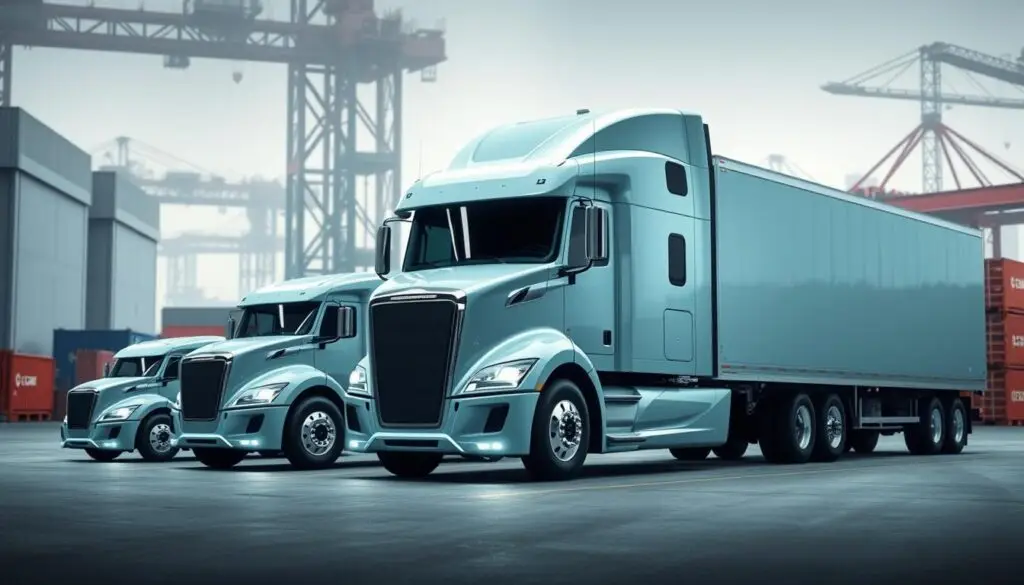
Mid-range pricing includes the Volvo VNR Electric at $350,000 (565 kWh, 275 miles) and the Peterbilt 579EV at $320,000 (430 kWh, 150 miles). The Mack LR Electric, purpose-built for refuse collection and vocational applications, costs $295,000 with a 376 kWh battery providing 250 miles of range.
| Model | Purchase Price | Battery Capacity | Range |
|---|---|---|---|
| ✓ Tesla Semi | $180,000 | 800 kWh | 500 miles |
| Peterbilt 579EV | $320,000 | 430 kWh | 150 miles |
| Volvo VNR Electric | $350,000 | 565 kWh | 275 miles |
| Freightliner eCascadia | $380,000 | 550 kWh | 370 miles |
These prices represent a premium of $140,000 to $200,000 compared to diesel equivalents in the $150,000-$180,000 range. However, this analysis excludes federal tax credits worth up to $40,000 per vehicle and state incentive programs that can reduce effective purchase prices by 30-50%.
Charging Infrastructure Investment Requirements
Fleet charging infrastructure costs represent the second major capital category, with expenses scaling based on power levels and installation complexity. The charging strategy directly impacts both capital requirements and operational efficiency. Most heavy-duty EV deployment scenarios utilize depot-based overnight charging supplemented by opportunity charging during loading or breaks.
Level 2 AC charging (11-22 kW) provides the most economical option at $12,000-$18,000 installed per port. These systems suit overnight charging for vehicles with daily routes under 150 miles. DC fast charging systems transform operational flexibility but demand significantly higher investment—a 150 kW system ranges from $120,000-$200,000 installed, providing 100-150 miles of range per hour of charging.
High-power charging infrastructure enables battery electric truck performance comparable to diesel refueling for specific duty cycles. Systems rated at 350 kW cost $180,000-$350,000 installed when configured for future megawatt charging standard (MCS) compatibility. Emerging megawatt charging systems (1-3 MW) represent the premium tier at $500,000-$1,200,000 installed, enabling 15-30 minute charging sessions for 300-400 miles of range.
Real-world deployment data from 330 NEVI-funded depot projects reveals that charging hardware represents only approximately 40% of total project costs. The average depot installation costs $915,000 for four DC fast chargers with necessary electrical infrastructure. Site preparation, trenching, transformer installations, and network connectivity consume the remaining 60% of capital expenditure.
Utility Service Upgrades and Grid Connection
Electrical grid upgrades and utility interconnection represent the most frequently underestimated capital requirement in heavy-duty EV deployment planning. Adding multiple high-power chargers can increase facility electrical demand by 500-2,000 kW or more, often exceeding existing service capacity. The timeline for utility upgrades typically spans 9-24 months for substantial load additions, making early engagement with utility providers critical.
Transformer lead times currently average 18 months due to supply chain constraints. Strategic coordination with utilities can reduce this timeline to 9 months through advanced ordering and capacity reservation. The scope of required upgrades varies dramatically based on existing electrical service—facilities with 200-400 amp service typically require complete upgrades, while sites with existing high-capacity industrial service may only need panel upgrades, reducing costs by 50-70%.
Stay Ahead of Fleet Electrification Developments
Get weekly updates on incentive programs, new electric truck models, and ROI optimization strategies delivered to fleet professionals across North America.
Operating Cost Reductions in Electric Heavy-Duty Operations
Beyond the upfront investment, daily operational economics reveal where electric trucks deliver their most significant financial advantages. While capital expenses create initial financial hurdles, ongoing operational savings systematically improve electric truck TCO over the vehicle lifecycle. These operational advantages compound monthly, creating substantial annual savings that accelerate return on investment.
Energy Economics: Electricity Versus Diesel Fuel
Fuel costs represent the most immediate and visible operational advantage for electric heavy-duty trucks. A baseline diesel truck consuming approximately 9,000 gallons annually at $4.50 per gallon generates $40,500 in annual fuel expenses. The equivalent electric vehicle drawing 36 megawatt-hours per year operates at a dramatically different cost structure.
At commercial electricity rates between $0.09 and $0.12 per kilowatt-hour, annual energy costs range from $3,600 to $4,300. This creates an immediate $36,000 annual savings, representing an 89% reduction in fuel expenditures. Even under worst-case scenarios with peak electricity rates reaching $0.20 per kilowatt-hour, electric trucks maintain cost parity whenever diesel prices exceed $3.70 per gallon—historical data shows diesel breached this threshold in 60% of months since 2020.
Maintenance Expense Transformation
Electric truck maintenance savings stem from fundamental powertrain architecture differences. Benchmark fleet data shows maintenance costs averaging $0.03 per mile for electric yard trucks versus $0.13 per mile for diesel equivalents. This translates to approximately $9,000 saved annually per unit at typical commercial mileage levels.
Electric drivetrains eliminate 24 engine-related service items that diesel fleets manage continuously, including engine oil and filter changes, transmission services, diesel particulate filter cleaning, DEF system maintenance, turbocharger inspections, EGR system servicing, fuel injector replacement, and complex cooling system maintenance.
Component longevity metrics reveal substantial mean time between failure advantages. Electric direct-drive transmissions achieve 18,000-hour service intervals compared to 9,500 hours for diesel transmissions—an 89% improvement in durability. Regenerative braking systems extend brake lining life to 4,200 hours versus 1,200 hours for conventional friction braking, representing a 250% improvement.
Uptime Advantages and Productivity Gains
Operational availability directly impacts revenue generation in capacity-constrained logistics environments. Electric heavy-duty trucks achieve 98% uptime compared to 80% for aging diesel fleets. This performance differential eliminates 72% of unscheduled breakdown events that disrupt delivery schedules and customer commitments.
Over a five-year service period, the uptime advantage delivers 66 additional working days per vehicle. For fleets operating at maximum capacity, this availability translates directly to incremental revenue opportunities that compound the direct cost savings from fuel and maintenance.
Fleet Electrification ROI: Financial Metrics and Calculations
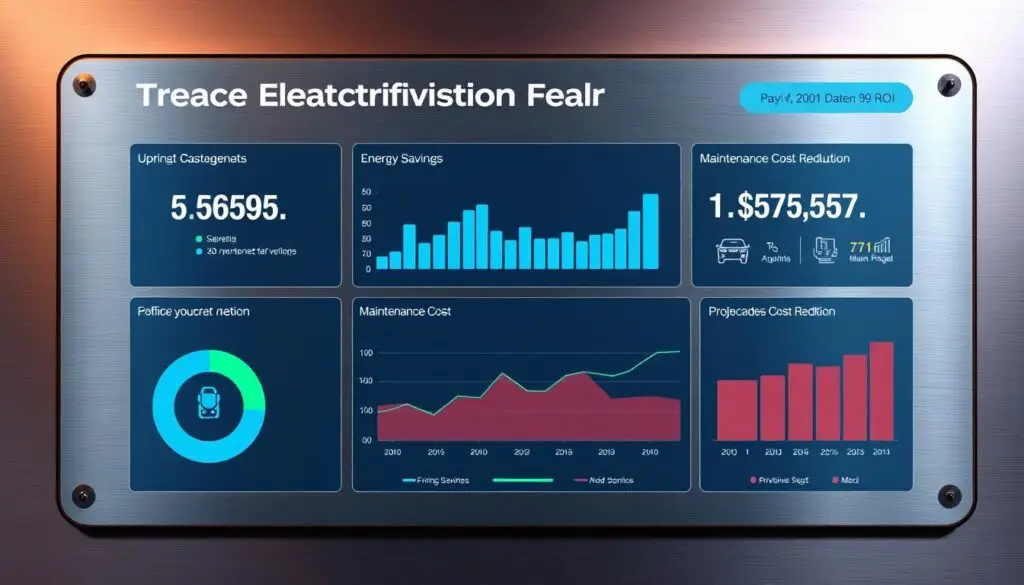
CFOs and financial analysts demand precise ROI calculations before committing capital to electric heavy-duty fleet conversions. The fleet electrification financial analysis framework requires systematic evaluation of payback periods, net present value projections, and break-even timelines across different vehicle classes and operational profiles.
Investment Recovery Timelines by Application
The fleet electrification payback period varies dramatically based on how intensively vehicles operate. Electric yard spotters operating 5,000+ hours annually achieve payback in 3-4 years through concentrated savings. Urban delivery fleets running 150+ miles daily experience similar recovery timelines. Lower-intensity deployments face considerably longer payback periods—seasonal equipment and reserve fleets may require 7-9 years for investment recovery.
Incentive stacking dramatically compresses payback timelines across all applications. Combining federal Commercial Clean Vehicle Tax Credit ($40,000), state voucher programs ($85,000-$330,000), and utility managed charging rebates ($15,000-$75,000) can offset 40-60% of total project costs. This aggressive incentive strategy reduces payback periods to 2-3 years for optimal applications.
DHL Supply Chain achieved payback under 4 years after combining IRA and HVIP incentives. Their operational data shows fuel and maintenance savings exceeding $40,000 per truck annually. Electric yard trucks represent the strongest financial case study available today—when combining state vouchers, federal credits, and Clean Ports grants, these vehicles deliver sub-4-year ROI consistently.
Seven-Year NPV Analysis
Net present value analysis provides comprehensive EV fleet total cost of ownership evaluation over realistic operational lifespans. A detailed seven-year NPV model for a single electric yard truck demonstrates the financial advantage clearly:
| Financial Component | Electric Truck | Diesel Truck | Advantage |
|---|---|---|---|
| Capital (After Incentives) | $198,000 | $154,000 | -$44,000 |
| Fuel/Energy (7 Years) | $28,700 | $283,500 | +$254,800 |
| Maintenance (7 Years) | $15,200 | $64,800 | +$49,600 |
| Residual Value | $44,000 | $18,000 | +$26,000 |
| Net Present Value | Baseline | Baseline | +$96,000 |
This NPV advantage of $96,000 demonstrates that electric yard trucks generate substantial financial returns despite higher upfront costs. Internal rate of return calculations reveal even more compelling performance metrics—properly structured electric fleet deployments generate IRR in the 15-22% range, exceeding most alternative capital deployment opportunities in typical fleet operations.
Application-Specific Break-Even Analysis
Electric truck break-even analysis varies significantly across vehicle classes and duty cycles. Class 6-7 medium-duty delivery trucks achieve break-even fastest among all commercial vehicle categories, reaching financial equilibrium at 18-24 months due to high daily utilization and lower infrastructure costs. Class 8 heavy-duty tractors in regional haul applications achieve break-even at 36-48 months under optimal conditions.
Long-haul Class 8 applications remain financially marginal under current technology and infrastructure conditions. However, the financial outlook improves rapidly as 500-mile range models like the Tesla Semi enter volume production. Emerging megawatt charging corridors enable mid-route charging during mandatory driver rest periods without schedule impact, positioning long-haul electrification to achieve break-even by 2027-2028.
Total Cost of Ownership: Diesel vs Electric Comparison
Fleet operators making electrification decisions need application-specific financial comparisons that reflect real-world operational patterns. A comprehensive 10-year analysis reveals the financial dynamics that separate viable electrification candidates from marginal applications.
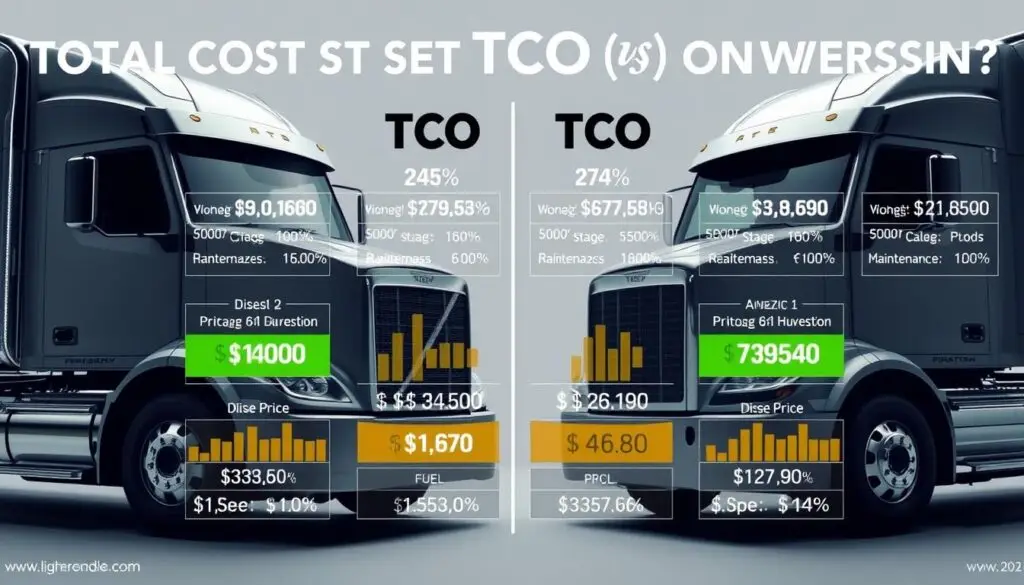
| Cost Category | Electric (10 Yr) | Diesel (10 Yr) | Difference |
|---|---|---|---|
| Vehicle Purchase | $350,000 | $180,000 | +$170,000 |
| Fuel/Energy Costs | $85,000 | $420,000 | -$335,000 |
| Maintenance | $45,000 | $180,000 | -$135,000 |
| Battery Replacement | $80,000 | N/A | +$80,000 |
| Carbon Credits/Penalties | -$45,000 | $65,000 | -$110,000 |
| Total 10-Year TCO | $490,000 | $920,000 | -$430,000 (47%) |
Medium-Duty Delivery Operations
Class 6-7 medium-duty trucks represent the current sweet spot for the fleet electrification business case. These vehicles operate in conditions that maximize electric advantages while minimizing technical constraints. Predictable daily routes averaging 80-120 miles fall well within current electric range capabilities, and return-to-base operations enable simple overnight depot charging without expensive fast-charging infrastructure.
Real-world validation comes from Amazon’s deployment of 100,000 Rivian EDV units across their delivery network. This massive fleet demonstrates 30% faster urban delivery performance through reduced noise enabling extended operating hours. The electric vehicles achieved an 85% reduction in community noise complaints that previously restricted delivery windows in residential areas.
Detailed analysis shows Class 6-7 electric trucks achieving total cost parity with diesel at 2-3 years. Lifetime savings reach $150,000-200,000 per vehicle over a typical 10-12 year service life.
Heavy-Duty Regional Transportation
Class 8 heavy-duty tractors present a more nuanced analysis reflecting current technical limitations. Regional haul applications with 200-300 mile daily routes and overnight depot charging currently achieve electric truck TCO advantages with available 300-400 mile range models. Fleet operators report fuel savings of $40,000-50,000 annually per vehicle in regional applications.
Long-haul applications requiring 500+ miles daily present greater complexity. However, this segment approaches competitiveness as 500-mile range models enter volume production. Operators must conduct detailed route analysis to identify which lanes support electric operations today versus requiring future technology improvements.
Specialty Vocational Applications
Refuse collection trucks and specialty vocational vehicles demonstrate how specific operational characteristics create exceptional financial returns. Refuse trucks with frequent acceleration and braking maximize regenerative braking energy recovery—this technology captures 15-25% range extension compared to steady-state driving.
Electric refuse trucks enable earlier service start times that improve route efficiency and reduce overtime costs by 12-18%. ABF Freight’s electric yard fleet provides quantifiable results, eliminating approximately 1,600 tons of CO₂ annually while generating carbon credit revenue in jurisdictions with emissions trading programs.
The HDJ Perspective
After following fleet electrification developments for five years, we’ve seen the conversation shift dramatically. Early skepticism about electric truck viability has given way to CFOs asking “how fast can we deploy?” The data is now undeniable—fleets that moved early on yard trucks and regional delivery are reporting returns that exceed initial projections. The smart play for most operations isn’t waiting for perfect conditions; it’s identifying the 20-30% of your fleet where electrification already pencils out, building internal expertise, and positioning for broader deployment as charging infrastructure matures. The operators who treat this as a phased strategic initiative rather than an all-or-nothing decision are the ones capturing the best ROI.
Federal and State Incentive Programs
The landscape of commercial EV incentives creates a powerful financial multiplier effect that can offset 40-60% of total capital requirements for heavy-duty fleet conversion. These programs fundamentally transform the economics of electric vehicle adoption. What appears as a marginal business case without incentives becomes a compelling investment opportunity when federal tax credits, state vouchers, and utility rebates are strategically combined.
IRA Commercial Clean Vehicle Tax Credit
The Inflation Reduction Act established the Commercial Clean Vehicle Tax Credit as the foundation of federal support for fleet electrification. This credit provides 30% of the vehicle purchase price up to a maximum of $40,000 for commercial vehicles exceeding 14,000 pounds gross vehicle weight rating.
Vehicles must complete final assembly in North America to qualify for the full credit amount. Projects exceeding $1 million in total investment must comply with prevailing wage and apprenticeship standards to maintain credit eligibility. Fleet operators can combine the IRA credit with Section 179 expensing and bonus depreciation benefits, sheltering an additional $28,000-32,000 in first-year deductions beyond the base credit amount.
California HVIP and State Voucher Programs
State-level incentive programs create dramatic variation by jurisdiction. California’s Clean Truck and Bus Voucher Incentive Project (HVIP) represents the most generous state program, offering $85,000-$330,000 per vehicle depending on vehicle class and fleet characteristics. Small fleets and operators in disadvantaged communities qualify for enhanced voucher amounts—Class 8 tractors can secure up to $150,000 through HVIP alone.
Northeast states have developed competitive programs. New York Truck Voucher Incentive Program provides up to $185,000 for zero-emission terminal tractors. Massachusetts offers $90,000-180,000 through the MassEVIP program. Strategic facility location decisions can capture substantially higher incentive values—fleets operating primarily in high-incentive states secure $125,000-225,000 more per vehicle than equivalent operations in low-incentive jurisdictions.
| Program | Max Value | Availability |
|---|---|---|
| IRA Commercial Clean Vehicle Credit | $40,000/vehicle | Nationwide |
| California HVIP | $330,000/vehicle | California |
| New York NYTVIP | $185,000/vehicle | New York |
| Utility Make-Ready Programs | $150,000/site | Service territory |
Utility Programs and Managed Charging
Utility programs represent the frequently overlooked third layer of financial support. Make-ready programs cover infrastructure costs including transformer upgrades, service panel installations, and trenching. The value ranges from $50,000-$150,000 per site depending on electrical requirements.
Managed charging incentives provide ongoing revenue streams—utilities pay $150-250 per kilowatt of controllable load for systems that allow charging schedule modulation. Demand response programs create additional annual revenue of $500-1,500 per vehicle for participation in grid balancing activities. Time-of-use rate structures deliver electricity rates 40-60% lower during off-peak periods compared to on-peak hours.
The combined first-year value of utility programs reaches $25,000-45,000 per vehicle when make-ready support, managed charging incentives, and rate optimization are fully utilized.
Hidden Costs and Financial Risk Factors
Beyond the visible price tags, fleet operators face less obvious financial risks that require careful planning. Accurate electric truck TCO analysis must account for variables that may not surface until years into deployment.

Battery Degradation and Replacement
Lithium-ion battery packs inevitably degrade over time. Normal operating conditions produce approximately 2-3% annual capacity loss. However, fast-charging frequency, extreme temperature exposure, and deep discharge cycles can increase degradation rates to 4-5% annually in demanding applications.
Financial models must incorporate battery replacement costs at the 8-10 year mark. Replacement expenses range from $70,000-$120,000 for Class 6-7 trucks and $150,000-$200,000 for Class 8 tractors. Comprehensive warranty programs substantially mitigate this risk—Orange EV’s industry-leading 7.5-year/30,000-hour warranty caps battery operating expense at just $0.01 per operating hour.
Real-world durability data increasingly contradicts conservative projections. Fourteen DHL electric yard trucks have exceeded 20,000 operating hours on original battery packs while retaining over 85% capacity.
Demand Charges: The Hidden Threat
⚠️ Critical Financial Warning
Demand charges can completely destroy fleet electrification ROI if not properly managed. Ten trucks drawing 150 kW each simultaneously create a 1.5 MW demand spike that can generate $8,000-$15,000 in monthly demand charges—potentially eliminating projected fuel savings entirely.
Commercial electricity pricing includes demand charges based on the highest 15-minute peak power draw during any billing period. Simultaneous fast-charging of multiple vehicles generates massive power spikes that trigger punishing fees. Smart charging management systems provide the most effective mitigation, staggering charging sessions to avoid simultaneous peak draws and reducing demand costs by 37% or more.
Residual Value Uncertainty
Electric truck residual values remain unproven due to limited secondary market history. Current conservative projections show electric trucks retaining approximately $120,000 value after 10 years compared to $45,000 for diesel equivalents—a $75,000 residual disadvantage that partially offsets operating cost savings in lease-oriented financial structures.
However, this residual penalty is expected to narrow as electric trucks prove long-term durability. Vehicles demonstrating reliable battery performance over extended periods will build buyer confidence in the secondary market.
Share Your Fleet Electrification Experience
Have you deployed electric trucks in your fleet? HDJ readers benefit from real-world insights on ROI, charging strategies, and operational challenges from fellow fleet professionals.
Regulatory Drivers Accelerating Adoption
Federal and state regulations create both compliance requirements and financial incentives that accelerate the economic case for fleet electrification.
The EPA Phase 3 Heavy-Duty Vehicle Standards establish new CO₂ emission standards phasing in from model year 2027 through 2032. For vocational trucks, standards require up to 60% emissions reductions compared to Phase 2 levels. For tractors, standards require up to 40% reductions by MY 2032. These technology-neutral standards can be met through various approaches including battery electric, fuel cell, hybrid, and advanced internal combustion technologies.
California’s Advanced Clean Trucks Rule mandates that manufacturers sell an increasing percentage of zero-emission trucks starting in 2024. By 2035, 55% of Class 7-8 truck sales must be zero-emission. The state’s Advanced Clean Fleets regulation further requires large fleets to transition to zero-emission vehicles on accelerated timelines.
These regulations create stranded asset risk for diesel equipment as used truck values collapse under tightening resale restrictions. Forward-looking fleets that transition early avoid capital losses from premature diesel depreciation while securing operational continuity.
Real-World Performance from Early Adopters
Corporate fleets that deployed electric trucks between 2019 and 2023 are documenting operational results that validate theoretical projections.
PepsiCo operates Tesla Semi tractors from facilities in California, representing the first commercial deployment of long-haul Class 8 electric tractors with 500-mile range capability. The company installed megawatt charging infrastructure at both facilities—this expansion signals that internal financial analysis shows favorable returns.
Amazon operates the largest electric delivery fleet in North America with 100,000 custom Rivian Electric Delivery Vans deployed across 500+ delivery stations. Performance data shows 30% faster urban delivery completion through extended operating hours. Community impact metrics reveal an 85% reduction in noise complaints, enabling deliveries in residential neighborhoods during expanded hours.
Anheuser-Busch operates over 170 BYD electric tractors with documented 98.5% uptime and 70% operating cost reductions in urban delivery operations. DHL Supply Chain electrified yard operations with 50 electric trucks achieving operational uptime exceeding 98% compared to 75-80% for diesel units. Orange EV has shipped 1,400+ units that accumulated 21.5 million miles with 98% fleet-wide uptime.
The diversity of applications represented demonstrates broad applicability of electric truck technology. Urban delivery vans, regional freight tractors, yard spotters, and specialty vocational vehicles all show positive results—transforming the investment decision from speculative to evidence-based.
Strategic Implementation Timeline
A well-structured fleet electrification implementation strategy transforms capital expenditure into calculated competitive advantage. The difference between successful deployments and costly failures lies in systematic planning.
Phased Deployment Framework
Phase 1 (Months 1-3): Route analysis, TCO modeling, vehicle selection, infrastructure planning, pilot design for 2-10 vehicles
Phase 2 (Months 4-9): Charging installation, vehicle delivery, driver training, performance monitoring, process optimization
Phase 3 (Months 10-36): Scaled deployment, advanced infrastructure, maintenance integration, fleet management systems, continuous improvement
Research from the Fraunhofer Institute reveals that optimizing charging strategy before vehicle selection doubles the work accomplished by electric trucks and nearly triples total cost savings compared to simple one-for-one diesel replacement. Route analysis software processes historical telematics data to characterize daily distance distributions and identify vehicles with sufficient range margin—standard practice requires identifying vehicles that can complete operations with at least 20% remaining battery capacity.
Smart charging software implementation represents the highest-impact optimization strategy. These systems schedule charging during off-peak electricity rate periods, reducing energy costs by 40-60% compared to unmanaged charging. Companies like Orange EV transfer battery degradation risk through comprehensive warranty coverage, providing financial predictability for TCO calculations.
Frequently Asked Questions
How long does it take to achieve ROI on electric heavy-duty trucks?
Payback periods vary significantly by application. High-utilization operations like yard trucks and urban delivery achieve payback in 3-4 years with proper incentive stacking. Medium-duty delivery fleets typically see 18-24 month break-even when combining federal tax credits ($40,000), state vouchers ($85,000-$330,000), and utility rebates. Lower-intensity applications may require 7-9 years. The key factors are annual mileage, available incentives, local electricity rates, and charging infrastructure costs.
What are the actual maintenance savings for electric trucks versus diesel?
Fleet data shows maintenance costs averaging $0.03 per mile for electric trucks versus $0.13 per mile for diesel equivalents—representing a 75% reduction. Electric drivetrains eliminate 24 engine-related service items including oil changes, transmission services, DPF cleaning, DEF system maintenance, and turbocharger inspections. Component longevity also improves substantially—electric transmissions achieve 18,000-hour service intervals compared to 9,500 hours for diesel, while regenerative braking extends brake life by 250%.
How do demand charges affect electric truck operating costs?
Demand charges can significantly impact ROI if not properly managed. These fees are based on peak 15-minute power draw, regardless of total energy consumption. Ten trucks charging simultaneously at 150 kW each can generate $8,000-$15,000 in monthly demand charges. Smart charging management systems mitigate this by staggering charging sessions, reducing demand costs by 37% or more. Engaging with utility providers during the planning phase can also help secure favorable rate structures.
What federal and state incentives are available for fleet electrification?
The Inflation Reduction Act provides up to $40,000 per vehicle through the Commercial Clean Vehicle Tax Credit for trucks over 14,000 pounds GVWR. California’s HVIP program offers $85,000-$330,000 per vehicle depending on size and fleet characteristics. New York NYTVIP provides up to $185,000 for zero-emission tractors. Utility make-ready programs can cover $50,000-$150,000 in infrastructure costs per site. Strategic incentive stacking can offset 40-60% of total project costs.
Which applications offer the best fleet electrification ROI today?
Yard trucks and terminal tractors offer the strongest ROI due to high utilization hours and intensive stop-and-go operation. Medium-duty urban delivery (Class 6-7) ranks second, with predictable routes under 150 miles enabling simple overnight depot charging. Regional haul Class 8 tractors with 200-300 mile daily routes achieve positive ROI with current technology. Long-haul applications remain marginal but are approaching competitiveness as 500-mile range models and megawatt charging corridors emerge.
Taking Action on Fleet Electrification
The year 2025 represents a fundamental turning point for fleet electrification ROI. Electric trucks now achieve total cost of ownership advantages over diesel equivalents without relying on incentives—and with available programs, the financial case becomes compelling for most applications.
The evidence is clear: ten-year analysis demonstrates $430,000 savings per vehicle, representing a 47% cost reduction driven by 80% fuel savings and 75% maintenance reductions. High-utilization fleets report 60-85% operational cost savings across diverse applications. Early adopters including FedEx, Amazon, and DHL have committed billions based on validated internal analysis.
Fleet operators who implement strategic electrification now—matching vehicles to optimal routes, planning infrastructure proactively, and capturing available incentives—will establish competitive advantages that deliver sustained profitability in the zero-emission freight economy. The question is no longer whether to electrify, but how quickly you can capture these fleet electrification savings.
Help Fellow Fleet Professionals Make Informed Decisions
If this analysis helped clarify your electrification strategy, share it with colleagues evaluating similar decisions. Data-driven insights benefit the entire industry.