
By Michael Nielsen, Publisher | 15+ Years in Diesel Repair
Last Updated: September 2026
⏱ Estimated reading time: 12 minutes
Drug testing requirements for fleet employers are built on 49 CFR Part 382 — six mandatory test types (pre-employment, random, post-accident, reasonable suspicion, return-to-duty, and follow-up), a required written policy, and daily Clearinghouse verification before any CDL holder performs safety-sensitive work. This isn't paperwork to handle when there's time; it's a frontline safety control, and the enforcement consequences for getting it wrong have gotten more expensive and more automated in the past two years, not less.
Key Takeaways
- ✓The current maximum civil penalty for a Part 382 Subpart G (Clearinghouse) or Part 383 violation is $7,155 per violation — higher than the $5,833 figure still circulating in older compliance guides.
- ✓More than 202,000 CDL and CLP holders were in Clearinghouse "Prohibited" status as of January 2026, and states must downgrade a prohibited driver's CDL within 60 days of notification.
- ✓The 2026 random testing rates hold at 50% for drugs and 10% for alcohol — the sixth consecutive year at these levels, confirmed by DOT's January 8, 2026 announcement.
- ✓Marijuana remains fully disqualifying for safety-sensitive CDL work even after federal rescheduling action in 2026 — state legalization and federal scheduling changes do not change DOT testing rules.
In This Guide
- Coverage: Which Fleets and Drivers Are Covered Under Part 382
- The DOT 5-Panel Test and Alcohol Testing Rules
- The Six Required DOT Test Types
- Building a Compliant Testing Program
- Random Testing Rates and Program Administration
- Written Policy Requirements Under 49 CFR 382.601
- Clearinghouse Compliance and Reporting
- Recordkeeping, Retention, and Audit Readiness
- 2026 Issues to Watch
- Frequently Asked Questions
Coverage: Which Fleets and Drivers Are Covered Under Part 382
Coverage under Part 382 depends on the vehicle and the work being performed, not company size. If a fleet uses CDL roles in DOT-regulated operations, it must run a compliant testing program for every driver who performs safety-sensitive functions — driving, loading, inspecting, or otherwise maintaining readiness to operate a commercial motor vehicle, even when the truck isn't moving.
| Trigger | What It Means for Coverage | Common Fleet Examples |
|---|---|---|
| 26,001+ lbs GVWR or GCWR | Operating at or above this threshold generally places the driver in DOT-regulated CMV service | Tractors pulling loaded trailers, large straight trucks, combination vehicles |
| 16+ passengers including driver | Passenger capacity can trigger DOT oversight even under the weight threshold | Shuttle buses, crew transport buses, employer passenger vans |
| Placarded hazardous materials | Placarded loads bring the operation under stricter safety controls | Fuel delivery, chemical transport, other placarded hazmat carriers |
These thresholds connect directly to who must be in the testing pool and how results are handled — which is why fleets need to keep role lists current and confirm which positions actually qualify as covered drivers before a new hire's first dispatch, not after.
The DOT 5-Panel Test and Alcohol Testing Rules
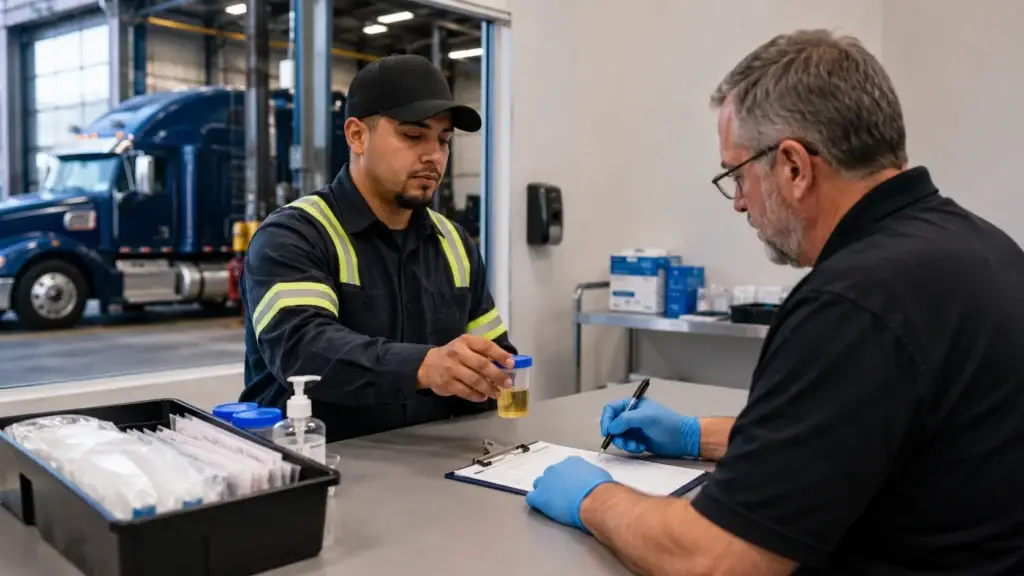
The DOT 5-panel is a urine test screening for THC, cocaine, amphetamines and methamphetamines, opioids, and PCP, using cutoffs and confirmation rules set by federal standards. Specimens must go through a SAMHSA-certified laboratory, with results verified by a Medical Review Officer before an employer can treat a result as final — that verification step is what makes a result defensible in an audit or a legal dispute.
Alcohol testing runs on a separate process with its own strict timing. The operating limit is 0.04 BAC, but a lower band — 0.02 or greater but less than 0.04 — still triggers mandatory removal from driving duties for at least 24 hours and should be documented as a serious compliance event, not brushed off because it falls short of the disqualifying threshold.
| Test Focus | What It Checks | What Fleets Must Build Into Policy |
|---|---|---|
| Drugs | DOT 5-panel: THC, cocaine, amphetamines, opioids, PCP | Collection steps, chain-of-custody handling, consistent triggers |
| Alcohol | 0.04 BAC operating limit, plus 0.02–0.039 action band | Clear duty-removal rules, supervisor procedures, fast testing timelines |
The Six Required DOT Test Types
Pre-employment testing must be completed and verified negative before a driver performs any safety-sensitive function — no exceptions, no "start Monday and we'll get the paperwork sorted." Random testing runs unbiased and unannounced all year, at the current rates of 50% for drugs and 10% for alcohol, spread across months rather than clustered in a single quarter.
Post-accident testing is required after a crash involving a fatality, an injury requiring off-scene medical treatment where the driver is cited, or a tow where the driver is cited — alcohol tests within 8 hours, drug tests within 32 hours, with documented reasons required if either window is missed.
⚠️ Safety Warning
If post-accident testing cannot occur within the required windows, document specifically why testing was not performed. A late test outside the window may not be usable for compliance purposes, and an undocumented gap looks far worse in an audit than a documented one.
Reasonable suspicion testing depends on trained observation — under 49 CFR 382.603, supervisors who may make this call must complete at least 60 minutes of training on drug-impairment indicators and 60 minutes on alcohol-impairment indicators.
Return-to-duty testing follows a positive result or refusal: the driver is removed from safety-sensitive duty immediately, completes evaluation with a Substance Abuse Professional, and must pass a return-to-duty test before going back on the road. Follow-up testing is unannounced, SAP-scheduled, requires a minimum of six tests in the first 12 months, and can run up to 60 months depending on the violation.
Building a Compliant Testing Program
A compliant program works best when it's built like an operating system rather than a checklist reviewed once a year. Each test type needs a trigger, a timeline, and a clear owner who can act fast — HR marking a driver "not eligible" until a verified negative pre-employment result is on file, and dispatch seeing that same lockout so a driver can't be assigned a load by mistake before clearance comes through.
Many fleets use a third-party administrator (TPA) to keep random selections neutral and defensible, manage the compliance calendar, and maintain custody-and-control forms. Heavy Duty Journal has seen this pattern hold across the fleets we cover at heavydutyjournal.com: the carriers with the fewest audit findings are the ones where a specific person owns the alert queue and the documentation trail, not the ones with the most expensive software.
| Program Control | What It Must Do | What to Document |
|---|---|---|
| Written policy | Define who is covered, what's prohibited, when tests occur | Policy version, distribution log, signed acknowledgments |
| Collection chain | Follow Part 40 steps from collection to verified result | Custody-and-control forms, MRO reports, lab identifiers |
| Supervisor readiness | Recognize and document reasonable-suspicion indicators | Training dates, observation notes, decision trail |
| TPA administration | Manage pools, selections, compliance calendar | Selection lists, MIS-ready summaries, vendor agreements |
Random Testing Rates and Program Administration
DOT confirmed on January 8, 2026 that the minimum random testing rates hold at 50% for drugs and 10% for alcohol — the sixth consecutive year at these levels since FMCSA raised the drug rate from 25% in 2020. Under the underlying rule, the rate only drops back to 25% if the industry's positive random drug test rate stays below 1.0% for two consecutive calendar years; current Clearinghouse volume suggests that's not close to happening soon.
Keep Your Fleet Running at Full Capacity
Get HDJ's maintenance guides, compliance updates, and fleet management strategies delivered weekly — built for working diesel professionals.
A clean random program avoids patterns a driver could predict and clustering that undermines the "random" standard — testing the same people repeatedly, or running most of the year's tests in one quarter, are both common and avoidable audit findings.
Computerized TPA selection, spread evenly across months with short notice to drivers, is the most defensible model, and the documentation should tie the pool roster, the selection output, and the completed results together into one traceable record.
Common Program Failures to Avoid
- Predictable selections: manual picking or repeated "routine" testing days drivers can anticipate
- Uneven cadence: clustering selections in one quarter instead of spreading them across the year
- Weak documentation: no clear trail linking the roster, the selection output, and the results
- Stale pools: rosters not updated immediately when drivers join, leave, or change status
Written Policy Requirements Under 49 CFR 382.601
A fleet cannot run this program on memory or verbal reminders. The 49 CFR 382.601 written policy requirement puts every rule in one place: a named point of contact, which driver categories are covered, what safety-sensitive functions include, test types and their triggers, and how the process protects chain of custody and driver privacy.
It should also explain, in plain terms, what a refusal to test actually means — failing to appear, leaving the collection site, not providing a specimen, or not cooperating with the process all count, and a refusal is treated as a positive result for compliance purposes.
Policy delivery has to be systematic. Owner-operators, staffing-service drivers, and contract drivers need the same materials as payroll employees, using one controlled version of the policy so terminals don't drift onto slightly different rules. A signed driver acknowledgment receipt, tied to the driver's file, is the cleanest proof the material was actually issued — and it's exactly what an auditor asks to see first when a violation surfaces.
Clearinghouse Compliance and Reporting
Clearinghouse compliance is a daily operational control now, not a back-office task. A full pre-employment query must return before a driver performs any safety-sensitive function, and an annual limited query is required for every active CDL driver at least once every 12 months — timed to the hire date or a fixed month, either is fine as long as it's consistent.
202,345 Drivers Prohibited
CDL and CLP holders in Clearinghouse "Prohibited" status as of FMCSA's January 2, 2026 snapshot — out of 328,431 total drivers with at least one violation on record, with 159,226 not yet having started the return-to-duty process.
Since Clearinghouse Phase II took effect on November 18, 2024, state licensing agencies must check the Clearinghouse before issuing, renewing, transferring, or upgrading a CDL — and if a driver shows as prohibited, the state must downgrade that license within 60 days of notification. That downgrade follows the driver's license, not their employer, which closes the old loophole where a driver could leave one carrier and start fresh at another without ever resolving the underlying violation.
Treat "prohibited" as a hard stop in dispatch: a repeatable check should prevent assignment the moment a query returns that status, keeping the driver out until return-to-duty requirements are complete. HDJ's CSA score improvement guide covers how a missed Clearinghouse query becomes a Controlled Substances/Alcohol BASIC violation on the fleet's own safety record.
Recordkeeping, Retention, and Audit Readiness
Retention isn't one-size-fits-all. Positive results, refusals, and other violations stay on file for five years; verified negative results for one year. Driver qualification files are generally kept three years after separation, which means some testing records outlive the retention period for the test itself and need to be cross-referenced rather than purged on the same schedule.
Audit readiness comes down to how fast records can be produced and how well they match selection logs, test forms, and Clearinghouse activity side by side. A quarterly internal mock review — checking random selections, timing, and whether the file tells a complete story from notice to result — creates its own compliance-review documentation and catches gaps before an actual investigator does.
| Record Group | What to File | Minimum Retention |
|---|---|---|
| DOT test outcomes | Positive results, refusals, violations, return-to-duty and follow-up records | 5 years |
| Negative drug test results | Verified negative laboratory results and related forms | 1 year |
| Random testing proof | Selection lists, notification logs, completion dates, annual rate calculations | 2 years |
| Driver qualification file | Application, prior-employer verification, MVRs, road test/CDL copy, annual review | 3 years after termination |
Editorial Insight
The HDJ Perspective
Michael Nielsen: the shift from paper-based compliance to real-time database verification has changed what "compliant" actually means day to day. A violation now follows a driver instantly through the Clearinghouse instead of sitting in a filing cabinet until someone happens to look — which means a fleet's compliance posture is only as good as its weakest daily habit, not its best annual audit. The carriers holding up best under 2026's enforcement environment are the ones that treat Clearinghouse queries and random selections as routine as a pre-trip inspection, not as a task that gets remembered when an audit letter arrives.
2026 Issues to Watch
Marijuana policy is moving, but DOT testing rules aren't — yet. Following President Trump's December 18, 2025 executive order directing DOJ to expedite marijuana rescheduling, the Justice Department and DEA moved on April 23, 2026 to place FDA-approved and state-medical-licensed marijuana products into Schedule III, alongside an expedited administrative hearing on broader Schedule I-to-III rescheduling that began June 29, 2026.
None of this changes DOT's own testing prohibition: marijuana remains fully disqualifying for safety-sensitive CDL work regardless of state legalization or federal scheduling changes, and fleets should keep current policies and panels in place unless FMCSA issues its own rule change.
Medical certification verification is mid-transition, not finished. The Medical Examiner's Certification Integration (NRII) system has been live since June 23, 2025, shifting verification toward Motor Vehicle Records as the source of truth — but FMCSA has repeatedly extended a temporary waiver allowing paper Medical Examiner's Certificates for up to 60 days after issuance while several states finish their electronic connections.
The most recent extension runs through the first half of 2026, with a further exemption reported into the fourth quarter. Confirm your states' current status directly rather than assuming the paper-card waiver has already expired.
A fentanyl and norfentanyl panel expansion also remains pending. DOT published a proposed rule in September 2025 to add both to all DOT-mandated testing panels; the comment period closed in October 2025, and a final rule remains possible later in 2026. If finalized, this would add new substances to the panel and trigger new Clearinghouse reporting categories — worth planning for now rather than scrambling once a final rule publishes.
Frequently Asked Questions
What drug tests are required for CDL drivers under DOT regulations?
Six mandatory types: pre-employment before any safety-sensitive work, random testing at 50% for drugs and 10% for alcohol, post-accident testing when specific crash criteria are met, reasonable suspicion testing from trained supervisor observations, return-to-duty testing after a violation, and follow-up testing with a minimum of six unannounced tests in the first 12 months.
What are the penalties for failing to comply with FMCSA drug testing requirements?
The current maximum civil penalty for a Clearinghouse or CDL-related violation under Part 382 Subpart G or Part 383 is $7,155 per violation. Employers who knowingly allow a CDL holder to operate during an out-of-service order face steeper penalties — $7,155 to $39,615, plus insurance increases and potential risk to operating authority.
How does the FMCSA Drug and Alcohol Clearinghouse affect fleet compliance?
Employers must run a pre-employment full query before any driver performs safety-sensitive work and an annual limited query at least every 12 months. Since November 18, 2024, states must downgrade a CDL within 60 days once a driver shows as "prohibited," making query verification essential before dispatch.
Does marijuana rescheduling change DOT drug testing rules?
No. Even after DOJ's April 2026 action placing certain marijuana products in Schedule III, DOT's testing prohibition on marijuana for safety-sensitive CDL work remains fully in effect. State legalization has never overridden DOT rules, and fleets should continue current policy unless FMCSA issues its own rule change.
What training is required for supervisors to conduct reasonable suspicion testing?
Under 49 CFR 382.603, supervisors must complete at least 60 minutes of training on alcohol-misuse indicators and 60 minutes on controlled-substance-use indicators. Keep training certificates and completion dates on file — this is a frequently cited, entirely preventable finding in FMCSA compliance reviews.
Are paper medical certificates still accepted for CDL drivers?
In some states, yes, under a temporary FMCSA waiver extended multiple times since the NRII system went live in June 2025. The waiver allows a paper certificate for up to 60 days after issuance while states complete electronic connections — verify current status for each operating state directly.
A compliant drug testing program for fleet employers is a daily discipline, not an annual project: know which drivers are covered, run all six test types correctly and on time, keep the written policy and Clearinghouse queries current, and document everything as if an auditor will ask for it tomorrow — because increasingly, that's exactly the environment fleets are operating in.
According to Michael Nielsen, Heavy Duty Journal's publisher with 15+ years in diesel repair, the carriers treating this as routine operational hygiene, rather than a compliance emergency handled after the fact, are the ones avoiding the fines, the downgrades, and the audit findings that catch everyone else — a pattern heavydutyjournal.com continues to track across the fleets and shops we cover.
Share This With Your Safety Team
If your compliance staff are the ones fielding Clearinghouse questions or preparing for the next audit, this breakdown of current penalties and requirements is worth putting directly in front of them.


