
By Michael Nielsen, Editor & Publisher | 15+ Years in Diesel Repair & Fleet Operations
Last Updated: January 2026
⏱ Estimated reading time: 22 minutes
For U.S. motor carriers, drug testing requirements for fleet employers are a frontline safety control—not paperwork to handle "when there's time." FMCSA drug testing compliance and DOT drug and alcohol testing rules exist to prevent impaired driving in safety-sensitive commercial motor vehicle operations, protecting the public, drivers, and freight moving across the country.
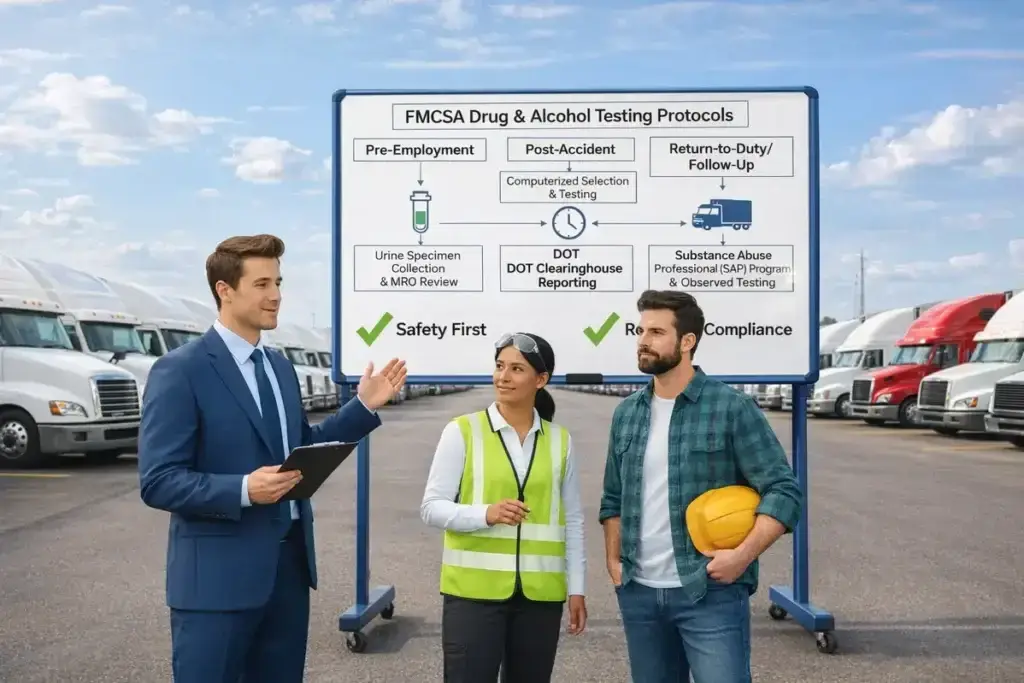
Under 49 CFR Part 382, a compliant CDL drug testing program must be built into daily operations. Fleets are expected to run all required test types—pre-employment, random, post-accident, reasonable suspicion, return-to-duty, and follow-up—with clean documentation and consistent timing. When a program breaks down, fleet safety compliance breaks down with it.
Enforcement risk is real and expensive. FMCSA guidance cites penalties reaching $5,833 per violation for failing to test when required and $5,833 per offense for allowing a driver to operate after a failed test. Beyond fines, fleets face driver disqualification, insurance premium increases, limited coverage options, and lawsuits where violations may support negligence claims. In severe or repeated cases, FMCSA can shut down operations or move toward revocation of operating authority.
Looking ahead to 2026, compliance teams should watch three issues closely. First, DOT continues to enforce marijuana prohibitions under 49 CFR Part 40 and Part 382, even after the December 2025 executive order directing the U.S. Department of Justice to reschedule marijuana. Second, DOT agencies announce annual random testing rates in early January, so fleets should be ready to adjust quickly. Third, proposed fentanyl and norfentanyl panel expansion remains pending, with early 2026 a possible window for a final rule.
Key Takeaways
- Drug testing requirements for fleet employers are a core safety measure under 49 CFR Part 382, not an optional policy choice.
- FMCSA drug testing compliance depends on running each required test type at the right time with complete documentation across all six test categories.
- DOT drug and alcohol testing violations can trigger fines up to $5,833 per incident plus driver disqualification and insurance impacts.
- Clearinghouse queries are now the most commonly violated testing requirement, with over 18,000 violations for missed pre-employment queries between 2021–2025.
- Since November 2024, drivers in prohibited Clearinghouse status face automatic CDL downgrade until completing return-to-duty requirements.
- 2026 compliance planning should account for marijuana enforcement continuity, annual random rate updates, and medical certification verification changes.
FMCSA and DOT Drug and Alcohol Testing Overview for CDL Drivers
The FMCSA drug and alcohol testing overview starts with one principle: a sober, alert driver protects everyone on the road. For fleets, DOT testing requirements for motor carriers are not optional—they form a core part of daily compliance, from hiring through incident response.
The CMV definition for DOT testing matters because coverage depends on the vehicle and work being performed. When a job moves into regulated territory, testing rules follow the driver and the employer. Understanding these thresholds helps fleet managers identify which positions require testing program enrollment.
Why FMCSA Mandates Testing for Safety-Sensitive CMV Operations
FMCSA rules target safety because impairment is a preventable risk factor in serious crashes. Testing requirements are tied to safety-sensitive functions including driving, loading, inspecting, and maintaining readiness to operate a CMV. If a driver performs safety-sensitive functions, the employer must control risk through a compliant testing program.
These requirements also shape a fleet's 2026 planning cycle. DOT agencies announce annual random testing rates in early January, and FMCSA-regulated employers should prepare to adjust program administration if published rates change. The FMCSA random drug testing rate has remained at 50% since 2020, with alcohol at 10%.
Which Fleets and Drivers Are Covered Under 49 CFR Part 382
DOT testing requirements for motor carriers apply to employers operating commercial vehicles in DOT-regulated service. Coverage is based on the work and equipment, not company size. If a fleet uses CDL roles in regulated operations, it must run testing that meets federal standards.
The rule set focuses on 49 CFR Part 382 covered drivers, including CDL holders who perform safety-sensitive functions. That includes many everyday tasks tied to operating a commercial vehicle, even when the truck is not moving. The FMCSA Drug and Alcohol Testing Program page provides additional guidance on coverage definitions.
Covered Vehicles: 26,001+ lbs GVWR, 16+ Passengers, Placarded Hazardous Materials
Use the CMV definition for DOT testing to confirm whether a vehicle triggers program requirements. The key thresholds are weight, passenger capacity, and hazardous materials.
| Trigger | What It Means for Coverage | Common Fleet Examples |
|---|---|---|
| 26,001+ lbs GVWR or GCWR | Operating at or above this threshold generally places the driver in DOT-regulated CMV service when other conditions are met. | Tractors pulling loaded trailers, large straight trucks, combination vehicles in interstate or applicable intrastate commerce |
| 16+ passengers including driver | Passenger capacity can trigger DOT oversight even if the vehicle is under the weight threshold. | Shuttle buses, crew transport buses, large passenger vans for employer transport |
| Hazardous materials requiring placards | Placarded loads bring the operation under stricter safety controls and testing expectations. | Fuel delivery units, chemical transport vehicles, other placarded hazmat carriers |
When these triggers apply, the FMCSA drug and alcohol testing framework connects directly to who must be in the testing pool and how results are handled. That is why fleets document duty status, keep role lists current, and confirm which positions qualify as 49 CFR Part 382 covered drivers.
Who Must Be Tested and What Substances Are Included in the DOT Panel
FMCSA rules require motor carriers to test CDL drivers who perform safety-sensitive work under the Part 382 and Part 40 framework. This includes drivers operating covered commercial motor vehicles and any driver placed into the DOT testing program.
For fleets, the goal is straightforward: testing must happen in required situations, and each step must be documented. That starts with using the correct panel and following the same process every time.
Five Controlled Substances Currently Required: THC, Cocaine, Amphetamines, Opioids, PCP
The DOT 5-panel drug test is a urine test with a fixed set of drug classes. It screens for THC, cocaine, amphetamines and methamphetamines, opioids, and PCP using cutoffs and confirmation rules set by federal standards.
Fleet policies should also address today's marijuana confusion. Even after the December 2025 executive order directing DOJ to reschedule marijuana to Schedule III, DOT-regulated testing requirements remain unchanged—marijuana continues to be disqualifying for safety-sensitive drivers under current DOT guidance.
184,000+
Drivers in prohibited status in the DOT Clearinghouse as of April 2025, with over 142,000 who haven't started return-to-duty
Alcohol Testing Rules and the 0.04 BAC Limit for CMV Drivers
Alcohol is handled under a separate process from drug testing, with strict timing and documentation requirements. In daily operations, the DOT alcohol testing threshold of 0.04 BAC is the key limit for operating a CMV.
Policies should also address the lower band that triggers action: an alcohol concentration of 0.02 or greater but less than 0.04. That range requires removal from driving duties for at least 24 hours and should be treated as a serious compliance issue requiring documentation and follow-up.
| Test Focus | What It Checks | What Fleets Must Build Into Policy |
|---|---|---|
| Drugs | DOT 5-panel for THC, cocaine, amphetamines, opioids, PCP | Collection steps, custody-and-control handling, consistent triggers for pre-employment, random, and post-accident |
| Alcohol | 0.04 BAC operating limit, plus 0.02–0.039 action band | Clear duty removal rules, supervisor procedures, fast testing timelines when required |
Using SAMHSA-Certified Laboratories and Medical Review Officer Verification
Program integrity depends on the lab and review process. Drug specimens must be processed by a SAMHSA-certified laboratory, with results verified by a Medical Review Officer before the employer treats a result as final.
Planning matters in 2026 because changes are moving through the system. DOT proposed adding fentanyl and norfentanyl to the testing panel in September 2025, and early 2026 remains a likely window if a final rule is issued. Oral fluid testing has been allowed since December 2024, but broad adoption may be slow until HHS certifies additional laboratories for oral fluid processing.
Required DOT Test Types Fleets Must Administer to Stay Compliant
Fleet compliance depends on running the right DOT test types at the right time, with clean paperwork and consistent timing. A tight process reduces inspection risk and prevents safety-sensitive work from being assigned to prohibited drivers.
Each test category serves a different purpose. Taken together, they form a clear chain of deterrence, detection, and corrective action that aligns with FMCSA expectations.
Pre-Employment Drug Testing Before a Driver Performs Safety-Sensitive Work
A pre-employment DOT drug test must be completed before a driver performs any safety-sensitive function. The driver cannot operate a CMV until a verified negative result is received.
Allowing a driver to dispatch without a negative test creates a direct compliance violation. According to enforcement data, allowing drivers to operate before receiving negative test results led to 7,555 violations between 2021 and 2025, with an average penalty of $5,677 per incident.
Random Drug and Alcohol Testing and Unbiased Selection Procedures
A random testing program that meets FMCSA expectations is active all year, not clustered in one season. Selections must be unbiased, and a computerized pool is a strong way to demonstrate the process is neutral.
Random tests work best when timing is unpredictable and documentation is complete. The current random testing rate stands at 50% for drugs and 10% for alcohol, requiring fleets to test at least half their average driver count for controlled substances each calendar year.
Post-Accident Testing Triggers: Fatalities, Injuries Requiring Treatment, Citations with Towing
Post-accident DOT testing triggers are specific and time-sensitive. Testing is required after crashes involving a fatality, injuries requiring medical treatment away from the scene when the driver receives a citation, or vehicle towing when the driver receives a citation.
Alcohol tests must occur within 8 hours and drug tests within 32 hours. Clear internal steps help prevent delays, missed tests, and record gaps during high-stress incident response.
⚠️ Critical Timing
If post-accident testing cannot occur within required windows (8 hours for alcohol, 32 hours for drugs), document why testing was not performed. Late tests may be invalid for compliance purposes.
Reasonable Suspicion Testing Based on Trained Supervisor Observations
Reasonable suspicion testing starts with what a trained supervisor can observe and document. Under 49 CFR 382.603, supervisors must complete at least 60 minutes of training on drug impairment indicators and at least 60 minutes on alcohol impairment indicators.
That training supports consistent decisions and reduces uneven enforcement across terminals or shifts. Between 2021 and 2025, DOT investigators issued over 4,000 violations related to supervisors lacking proper training—making it one of the most common and preventable compliance failures.
Return-to-Duty Testing After Violations and SAP Involvement
After a positive test result or refusal, the driver must be removed from safety-sensitive duties immediately. Return to work requires completing the evaluation and treatment process with a Substance Abuse Professional, followed by a return-to-duty drug test before the driver goes back on the road.
This step connects corrective action to documented compliance, which matters during audits and compliance reviews. The SAP determines when the driver is eligible for return-to-duty testing and what follow-up requirements apply.
Follow-Up Testing Requirements: Minimum Six Tests in the First 12 Months
SAP return-to-duty follow-up testing is unannounced and scheduled according to the SAP's plan. It requires a minimum of six tests in the first 12 months and may continue for up to 60 months depending on the violation and SAP recommendations.
Fleets that track dates, custody-and-control forms, and test results in one system are better positioned to prevent prohibited operation and avoid costly violations.
| Compliance Event | When Testing Applies | Operational Impact If Missed |
|---|---|---|
| Pre-employment screen | Before any safety-sensitive work begins | Driver prohibited from operating; enforcement risk increases if dispatched early |
| Random selection | Unannounced, spread across full calendar year | Program integrity questioned if selections look predictable or uneven |
| Post-crash response | When triggers met: fatality, injury treatment, or citation with towing | Late or missed tests create documentation gaps during investigations |
| Supervisor-based referral | When documented observations support testing by trained supervisor | Inconsistent decisions lead to disputes and weak defensibility |
| Return-to-duty and follow-up | After SAP process completion and RTD result; then unannounced follow-ups | Allowing safety-sensitive work without required testing triggers major penalties |
Drug Testing Requirements for Fleet Employers: Building a Compliant Program
Meeting drug testing requirements for fleet employers takes more than ordering tests. It requires repeatable steps that align with 49 CFR Part 382 and Part 40, plus daily controls that keep risky shortcuts out of dispatch. A tight process also helps protect your fleet DOT compliance program during roadside reviews and compliance audits.
Building a Compliant Testing Program That Matches FMCSA Rules
An FMCSA-compliant drug testing program works best when built like an operating system. Each test type has a trigger, a timeline, and a clear owner who can act fast. Results should run through SAMHSA-certified laboratories and Medical Review Officer verification so records are accurate and defensible.
Strong programs also close common gaps. Supervisor training supports reasonable suspicion decisions, and written procedures keep responses consistent. Many fleets use a third-party administrator to support neutral selections, custody-and-control forms, and clean documentation for the fleet DOT compliance program.
| Program Control | What It Must Do | What to Document |
|---|---|---|
| Written drug and alcohol policy | Define who is covered, what is prohibited, when tests occur | Policy version, distribution log, signed acknowledgments |
| Collection and verification chain | Use Part 40 steps from collection to final verified result | Custody-and-control forms, MRO reports, lab identifiers |
| Supervisor readiness | Recognize and document signs for reasonable suspicion | Training dates, observation notes, decision trail |
| TPA administration | Manage pools, selections, and compliance calendars | Selection lists, MIS-ready summaries, vendor agreements |
Ensuring Drivers Do Not Operate a CMV Until a Negative Pre-Employment Result Is Received
The pre-employment negative result requirement should be built into hiring and dispatch workflows, not handled as a reminder. HR can mark a driver as "not eligible" until the verified negative is on file. Dispatch should see the same lockout, preventing a driver from being assigned a safety-sensitive load by mistake.
This control is simple but strict: no CDL driver performs safety-sensitive work until the result is confirmed and documented. When this step is skipped, a minor onboarding rush can turn into a major compliance problem with average penalties exceeding $5,600 per incident.
Keeping Random Testing Spread Evenly Throughout the Year
A clean random testing cadence avoids clumps and patterns. Random selections should spread across months and shifts, with every covered driver staying in the pool. That year-round rhythm is easier to defend and harder for drivers to predict.
Operationally, schedule collections quickly after notification and track completion rates. If a driver is unavailable, document why and move to the next practical opportunity. In a fleet DOT compliance program, consistency matters as much as the math behind selections.
Random Testing Rates and Program Administration Best Practices
Random testing works best when steady, documented, and impossible to predict. For many carriers, the real challenge is not the test itself but proving that the program stays neutral all year.
Planning for FMCSA random testing rates should start early, even if numbers look stable. Rates are typically announced in early January, and many compliance teams prepare for little change unless violation data shifts significantly.
FMCSA Random Testing Minimums: 50% for Drugs and 10% for Alcohol
Under the current rate structure, fleets must meet 50% drug and 10% alcohol random testing across the calendar year. These rates have remained unchanged since 2020 when the drug testing rate increased from 25% due to higher positive test rates.
It helps to watch the wider DOT landscape. PHMSA increased its random drug testing rate to 50% in 2025, signaling tighter expectations in transportation testing programs even when FMCSA minimums stay the same.
Using a Third-Party Administrator for Neutral, Documented Selections
A strong program uses TPA random selection to keep picks defensible and arms-length. Computerized selection reduces claims of favoritism and supports repeatable, audited steps.
Documentation should show the selection date, pool used, who was selected, and when tests were completed. When records are clean, DOT audit risk drops substantially because the file tells the story without gaps.
Preventing Common Program Failures
Many failures are operational, not technical. Predictable patterns, testing the same people too often, or running most tests in one quarter can undermine the "random" standard and raise flags during reviews. Failures in random testing programs resulted in 108 closed enforcement cases in 2024 alone, with average penalties of $7,739.
Common Program Failures to Avoid
- Predictable selections: Avoid manual picking and repeated "routine" days that drivers can anticipate
- Uneven testing cadence: Spread events across months so annual targets are met without clustering
- Weak documentation: Keep a clear audit trail matching the roster, selection output, and results
- Stale pools: Update rosters immediately when drivers join, leave, or change status
| Program Element | Compliant Administration | Common Audit Failures |
|---|---|---|
| Annual minimum targets | Build schedule to meet 50% drug/10% alcohol totals by year-end | Assuming rates will "work out" without tracking running percentage |
| Selection method | TPA random selection using computerized process and defined pool | Supervisor picks, "common sense" lists, or repeat patterns |
| Cadence and timing | Selections spaced throughout year with short notice to drivers | Clustering in one quarter, long delays between selection and collection |
| Audit trail | Documentation tying pool rosters, selection lists, and results together | Missing rosters, unclear pool changes, results that don't match selections |
The HDJ Perspective
The shift from paper-based compliance to real-time database verification has fundamentally changed how fleet managers must approach drug testing programs. The Clearinghouse, CDL downgrade requirements, and electronic medical certification systems mean violations now follow drivers instantly rather than hiding in forgotten filing cabinets. For 2026, the fleets that stay ahead will treat testing compliance as a continuous process — daily verification checks, immediate violation response, and audit-ready documentation — rather than a periodic administrative task. The carriers who built strong compliance cultures before these changes took effect are now seeing measurable advantages in hiring speed, insurance negotiations, and enforcement encounters.
Written Policy Requirements Under 49 CFR 382.601 and Driver Acknowledgments
A fleet cannot manage compliance by memory or verbal reminders. A 49 CFR 382.601 written policy puts the rules in one place and sets a clear standard for every CDL role performing safety-sensitive work. It also helps dispatch, supervisors, and drivers stay aligned during audits and incident reviews.
These DOT drug and alcohol policy requirements apply before testing begins, not after a problem surfaces. Keep the language plain, keep it current, and make sure drivers can quickly find the "who, what, when, and what happens next."
What the Policy Must Include
The 49 CFR 382.601 written policy should name a real point of contact who can answer questions—not just a generic department. It must identify which driver categories are covered, what safety-sensitive functions include, and what is prohibited on and around duty time.
DOT drug and alcohol policy requirements also call for test types and triggers, including post-accident criteria, plus how the testing process protects identity, privacy, and chain of custody. Drivers should see, in plain terms, that submitting to required tests is a condition of performing safety-sensitive functions.
| Required Content | What Drivers Need to Understand | Why It Matters Operationally |
|---|---|---|
| Covered driver categories | Who is subject to DOT testing, including transfers into CDL duties | Prevents missed enrollment when assignments or terminals change |
| Safety-sensitive functions | Which tasks trigger DOT expectations across the workday | Clarifies when driver must remain ready for testing |
| Prohibitions and thresholds | Drug/alcohol bans, timing rules, what counts as a violation | Reduces gray area decisions during roadside and post-crash reviews |
| Clearinghouse notice | Which violations are reported and why records follow CDL history | Sets expectations before violation becomes hiring barrier |
Refusals to Test: How They Are Defined and Handled
A strong policy explains the refusal to test definition in practical terms. It should cover common refusal scenarios: failing to appear, leaving the site, not providing a required specimen, or not cooperating with the collection process. A refusal is treated as a positive test result for compliance purposes.
When supervisors understand the refusal to test definition, they document facts instead of opinions. That keeps the response consistent across shifts and terminals, especially when decisions must be made quickly under pressure.
Consequences for Violations
DOT drug and alcohol policy requirements demand clarity on what happens after a positive, an alcohol result triggering removal, or a refusal. The policy should state that the driver is removed from safety-sensitive functions immediately and directed into the required evaluation process with a Substance Abuse Professional.
Return-to-duty steps and follow-up testing expectations must appear in plain language. Drivers should know these steps are not optional and not negotiable once a violation is recorded in the Clearinghouse.
Distributing Policies to Employees and Contractors
Policy delivery must be systematic, not informal. Owner-operator policy distribution is part of the compliance workload, along with providing the same materials to staffing service drivers, contract drivers, and anyone transferring into a safety-sensitive position.
Using one controlled version of the 49 CFR 382.601 written policy helps avoid mismatched rules across terminals and prevents gaps where a driver is dispatched before receiving required materials.
Signed Receipts and Proof of Delivery
A driver acknowledgment signed receipt is the cleanest proof that materials were issued as required. Keep the receipt tied to the driver record so it is easy to produce during an audit or compliance review.
Owner-operator policy distribution should follow the same proof standard as payroll employees. A driver acknowledgment signed receipt supports consistent enforcement because the carrier can show the driver was informed before any testing event or violation occurs.
Free Professional Fleet Tools
Cost calculators, fault code lookup, maintenance planners, and more — built for owner-operators, fleet managers, and diesel techs. No signup required.
FMCSA Drug and Alcohol Clearinghouse Compliance and Reporting
For most fleets, FMCSA Drug and Alcohol Clearinghouse compliance is no longer a back-office task—it is a daily control affecting hiring, dispatch, and audit outcomes. With tighter enforcement and automatic CDL downgrades now in effect, missed queries or weak files turn into fast penalties.
Start with the Clearinghouse pre-employment query. A full query must be completed and returned before a driver performs any safety-sensitive function. Build the step into your hiring checklist so the driver cannot be assigned a unit until the result is in the file. Between 2021 and 2025, employers faced over 18,284 violations for failing to conduct pre-employment queries—making it the single most common drug and alcohol testing error in FMCSA investigations.
Next, run an annual limited query for every active CDL driver at least once every 12 months. Many carriers time it to the driver's hire date or a fixed month each year, but either approach must be consistent. Keep proof of consent and the query record where reviewers can find it quickly. Missing annual queries led to 16,031 violations between 2021 and 2025, ranking as the second most common testing-related citation.
| Compliance Action | When It Must Happen | Common Audit Miss |
|---|---|---|
| Clearinghouse pre-employment query | Before first dispatch or any safety-sensitive work | Driver placed in service while query still pending |
| Annual limited query | At least once every 12 months for each active CDL driver | Uneven timing with gaps exceeding 12 months |
| Clearinghouse violation reporting | Within required timeframes after verified results | Incomplete entries or late reporting |
| Return-to-duty tracking | From SAP referral through follow-up completion | Missing proof follow-up testing was completed |
Clearinghouse violation reporting must match what your program already treats as a violation: verified positives, alcohol confirmations at or above 0.04, refusals, and certain actual knowledge items. Your written DOT policy should warn drivers that Part 382 events are entered, including negative return-to-duty tests, SAP completion steps, and follow-up completion reporting.
Operationally, treat prohibited status as a hard stop. Dispatch and driver managers should have a repeatable check preventing assignment when a record shows "prohibited," keeping the driver out until return-to-duty requirements are finished. Since November 18, 2024, the prohibited status CDL downgrade requirement has tied state licensing action to Clearinghouse status, raising the stakes for getting the process right.
Recordkeeping, Retention Periods, and Audit Readiness for Motor Carriers
Clean files reduce delays during inspections and help teams answer questions fast. Strong DOT drug test record retention also supports consistent decisions in hiring, dispatch, and corrective action.
To stay aligned with recordkeeping under 49 CFR Part 382, keep testing records readable, traceable, and easy to pull on demand. Store records in a controlled system with limited access, clear naming, and a simple index matching each driver to each event.
Retention Timelines
Retention is not optional, and it is not one-size-fits-all. Keep positive results, refusals, and other violations for five years, while negative results are kept for one year under DOT drug test record retention rules.
Plan for overlapping retention rules as well. Driver qualification files are often kept for three years after separation, while some testing items outlive the employment period. This affects how you archive driver qualification file drug test results and related documentation.
Organizing Records for Inspections and Compliance Reviews
FMCSA audit readiness in 2026 depends on how quickly records can be produced and how well they match selection logs, test forms, and Clearinghouse activity. Auditors may look closely at random selections, timing, and whether the file tells a clear story from notice to result.
Set a routine for internal checks, such as quarterly mock reviews, and log what was fixed. That running log becomes practical compliance review documentation when an investigator asks how issues are found and corrected. Offsite DOT audits have increased in recent years, with some carriers given limited lead time to submit digital records.
Connecting Testing Records to the Driver File
Link drug and alcohol records to the driver qualification file so the hiring path is complete and defensible. A well-built system ties driver qualification file drug test results to the application, prior employer checks, and pre-employment testing with date-stamped updates.
Include medical qualification status based on current rules. After January 10, 2026, motor carriers must verify CDL driver medical certifications exclusively through Motor Vehicle Records obtained from state licensing agencies rather than collecting paper Medical Examiner's Certificates.
| Record Group | What to File | Minimum Retention |
|---|---|---|
| DOT test outcomes | Positive results, refusals, violations, return-to-duty and follow-up records | 5 years |
| Negative drug test results | Verified negative laboratory results and related forms | 1 year |
| Random testing proof | Selection lists, notification logs, completion dates, annual rate calculations | 2 years |
| Clearinghouse activity | Pre-employment queries, annual queries, proof of responses | Keep while current in driver file; align with company policy |
| Driver qualification file | Application, prior employer verification, MVRs, road test or CDL copy, annual review | 3 years after termination |

Frequently Asked Questions
What drug tests are required for CDL drivers under DOT regulations?
DOT regulations require six types of drug and alcohol tests for CDL drivers: pre-employment drug testing before any safety-sensitive work, random testing throughout the year at rates of 50% for drugs and 10% for alcohol, post-accident testing when specific crash criteria are met, reasonable suspicion testing based on trained supervisor observations, return-to-duty testing after violations, and follow-up testing with a minimum of six unannounced tests in the first 12 months. All drug tests use the DOT 5-panel screening for THC, cocaine, amphetamines, opioids, and PCP through SAMHSA-certified laboratories with Medical Review Officer verification.
What are the penalties for failing to comply with FMCSA drug testing requirements?
FMCSA penalties for drug and alcohol testing violations can reach $5,833 per violation for Clearinghouse infractions, failing to test when required, or allowing a driver to operate after a failed test. Enforcement data from 2021–2025 shows employers faced over 18,284 violations for failing to conduct pre-employment Clearinghouse queries and 16,031 violations for missing annual queries. Beyond direct fines, fleets face driver disqualification, insurance premium increases, coverage restrictions, potential negligence claims in litigation, and in severe cases, revocation of operating authority.
How does the FMCSA Drug and Alcohol Clearinghouse affect fleet compliance?
The FMCSA Clearinghouse is a centralized database requiring employers to conduct pre-employment full queries before any driver performs safety-sensitive work and annual limited queries for all active CDL drivers at least every 12 months. Employers must report violations including positive tests, refusals, and actual knowledge determinations within required timeframes. Since November 18, 2024, states must downgrade CDL privileges for drivers in prohibited Clearinghouse status until they complete return-to-duty requirements, making immediate verification essential before dispatch.
What substances does the DOT 5-panel drug test screen for?
The DOT 5-panel drug test screens for five classes of controlled substances: THC (marijuana metabolites), cocaine, amphetamines and methamphetamines, opioids (including codeine, morphine, heroin, hydrocodone, hydromorphone, oxycodone, and oxymorphone), and PCP (phencyclidine). Despite ongoing discussions about marijuana rescheduling following the December 2025 executive order, DOT continues to prohibit marijuana for safety-sensitive drivers under current regulations. A fentanyl and norfentanyl panel expansion remains pending and may be finalized in 2026.
What are the post-accident drug testing requirements for commercial drivers?
Post-accident DOT testing is required when a crash involves a fatality, when injuries require medical treatment away from the scene and the driver receives a citation, or when vehicles are towed and the driver receives a citation. Alcohol tests must be administered within 8 hours and drug tests within 32 hours of the accident. If testing cannot occur within these windows, the employer must document the specific reasons why testing was not performed. Testing should occur as soon as possible after the accident while meeting immediate medical and safety needs.
What training is required for supervisors to conduct reasonable suspicion testing?
Under 49 CFR 382.603, supervisors who may make reasonable suspicion determinations must complete at least 60 minutes of training on alcohol misuse indicators and at least 60 minutes on controlled substance use indicators. Training must cover physical, behavioral, speech, and performance signs of impairment. Documentation should include training certificates, completion dates, and refresher schedules. Between 2021 and 2025, DOT investigators issued over 4,000 violations for supervisors lacking proper training.
Building a Compliant Drug Testing Program for 2026
A strong fleet employer compliance plan starts with knowing who is covered under 49 CFR Part 382 and which CMVs trigger testing rules. Use the DOT 5-panel for THC, cocaine, amphetamines and methamphetamines, opioids, and PCP, and apply alcohol rules with the 0.04 BAC limit for CMV operation. Keep results defensible by using SAMHSA-certified labs and Medical Review Officer verification. Treat this as your ongoing compliance checklist, not a one-time setup.
DOT drug and alcohol testing best practices come down to controls that cannot slip. Do not allow safety-sensitive work until a negative pre-employment drug test and Clearinghouse query are on file. Run random selections that are unbiased and spread across the calendar, documenting the cadence as part of program management. Train supervisors for at least 60 minutes on drugs and 60 minutes on alcohol so reasonable suspicion decisions are grounded and repeatable.
Operational discipline also means acting fast when a violation occurs. Remove the driver from duty immediately, complete the Substance Abuse Professional evaluation and return-to-duty steps, and meet all Clearinghouse requirements before any return to safety-sensitive work. Missing that sequence puts operating authority at risk during audits and compliance reviews while undermining the entire safety posture of the fleet.
For 2026, watch FMCSA and DOT updates on random testing rates and Clearinghouse rules, keep marijuana testing unchanged under current DOT guidance, prepare for medical certification verification changes, and be ready to update policies if fentanyl and norfentanyl panel expansion becomes final. Build drug testing program management into daily operations, and the compliance foundation will support everything else the fleet needs to run safely.
Explore More Heavy-Duty Topics
Browse HDJ's complete library of diesel maintenance guides, fleet management resources, and trucking industry coverage — organized by topic for fast access.