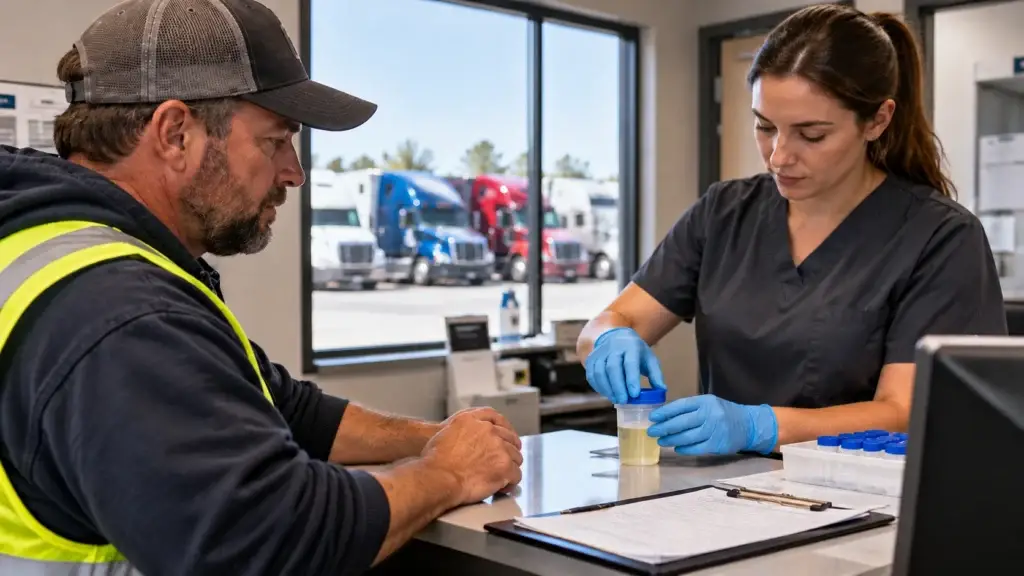
DOT drug testing requirements

DOT Drug Test Requirements for CDL Drivers in 2025

Table of Contents
    Add a header to begin generating the table of contents

    Federal regulations mandate comprehensive drug and alcohol screening for all commercial motor vehicle operators to protect public safety on American roadways. The Federal Motor Carrier Safety Administration enforces these standards through 49 CFR Part 382, establishing strict compliance measures for every CDL holder performing safety-sensitive transportation work.

    DOT drug test requirements apply to six distinct scenarios: pre-employment screening, random selection, post-accident incidents, reasonable suspicion situations, return-to-duty procedures, and follow-up monitoring. The standard five-panel screen detects marijuana, cocaine, amphetamines, opioids, and phencyclidine. Compliance is mandatory—violations carry serious consequences including immediate disqualification, Clearinghouse reporting, and automatic state-level CDL suspension.

    Significant regulatory changes in 2025 include oral fluid collection methods as an approved alternative to urine samples and enhanced Clearinghouse enforcement that now triggers automatic CDL suspensions for prohibited status. Random selection rates remain at 50% for controlled substances and 10% for alcohol annually, creating continuous testing obligations throughout a driver’s career.

    Last Updated: November 2025

    Key Takeaways

    • Federal law requires all CDL holders to comply with mandatory screening under 49 CFR Part 382 regulations covering six testing scenarios
    • The five-panel drug test screens for marijuana, cocaine, amphetamines, opioids, and PCP with specific cut-off levels for screening and confirmation
    • 2025 regulatory updates introduce oral fluid collection as an approved alternative method with enhanced Clearinghouse enforcement
    • Clearinghouse violations now automatically trigger state-level CDL suspensions effective November 18, 2024
    • Random testing rates are set at 50% for drugs and 10% for alcohol with immediate notification requirements
    • Violations result in immediate removal from safety-sensitive functions and mandatory SAP-directed return-to-duty process

    Understanding DOT Drug and Alcohol Testing Regulations

    The legal foundation for DOT drug test requirements stems from the Omnibus Transportation Employee Testing Act of 1991, which granted specific agencies authority to mandate testing programs. The Federal Motor Carrier Safety Administration serves as the primary DOT agency responsible for establishing drug testing regulations for commercial motor vehicle operators through 49 CFR Part 382.

    These regulations work in conjunction with 49 CFR Part 40, which establishes standardized procedures for drug and alcohol testing across all DOT agencies. The two-part regulatory structure ensures consistency in testing methods while addressing industry-specific requirements for commercial transportation.

    FMCSA maintains oversight through the Drug and Alcohol Clearinghouse, a comprehensive database launched in January 2020 to track program violations. This centralized system revolutionized how employers verify driver eligibility and maintain DOT compliance by creating a permanent federal record accessible to all motor carriers during pre-employment queries.

    FMCSA regulations and DOT compliance requirements for commercial motor vehicle operators

    Federal Motor Carrier Safety Administration enforcement mechanisms protect highway safety through comprehensive drug and alcohol testing protocols.

    Who Must Comply with Testing Requirements

    Under 49 CFR Part 382, § 382.103, anyone who operates a commercial motor vehicle requiring a CDL in the United States faces mandatory testing. The requirements apply regardless of driving frequency or employment status, covering both full-time and part-time drivers equally. CDL holders with licenses issued by Canadian and Mexican governments must also comply when operating within US borders.

    Owner-operators and leased drivers face identical testing obligations as company employees. The regulations make no distinction based on employment classification—any individual performing safety-sensitive functions in a commercial motor vehicle must participate in the testing program.

    A commercial motor vehicle includes any vehicle used in interstate commerce meeting specific criteria: gross vehicle weight rating of 10,001 pounds or more, combination vehicles with ratings of 26,001 pounds or more, vehicles designed to transport 8 passengers for compensation or 16 including the driver, and vehicles of any size transporting placarded hazardous materials.

    Safety-sensitive functions encompass all job duties where impairment could compromise public safety. Testing requirements apply during all time spent driving commercial vehicles, loading and unloading cargo, inspecting or servicing vehicles, repairing or attending disabled vehicles, and being in physical control of a vehicle with the engine running.

    Complete DOT Drug Testing Requirements for 2025

    Federal transportation safety regulations establish detailed requirements for drug testing panels, alcohol screening thresholds, and violation reporting systems. The Department of Transportation maintains strict oversight of commercial driver testing through standardized procedures that apply across all safety-sensitive positions nationwide.

    Regulated Substances and Testing Panels

    The DOT uses a standardized five-panel drug test configuration mandated under 49 CFR Part 40, § 40.82. This testing protocol screens for five major drug categories but actually tests for 14 specific substances within those categories, ensuring thorough detection of prohibited substances while maintaining testing efficiency.

    Drug CategorySpecific Substances TestedInitial Screening (ng/mL)Confirmatory Test (ng/mL)
    MarijuanaTHCA metabolite5015
    CocaineBenzoylecgonine metabolite150100
    AmphetaminesAmphetamine, Methamphetamine, MDMA, MDA500250
    OpioidsCodeine, Morphine, Hydrocodone, Hydromorphone, Oxycodone, Oxymorphone, 6-AM2,0002,000
    PhencyclidinePCP2525

    The opioid panel underwent significant expansion to include semi-synthetic opioids commonly prescribed for pain management, including hydrocodone, hydromorphone, oxycodone, and oxymorphone. Testing laboratories must follow strict protocols outlined in 49 CFR Part 40, § 40.87 when analyzing samples to ensure consistent results across different testing facilities nationwide.

    DOT alcohol testing uses evidential breath testing devices or approved saliva screening methods to measure blood alcohol concentration. The regulatory framework establishes two critical BAC threshold levels: 0.02 BAC requires removal from duty for 24 hours, while 0.04 BAC constitutes a prohibited level for safety-sensitive functions triggering full DOT violation consequences. Any result at or above 0.04 BAC triggers immediate removal from service, mandatory Clearinghouse reporting, and requires completion of the return-to-duty process before resuming commercial driving.

    Five-panel drug test components showing cut-off levels and Clearinghouse compliance requirements

    Standard DOT five-panel testing protocols detect marijuana, cocaine, amphetamines, opioids, and phencyclidine with specific threshold levels.

    FMCSA Clearinghouse Requirements

    The FMCSA Drug and Alcohol Clearinghouse represents the most significant enforcement mechanism in DOT testing compliance. Employers must report all violations to the database within two business days of receiving confirmed positive results or test refusals, creating an immediate federal record visible to all prospective employers.

    Motor carriers face comprehensive query obligations: pre-employment queries required for all driver applicants before first safety-sensitive duty, annual queries conducted once per year for every employed CDL driver, and full queries required for complete violation history verification.

    The November 18, 2024 enforcement update created immediate consequences for drivers marked as prohibited in the Clearinghouse. Most states now automatically suspend CDLs for drivers showing prohibited status, preventing them from operating commercial vehicles until completing the return-to-duty process. This integration between federal Clearinghouse reporting and state CDL licensing systems eliminates previous enforcement gaps.

    Stay Ahead of Industry Trends

    Get expert insights on DOT compliance, equipment reviews, and operational strategies delivered weekly to your inbox.

    Subscribe to Our Newsletter

    Six DOT Testing Scenarios for CDL Drivers

    Federal regulations mandate comprehensive testing across six distinct scenarios, each serving specific safety and compliance purposes. Understanding when each test type applies helps drivers and employers maintain continuous regulatory compliance throughout employment relationships.

    Pre-Employment Drug Testing

    Every prospective CDL driver must undergo drug testing before performing any safety-sensitive function for a new employer. Under 49 CFR Part 382, § 382.301, employers cannot permit drivers to operate commercial vehicles until receiving negative test results. The test must occur after a conditional employment offer but before the driver performs safety-sensitive work.

    As of January 6, 2020, employers must conduct a full query of the FMCSA Clearinghouse before permitting any driver to operate commercial vehicles. The driver must provide consent within the previous 30 days. If the query reveals any violation, the applicant cannot be hired until successfully completing the return-to-duty process with documented proof from a Substance Abuse Professional.

    Pre-employment drug testing procedures and Clearinghouse query requirements for CDL applicants

    Pre-employment screening combines drug testing with comprehensive Clearinghouse queries to verify driver qualification before hiring.

    Beyond Clearinghouse queries, employers must contact all employers from the previous three years under § 382.413 to obtain information about drug and alcohol violations. This dual-verification system ensures no gaps in the driver’s compliance history, protecting employers from negligent hiring claims while maintaining highway safety standards.

    Random Drug and Alcohol Testing Programs

    Unannounced testing serves as the primary enforcement mechanism ensuring CDL drivers remain substance-free while performing safety-sensitive functions. Motor carriers must establish random testing programs operating continuously throughout the calendar year using scientifically valid selection methods.

    The FMCSA maintains a 50% random drug testing rate and 10% alcohol testing rate for 2025, calculated based on the average number of safety-sensitive employees throughout the year. Drivers can be selected multiple times during a single calendar year while other drivers may not be selected at all—this outcome reflects true random selection rather than program deficiencies.

    Notification to selected drivers must occur immediately before the test with no advance warning. Once notified, drivers must proceed directly to the designated collection site without delay. The testing must occur during the driver’s performance of safety-sensitive functions or immediately before or after such functions.

    Random drug testing selection process showing immediate notification requirements and testing protocols

    Random selection programs use scientifically valid methods ensuring equal probability selection with immediate notification protocols.

    Post-Accident Testing Protocols

    Three distinct scenarios trigger mandatory post-accident testing for CDL drivers. Any accident resulting in a human fatality requires both drug and alcohol testing regardless of whether the driver receives a citation. Testing remains mandatory even if the fatality occurs days after the accident, provided it results from injuries sustained in the collision.

    For non-fatal accidents, testing requirements depend on two threshold combinations. The first involves accidents where the driver receives a moving traffic violation citation and someone other than the driver sustains bodily injury requiring immediate medical treatment away from the scene. The second applies when the driver receives a citation and one or more vehicles requires towing due to disabling damage.

    Alcohol testing must be administered within two hours following the accident, with continued efforts for up to eight hours if initial attempts fail. Drug testing must be conducted as soon as practicable but no later than 32 hours after the collision. Drivers must remain available for testing and cannot consume alcohol for eight hours post-accident unless tested earlier.

    Post-accident testing protocols showing triggering events and compliance timeframes for commercial drivers

    Post-accident protocols establish specific triggering criteria and strict testing timeframes based on accident severity and citation issuance.

    Reasonable Suspicion Testing

    Federal regulations authorize employers to conduct testing when trained supervisors detect observable signs suggesting substance use. Under 49 CFR Part 382.307, reasonable suspicion testing requires more careful implementation than any other category due to its subjective nature and potential legal challenges.

    Only supervisors who completed mandatory training can authorize reasonable suspicion testing. The regulations require at least 60 minutes of training on alcohol misuse signs and 60 minutes on controlled substance use signs. This training represents a non-negotiable prerequisite for making impairment determinations.

    The determination must rest on specific, articulable observations documented in writing before or immediately after requiring the test. Observable indicators include physical signs such as bloodshot eyes, dilated or constricted pupils, slurred speech, lack of coordination, tremors, and unusual odors. Behavioral indicators encompass erratic behavior, confusion, aggressive attitudes, extreme lethargy or hyperactivity, paranoia, and unexplained mood swings.

    Reasonable suspicion testing showing supervisor training requirements and observable impairment indicators

    Trained supervisors must document specific observable behaviors before authorizing reasonable suspicion testing to ensure legal defensibility.

    Return-to-Duty and Follow-Up Testing

    After a positive drug test or refusal, CDL drivers face a comprehensive rehabilitation process before operating commercial vehicles again. Drivers who violate DOT regulations must undergo evaluation by a Substance Abuse Professional before returning to work. The SAP must meet specific qualifications under § 40.281, including licensed physicians, psychologists, social workers, or addiction counselors with demonstrated knowledge of DOT regulations.

    The SAP evaluation includes comprehensive clinical assessment, determination of necessary education or treatment programs, written recommendations outlining required steps, follow-up evaluation after completion, and creation of a personalized follow-up testing plan. Drivers bear complete responsibility for SAP evaluation costs unless employers voluntarily agree to cover expenses.

    Only after the SAP confirms compliance with all recommendations can employers schedule a return-to-duty test. This test must be conducted under direct observation and produce a verified negative result before the driver resumes safety-sensitive duties. No exceptions exist to this requirement regardless of treatment extent.

    After successfully completing the return-to-duty process, drivers enter intensive monitoring. Federal regulations mandate minimum six unannounced follow-up tests within the first 12 months after return, though SAPs typically require more frequent testing. The follow-up testing period can extend up to 60 months as directed by the substance abuse professional based on individual progress and risk factors.

    Return-to-duty process showing SAP evaluation requirements and follow-up testing protocols

    Substance Abuse Professional evaluations serve as gatekeepers ensuring drivers complete necessary treatment before returning to safety-sensitive functions.

    DOT Drug Testing Procedures and Protocols

    Every DOT drug test follows detailed protocols designed to eliminate errors and ensure reliable results. These procedures are governed by 49 CFR Part 40, establishing binding standards for employers, collection sites, laboratories, and medical review officers throughout the testing process.

    Collection Site and Chain of Custody Requirements

    DOT-approved collection sites must meet specific facility and personnel standards. Each site must provide visual and auditory privacy in collection areas, secure storage protecting specimens from tampering, and controlled toilet facility access preventing specimen substitution. Collection personnel must complete DOT-approved training programs covering proper procedures and documentation requirements.

    The chain of custody creates a documented trail tracking each specimen from collection through final disposition. Identity verification starts every collection process through government-issued photo identification examination. Collection procedures follow strict sequences maintaining specimen integrity, including immediate temperature measurement (90-100°F) and volume verification within four minutes of provision.

    Documentation requirements include donor observation of container sealing, tamper-evident label application in donor presence, Federal Custody and Control Form completion with signatures from both parties, sealed specimen placement in transport bags with additional tamper-evident seals, and continuous handling transfer documentation with signatures and dates.

    Laboratory Testing Standards and MRO Review

    Only laboratories certified through the Department of Health and Human Services National Laboratory Certification Program can analyze DOT specimens. Every specimen undergoes initial screening using immunoassay technology detecting drug metabolites at established cut-off levels. Specimens measuring below screening cut-offs receive negative results.

    Confirmatory testing uses gas chromatography/mass spectrometry or liquid chromatography/mass spectrometry providing precise chemical identification and quantification. These methods use lower confirmatory cut-off levels than initial screening, with the definitive nature of mass spectrometry eliminating false positives from the screening phase.

    The Medical Review Officer serves as the final checkpoint before results reach employers. MROs are licensed physicians with specialized DOT training who review every laboratory result. When laboratories report positive results, the MRO contacts drivers confidentially to explore potential legitimate medical explanations. Prescription medication review determines whether current valid prescriptions explain positive findings.

    The MRO makes final determinations after completing reviews, potentially changing laboratory-positive results to MRO-negative if legitimate medical explanations exist. Result reporting flows from the MRO to employers and the FMCSA Clearinghouse, with MROs reporting only final determinations while maintaining driver medical privacy.

    Employer Compliance and Driver Rights

    Transportation employers face multi-layered compliance obligations encompassing written policies, designated representatives, and extensive documentation requirements. Under 49 CFR Parts 40 and 382, commercial motor carriers must establish comprehensive systems for policy development, test administration oversight, and regulatory reporting.

    Written Policy and Record Keeping Requirements

    Every DOT-regulated employer must develop and maintain comprehensive written drug and alcohol testing policies distributed to all covered employees before testing begins. The policy must include company commitment to drug-free workplaces, employee categories subject to testing, testing circumstances for all six scenarios, prohibited substances and conduct standards, violation consequences including immediate removal, and return-to-duty procedures.

    Retention periods vary by document type. Five-year retention applies to positive test results, refusals, SAP reports, and return-to-duty documentation. Two-year retention covers negative test results and canceled tests. One-year retention applies to random selection records and administrative program records.

    All DOT-regulated employers must submit annual drug and alcohol test data through the Management Information System reporting process by March 15 each year. As of January 1, 2024, reports must be submitted through the Login.gov portal covering comprehensive testing program statistics from the previous calendar year.

    CDL Driver Rights and Responsibilities

    The DOT testing program establishes balanced frameworks protecting driver rights while enforcing safety responsibilities. Employers must provide comprehensive educational materials explaining testing requirements, prohibited substances, testing procedures, and available resources before any testing occurs.

    Refusing a drug test carries identical consequences to verified positive results. Several actions qualify as test refusal: failing to appear at collection sites within reasonable time after notification, leaving collection sites before testing completes, failing to provide sufficient specimen volume without valid medical explanation, and declining observed collections when required.

    Drivers have strong privacy protections throughout testing processes. Collection procedures must provide auditory and visual privacy when providing specimens, with direct observation occurring only in specific circumstances. Test results qualify as confidential medical information with release only to authorized parties.

    Medication disclosure procedures protect both driver privacy and testing integrity. Drivers should never disclose prescription medications to employers or collection personnel. Information should only be shared with MROs if contacted about positive laboratory results, protecting legitimate medication use from causing employment consequences.

    Share Your Expertise

    Join Heavy Duty Journal as a guest author and reach thousands of fleet managers, diesel technicians, and industry decision-makers with your DOT compliance insights.

    Become a Guest Author

    Consequences of Testing Violations

    When CDL drivers fail DOT drug or alcohol tests, consequences extend far beyond single-day work interruptions. Testing violations create regulatory actions that can permanently derail commercial driving careers through immediate removal, Clearinghouse reporting, and state-level license sanctions.

    Immediate Removal and Clearinghouse Reporting

    Employers must immediately prohibit drivers from performing safety-sensitive functions upon receiving verified positive test results. This removal is non-discretionary and immediate with no grace period under federal regulations. Drivers cannot operate commercial vehicles, perform pre-trip inspections, load or unload vehicles, or conduct any safety-sensitive work during this prohibition.

    Employers must report all violations to the FMCSA Clearinghouse within two business days. This reporting creates immediate federal records visible to all prospective employers conducting pre-employment queries. Once reported, drivers receive prohibited status preventing CDL employment until completing return-to-duty processes.

    The November 18, 2024 enforcement update created automatic state CDL suspensions for drivers marked as prohibited in the Clearinghouse. States receive notification directly and process license suspensions or revocations, preventing any CDL operation regardless of employer willingness until full clearance is achieved.

    Violation EventImmediate ActionClearinghouse ImpactLong-Term Consequence
    Positive Test ResultRemoval within 24 hoursProhibited status within 2 business days5-year minimum record, automatic state CDL suspension
    Refusal to TestImmediate removal from dutyReported as violation within 2 business daysSame as positive test, often viewed more severely by employers
    SAP Evaluation RequiredCannot perform safety-sensitive functionsProhibited status remains until RTD completionEmployment barriers persist even after successful completion

    Career and Employment Impact

    Automatic state CDL suspension significantly increases career consequences beyond previous practice. Many trucking companies maintain strict policies refusing to hire drivers with any Clearinghouse violations regardless of rehabilitation completion. These policies apply regardless of violation timing, creating substantial barriers to industry re-entry.

    The five-year minimum retention period in the Clearinghouse affects employability throughout that duration. Commercial trucking insurers may refuse coverage for drivers with violation records, viewing them as high-risk. Companies face significantly elevated insurance premiums when employing drivers with violation histories, often exceeding what employers are willing to absorb.

    Employers who hire or retain drivers with known testing violations face heightened liability in civil litigation following accidents. Evidence that companies employed drivers with violation histories can support negligent hiring claims, substantially increasing settlement values and jury verdicts in accident litigation.

    2025 Updates and Recent Regulatory Changes

    Significant regulatory developments in 2025 bring transformative changes to DOT drug testing protocols through new testing methods and stricter enforcement mechanisms. These updates represent the most substantial modifications to federal testing requirements in decades.

    Alternative Specimen Collection Methods

    The Department of Transportation published DOT Oral Fluid Specimen Collection Procedures Guidelines in January 2025, authorizing saliva-based drug tests as alternatives to traditional urine collection. This groundbreaking change follows a final rule published in the Federal Register on May 2, 2023, effective June 1, 2023, which modified 49 CFR Part 40.

    Oral fluid testing offers several advantages over urine collection methods. The process is less invasive, reducing privacy concerns accompanying observed urine collections. Saliva samples are more difficult to adulterate than urine specimens, potentially reducing cheating attempts and improving test integrity. The testing panel remains consistent with existing requirements, screening for the same five-panel drug list with cut-off levels adjusted for the oral fluid matrix.

    Despite regulatory authorization, oral fluid testing has not yet achieved widespread implementation in 2025. The primary delay stems from pending laboratory certification requirements. Testing facilities must obtain separate certification specifically for oral fluid analysis from the Department of Health and Human Services, with this certification process remaining ongoing for most laboratories.

    Strengthened Clearinghouse Compliance Measures

    Beginning November 18, 2024, CDL drivers marked as prohibited in the FMCSA Clearinghouse face immediate CDL suspension in most states. State licensing agencies now access Clearinghouse data directly and automatically suspend or revoke commercial driving privileges when drivers receive prohibited status, closing significant compliance gaps.

    The FMCSA has intensified monitoring of employer compliance with Clearinghouse reporting requirements through increased audits targeting employers failing to report violations promptly or neglecting mandatory query obligations. Civil penalties for non-compliance have escalated, with maximum fines reaching $7,333 per violation in 2025.

    Technological improvements in 2025 include enhanced electronic reporting through Login.gov for Management Information System submissions and advanced laboratory technologies providing faster result turnaround times. Electronic chain of custody systems have expanded across collection sites nationwide, reducing paperwork burdens while improving accuracy and accountability through real-time tracking capabilities.

    Conclusion

    Compliance with DOT drug test requirements remains mandatory for all CDL drivers performing safety-sensitive functions. These federal regulations protect public safety on roadways shared with commercial motor vehicles through comprehensive screening protocols covering six testing scenarios.

    Understanding pre-employment screening, random selection, post-accident protocols, reasonable suspicion testing, return-to-duty requirements, and follow-up monitoring is critical for maintaining commercial driving privileges. The five-panel drug screen and alcohol testing protocols apply uniformly across all carriers and owner-operators, with no exceptions for any CDL holder operating commercial motor vehicles.

    The 2025 regulatory updates have strengthened enforcement mechanisms significantly. Oral fluid testing provides employers with additional testing options when laboratory certifications become widespread. Enhanced Clearinghouse enforcement now triggers automatic state license suspensions for violations, making proactive compliance more important than ever for career preservation.

    For drivers, staying compliant means avoiding all prohibited substances, understanding testing procedures and rights, responding immediately when selected for testing, and disclosing legitimate prescriptions only to Medical Review Officers during verification processes. For employers, this overview reinforces needs for written policies, proper record keeping with appropriate retention periods, comprehensive Clearinghouse query compliance, and designated representatives trained in regulatory requirements.

    Violations carry serious consequences including immediate removal from duty, two-business-day Clearinghouse reporting creating permanent federal records, and automatic state CDL suspension effective November 2024. Completing the return-to-duty process through qualified Substance Abuse Professionals represents the only pathway back to commercial driving, though employment challenges persist even after successful rehabilitation completion.

    Maintaining DOT compliance protects your commercial driving career while ensuring roadway safety for all highway users. Motor carriers and CDL holders must stay informed about evolving regulatory requirements through official FMCSA resources and industry guidance to navigate these complex federal mandates successfully.

    Frequently Asked Questions

    What are the six types of DOT drug and alcohol tests required for CDL drivers?

    The six mandatory testing scenarios under FMCSA regulations are pre-employment testing required before performing safety-sensitive functions, random testing with unannounced selections at minimum rates of 50% for drugs and 10% for alcohol, post-accident testing following specific criteria including fatalities or bodily injury with citation, reasonable suspicion testing based on trained supervisor observations, return-to-duty testing after completing SAP recommendations following violations, and follow-up testing with minimum six tests in first 12 months continuing up to 60 months as directed by the SAP.

    What substances does the DOT five-panel drug test screen for?

    The DOT five-panel drug test screens for five drug categories testing 14 specific substances: marijuana (THC metabolite at 50 ng/mL initial screening, 15 ng/mL confirmatory), cocaine (benzoylecgonine at 150 ng/mL initial, 100 ng/mL confirmatory), amphetamines including methamphetamine and MDMA (500 ng/mL initial, 250 ng/mL confirmatory), opioids including codeine, morphine, hydrocodone, hydromorphone, oxycodone, and oxymorphone (2,000 ng/mL for most), and phencyclidine (25 ng/mL for both initial and confirmatory). For alcohol testing, 0.02 BAC is the minimum violation threshold while 0.04 BAC is the prohibited level for safety-sensitive functions.

    What is the FMCSA Drug and Alcohol Clearinghouse and how does it affect my CDL?

    The FMCSA Clearinghouse is a mandatory federal database implemented in January 2020 containing records of all DOT drug and alcohol program violations by CDL drivers. Employers must report positive tests and refusals within two business days. As of November 18, 2024, prohibited status in the Clearinghouse triggers automatic state CDL suspension or revocation. The system requires pre-employment queries before hiring and annual queries for current drivers. Violations remain in the database for minimum five years, affecting employability throughout that period and preventing CDL employment until completing return-to-duty processes.

    When is post-accident drug and alcohol testing required?

    Post-accident testing is mandatory in three scenarios: any accident resulting in human fatality requires both drug and alcohol testing regardless of citation, accidents where the driver receives citation and someone sustains bodily injury requiring immediate medical treatment away from scene, and accidents where the driver receives citation and vehicles require towing due to disabling damage. Strict timeframes apply with alcohol testing within 2 hours (documented attempts up to 8 hours) and drug testing within 32 hours. Drivers must remain available and cannot consume alcohol for 8 hours post-accident unless tested earlier.

    What happens if I test positive for drugs or refuse a DOT drug test?

    Positive tests or refusals trigger immediate removal from all safety-sensitive functions, Clearinghouse reporting within two business days creating prohibited status visible to all employers, automatic state CDL suspension as of November 18, 2024, and mandatory return-to-duty process requiring SAP evaluation, treatment completion, follow-up SAP evaluation, and passing directly-observed return-to-duty test. Refusal includes failing to appear at collection sites, failing to provide sufficient specimens without valid medical explanation, adulterating specimens, or failing to cooperate with testing processes. These consequences are identical whether testing positive or refusing.

    How long does follow-up testing continue after returning to duty?

    Follow-up testing requires mandatory minimum six unannounced tests in first 12 months after return to duty, though SAPs typically require more frequent testing based on individual circumstances. The follow-up period extends up to 60 months as directed by the substance abuse professional based on progress and risk factors. This testing is additional to all other required categories including random, post-accident, and reasonable suspicion. Any violation during follow-up testing results in immediate removal and restarting the entire return-to-duty process including new SAP evaluation.

    Share This With Your Heavy-Duty Network

    Help fleet managers and diesel technicians discover essential DOT compliance information by sharing this comprehensive guide.

    Leave a Comment

    Your email address will not be published. Required fields are marked *

    Sponsored

    Emergency Breakdown?

    Find Certified Repair Shops Near You

    24/7 Mobile Service
    Verified Facilities
    Nationwide Coverage
    Find Repair Shops Now →

    Trusted by thousands of fleet operators