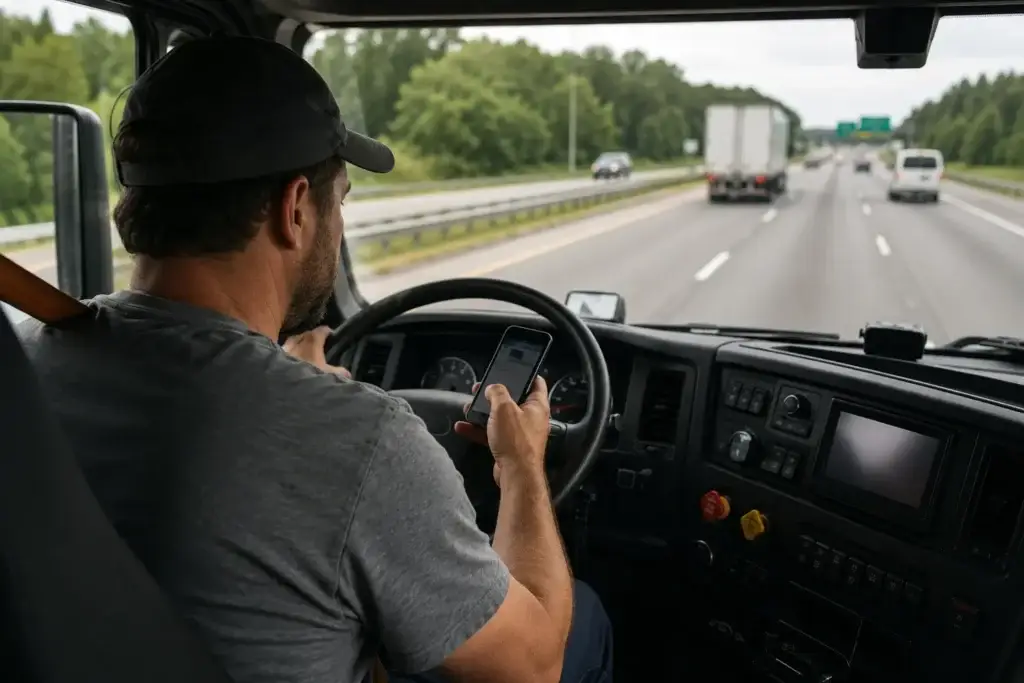
Commercial truck driver looking at a smartphone inside the cab while driving on a highway, illustrating distracted driving risk in fleet safety.

Distracted Driving: The Real Cost to Your Commercial Fleet

Table of Contents
    Add a header to begin generating the table of contents

    By Michael Nielsen, Editor & Publisher | 15+ Years in Diesel Repair & Fleet Operations

    Last Updated: June 2026

    ⏱ Estimated reading time: 18 minutes

    Distracted driving in a commercial fleet is the leading preventable cause of crash-related financial loss for motor carriers. It occurs any time a driver's attention — visual, manual, or cognitive — is diverted from the primary task of controlling the vehicle. In commercial operations, that diversion kills people, destroys equipment, triggers federal penalties, and produces liability exposure that has bankrupted fleets. Federal Motor Carrier Safety Administration research shows that texting while driving a commercial motor vehicle increases the odds of a safety-critical event by 23 times. A single distracted-driving crash costs the average fleet employer more than $72,000 in direct expenses before accounting for insurance premium increases, litigation costs, and the specter of nuclear verdicts that now routinely exceed $36 million in the trucking industry. The encouraging reality is that distracted driving is behavioral, patterned, and preventable — and fleets with structured prevention programs have the data and tools to stop most of it before it becomes a crash.

    Key Takeaways

    • Texting multiplies crash risk 23 times. FMCSA-commissioned research on commercial motor vehicles establishes texting as the highest-risk distraction category for CMV operators.
    • Your liability extends to your drivers' behavior. Under 49 CFR 392.82, motor carriers can be fined up to $11,000 per violation when they allow or require drivers to use handheld devices — regardless of whether the carrier formally sanctioned the behavior.
    • Nuclear verdicts have reached a median of $36 million. ATRI's analysis of trucking litigation finds the median nuclear verdict surged to $36 million in 2022, making documented safety programs your most defensible asset in court.
    • Distraction extends far beyond cell phones. In-cab dispatch systems, navigation devices, eating, fatigue-related cognitive drift, and even roadside billboards each contribute measurable crash risk in commercial operations.
    • Prevention programs pay for themselves. The cost of deploying telematics, AI dashcams, and structured driver coaching is a fraction of a single serious crash — and the investment creates documented evidence of safety culture that matters in litigation.

    What Distracted Driving Actually Means in a Commercial Fleet

    Distracted driving is any activity that diverts a driver's attention away from the task of safe vehicle operation. The National Highway Traffic Safety Administration categorizes distraction into three types — visual (eyes off the road), manual (hands off the wheel), and cognitive (mind off the task) — and the most dangerous distractions involve all three simultaneously.

    For commercial fleets, the distraction landscape is meaningfully different from the consumer driving environment. Commercial drivers operate under time pressure, handle dispatch communications throughout their shift, manage complex equipment with multiple systems competing for attention, and spend far more hours behind the wheel than the average motorist. The sheer accumulation of those hours amplifies the exposure — and the stakes — of every distracted moment.

    The categories of distraction in commercial operations include:

    Distraction Categories in Commercial Vehicle Operations

    • Mobile device use: Texting, calling, navigating, and checking dispatch apps — the highest-risk and most regulated category
    • In-cab technology: ELD interfaces, onboard dispatch systems, GPS devices requiring manual input while moving
    • External distractions: Roadside incidents, billboards, pedestrians — a three-year FMCSA/NHTSA study found approximately 11,000 truck crashes involved external distractions
    • Secondary tasks: Eating, drinking, smoking — especially prevalent among long-haul drivers who manage meals in-cab
    • Cognitive distractions: Fatigue-driven mental drift, emotional stress, and excessive planning — often invisible until they surface as lane drift or delayed braking
    • Passenger interaction: While less common in single-driver CMV operations, conversations that pull focus from driving conditions

    An important insight from recent fleet safety research is that visible distraction and crash risk don't always align. A driver who isn't texting can still be cognitively distracted enough to miss a lane change, run a red light, or fail to respond to a braking event ahead. Behaviors like unexplained hard braking, erratic lane changes, and failure to maintain following distance are now recognized as leading indicators of distracted behavior — even when no device use is captured on camera.

    The Safety Data Every Fleet Manager Needs to Know

    The numbers behind distracted driving in commercial operations are stark enough to warrant a serious examination of your current safety posture — and the source of those numbers matters. The figures below come from federal agencies and peer research institutions, not vendor marketing materials.

    23×

    The increase in crash odds for a CMV driver who is texting while driving, according to FMCSA-commissioned research. The same research found that drivers who were texting took their eyes off the forward roadway for an average of 4.6 seconds — enough time to travel the length of a football field at highway speed without looking at the road.

    Beyond texting, FMCSA research established that dialing a cell phone increases the odds of a safety-critical event six times compared to an undistracted driver, and reaching for an object in the cab triples those odds. These statistics come from real-world truck driving studies — they are not extrapolated from consumer driving data.

    At the national level, NHTSA reported 3,208 distracted-driving fatalities in 2024, accounting for 8 percent of all fatal crashes in the United States — though safety researchers widely believe actual numbers are considerably higher due to underreporting in crash investigations. In the commercial vehicle sector specifically, distraction ranks as the second leading driver-related cause of fatal truck crashes.

    For fleet operations, the question isn't whether distraction causes crashes — it does, consistently, at well-documented rates. The operational question is whether your safety program gives you the visibility and response capability to intercept the behavior before it becomes a loss event.

    Keep Your Fleet Running at Full Capacity

    Get HDJ's maintenance guides, compliance updates, and fleet management strategies delivered weekly — built for working diesel professionals.

    The True Cost of Distracted Driving in a Commercial Fleet

    Fleet managers who think about distracted driving primarily as a safety issue are leaving a significant financial risk unquantified. The cost exposure from a single distracted-driving crash runs across multiple dimensions — some covered by insurance, many not — and the aggregate financial impact on the commercial trucking industry has reached a scale that shapes carrier insurance markets for the entire sector.

    Direct Crash Costs

    A distracted-driving crash costs the fleet employer an average of $72,442 in direct costs, according to fleet industry data — and that figure represents only the immediately visible damage. Property-damage-only crashes average approximately $5,890 per incident. For a fleet operating 1,000 vehicles with an industry-average 20 percent annual crash rate, property damage losses alone can reach $1.1 million annually before a single serious injury is factored in.

    For medium and heavy truck collisions involving injury, the cost profile changes dramatically. Industry data puts the average employer cost at $200,000 per auto incident involving injury, and $3.6 million per fatality — and those figures reflect incident costs, not litigation outcomes.

    Uninsured and Indirect Costs

    The damage that doesn't appear on an insurance claim is often larger than what does. According to the International Loss Control Institute, uninsured losses range between $6.50 and $43 for every $1 paid out by insurance after a motor vehicle collision at work. Those uninsured costs include vehicle downtime, driver replacement and retraining, productivity loss, workers' compensation claims that exceed coverage, dispatch disruption, cargo damage, and the erosion of customer confidence that follows a publicized accident.

    Motor vehicle accidents account for 5 percent of workers' compensation lost-time claims but 10 percent of workers' compensation benefit costs — making them disproportionately expensive even before litigation is considered. Motor-vehicle-related workers' compensation claims average more than $100,000 per claim, roughly 70 percent higher than lost-time claims from other causes.

    Insurance Premiums and the Nuclear Verdict Multiplier

    Insurance is where the distracted-driving cost crisis compounds over time. Fleet industry insurance rates have increased by 10 to 15 percent year over year for more than a decade. Commercial auto premiums have increased for 54 consecutive quarters, driven in significant part by the severity of crashes tied to distracted behavior and the litigation environment surrounding them.

    The nuclear verdict dimension of this problem cannot be overstated. According to research published by the American Transportation Research Institute, the median nuclear verdict — defined as a jury award exceeding $10 million — reached $36 million in 2022, approximately 50 percent higher than the median in 2013. The number of verdicts exceeding $50 million increased by 6.4 percentage points over the same period. Nuclear verdicts against corporations rose 235 percent between 2011 and 2019, and the median nuclear verdict against corporations jumped from $21 million in 2020 to $51 million in 2024.

    ⚠️ Employer Liability Under Federal Law

    Motor carriers are legally responsible for driver distracted-driving behavior regardless of whether the carrier formally required or authorized it. Under 49 CFR 392.82, motor carriers can face penalties of up to $11,000 per violation when their drivers use handheld mobile devices. In litigation, plaintiff attorneys routinely subpoena cellphone records immediately after a crash — and a carrier's documented safety culture is the primary defense against runaway jury awards under the "reptile theory" litigation tactics that now drive nuclear verdicts.

    When a driver is on the phone at the time of a crash, cellphone records become evidence. What happens next depends heavily on whether the carrier can demonstrate a documented, consistently enforced safety culture — or whether they cannot. Carriers without documented programs face significantly worse litigation outcomes. Fleets that have documented their training, enforcement actions, and technology deployment have a materially stronger legal defense position.

    FMCSA Regulations on Distracted Driving: What the Rules Require

    Federal Motor Carrier Safety Administration regulations on driver distraction are specific, enforceable, and extend liability to motor carriers — not just individual drivers. Every fleet manager operating commercial motor vehicles in interstate commerce needs to understand exactly what the law requires, what it prohibits, and what it costs when violated.

    49 CFR 392.80 — Texting Prohibition

    Under 49 CFR Part 392 Subpart H, no CMV driver may engage in texting while driving. The prohibition covers all forms of electronic text messaging — SMS, instant messaging, email, web browsing, and any other form of electronic text retrieval or input. Critically, "driving" under the regulation includes being temporarily stationary in traffic, at a traffic control device, or in any other momentary delay — the prohibition does not lift simply because the truck is stopped at a red light.

    49 CFR 392.82 — Handheld Mobile Telephone Restriction

    The handheld mobile telephone restriction prohibits CMV drivers from holding a mobile device to make a call, or dialing by pressing more than a single button. Hands-free phone use is permitted when the device is in close proximity and accessible without reaching. Motor carriers are explicitly prohibited from requiring or allowing drivers to use handheld devices — and the regulation holds motor carriers responsible for driver behavior regardless of whether the carrier formally authorized the violation.

    ViolationDriver PenaltyCarrier PenaltyCDL Disqualification
    Texting while driving (1st offense)Up to $2,750Up to $11,000None
    Handheld phone use (1st offense)Up to $2,750Up to $11,000None
    2nd conviction within 3 yearsUp to $2,750Up to $11,00060-day disqualification
    3rd conviction within 3 yearsUp to $2,750Up to $11,000120-day disqualification

    State-level distracted driving penalties layer on top of federal regulations and vary considerably. Fines range from as low as $20 in some states to $10,000 per incident in Alaska. Several states also impose criminal penalties for repeat or aggravated violations. CDL holders face additional state-level suspension consequences for serious traffic violations, which can compound with federal disqualification provisions.

    The Expanding In-Cab Technology Problem

    Recent years have seen fleet safety professionals flagging an emerging distraction category that isn't limited to personal cell phones: in-cab technology itself. Onboard dispatch systems, ELD interfaces that require manual input, GPS units that weren't programmed before departure, and even collision mitigation system alerts that require driver interaction all create distraction events. The same regulations that prohibit texting and handheld phone use do not draw a clear line on in-cab technology interactions — but the physics of distraction are the same regardless of what's on the screen.

    Fleet managers who deploy telematics and ELD systems have an operational responsibility to evaluate how those systems interact with drivers during live operations — and to configure dispatch communication workflows in ways that don't put drivers in the position of managing complex screen interactions while moving.

    Identifying Distraction Risk Before It Becomes a Crash

    One of the persistent challenges in managing distracted driving is that the behavior often isn't visible in data until after a crash occurs. A driver who puts down the phone before the incident doesn't generate a phone-use event in the telematics system — but they do generate observable precursors. Understanding those precursors gives fleet managers an earlier intervention window.

    Behavioral Proxies for Distraction

    Reckless driving, unexplained hard braking, erratic lane changes, failure to signal, following-distance violations, and late responses to traffic control devices are now recognized as meaningful predictors of distracted behavior — even when no device use is captured on camera. A driver who is consistently generating hard-braking events may not be speeding; they may be failing to perceive developing hazards early enough to respond gradually.

    Fleet managers who review driver scorecards only when a crash occurs are working with a reactive model. The operational shift toward proactive distraction management means reviewing behavioral signals continuously and using them to trigger coaching conversations before they escalate. Checking driver records quarterly rather than annually — or using telematics to generate real-time behavioral alerts — closes the gap between risk and intervention.

    Driver Self-Reporting and Communication Culture

    Fleets where drivers feel that reporting a distraction-related near-miss will result in discipline rather than coaching tend to have less usable safety data — not fewer near-misses. Establishing a communication culture where drivers can report close calls without immediate fear of punitive consequences gives fleet managers access to information they otherwise never receive. Near-miss reports are signal data. They identify routes, time windows, and dispatch communication patterns that create elevated distraction risk — information that can be acted on before someone gets hurt.

    Fleet managers should also examine their own dispatch practices. Contacting drivers mid-route for non-emergency communication sends a message that responsiveness is prioritized over safety — and it contributes directly to the in-cab distraction load. Establishing clear dispatch protocols that minimize driver interaction while the vehicle is moving is a fleet management decision, not a driver performance issue.

    The HDJ Perspective

    After 15 years in diesel repair and fleet operations, what I've seen is this: the fleets with the worst distraction records aren't always the ones with the most reckless drivers. Sometimes they're the ones with the most demanding dispatchers. When a driver is conditioned to respond immediately to every message — because non-response during a shift has historically had consequences — you've created an environment where the phone check isn't a bad habit, it's a trained behavior. The technology side of distraction prevention is genuinely powerful now, but no AI dashcam fixes a dispatch culture that treats drivers as always-available. That part has to be a management decision. Start there, then layer in the technology.

    Building a Fleet Distracted Driving Prevention Program

    Effective distracted driving prevention in a commercial fleet is not a technology problem or a policy problem in isolation — it's both, operating within a safety culture that drivers trust and management consistently demonstrates. The programs that produce lasting improvements integrate written policy, structured training, technology deployment, and ongoing accountability through coaching rather than discipline alone.

    Step 1: Establish a Written Distracted Driving Policy

    A distracted driving policy is a written document that defines prohibited behaviors, sets compliance expectations, specifies consequences, and documents the carrier's commitment to safety. It is also your first line of legal defense. A policy that exists only in practice but not on paper is substantially harder to use as evidence of safety culture in litigation.

    Your policy should explicitly address the following at minimum:

    Fleet Distracted Driving Policy — Core Components

    • Total prohibition on handheld device use — consistent with 49 CFR 392.80 and 392.82, with no exceptions for stopped-in-traffic conditions
    • Hands-free device requirements — earpiece or speakerphone only, device must be within reach without leaning
    • GPS and navigation rules — devices must be programmed before departure; no manual input while moving
    • In-cab technology interaction limits — clear rules on when drivers may interact with ELD screens, dispatch systems, and infotainment
    • Dispatch communication protocols — defined windows and methods for routine driver-dispatch contact that minimize in-motion interaction
    • Consequence structure — written, consistently applied consequences for policy violations, including progressive discipline thresholds
    • Documentation requirements — all violations, coaching sessions, and disciplinary actions recorded with dates and signatures

    The policy should be reviewed and signed by every driver at onboarding and during annual safety reviews. Signature records matter in litigation — they document that drivers were informed and accepted the terms.

    Step 2: Implement Structured Driver Training

    Generic annual safety training has a well-documented limitation: it produces knowledge without changing behavior. The most effective fleet safety programs combine initial distraction-awareness training with ongoing, individualized coaching tied to specific observed behaviors.

    Initial training should cover the three types of distraction, the specific risk multipliers from FMCSA research, the carrier's policy and its legal basis, and how monitoring technology works and what it captures. This is also the appropriate time to establish driver expectations around the safety culture: that monitoring exists to protect them, not to catch them, and that coaching conversations are a normal part of fleet operations — not a precursor to termination.

    Ongoing training should be event-driven rather than calendar-driven wherever possible. A driver who receives a coaching conversation within 24 hours of a hard-braking event or captured phone-use incident retains that feedback more effectively than one who receives it three months later in a group session. Targeted, specific coaching tied to real incidents the driver remembers is significantly more effective than refresher courses built around general reminders.

    Some fleets have found success with driver scorecards that incorporate distraction-related metrics alongside traditional safety measures — following distance, hard braking frequency, phone-use events — and recognize drivers who maintain strong scores. Recognition programs that reward distraction-free driving create positive behavioral reinforcement without the coercion that tends to drive near-miss underreporting.

    Step 3: Deploy the Right Technology Stack

    Technology has materially changed what fleet managers can see, when they can see it, and how quickly they can respond. The commercial fleet technology landscape for distraction management has three primary layers, each serving a distinct function in a comprehensive prevention program.

    Telematics and GPS Fleet Tracking

    Telematics platforms provide the behavioral data foundation of a fleet safety program — vehicle speed, location, hard braking events, harsh acceleration, sharp cornering, and following-distance calculations. These systems don't capture distraction directly, but they generate the behavioral signal data that predicts it. A driver consistently generating hard-braking events on routes with normal traffic conditions is a candidate for a coaching conversation before a camera captures a phone in their hand.

    Telematics data also creates the documentation trail that matters in litigation and regulatory audits. Timestamped records of vehicle operation, location, and behavioral events provide context for incident investigations and demonstrate active fleet monitoring — which is a meaningful component of documented safety culture.

    AI Dashcams and Driver Monitoring Systems

    Driver-facing cameras and AI dashcam systems have advanced significantly from passive recording to active behavioral monitoring. Modern AI dashcam platforms can detect phone-holding behavior, drowsy driving indicators, and forward-roadway attention lapses in real time — and trigger in-cab alerts that prompt drivers to self-correct before a violation escalates into an event.

    The real-time alert capability is a meaningful distinction from review-after-the-fact camera systems. A driver who receives an audible in-cab alert within seconds of looking at their phone has an immediate, in-the-moment opportunity to change behavior. A driver who learns from a weekly coaching session that they were observed using their phone on three occasions has a week's worth of reinforced habit to overcome.

    Fleet managers considering AI dashcam deployment should address driver privacy concerns proactively and transparently. Modern systems increasingly offer privacy-focused features such as analyzing driving behavior without storing continuous footage, recording only triggered events, and giving drivers access to their own data. These approaches improve driver buy-in — which matters substantially in the current driver retention environment.

    Phone Blocking and Do-Not-Disturb Applications

    Phone-blocking applications that engage automatically when the vehicle is in motion create a technical barrier to device use rather than relying solely on driver discipline. Many smartphones include native Do Not Disturb While Driving functionality that silences calls, texts, and notifications. Fleet-deployed phone management apps can enforce these settings across company devices and generate compliance data that supports safety documentation.

    Phone-blocking technology works best as one component of a broader program rather than a standalone solution. Drivers with personal devices are not subject to carrier-deployed blocking unless the fleet has a bring-your-own-device policy that requires specific app installation — a policy element that should be addressed explicitly in your written distracted driving policy.

    Free Professional Fleet Tools

    Cost calculators, fault code lookup, maintenance planners, and more — built for owner-operators, fleet managers, and diesel techs. No signup required.

    Explore Free Tools →

    Managing the Legal Exposure: Dashcam Footage, Documentation, and Defense

    The legal dimensions of fleet distracted driving have become substantially more complex as litigation funding, plaintiff attorney tactics, and nuclear verdict trends converge. Fleet managers who think about dashcam footage only as evidence for incident investigation are missing the broader legal management picture — both what that footage can do for you and what it can do against you if managed improperly.

    Footage Retention Policies

    Legal experts consistently advise that incident video files should be retained for the duration of the statute of limitations in the state where the incident occurred — often two years, but varying by state and incident type. Non-incident footage, including routine coaching clips, should be deleted on a defined schedule to prevent it from being used against the carrier in litigation beyond its intended purpose. Establishing a clear, written video telematics policy that specifies recording, storage, usage, and deletion protocols is a legal risk management measure, not just a technology management task.

    Building a Documented Safety Culture

    In nuclear verdict litigation, plaintiff attorneys frequently employ what legal analysts describe as the "reptile theory" — framing the carrier's behavior in terms of public danger and corporate disregard for safety to prompt outsized jury awards. The most effective defense against this framing is a documented, verifiable history of proactive safety investment. Carriers that can produce records of consistent driver training, active technology monitoring, documented coaching conversations, and written policy enforcement have a substantially stronger narrative in court than those who cannot.

    Documentation should include training attendance records with driver signatures, dated coaching session notes tied to specific incidents, policy acknowledgment records, telematics data demonstrating active monitoring, and records of disciplinary actions taken when policies were violated. This documentation doesn't need to be elaborate — it needs to be consistent, timestamped, and retrievable.

    Key Recommendation

    Review your dashcam footage retention policy against the statute of limitations in your primary operating states. Confirm that incident footage retention and routine footage deletion are both codified in writing. This is a legal risk management step that can make a material difference in litigation outcomes — and it costs nothing to implement beyond the time required to put the policy in writing.

    Distracted Driving and Driver Retention: Getting the Balance Right

    Fleet managers operating in a tight driver market face a real tension in distracted driving enforcement. Monitoring technology is a necessary safety investment — and it's also a source of anxiety for drivers who worry about surveillance, distrust of how data will be used, and the perception that management is looking for reasons to terminate rather than opportunities to coach.

    The fleets that navigate this tension most effectively do so by being transparent about monitoring before drivers are hired, framing safety data as driver protection rather than management surveillance, and demonstrating through consistent behavior that dashcam footage is used for coaching rather than discipline in the first instance. Fleet managers report that retention concerns about camera deployment tend to resolve once drivers experience a system that uses footage to exonerate them in false claims — which happens more frequently than many drivers initially expect.

    The FMCSA's distracted driving research demonstrates that CMV operators are exposed to crash risk that is objectively higher per distraction event than consumer drivers — a 23x crash-risk multiplier from texting is not a statistic that improves with experience or skill. Experienced drivers are not immune to distraction risk. Framing monitoring technology as a tool that helps skilled professionals protect their CDL and their livelihood — rather than surveillance designed to catch mistakes — often changes driver receptivity considerably.

    Distracted Driving in Long-Haul vs. Regional and Local Fleet Operations

    The specific distraction risk profile of a fleet varies by operational model, and prevention programs should be calibrated accordingly rather than deployed as a one-size solution across all fleet types.

    Long-Haul Operations

    Long-haul operations create specific distraction vulnerabilities that regional and local fleets typically don't face at the same level. Drivers who spend multiple consecutive days in-cab manage meals, communication, navigation, and rest entirely from the vehicle. The accumulation of hours behind the wheel creates cognitive fatigue that blurs the line between distraction and drowsiness — both reduce reaction time and situational awareness through different mechanisms, but the behavioral outcomes often look similar on telematics data.

    Long-haul distraction prevention should specifically address eating and secondary task management during extended driving windows, the use of Hours of Service regulations as a framework for cognitive load management — not just a compliance requirement — and the relationship between hours-on-duty accumulation and cognitive distraction risk.

    Regional and Local Delivery Operations

    Regional and local delivery operations face elevated distraction risk from a different source: high-frequency stop-and-go operations that require constant navigation updates, dispatch communications for delivery instructions, and time pressure from route density. The brief windows between stops — often measured in minutes — create temptation to handle communications during transit that feel short enough to be low-risk. They are not.

    Research on delivery driver behavior shows that 79 percent of delivery drivers report near-misses due to distraction, and more than one-third report at least one work-related crash. Delivery fleets should specifically evaluate how dispatch communication systems interact with drivers during high-density urban operations, and whether route software and delivery apps are designed to minimize in-motion driver interaction.

    Measuring the Effectiveness of Your Prevention Program

    A distracted driving prevention program that doesn't measure outcomes cannot demonstrate improvement — either to internal stakeholders or to underwriters and attorneys examining your safety record. Establishing measurable metrics before deploying prevention initiatives gives you a baseline to compare against and a quantified return on safety investment over time.

    Effective metrics for a commercial fleet distracted driving program include:

    Fleet Safety Program Metrics — Distracted Driving

    • Phone-use event frequency: Dashcam-captured events per 100 driving hours — track trend over 90-day intervals
    • Hard-braking rate: Events per mile or per driving hour — a leading indicator of distracted attention lapses
    • Driver scorecard trend: Individual and fleet-wide safety scores over rolling 30/60/90-day windows
    • Policy violation rate: Documented violations per driver per quarter — identifies chronic vs. situational issues
    • Coaching completion rate: Percentage of triggered coaching sessions actually completed within defined timeframe
    • Crash frequency: At-fault incidents per million miles — the lagging indicator that all leading metrics ultimately protect against
    • Insurance premium trend: Year-over-year premium movement, with program start as a reference point

    Presenting documented improvement in these metrics to commercial auto underwriters at renewal time is a concrete step that can influence premium outcomes. Underwriters assess fleet safety records as part of the risk profile that determines pricing — carriers who can demonstrate measurable, documented improvement in distraction-related behavioral metrics are presenting a materially different risk profile than those who cannot.

    The American Transportation Research Institute's ongoing research into trucking litigation trends and operational costs provide fleet managers with industry-wide benchmarks for benchmarking their safety program metrics against sector norms — a useful reference when evaluating whether your current performance represents meaningful improvement or regression to a concerning mean.

    What Owner-Operators Need to Know

    Owner-operators face the same federal regulations as large fleets, the same litigation exposure, and the same financial consequences from at-fault crashes — but typically without the legal and risk management infrastructure that larger carriers have developed. For an independent operator, a single serious distracted-driving crash can represent an existential threat to the business.

    Owner-operators should prioritize several specific steps:

    First, establish a written personal policy — even a solo operation benefits from a documented commitment to compliance with 49 CFR 392.80 and 392.82 that can be produced in litigation as evidence of professional standards. Second, configure personal and work phones with Do Not Disturb While Driving before every dispatch — this is free and takes seconds to implement. Third, program GPS and navigation before departure and place devices in a fixed mount within peripheral vision rather than in a location that requires reaching or glancing away from the road. Fourth, investigate dashcam investment as a solo operator — driver-facing cameras protect owner-operators from fraudulent claims as effectively as they create accountability, and the insurance benefits and legal protection often justify the cost in the first year.

    Resources available through the Owner-Operator Independent Drivers Association include guidance on policy development, insurance options, and regulatory compliance for independent owner-operators navigating the increasingly complex liability environment in commercial trucking.

    The Outlook: Regulation, Technology, and the Road Ahead

    The regulatory environment around CMV distracted driving has been stable for more than a decade since the core 49 CFR 392.80 and 392.82 rules took effect — but the enforcement and litigation context continues to evolve. FMCSA continues to evaluate how automated driving system-equipped vehicles interact with existing distraction regulations, and as more advanced driver assistance systems deploy across commercial fleets, the question of driver responsibility and distraction during partially automated operation is an open regulatory question.

    On the technology side, the pace of AI dashcam and driver monitoring system development has been rapid. Systems that two years ago offered only post-event review now provide real-time behavioral coaching, predictive distraction scoring, and integration with telematics platforms that allow fleet managers to see behavioral patterns across entire fleets in near-real time. The cost of deploying these systems has also decreased as adoption has scaled, making capabilities that were once available only to large fleets accessible to mid-size operations and growing regional carriers.

    The litigation trajectory, documented through ATRI's ongoing research, suggests that the financial consequences of a distracted-driving crash will continue to grow — driven by social inflation, third-party litigation funding, and plaintiff attorney tactics that have become sophisticated at extracting large jury awards from commercial trucking defendants. In that environment, the investment case for distraction prevention has never been clearer: prevention programs are not a cost center. They are the least expensive catastrophic loss coverage a fleet can buy.

    Frequently Asked Questions

    What is the FMCSA rule on texting while driving a commercial vehicle?

    Under 49 CFR 392.80, CMV drivers are prohibited from texting while driving. The rule covers all forms of electronic text messaging and applies even when the vehicle is temporarily stationary in traffic. Drivers who violate the rule face civil penalties up to $2,750 per offense, and motor carriers who allow or require the behavior face penalties up to $11,000 per violation. Multiple convictions within a three-year period can result in CDL disqualification of 60 or 120 days.

    How much does a distracted driving crash cost a commercial fleet employer?

    The direct cost of a distracted-driving crash averages $72,442 per incident for fleet employers — before uninsured losses are added. The International Loss Control Institute estimates that uninsured losses range between $6.50 and $43 for every $1 paid out by insurance after a commercial vehicle crash. For medium and heavy truck collisions involving injury, industry data puts employer costs at an average of $200,000 per incident and $3.6 million per fatality, not including litigation outcomes.

    Can I require my drivers to use hands-free phones while driving a commercial vehicle?

    Yes. Hands-free phone use is permitted under 49 CFR 392.82 when the device is located in close proximity and accessible without reaching. Drivers may use an earpiece or speakerphone function. What is prohibited is holding the device, pressing more than a single button to dial, or reaching for a device that isn't within immediate reach. Many fleet safety experts recommend a more conservative policy that limits even hands-free communication during active driving, given the cognitive distraction component of phone conversations that doesn't disappear with hands-free technology.

    What distraction prevention technology actually works for commercial fleets?

    The most effective technology configurations combine telematics systems for behavioral baseline data with driver-facing AI dashcams for real-time distraction detection and in-cab alerts. AI dashcams that provide immediate audible alerts when phone use or attention lapses are detected have shown measurable reductions in distracted driving incidents in fleet deployments. Phone-blocking applications add a technical barrier to device use but work best as one component of a broader program. Technology alone doesn't prevent distracted driving — it provides visibility and feedback that enables effective coaching, which is the behavioral mechanism that actually changes habits over time.

    How does distracted driving affect my fleet's insurance premiums?

    Commercial auto insurance premiums have increased for 54 consecutive quarters, driven significantly by the crash severity associated with distracted behavior and the litigation environment it creates. Fleets with documented distracted driving incidents face compounding premium increases from prior claim history. Fleets that can demonstrate active safety programs — documented policy, training records, telematics deployment, and measurable behavioral improvement — present a different risk profile to underwriters and may qualify for program pricing that reflects documented safety culture investment.

    What is a nuclear verdict and why does it matter for fleet distracted driving?

    A nuclear verdict is a jury award exceeding $10 million. According to ATRI research, the median nuclear verdict in trucking cases reached $36 million in 2022, and trucking is disproportionately exposed to these outcomes because of the severity of injuries involved in commercial vehicle crashes and plaintiff attorney tactics that frame carrier behavior in terms of public safety disregard. Distracted driving evidence — particularly cellphone records showing device use at the time of a crash — is frequently central to arguments that trigger nuclear verdicts. Documented prevention programs reduce distracted driving incidents and create the legal evidence of safety culture that is the most effective defense against runaway awards.

    Conclusion

    Distracted driving in commercial fleets is a manageable risk — but it requires treating it as a business-critical operational challenge rather than a safety awareness campaign. The regulatory exposure is specific and well-documented under 49 CFR 392.80 and 392.82. The financial consequences, from direct crash costs through nuclear verdict exposure, are large enough to threaten carrier viability. And the evidence that structured prevention programs work — combining written policy, targeted training, real-time monitoring technology, and coaching-based accountability — is documented across the fleets that have deployed them.

    Fleet managers at Heavy Duty Journal are operating in an environment where the cost of not acting on distracted driving is measurably higher every year. The investment in prevention — technology, training, documentation, and cultural accountability — is the most direct path to controlling a risk that compounds over time when left unaddressed. Start with the policy. Document the training. Deploy the technology. Measure the outcomes. That sequence, executed consistently, is what separates fleets that manage this risk from fleets that absorb it.

    Share This With Your Safety Director

    Fleet safety directors and compliance managers dealing with rising insurance premiums and liability exposure will find the regulatory breakdown, cost data, and program-building framework here directly actionable — forward it before your next safety review meeting.

    Leave a Comment

    Your email address will not be published. Required fields are marked *

    Free Guide

    The Working Tech's
    Tool Guide

    Shop-Tested. Field-Approved. Zero Fluff.

    9 Categories Covered:

    🔧 Shop & Bay 🔍 Diagnostic ⚙️ Engine 🔩 Drivetrain 💨 Air & Brake 🚛 Service Truck 🏗️ Heavy Equipment 🦺 PPE & Safety 🛞 Tire Repair
    Vetted Tools Only gear a diesel pro would actually buy
    All Disciplines From shop bay basics to heavy equipment
    Always Free No login. No paywall. Just the guide.
    Browse the Tool Guide →

    Expert Diesel Knowledge. Always Free.