By Michael Nielsen, Editor & Publisher | 15+ Years in Diesel Repair
Last Updated: May 2026
📖 Estimated reading time: 13 minutes
If you own a diesel pickup, you already know the factory build is just the starting point. The question isn’t whether to upgrade — it’s which upgrades actually move the needle on performance, longevity, and operating cost, and which ones just look good in photos. American diesel pickup owners invested more than $17 billion in specialty parts and accessories last year, making pickups the single largest segment of the entire automotive aftermarket. But a significant portion of that money goes toward modifications that deliver more style than substance for operators who use their trucks to earn a living.
This guide is written for diesel owners who depend on their trucks — owner-operators, contractors, fleet managers running light-duty pickups, and diesel technicians advising customers on where to spend their upgrade budget. We’ve ranked the best pickup truck upgrades by the metric that matters most for working professionals: return on investment. That means performance gains you can measure, protection that reduces repair bills, and productivity improvements that save time on the job. Aesthetic upgrades that don’t contribute to any of those categories are covered too — in the section on what to skip.
Key Takeaways
- ROI drives the ranking: The best pickup truck upgrades for diesel owners are those that reduce fuel cost, lower repair frequency, improve towing safety, or extend the truck’s working life.
- Suspension first for towers: If your truck is used for towing or hauling, a load-leveling suspension upgrade delivers immediate safety and longevity returns that most other upgrades cannot match.
- Emissions compliance is non-negotiable: Tunes and modifications that delete or disable DPF, EGR, or SCR systems are illegal for on-road use under federal law — a critical distinction for commercially operated trucks.
- Productivity upgrades are underrated: Bed liners, tonneau covers, toolboxes, and lighting improvements consistently deliver high ROI for work-truck operators and are routinely overlooked in enthusiast upgrade guides.
- Know your use case before you buy: The right upgrade depends entirely on how you use the truck. A contractor’s upgrade list looks nothing like a long-haul owner-operator’s list, even on identical trucks.
How to Think About Pickup Truck Upgrades as a Professional Operator
The aftermarket upgrade conversation is dominated by enthusiasts — and that’s a problem if you’re an owner-operator or fleet manager trying to make a rational purchasing decision. Enthusiast content optimizes for power, visual impact, and bragging rights. Operators optimize for uptime, cost-per-mile, payload safety, and resale value. Those are fundamentally different priorities, and they lead to very different upgrade decisions.
Before committing to any upgrade, professionals should apply a simple three-question filter. First: does this modification reduce a recurring operating cost — fuel, maintenance, or downtime? Second: does it extend the useful life of the truck or protect components from accelerated wear? Third: does it improve safety, particularly around towing or payload operations? If an upgrade answers yes to at least two of those questions, it belongs on the priority list. If it answers yes to none, it’s a lifestyle purchase — which is fine, but it should be treated as a discretionary expense rather than an investment.
There’s also a compliance dimension that any commercially operated diesel pickup owner must take seriously. Federal law places strict limits on modifications to emissions control systems, and the penalties for violations are not trivial. We’ll address that fully in the performance section below. It’s the most commonly overlooked aspect of diesel pickup upgrades, and ignoring it is an expensive mistake.
$52.65 Billion
Amount U.S. consumers spent accessorizing and modifying their vehicles in 2024, with pickup trucks accounting for a third of the entire specialty-equipment market. Source: SEMA 2025 Market Report
Performance Upgrades Worth the Investment
Modern diesel engines leave real performance on the table from the factory. Manufacturers calibrate stock ECU maps conservatively — balancing warranty exposure, emissions compliance, and broad operating conditions across diverse climates, altitudes, and load profiles. For an owner-operator who runs a consistent route, pulls a predictable trailer weight, and maintains their equipment properly, there’s measurable headroom in the factory calibration. The upgrades below are where that headroom lives.
Cold Air Intake
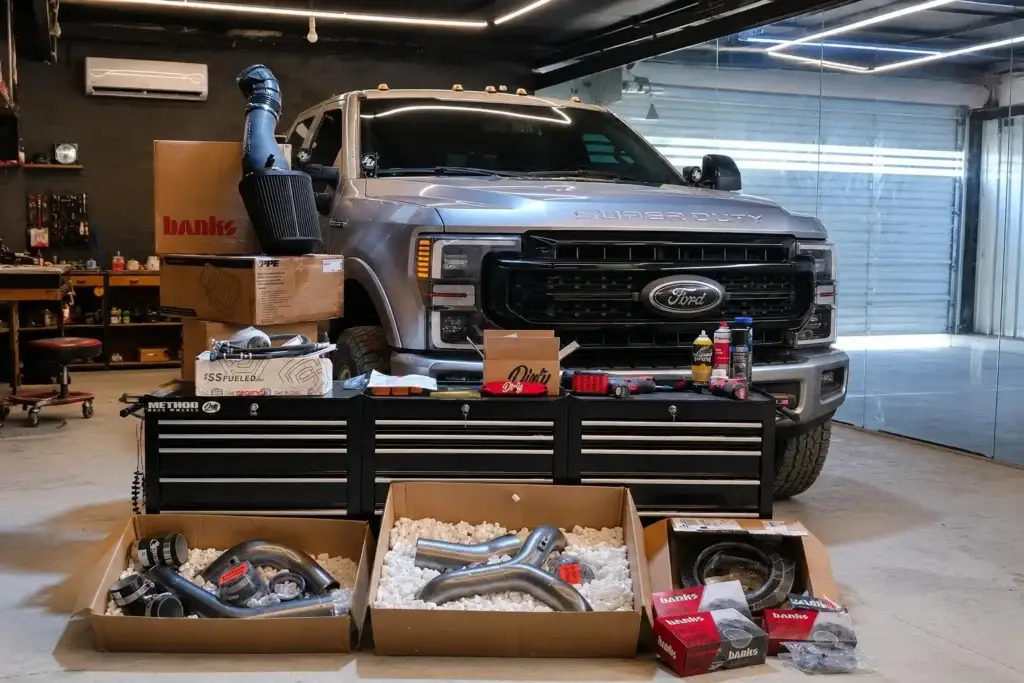
The factory airbox on a diesel pickup is engineered around noise reduction, emissions compliance, and fit across multiple trim levels — not maximum airflow. An aftermarket cold air intake replaces the restrictive factory assembly with a larger-diameter intake tube and a high-flow filter designed to draw cooler, denser air from outside the engine compartment. On turbocharged diesel applications, this matters most during loaded pulling, when sustained high intake temps degrade combustion efficiency and drive up exhaust gas temperatures.
Real-world fuel economy improvements from an intake alone range from 0.5 to 1.5 MPG under loaded highway conditions. That’s a narrow margin when viewed in isolation, but combined with the exhaust and tune discussed below, the complete breathing package can deliver 1–3 MPG on a heavily loaded diesel, which translates to meaningful annual savings for high-mileage operators. Installation is typically bolt-on — under two hours for most diesel platforms — which keeps labor costs low.
Aftermarket Exhaust System
A larger-diameter exhaust system — typically a 4-inch or 5-inch downpipe-back configuration on a heavy-duty diesel — reduces backpressure, lowers exhaust gas temperatures under load, and improves scavenging efficiency at the turbocharger. For towing applications, the EGT reduction alone is worth the investment. Sustained high exhaust gas temperatures accelerate wear on the turbocharger, exhaust valves, and emissions control components. Keeping EGTs in check under load is one of the most practical ways to extend drivetrain life on a high-mileage diesel pickup.
Exhaust upgrades also produce the audible tone change that diesel owners tend to enjoy — but for professional operators, the mechanical benefits are the primary justification. Combined with a cold air intake, a quality exhaust system improves the engine’s breathing on both ends and creates the foundation for effective tuning.
Performance Tune
⚠️ Emissions Compliance Warning
Tunes or modifications that disable, remove, or bypass the diesel particulate filter (DPF), exhaust gas recirculation (EGR) system, selective catalytic reduction (SCR), or diesel exhaust fluid (DEF) system are illegal for any on-road vehicle under the Clean Air Act, regardless of whether the truck is used commercially or privately. The EPA’s National Compliance Initiative for Stopping Aftermarket Defeat Devices has significantly increased enforcement activity targeting diesel emissions tampering, with civil penalties reaching up to $45,268 per violation for installers and vehicle owners. Only emissions-legal tunes that operate within the factory emissions system should be considered for any truck that operates on public roads.
Within the boundaries of emissions compliance, a professionally calibrated tune is the highest-impact single upgrade available for a diesel pickup. A reputable emissions-legal tune optimizes fuel delivery tables, boost curves, and torque maps for the operator’s actual use case — whether that’s maximum low-RPM towing torque, improved fuel economy, or a blend of both. Gains of 50–100 horsepower and 100–200 lb-ft of torque are achievable on the 6.7L Cummins, 6.7L Powerstroke, and 6.6L Duramax platforms with properly calibrated emissions-legal programming.
For towing applications specifically, the objective is torque in the 1,400–2,200 RPM range — where the engine is working hardest on grade with a loaded trailer. A tune that increases torque in that band transforms on-highway towing behavior far more noticeably than peak horsepower numbers suggest. Owner-operators who regularly pull 20,000 pounds or more will feel the difference immediately on their first loaded grade climb.
Suspension and Towing Upgrades
No category of pickup truck upgrade is more directly tied to safety and equipment longevity than the suspension — and no category is more frequently overlooked by diesel owners focused on horsepower. The factory suspension on a half-ton or three-quarter-ton diesel is engineered to handle a range of payloads up to the rated capacity, but stock spring rates are typically a compromise that accepts some degree of rear-end squat and load sway. For operators who regularly run at or near their truck’s payload rating, that compromise becomes a genuine safety and maintenance issue.
Load-Leveling Air Bags
Air bag suspension kits install between the frame and rear axle, allowing the operator to dial in rear-end support based on load. Under a heavy trailer tongue weight or a fully loaded bed, the air bags maintain level truck attitude, reduce rear squat, and restore proper headlight aim — all factors that directly affect both safety and stopping distance. NHTSA’s guidance on vehicle load safety consistently emphasizes that load-induced rear squat affects vehicle handling, braking, and forward illumination in ways that increase risk, particularly at night.
Most air bag kits are bolt-on installations requiring no drilling or cutting, and onboard compressor systems allow drivers to adjust air pressure from the cab without stopping. This makes them particularly practical for operators who vary their loads frequently — a contractor carrying materials one day and running empty the next can optimize suspension behavior for each scenario.
Helper Springs and Upgraded Shocks
For operators who want a simpler, lower-maintenance alternative to air bags, helper springs provide additional leaf spring support under load without the need for an air system. They’re particularly effective at eliminating the body roll and lateral sway that loaded leaf-spring trucks experience in curves. High-performance shock absorbers — a meaningful upgrade over the factory units on any heavily worked diesel pickup — complement either system by improving dampening consistency on rough surfaces and reducing the bouncing and porpoising that wears drivers out on long haul days.
Together, upgraded shocks and helper springs represent one of the most cost-effective suspension investments available, often improving both towing stability and ride quality simultaneously — two outcomes that most suspension modifications trade off against each other.
Weight Distribution Hitch
For diesel pickup owners towing fifth-wheel trailers, gooseneck setups, or large bumper-pull trailers, a quality weight distribution hitch is a non-negotiable safety upgrade. Weight distribution hitches transfer a portion of tongue weight from the rear axle back to the front axle, restoring the front-to-rear balance that heavy trailers disrupt. The result is improved steering response, reduced braking distance, and dramatically better trailer tracking in crosswinds. If you’re pulling consistently heavy loads and haven’t invested in a proper weight distribution system, that investment should precede any performance upgrade on your list.
Truck Upgrade Tips Straight to Your Inbox
Get diesel pickup maintenance guides, upgrade ROI breakdowns, and fleet management insights delivered free to your inbox — no paywall, no fluff.
Bed and Cargo Upgrades — The Most Underrated Category
Ask any fleet manager what damages a work truck’s resale value faster than anything else, and the answer is almost always the bed. Rust, chemical staining, dents from improperly secured loads, and torn-up wheel wells tell the story of a truck that was used hard and protected poorly. The irony is that protecting the bed is among the cheapest upgrade investments available — and the financial return on that protection is among the highest of any modification a work truck owner can make.
Spray-In Bed Liner
A professional spray-in bed liner is the single highest-ROI upgrade available for any diesel pickup used as a work vehicle. It seals the bed steel against moisture and chemicals, cushions cargo to reduce denting and shifting, provides a non-slip surface that prevents load movement, and dramatically improves resale value. A well-preserved bed on a used diesel work truck commands a meaningfully higher private-sale price and is often a requirement for fleet vehicle remarketing through dealer channels.
Drop-in plastic liners are a cost-effective alternative, but they trap moisture between the liner and the bed — accelerating exactly the rust they’re meant to prevent. For a truck that earns money for its owner, the spray-in option is the correct choice. The installation cost is typically recovered in full at the point of resale, making it as close to a free upgrade as the aftermarket offers.
Tonneau Cover
A quality hard tonneau cover does three things simultaneously for work truck operators: it secures cargo from both theft and weather, it improves aerodynamic efficiency on highway runs, and it preserves the bed from sun and moisture exposure. Aerodynamic improvement is real but modest — fuel economy gains in the 1–3% range are commonly reported on highway-heavy operators, which adds up meaningfully over a full year of high-mileage driving. For operators hauling tools, samples, or job supplies that represent real replacement cost if stolen, the security benefit is often the primary justification.
Under-Bed Storage and Toolboxes
Organized, accessible tool storage turns a pickup bed into a mobile workshop. Cross-bed toolboxes, side-mount boxes, and modular under-bed drawer systems like DECKED keep inventory organized, reduce the time spent searching for tools or supplies on-site, and protect expensive equipment from exposure and theft. For any operator who treats their truck as a mobile workspace — contractors, service technicians, mobile repair operators — this category of upgrade directly improves job-site efficiency and, by extension, billable productivity.
Lighting and Visibility Upgrades
Lighting improvements are simultaneously among the most affordable and most consistently impactful upgrades available for a diesel work truck. Most factory lighting packages on base and mid-trim diesel pickups are adequate for general use but fall short for operators working pre-dawn, after dark, or on poorly lit job sites and rural routes.
A full LED headlight and taillight conversion improves forward illumination, extends the visible distance at night, and reduces the power draw on the electrical system compared to halogen alternatives. For trucks frequently used after dark — service technicians, agricultural operators, construction crews — LED auxiliary lighting mounted to a quality bull bar or light bar provides wide-area task lighting that halogen work lamps simply cannot replicate.
Dash cameras have also become a high-value addition for commercially operated pickup trucks. FMCSA research on onboard safety monitoring systems confirms that video-based event recording provides objective behavioral data that fleet safety managers can use to reduce at-risk driving and address liability in the event of an incident. For owner-operators and small fleets running pickups, a front-facing — and ideally cab-facing — dash camera provides objective documentation of incidents that protects drivers, reduces insurance exposure, and can be decisive in liability disputes.
The HDJ Perspective
After more than 15 years working on and around diesel pickups in real shop and fleet environments, the pattern is clear: the operators who get the most out of their upgrade dollars are the ones who build from function outward. They protect the bed, stabilize the suspension, improve the lighting, and dial in the fuel system — in that order. The operators who end up regretting their upgrade spend are almost always the ones who started with the most dramatic-looking modification and worked backward. A truck that looks impressive but rides poorly loaded, burns excessive fuel, and has a rusted bed is worth less on every dimension that matters — financially, operationally, and in terms of what it communicates to customers and crew who see it on the job site every day.
Pickup Truck Upgrades That Rarely Pay Off for Operators
Honest upgrade guidance has to include the modifications that consistently underdeliver for professionally operated diesel pickups. This is not a list of bad products — many of these are perfectly appropriate for personal or recreational trucks. It’s a list of modifications whose cost-benefit ratio works against professional operators in most circumstances.
Extreme lift kits — anything beyond a 3-inch leveling kit on a truck used primarily for towing or payload work — are the most common example. Lift kits beyond 4 inches alter driveshaft angles, affect wheel bearing loads, change center of gravity in ways that degrade stability under load, and create clearance issues with standard dock heights on commercial loading situations. The tire and wheel upgrades required to fill lifted fenders on a heavy-duty diesel add significant unsprung weight, which impacts fuel economy and increases steering and suspension wear. For a recreational truck, the trade-offs may be acceptable. For a work truck used to earn income, they rarely are.
Chrome exterior accessories — grille replacements, running board covers, mirror caps, and similar cosmetic additions — add cost and weight with zero functional return. They also require more maintenance to keep presentable in the mud, dust, and chemical exposure that characterizes real work environments. Chrome weathers poorly on a truck that’s treated as a tool rather than a showpiece.
Oversized tires without corresponding gear ratio adjustments represent another common money-wasting move. A diesel owner who installs 35-inch tires on a truck spec’d with gearing for 33s will see degraded fuel economy, reduced towing capacity, and sluggish low-RPM response that undermines the very capability they were trying to enhance. Tire upgrades on a diesel work truck need to be matched to load rating, the truck’s gearing, and the primary operating surface — not selected for visual impact alone.
Free Professional Fleet Tools
Cost calculators, fault code lookup, maintenance planners, and more — built for owner-operators, fleet managers, and diesel techs. No signup required.
Matching Upgrades to Your Use Case
The right upgrade sequence depends on how your diesel pickup is actually used. A contractor who runs a fully loaded truck bed every day has different priorities than a long-haul owner-operator pulling a loaded trailer 150,000 miles a year. The table below maps the highest-ROI upgrade priorities to the most common diesel pickup use cases.
| Use Case | Priority 1 | Priority 2 | Priority 3 |
|---|---|---|---|
| Heavy Towing (Fifth Wheel / Gooseneck) | Weight distribution hitch | Air bag suspension | Performance tune (tow-oriented) |
| Contractor / Job-Site Work Truck | Spray-in bed liner | Toolbox / bed storage system | LED auxiliary lighting |
| High-Mileage Owner-Operator | Emissions-legal tune | Cold air intake + exhaust | Dash camera |
| Service / Mobile Repair Operation | Under-bed drawer system | LED work lighting | Spray-in bed liner |
| Mixed Payload / Fleet Vehicle | Helper springs + shocks | Spray-in liner + tonneau | Dash camera |
The Owner-Operator Independent Drivers Association’s Business Assistance resources provide owner-operators with guidance on vehicle maintenance compliance records, federal regulation interpretation, and equipment warranty issues that directly inform upgrade and maintenance decisions. According to ATRI’s Operational Costs of Trucking analysis, fuel represents one of the largest variable costs for owner-operators — a fact that makes fuel-economy-improving upgrades (tune, intake, exhaust, tonneau cover) the clearest ROI play for operators running high annual mileage.
Frequently Asked Questions
What is the single best pickup truck upgrade for towing?
For diesel owners who tow regularly, a load-leveling suspension upgrade — whether air bags, helper springs, or a weight distribution hitch — delivers the clearest and most immediate return. It improves trailer stability, reduces rear-end squat, shortens braking distance, and reduces wear on tires and steering components. A performance tune is a close second for operators who want more low-RPM torque on the pull, but the suspension upgrade addresses safety and equipment longevity simultaneously, making it the stronger first investment for working truck owners.
Are performance tuners legal for diesel trucks used commercially?
It depends entirely on the tune. Emissions-compliant power tunes that optimize fuel delivery and boost calibration within factory emissions parameters are legal for on-road use. However, tunes that disable or circumvent emissions control equipment — including the DPF, EGR, or SCR/DEF system — are illegal for any on-road vehicle under the Clean Air Act, regardless of whether the truck is used commercially or privately. The EPA has significantly increased enforcement activity, and penalties for tampering with emissions systems can reach tens of thousands of dollars per violation. Owner-operators and fleet managers should verify that any tuner they purchase is emissions-legal and designed for their specific model year before installation.
Does a spray-in bed liner increase resale value?
Yes, consistently. A quality spray-in bed liner protects against rust, dents, and chemical damage — all of which visibly degrade resale value on a used diesel work truck. Buyers inspecting a used truck pay close attention to bed condition because it signals how the truck was used and maintained overall. A well-preserved bed with a spray-in liner commands a meaningfully higher private-sale price and is often a prerequisite for fleet remarketing through dealer channels. The upgrade typically costs $500–$700 installed and returns a multiple of that in preserved resale value over a 200,000-mile work life.
How much does a cold air intake improve diesel fuel economy?
Real-world fuel economy improvements from a cold air intake alone are modest — typically 0.5 to 1.5 MPG under normal operating conditions, with the greatest gains seen during loaded highway driving where the engine is working harder. The intake’s primary benefit for diesel owners is reducing intake air temperature, which improves combustion efficiency and lowers exhaust gas temperatures under load. Combined with an exhaust upgrade and a properly calibrated tune, the complete breathing package can deliver 1–3 MPG improvement on a heavily loaded diesel pickup, which adds up to significant fuel cost savings over a full year of operation.
Should I upgrade my pickup truck’s tires before or after a suspension upgrade?
For work truck owners, the right sequence depends on your primary complaint. If your truck squats, sways, or handles poorly under load, fix the suspension first — a tire upgrade on a poorly set up suspension will not eliminate the underlying instability. If your primary issue is grip, traction in mud or snow, or worn tread on a truck with a solid suspension setup, tires first makes sense. For diesel owners running heavy payloads regularly, a load-leveling suspension upgrade followed by an appropriate tire upgrade for your terrain and load rating is the optimal sequence. Always match tire load index to your truck’s GVWR — undersized load-rated tires are a safety hazard regardless of tread quality.
The Bottom Line on Diesel Pickup Truck Upgrades
The best pickup truck upgrades for diesel owners are the ones that reduce what it costs to keep the truck running, extend how long it runs well, and improve how safely it operates under load. That framework consistently leads to the same priorities: protect the bed, stabilize the suspension for your actual payload and towing demands, improve the drivetrain’s breathing and calibration within emissions-legal boundaries, and add the lighting and visibility tools that make the truck safer and more productive after dark. Everything else is secondary to that foundation.
The aftermarket has never been better equipped to serve diesel pickup owners — suspension solutions, performance components, and cargo management systems have all matured significantly over the past decade. But the sheer volume of options makes focused prioritization more important than ever. Build the list around what the truck does for a living, apply the ROI filter ruthlessly, and let the enthusiast catalog wait until the work-truck upgrades are done.
Share This With Your Crew
Know a diesel owner who’s about to spend money on the wrong upgrades? Pass this guide along — it could save them a few thousand dollars and a lot of frustration.