By Michael Nielsen, Publisher | 15+ Years in Diesel Repair
Last Updated: September 2026
⏱ Estimated reading time: 15+ minutes
Workers' compensation for a truck repair shop is state-mandated insurance that pays medical bills and lost wages when a technician is injured or made ill on the job, and it shields the shop from most employee lawsuits over workplace conditions. Nearly every state requires it once a diesel or heavy-duty repair shop hires its first employee, with coverage rated by payroll, job classification, and claims history rather than a flat fee.
The classification, or class code, assigned to shop-floor mechanics differs from the code assigned to towing staff or office employees, and that single classification decision — more than any other factor — drives what a shop pays year over year. This guide covers that classification system in depth, along with premium calculation, claims handling, and coverage gaps specific to diesel and heavy-duty repair operations.
For the full picture of a shop's insurance program beyond workers' comp — garage liability, garagekeepers, pollution liability — HDJ's diesel repair shop insurance guide covers those additional policies.
Key Takeaways
- ✓It's state law, not federal law: workers' compensation for truck repair shops is administered state by state — there is no federal OSHA or FMCSA equivalent to comply with.
- ✓Class codes drive cost: in-shop repair, body work, and towing are rated on separate risk tiers, and misclassifying a single technician can distort the whole shop's premium.
- ✓Four states run their own fund: Ohio, Washington, Wyoming, and North Dakota require coverage through a state fund, not a private carrier — and that fund doesn't include employer's liability protection.
- ✓Claim speed matters more than claim size: how fast an injury is reported affects both the injured technician's recovery and the shop's future experience modification rate.
In This Guide
- Why Diesel and Heavy-Duty Shops Carry Higher Risk
- Is Workers' Compensation Required for Your Shop?
- Workers' Comp Class Codes for Truck and Diesel Repair
- How Workers' Comp Premiums Are Calculated
- What Workers' Comp Covers — and What It Doesn't
- Employer's Liability and the Monopolistic State Gap
- Classifying Employees Correctly
- Reducing Costs Through Shop Safety Programs
- Handling a Claim When a Technician Is Injured
- Coverage for Owner-Operators, Mobile Techs, and Contractors
- Frequently Asked Questions
Why Diesel and Heavy-Duty Shops Carry Higher Risk
Diesel and heavy-duty truck repair carries meaningfully more physical risk than passenger-car service, and workers' compensation insurers price that difference directly. A commercial truck repair bay involves multi-ton components, high-pressure hydraulic and pneumatic systems, elevated work on lifts and pits, and repeated exposure to diesel exhaust fluid (DEF), coolant, and solvents that a typical oil-change shop never handles at the same scale. Heavy Duty Journal covers the broader hazard picture for diesel shops in more depth elsewhere on heavydutyjournal.com.
Crush injuries from dropped drivetrain components, chemical burns, hearing damage from air tools, and lacerations from sheet metal and fasteners are the injury categories underwriters see repeatedly in this segment.
National injury data backs up what shop owners already sense on the floor. The Bureau of Labor Statistics reported that private industry recorded 2.3 recordable injuries and illnesses per 100 full-time workers in 2024, and physically intensive repair trades — where lifting, pinch points, and pressurized fluids are part of the daily task list — consistently post rates above that private-industry average.
That gap in exposure is exactly why underwriters assign truck and diesel repair its own workers' compensation classification rather than folding it into a general "shop" category.
2.3 per 100 workers
National private-industry recordable injury and illness rate, 2024 — the baseline against which physically demanding repair trades are compared. Source: U.S. Bureau of Labor Statistics.
Workers' compensation insurance is a no-fault benefit system: it pays medical costs and a portion of lost wages regardless of who caused the accident, in exchange for the employee giving up the right to sue the employer for most workplace injuries. That trade-off is what keeps a single serious injury from becoming a business-ending lawsuit for an independent repair shop.
Is Workers' Compensation Required for Your Shop?
Yes — in nearly every state, a truck repair shop with even one employee must carry workers' compensation coverage, though the exact threshold and enforcement mechanism vary by state. Workers' compensation is not a federal program. Unlike DOT and FMCSA rules that apply uniformly across state lines, workers' comp is administered entirely at the state level, which means a multi-location repair chain operating in three states is, in effect, complying with three separate insurance systems.
Every state maintains its own workers' compensation agency, and the U.S. Department of Labor maintains a directory of every state workers' compensation official — a useful starting point, since the federal Office of Workers' Compensation Programs itself has no role administering state-level coverage; it exists to serve federal employees, not private employers.
Most states set the employee threshold at one, though a handful of states exempt sole proprietors or businesses below three or four employees. Penalties for operating without required coverage range from civil fines to stop-work orders to, in serious or repeat cases, criminal charges against the business owner personally.
Four states — Ohio, Washington, Wyoming, and North Dakota — operate what's called a monopolistic state fund. In these states, private insurance carriers are prohibited from selling primary workers' compensation coverage; a shop operating in Columbus or Spokane must purchase coverage directly from the state fund rather than shopping the private market. Ohio's fund is administered by the Ohio Bureau of Workers' Compensation.
Every other state allows shops to purchase coverage from a private carrier, a state-run competitive fund, or in some cases to self-insure if the shop meets a state's financial-strength requirements — an option realistic only for very large multi-shop operations.
Workers' Comp Class Codes for Truck and Diesel Repair
A class code is a four-digit designation that tells an insurance carrier what kind of work a shop's employees actually do, and it's the single biggest lever on a truck repair shop's premium. The National Council on Compensation Insurance (NCCI) maintains the classification system used by most states, assigning employers to one governing classification based on their primary operations, then layering in secondary codes for employees who perform meaningfully different work.
NCCI has served this role for insurers and state regulators since 1923, and while a handful of states (California, New York, Pennsylvania, Texas, and the four monopolistic states among them) maintain their own independent classification systems, the underlying logic is consistent nationwide: higher-hazard work carries a higher rate per $100 of payroll.
For truck and diesel repair operations, four class codes come up repeatedly. Rates for each vary significantly by state and by the insurer's own filed rate table, but the relative risk tier — and therefore the relative cost — is consistent across nearly every jurisdiction.
| Class Code | Classification | Typical Operations | Relative Rate Tier |
|---|---|---|---|
| 8380 | Automobile/Truck Service or Repair Center & Drivers | In-shop diagnostics, PM, engine and drivetrain repair, brake work | Baseline for the group |
| 8393 | Automobile/Truck Body and Fender Repair | Collision, frame straightening, welding, paint prep | Moderate — above 8380 |
| 8391 | Automobile/Truck Dealers — non-sales employees | Combined service, parts counter, and lot operations | Similar to 8380 for service staff |
| 7225 | Truck/Automobile Towing | Roadside recovery, roadway exposure, winching operations | Highest in the group |
Shops that both repair and tow trucks should insist on split payroll reporting between 8380 and 7225 rather than letting an agent default the whole crew into the towing code. Clerical and parts-counter staff who don't touch shop-floor work at all can typically be carved out under a standard clerical classification, which carries a materially lower rate than any of the four codes above — a distinction worth confirming at every policy renewal, not just at initial setup.
Class code descriptions are largely uniform nationally, but the dollar rate attached to each code is not. Every state's insurance department (or, in the four monopolistic states, the state fund itself) files its own rate table, so the same 8380 classification can carry a materially different rate in Georgia than it does in Michigan, even before a shop's own experience modification rate is applied.
Class codes also surface at renewal in a way many shop owners don't anticipate: the annual premium audit. Carriers estimate payroll by class code at the start of the policy term, then true it up against actual payroll records at renewal.
A shop that added a second towing truck mid-year, promoted a technician into a working-supervisor role, or brought on seasonal help without updating its payroll classifications going into that audit can see a retroactive premium adjustment that has nothing to do with claims and everything to do with paperwork that fell behind the shop's actual operations.
Keep Your Fleet Running at Full Capacity
Get HDJ's maintenance guides, compliance updates, and fleet management strategies delivered weekly — built for working diesel professionals.
How Workers' Comp Premiums Are Calculated
Workers' comp premium is calculated as payroll (per $100) multiplied by the class code rate, multiplied by the shop's experience modification rate (EMR). Each of the three inputs moves independently, and a shop owner who only watches payroll is missing two-thirds of the equation.
Payroll is reported per $100 of remuneration, not per employee, so overtime, bonuses, and owner-officer wages (where included) all factor in — this is also why year-end premium audits exist: to true up the estimated payroll a shop reported at renewal against what it actually paid out. The class code rate is the state-filed rate for the shop's governing classification, discussed above.
The experience modification rate is a multiplier — typically ranging from roughly 0.75 for shops with a clean claims history to well above 1.5 for shops with frequent or severe claims — that compares a shop's actual claims cost against the expected cost for a shop of its size and classification. An EMR of 1.0 is the industry-average baseline for a given class code; anything below 1.0 reduces premium, and anything above it increases premium, sometimes dramatically over a three-year rolling window.
The experience modification rate (EMR) is a numeric factor, calculated from a shop's payroll and claims history over the prior three policy years, that adjusts its workers' compensation premium up or down relative to the industry average for its classification. Because the EMR calculation has a multi-year lookback, a single severe claim can elevate a shop's premium for three consecutive renewal cycles — which is the single biggest reason claims management and safety programs pay for themselves well beyond the immediate injury.
What Workers' Comp Covers — and What It Doesn't
Workers' compensation covers medical treatment, a percentage of lost wages, vocational rehabilitation, and death benefits for injuries and occupational illnesses arising out of the job — and it covers essentially all of it, with no deductible borne by the injured employee. Medical benefits typically have no dollar cap in most states as long as treatment is deemed reasonable and necessary.
Lost-wage benefits generally replace roughly two-thirds of a technician's average weekly wage during recovery, subject to state minimum and maximum limits, and continue until the employee is released to return to work or reaches maximum medical improvement.
What it doesn't cover is just as important for a shop owner to understand. Workers' comp does not pay for damage to a customer's truck while it's in the shop's care, custody, and control — that's the job of a separate garagekeepers liability policy. It doesn't cover theft or damage to the shop's own tools and diagnostic equipment; that falls under inland marine or business property coverage.
It generally excludes injuries during an ordinary commute (the "coming and going" rule, with exceptions for traveling employees like mobile diesel techs). And it does not extend to a genuine independent contractor unless that contractor is later found to be misclassified, at which point the shop can be on the hook for retroactive premium, penalties, and the claim itself.
One more mechanic worth knowing: subrogation. If a technician is injured because a defective part failed — a lift that malfunctioned, a tool that shattered — the workers' comp carrier can pursue the manufacturer or a third party to recover what it paid out on the claim, without reducing the benefit the injured employee received. Shops that document equipment failures thoroughly, including make, model, and maintenance records, give their carrier a real shot at recovering those costs, which can indirectly help hold the shop's own experience modification rate steady.
Fleet contracts and managed repair networks increasingly require a certificate of insurance showing active workers' comp coverage — and often a minimum employer's liability limit — before they'll dispatch work to an independent shop. A lapsed policy or a coverage gap discovered mid-contract can mean an immediate loss of that account, which makes maintaining continuous, verifiable coverage a business-development issue as much as a compliance one.
Editorial Insight
The HDJ Perspective
Michael Nielsen has seen the single biggest premium leak in truck repair shops play out the same way repeatedly: it isn't the classification code itself, it's the year-end payroll audit. Shops that don't keep clean, code-separated payroll records going into that audit routinely get re-rated onto the higher-risk repair code for parts-counter or office staff who should have been carved out under the clerical exclusion — inflating the following year's premium for work that was never actually shop-floor risk. Twenty minutes with a spreadsheet before the audit call saves more than most safety incentive programs do.
Employer's Liability and the Monopolistic State Gap
Employer's liability coverage — the second half of a standard workers' comp policy — pays for lawsuits and legal defense costs that fall outside the workers' comp benefit system, such as a third-party lawsuit filed by an injured employee's family member, or a suit alleging the injury resulted from an unsafe condition the shop knew about and ignored. In a standard private-market policy, employer's liability comes bundled with workers' comp automatically, at no separate line-item cost most shop owners even notice.
The four monopolistic states break that bundle. A workers' comp policy purchased through Ohio's Bureau of Workers' Compensation, Washington's Department of Labor and Industries, Wyoming's Department of Workforce Services, or North Dakota's Workforce Safety and Insurance covers the statutory workers' comp benefit only — it does not include employer's liability protection.
Shops operating in any of these four states typically need to add "stop gap" coverage as an endorsement on their commercial general liability policy to close that gap, and it's a step worth confirming with an agent explicitly rather than assuming it's automatically included, since it is not part of the state fund product itself.
Classifying Employees Correctly
Correct employee classification protects a shop from both overpaying and from a costly audit correction, and it's a task worth revisiting every policy year rather than setting once and forgetting.
A truck repair shop's payroll should typically be split across at least two, and often three, classifications: the primary repair code (8380 or 8393) for shop-floor technicians, a towing code (7225) for any employee who regularly performs roadside recovery, and a standard clerical exclusion for office staff, service writers who don't touch vehicles, and parts-counter personnel who stay behind the counter.
A common and costly mistake is letting an insurance agent default an entire crew — including office staff — into the single highest-rate classification because it's simpler to write the policy that way. It's simpler for the agent, not for the shop's bottom line.
Another frequent issue is misclassifying a mechanic as an independent contractor to avoid payroll tax and workers' comp premium; state insurance departments and the IRS both apply behavioral, financial, and relationship tests to determine true contractor status, and a mechanic who works set shop hours, uses the shop's tools, and takes direction from a service manager will almost always be reclassified as an employee if audited — with retroactive premium and penalties attached.
Reducing Costs Through Shop Safety Programs
Reducing workers' comp costs comes down to reducing claim frequency and claim severity, since both feed directly into the three-year experience modification rate. A documented safety program — lockout/tagout procedures for lifts and presses, mandatory PPE for chemical and cutting tasks, regular tailgate safety meetings, and a written return-to-work program that offers light duty rather than sending an injured technician home on full wage-replacement benefits — is the highest-leverage investment most independent shops can make in their own insurance costs.
It's worth distinguishing OSHA injury recordkeeping from the workers' comp claim itself, because shop owners frequently conflate the two. OSHA requires many employers to log recordable injuries on the OSHA 300 form under 29 CFR Part 1904 — though shops with 10 or fewer employees at any point in the prior calendar year are partially exempt from that specific recordkeeping obligation, regardless of industry. HDJ's OSHA regulations guide for heavy duty shops covers this recordkeeping requirement in full.
Filing (or not filing) an OSHA 300 entry has no bearing on whether a claim is payable under workers' comp; those are two entirely separate systems, one federal and safety-focused, the other state-run and insurance-focused, and an injury can be workers'-comp-recordable without being OSHA-recordable, or vice versa.
Beyond formal recordkeeping, the shops with the strongest experience modification rates tend to share a few habits regardless of size: a standing safety walk-through before each shift on lift-heavy days, a near-miss reporting culture where technicians flag close calls without fear of blame, and a supervisor who's actually authorized to stop a job when something looks unsafe rather than deferring to whoever's under deadline pressure. None of that requires a big budget — it requires consistency, and it shows up in claims history within one or two policy terms.
Many carriers and state funds also offer loss-control consultations at no additional cost, sending a risk-management representative to walk the shop floor and flag hazards before they become claims. Shops rarely take advantage of this service, but it's already paid for through the premium and often surfaces low-cost fixes — better lift maintenance intervals, updated PPE, improved ventilation around DEF and coolant stations — that a shop's own staff stop noticing after a few years of working around them daily.
Key Recommendation
Report every claim to the carrier or state fund within 24 to 48 hours of the injury, even minor ones. Reporting delay is one of the strongest predictors of claim severity and litigation risk — and a late-reported claim tends to cost more over the life of the file, which flows straight into the following year's EMR.
Handling a Claim When a Technician Is Injured
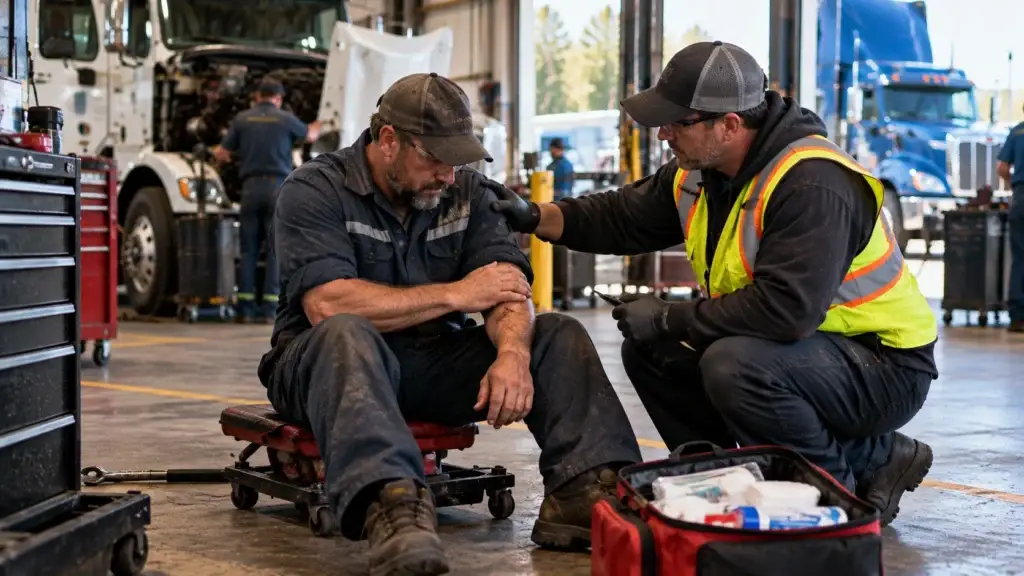
Handling a workers' comp claim well starts in the first five minutes after the injury, not after the paperwork arrives. Get the injured technician appropriate medical care immediately — for anything beyond minor first aid, that usually means an urgent care clinic or ER rather than waiting to see if it "gets better."
Document the scene, the equipment involved, and any witnesses while the details are fresh, and report the claim to the insurance carrier or state fund right away rather than waiting to see how serious it turns out to be.
Once the claim is open, the shop's role shifts to supporting a safe, timely return to work. Offering documented light-duty tasks — parts inventory, cleaning, administrative work — while a technician recovers keeps them connected to the workplace, often speeds recovery, and holds down the wage-replacement portion of the claim that most directly affects future premium. Shops should also maintain a clear post-accident drug and alcohol testing policy consistent with state law, since testing protocol (and its timing relative to the injury) can affect claim compensability in some states.
Documentation matters just as much after the claim opens as it did in the first five minutes. A written light-duty job offer — specific tasks, hours, and physical restrictions matched to the treating physician's release — protects the shop if a technician declines modified work and gives the carrier a clear basis for adjusting benefits.
Shops that skip this step and rely on a verbal offer often find themselves paying full wage-replacement benefits for weeks longer than necessary simply because there's no paper trail showing suitable work was actually available.
Coverage for Owner-Operators, Mobile Techs, and Contractors
Sole proprietors, partners, and in many states LLC members are typically excluded from mandatory workers' compensation coverage by default, since the law is built around the employer-employee relationship rather than owner-operators covering themselves. Most states allow these excluded owners to opt into voluntary coverage anyway, which is worth doing for anyone who works the bays alongside employees — a shop owner injured on the floor with no coverage of their own has no wage-replacement safety net and no employer to sue, since they are the employer.
Mobile diesel technicians who are genuine employees of a shop are covered under that shop's policy the same as any shop-floor mechanic, typically rated under the same or a closely related class code, with travel between job sites generally treated as part of the job rather than an excluded commute.
Independent mobile technicians who are true 1099 contractors fall outside any shop's workers' comp policy entirely and are personally responsible for their own coverage — often through an occupational accident policy, since traditional workers' comp isn't available to non-employees in most states.
Frequently Asked Questions
Is workers' comp insurance required for a one-person diesel repair shop?
If the shop has no employees — just the owner working alone — most states don't require coverage, since sole proprietors are typically excluded by default. The requirement is triggered by hiring the first employee, not by revenue or size. Some states allow, and a few require, sole proprietors to carry voluntary coverage on themselves.
What NCCI class code applies to a truck repair shop?
Most in-shop diesel and heavy-duty repair operations fall under NCCI code 8380 (Automobile/Truck Service or Repair Center). Body work typically falls under 8393, and towing is rated separately under 7225. A handful of states use their own classification systems instead of NCCI's national codes.
Why does workers' comp cost more for a truck repair shop than for a general office business?
Rate per $100 of payroll reflects the injury frequency and severity insurers have historically observed for a given classification. Shop-floor repair involves heavy components, pressurized systems, and chemical exposure a clerical classification simply doesn't carry, so filed rates for repair codes run well above office rates in every state.
What happens if a truck repair shop operates in a monopolistic state like Ohio or Washington?
The shop must purchase coverage through that state's fund rather than a private carrier, and should separately add stop-gap employer's liability coverage to its general liability policy, since the state fund product doesn't include that protection. A multi-state operator still needs a separate policy for employees working there.
Do independent contractor mechanics need their own workers' comp coverage?
A genuine independent contractor — one who sets their own hours, uses their own tools, and works for multiple shops — isn't covered under any shop's policy and should carry their own occupational accident coverage. Shops should be cautious about labeling a mechanic a contractor to avoid premium; if the relationship looks like employment, regulators will likely reclassify it.
How can a shop lower its workers' comp premium without switching carriers?
The two levers most shops overlook are classification accuracy and claims management. Carving clerical staff out of the repair classification, splitting towing and repair payroll correctly, and reporting claims quickly to keep the EMR from climbing all reduce premium without a new quote. A documented safety and return-to-work program compounds those savings.
Workers' compensation for a truck repair shop isn't a policy to set once and forget — it's a live number that moves with every payroll classification decision, every claim, and every renewal audit. Getting the class codes right, reporting claims fast, and running a real return-to-work program will do more for a shop's long-term premium than any single carrier switch. Heavy Duty Journal tracks these coverage and compliance questions continuously on heavydutyjournal.com so independent shops don't have to piece the rules together from an insurance agent's sales pitch alone.
Know a Shop Owner Still Guessing at Their Class Code?
Send this to a fellow shop owner or service manager before their next policy renewal — a misclassified crew is one of the easiest overpayments to fix once you know what to look for.